| Vendor |
Daily Rate |
Weekly Rate |
Review Score |
Website |
| United Rentals |
$397 |
$1 002 |
9 |
Visit |
| Sunbelt Rentals |
$280 |
$735 |
8 |
Visit |
| Herc Rentals |
$212 |
$531 |
2 |
Visit |
| Sunstate Equipment Co. |
$410 |
$1 079 |
8 |
Visit |
| Rocky Hill Equipment Rentals |
$250 |
$750 |
9 |
Visit |
2026 Austin skid steer loader equipment hire planning ranges (USD):</strong> for a wheeled skid steer loader (standard-flow, small-to-mid frame) budget $200–$450/day</strong>, $750–$1,200/week</strong>, and $2,000–$3,600 per 28-day month</strong>; compact track loaders (CTLs) typically plan higher at $300–$520/day</strong>, $1,050–$1,800/week</strong>, and $3,000–$5,000 per 28-day month</strong>, depending on ROC, cab, and hydraulics. Austin-specific “real cost” nearly always comes from logistics and risk items (delivery windows, dust-control cleaning, damage waiver, over-hours), not the published base day rate. Most Austin contractors will recognize the national yards (e.g., United Rentals, Sunbelt Rentals, Herc Rentals) alongside local dealer/rental departments; regardless of who you use, insist on an all-in quote that includes delivery/pickup, hour caps, and attachment line items. (m</p> skid steer loader rental</h2>
For estimating in Austin, treat “skid steer loader rental” as a rate structure</em> rather than a single price: (1) a machine class with a bucket (often included), (2) a billing clock (calendar day vs. “rental day” plus hour caps), and (3) a set of adders you will pay on almost every PO (delivery/pickup, damage waiver, fuel/cleaning, and attachments). National online marketplaces and OEM/dealer rental departments often show day/week/28-day pricing, but the jobsite location and delivery constraints are where Austin jobs can swing the total by 20–40%.</p> For planning, it helps to separate base equipment hire</strong> from non-productive costs</strong> (mobilization, idle days, cleaning, and over-hours). That separation also lets your PM team “buy down” cost by shortening the rental window, calling off-rent early, and staging attachments efficiently.</p> 2026 Planning Ranges for Skid Steer Equipment Hire in Austin</h2>
The figures below are practical 2026 planning ranges you can use for Austin budgets and bid-day leveling. They assume a well-maintained fleet unit, bucket included, and a standard 28-day “monthly” rate convention (many national providers define monthly as 28 days). (m</p>
- Small-frame wheeled skid steer (roughly 1,300–1,700 lb ROC, standard-flow):</strong> $200–$350/day; $750–$1,050/week; $2,000–$3,000/28-day month.</li>
- Mid-frame wheeled skid steer (roughly 1,700–2,200 lb ROC):</strong> $275–$450/day; $900–$1,250/week; $2,600–$3,600/28-day month.</li>
- Large-frame wheeled skid steer (production class, higher HP):</strong> $400–$575/day; $1,250–$1,900/week; $3,500–$5,200/28-day month. (m</li>
- Compact track loader (CTL) alternative:</strong> expect ~10–20% above a comparable wheeled unit in the same size class, plus higher cleaning/undercarriage expectations. (m</li>
- Austin reality check (local guide ranges):</strong> $200–$450/day is a common “typical” Austin band for skid steer loader base hire before attachments and fees, with delivery often quoted per trip. (m</li>
- Benchmark datapoint (marketplace average):</strong> one marketplace reports an average daily price around $397 for wheeled skid steer rentals in Austin, with weekly and monthly averages that align with the planning bands above. Use this only as a sense-check—not a guaranteed quote. (m</li> </ul>
Assumptions you should state in your estimate:</strong> standard bucket included; standard-flow hydraulics unless noted; 28-day month convention; machine delivered on a float (not customer pickup); and billing based on typical utilization caps (see over-hours section below).</p> What Actually Drives Skid Steer Loader Hire Prices in Austin?</h2>
Skid steer equipment hire cost in Austin rarely changes because the machine is “a skid steer.” It changes because your job needs a specific configuration and the rental house must protect fleet condition and utilization.</p>
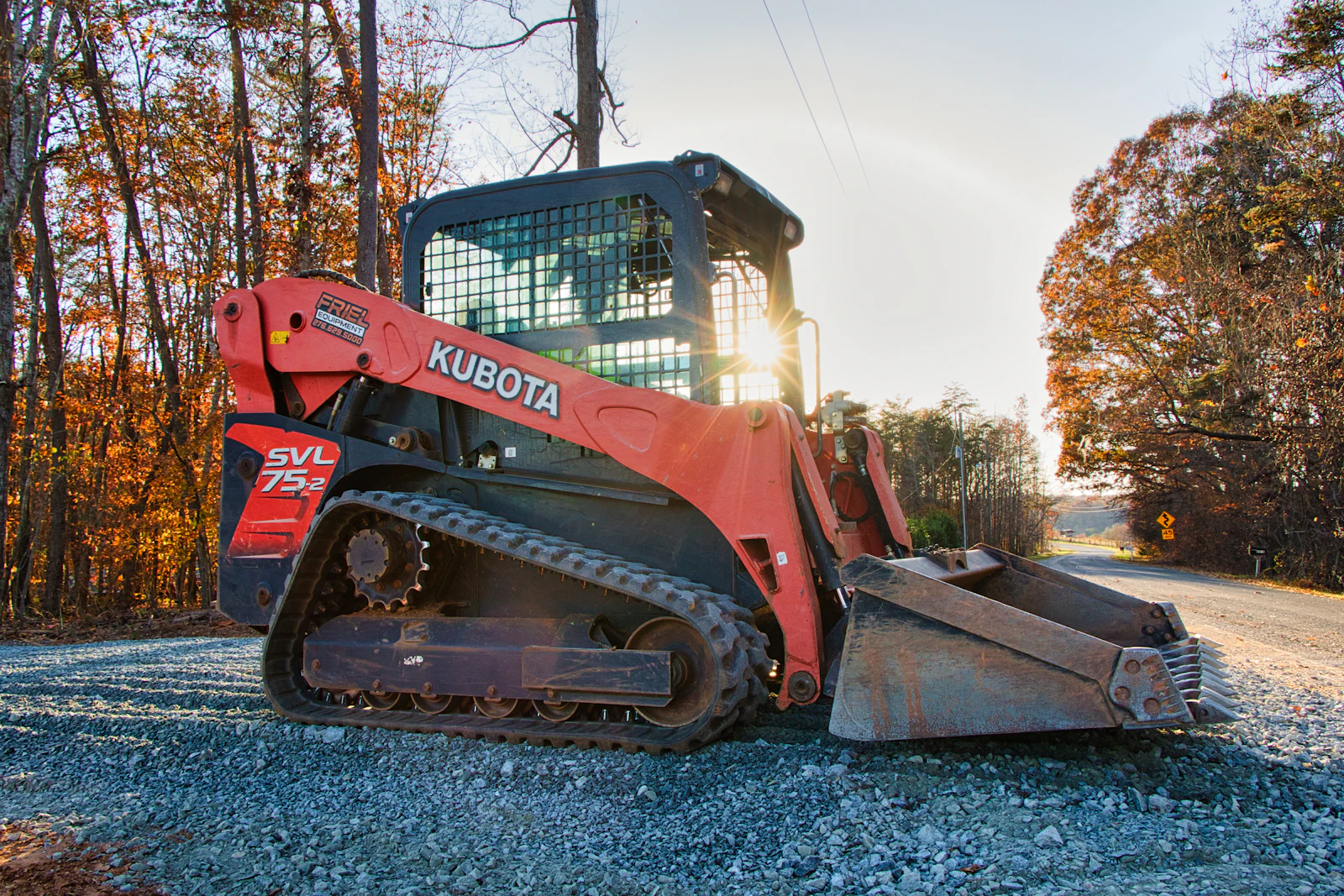
- Undercarriage choice (wheels vs. tracks):</strong> Tracks can be the right call for wet subgrade and soft landscaping scopes, but they push both base hire and return-condition risk (mud-packed undercarriage, track cuts, and time-consuming washout). BigRentz notes tracked skid steers commonly price above wheeled models in day/week/month bands. (m</li>
- Cab and comfort package:</strong> enclosed cab/AC materially improves operator productivity in Austin summer heat, but often steps the machine into a higher rate band and can increase damage-waiver base (higher replacement value).</p></li>
- Hydraulic flow (standard vs. high-flow):</strong> high-flow is not an “upgrade”; it is a different operating envelope for planers, mulchers, and high-demand brush cutters. Expect a daily premium plus higher exposure on attachment wear.</li>
- Rated operating capacity (ROC) and lift path:</strong> if you need to load tandem dumps or place pallets at height, you will pay for lift height and stability—especially if your safety plan calls for specific features (backup camera, beacon, etc.).</li>
- Seasonality and lead time:</strong> Austin demand spikes around heavy sitework and concrete cycles; same-day delivery and short-notice swaps tend to land on the upper end of the rate range. (m</li> </ul>
Attachments: The Fastest Way to Double the PO Total</h2>
Attachment pricing is where many “cheap day-rate” quotes break. Some attachments rent for a modest adder; others cost nearly as much as the base machine, and some carry wear charges that behave like consumables.</p>
2026 attachment hire planning adders (common ranges):</strong></p> - Auger:</strong> $75–$200/day (confirm whether one bit is included; additional bits are often separate). (m</li>
- Trencher attachment:</strong> $150–$350/day for skid steer-mounted trenchers. (m</li>
- Brush cutter / brush mower:</strong> $200–$400/day (higher for heavy-duty or forestry heads). (m</li>
- Pallet forks:</strong> commonly $25–$65/day depending on whether they are bundled; one sample rate sheet shows forks as low as $40/day when rented with the loader. (m</li>
- Hydraulic breaker (skid steer-mounted):</strong> commonly $125–$200/day depending on class; one sample rate sheet shows $125/day when rented with the loader. (m</li> </ul>
Wear-charge alert:</strong> some attachments add variable wear. Example: a sweeper may carry a broom-wear charge (one rate sheet references $85 per inch of broom wear). That is not a “fee” so much as a consumable you should carry as an allowance on abrasive surfaces. (m</p> Hidden-Fee Breakdown (What to Ask for Up Front)</h2>
This section is written for rental coordinators and estimators who need a repeatable checklist for total equipment hire cost—not just a base rate.</p>
- Delivery and pickup:</strong> In Austin, delivery within the metro is commonly quoted per trip; one local guide cites $75–$200 each way</strong> as typical. Use a conservative planning allowance of $150–$250 each way</strong> if your site is downtown, has restricted access, or requires a narrow delivery window. (m</li>
- Beyond-metro mileage:</strong> if you are sending the skid steer to areas like Dripping Springs, Bee Cave, or east toward Manor/Elgin with tight time windows, plan either (a) a flat haul zone or (b) a mileage adder. A practical planning band is $3.50–$6.00/mile</strong> after a base radius, plus a $150 minimum haul charge</strong> (varies by yard and fleet size).</li>
- Damage waiver / rental protection:</strong> commonly 10%–15%</strong> of the base rental rate (and sometimes applied to attachments too). Confirm whether it covers glass, tires/tracks, and theft, and whether it is mandatory. (m</li>
- Fuel and refuel:</strong> most contracts require return “full fuel.” If you return short, you pay retail fuel plus handling. One published rental sheet shows a refuel charge example of $5.75/gallon</strong> (subject to change). On Austin jobs with multiple operators, budget fuel as a controlled line item and require end-of-shift fueling. (m</li>
- Cleaning and undercarriage:</strong> plan $95–$250</strong> for basic wash/cleanup if the scope is muddy or involves fine material; for CTLs, undercarriage clean-out can realistically run $150–$400</strong> if clay packs the rollers and sprockets. If your scope includes wet caliche/clay or rain days, carry this allowance instead of being surprised at closeout.</li>
- Concrete and paint risk:</strong> if you run near wet concrete, waterproofing, or paint, include a “hard contamination” allowance of $300–$600</strong> for removal; many yards treat dried material as damage, not cleaning.</li>
- Over-hours / overtime:</strong> many rental schedules assume utilization caps such as 8 hours/day</strong>, 40 hours/week</strong>, and a defined monthly cap (one example sheet shows 120 hours/month</strong>), with an hourly overage rate (example shown $136.88/hour</strong> over maximum). For estimating, carry overage exposure any time you expect double shifts, weekend work, or standby with the machine running. (m</li>
- Weekend and holiday billing:</strong> confirm whether Saturday/Sunday count as billable days if the machine remains on site. Some yards offer “weekend special” structures; others bill calendar days. If you cannot off-rent before the weekend cutoff, you may unintentionally buy 2 extra days.</li>
- Administration / environmental / shop supplies:</strong> commonly appears as either a flat charge (e.g., $15–$45</strong>) or a small percentage. Don’t ignore it if you’re comparing two close quotes.</li>
- Sales tax:</strong> if your rental is taxable, Austin’s combined sales tax rate is commonly 8.25%</strong> (verify applicability by contract type and tax status). (v</li>
- Loss/damage incidentals:</strong> budgeting examples that routinely happen: $35–$75</strong> for a lost key; $20–$60</strong> for missing fuel caps/guards; $125–$300</strong> for a damaged cutting edge; $60–$120 per tire</strong> for foam-fill/tire service if required by your site conditions.</li> </ul>
Delivery, Off-Rent, and Billing Rules That Change Total Cost</h2>
On Austin projects, total equipment hire cost is frequently determined by when you can receive delivery</strong> and how you execute off-rent</strong>, not by the negotiated week rate.</p> - Delivery window constraints:</strong> downtown Austin and dense corridors often require staged deliveries (traffic, limited laydown, gate controls). If your site only accepts deliveries between 9:00 a.m. and 11:00 a.m.</strong> or requires escorted access, plan for an added mobilization charge or a higher delivery band (because the truck can’t run multiple drops).</li>
- Cutoff times:</strong> many yards have same-day dispatch cutoffs (often mid-morning). Missing the cutoff can add a standby day if the crew is waiting. This is a hidden productivity cost, not just a rental fee.</li>
- Off-rent effective time:</strong> confirm whether billing stops when you (a) request pickup, (b) the truck arrives, or (c) the unit is checked-in. Put the off-rent request in writing (email) with date/time and jobsite contact to avoid disputes.</li>
- Minimum rental periods:</strong> one-day minimums are common; some specialty attachments carry a two-day minimum. If your scope is only 3–4 productive hours, consider a weekend structure or a negotiated “one-shift” arrangement rather than paying full day plus delivery twice.</li> </ul>
Austin-Specific Considerations That Affect Skid Steer Hire Cost</h2> - Soils and cleanup:</strong> Austin-area clay can pack undercarriages after rain; when it dries, removal becomes labor-intensive. For CTLs, this is where the $150–$400</strong> undercarriage clean-out allowance is justified.</li>
- Heat impacts:</strong> summer heat drives the value of enclosed cab/AC for sustained production. If you stay open-cab, you may “save” $40–$80/day but lose more than that in reduced cycle time and operator fatigue on long pushes.</li>
- Downtown access and dust-control:</strong> if your scope includes sweeping, milling, or demolition support near occupied spaces, plan dust-control measures (water, vac attachments, or additional cleanup). Dust-control requirements can convert a simple bucket job into a broom/sweeper job with wear charges (e.g., broom wear measured per inch). (m</li> </ul>
Example: 5-Day Skid Steer Hire Package in East Austin (With Real Adders)</h2>
Scenario:</strong> grading and base placement on a constrained infill lot in East Austin. Access is through a single gate; deliveries must occur between 10:00 a.m. and 12:00 p.m.</strong>; the machine must be removed at the end of the week because street parking is not allowed overnight.</p> - Base hire (mid-frame wheeled skid steer):</strong> budget $950–$1,250/week</strong> depending on cab/high-flow and fleet availability.</li>
- Delivery + pickup:</strong> $150 each way</strong> (planning) = $300</strong>. (If quoted at the low end, Austin guides note delivery can sometimes be $75–$200 each way.) (m</li>
- Damage waiver:</strong> assume 12%</strong> of base hire (typical 10–15%). On a $1,100 week, that’s $132</strong>. (m</li>
- Pallet forks:</strong> $40/day</strong> x 5 days = $200</strong> (planning aligns with published sample schedules). (m</li>
- Auger for (2) days:</strong> assume $120/day</strong> x 2 = $240</strong> (within common $75–$200/day band). (m</li>
- Cleaning allowance:</strong> $150</strong> (mud and limestone fines; return clean expectations).</li>
- Refuel exposure:</strong> if returned 25 gallons</strong> short and refueled at $5.75/gal</strong>, add $143.75</strong>. (m</li>
- Admin/environmental:</strong> allowance $25</strong>.</li>
- Sales tax (if applicable):</strong> allowance 8.25%</strong> on taxable lines. (v</li> </ul>
Estimator takeaway:</strong> the base week rate may be ~$1.1k, but realistic “all-in” with common adders can land closer to $2.3k–$3.1k</strong> once delivery, waiver, forks, short-term attachments, cleanup, and tax are captured. The easiest savings levers are (1) minimize delivery events, (2) schedule attachment days tightly, and (3) avoid over-hours by planning workfaces and haul routes.</p> Budget Worksheet (Skid Steer Loader Equipment Hire Allowances)</h2> - Base skid steer loader hire (day/week/28-day): $________</li>
- Configuration premium (enclosed cab/AC, high-flow): $________</li>
- Delivery to site (Zone 1 / Zone 2): $________</li>
- Pickup / demob: $________</li>
- Damage waiver (10%–15%): $________ (m</li>
- Fuel (crew-supplied) or refuel exposure (e.g., $5.75/gal): $________ (m</li>
- Cleaning / washout allowance: $________</li>
- Undercarriage clean-out (CTL or muddy conditions): $________</li>
- Over-hours allowance (beyond 8/40/monthly caps): $________ (m</li>
- Attachments (forks, auger, trencher, brush cutter): $________</li>
- Consumable wear (broom wear, cutting edges, teeth): $________ (m</li>
- Jobsite protection (mats/plywood) if required: $________</li>
- Taxes (if applicable, up to 8.25% in Austin): $________ (v</li>
- Contingency for damage/theft exposure (project-specific): $________</li> </ul>
Rental Order Checklist (What Your Rental Coordinator Needs Before Calling the Yard)</h2> - PO number, cost code, and “bill to” details (including tax status/exemption documentation if applicable).</li>
- Exact jobsite address, on-site contact name/phone, and delivery window</strong> (with gate codes, escort requirements, and site access notes).</li>
- Requested machine spec: wheels vs. tracks; ROC target; enclosed cab/AC; standard-flow vs. high-flow; quick coupler type; bucket size; tire type (standard vs. non-marking/foam-filled if required).</li>
- Attachment list with quantities and exact days needed (forks, auger + bit diameters, trencher chain type, brush cutter duty class).</li>
- Utilization expectations: planned hours/day and whether weekend work is expected (so the yard can quote correct over-hours terms).</li>
- Insurance requirements (COI, additional insured, waiver options) and whether damage waiver is accepted or your policy will respond.</li>
- Return condition requirements: “return clean,” “return full fuel,” photo documentation at delivery and pickup, and any site decon requirements (dust, mud, concrete contamination).</li>
- Off-rent rules: confirm how to submit off-rent notice, cutoff time, and when billing stops (request vs. pickup vs. check-in).</li> </ul>
Rent Vs. Own Cost Framing (Fleet Manager Perspective)</h2>
Ownership vs. hire is a utilization question. If the skid steer will sit idle between scopes, rental is often cheaper even at a high day rate, because you’re avoiding capital, maintenance overhead, and transport management. If your Austin crews truly use a unit 3–4 days/week</strong> across multiple projects, you can justify ownership—but you still need an “internal rental rate” that includes (1) planned maintenance, (2) tire/track reserves, (3) insurance, (4) transport, and (5) downtime coverage. In mixed-use fleets, many contractors own one standardized unit and still hire specialty configurations (high-flow, CTL) only when the attachment scope demands it.</p>
How to Get a Cleaner All-In Equipment Hire Quote (Austin Scope Sheet)
If you want comparable quotes across yards in Austin, send the same scope sheet to each supplier. This reduces the “apples to oranges” problem where one quote includes waiver and delivery and another does not.
- Dates: delivery date/time window and planned off-rent date/time.
- Billing structure: ask for day, week, and 28-day rates, and confirm whether the weekly rate is a 7-calendar-day charge or a 5x8-hour/40-hour utilization structure.
- Hour caps and overage: confirm the utilization assumption (examples commonly reference 8 hours/day, 40/week, and a monthly cap, with hourly overage).
- Delivery/pickup: request a single “mobilize/demob” number and a separate line showing how it changes outside the metro radius (so you can price alternates like Pflugerville vs. downtown Austin).
- Attachments: list each attachment and confirm inclusions (e.g., “auger includes 1 bit” vs. bits separate). Typical attachment day-rate bands: auger $75–$200/day; trencher $150–$350/day; brush cutter $200–$400/day.
- Risk items: ask specifically whether tires/tracks and glass are excluded from damage waiver, and what the cleaning/undercarriage expectations are.
Managing Damage Risk Without Overpaying for Protection
From a cost-control standpoint, your goal is to prevent “unbudgetable” charges at return. The most common drivers are tires/tracks, undercarriage, glass, and contamination from concrete/paint.
- Condition documentation: require delivery photos of tires/tracks, bucket cutting edge, cab glass, and hour meter. Repeat at off-rent. This avoids paying for pre-existing damage.
- Track/tire strategy: if the job is on sharp limestone or demolition rubble, consider wheels with foam-filled tires (budget $60–$120 per tire service exposure) instead of tracks, unless traction demands CTL.
- Onsite cleanup rule: assign 15 minutes end-of-shift to knock off clay/mud; it’s cheaper than a $150–$400 undercarriage clean-out later.
- Lost items: budget small incidentals: $35–$75 for keys, $20–$60 for caps/guards, $25–$100 for missing pins/retainers, depending on yard policy.
When It’s Worth Paying for a CTL or High-Flow in Austin
Paying the CTL premium is usually justified when you’d otherwise lose days to stuck equipment, rework, or turf restoration. In Austin, that often means post-rain clay conditions, landscape work where rutting is a punch-list risk, or slopes where traction matters more than speed. High-flow is worth it only when the attachment requires it; otherwise you’re paying for capacity you won’t use.
- CTL premium planning: budget ~10–20% above wheel rate, plus higher cleaning/undercarriage reserves.
- High-flow premium planning: add $50–$150/day depending on class and availability, and confirm quick coupler compatibility for specialty heads.
- Attachment-driven escalations: if you’re running a planer/mulcher, don’t forget wear tooling, tooth replacement, and potential “minimum days” policies.
2026 Rental Market Notes for Austin (Practical Procurement Guidance)
Austin remains a fast-moving market where lead times and delivery constraints often matter as much as base equipment hire. Use these tactics to keep skid steer loader rental cost predictable:
- Reserve early for peak weeks: avoid premium delivery charges and forced substitutions by booking 7–14 days ahead on known mobilizations.
- Bundle attachments only for the days you use them: it is common to over-rent attachments “just in case.” Tight scheduling can pull $200–$600 out of a one-week PO by reducing attachment days.
- One delivery, multiple tools: if possible, have the yard deliver the skid steer once and swap attachments via smaller courier runs (when offered) rather than re-floats.
- Plan service exposure: on critical path work, carry an allowance for a field service mobilization (often $175–$300) if the unit needs a hose fitting, track tension check, or battery/lockout support.
Compliance and Site Controls That Add to Equipment Hire Cost
Even when the rental invoice doesn’t itemize these as “equipment costs,” they are real job costs tied directly to having the skid steer on site:
- Operator qualification and site orientation: ensure your plan accounts for trained operators and any required site-specific orientation time.
- Traffic control / spotters: downtown or active campus-like environments can require a dedicated spotter. Budget a spotter labor line if reversing and blind spots create a site rule.
- Ground protection: for finished pavement or sensitive landscaping, mats can prevent restoration work that dwarfs the rental invoice.
Closeout Tips (Preventing Surprise Charges)
- Submit off-rent in writing: include date/time and jobsite contact; confirm pickup ETA.
- Return full fuel: if you cannot, budget for refuel at posted rates (example published at $5.75/gal).
- Photograph condition at pickup: tires/tracks, cab glass, cutting edge, and attachment serials.
- Confirm tax and waiver application: ensure the invoice matches the quote, and that Austin sales tax assumptions (commonly 8.25%) were applied only where appropriate.
If you want, share your expected skid steer class (ROC), wheels vs. CTL, and which attachments you’re carrying in Austin, and I can help you convert it into a tighter 2026 all-in hire allowance (still vendor-neutral, no tables).