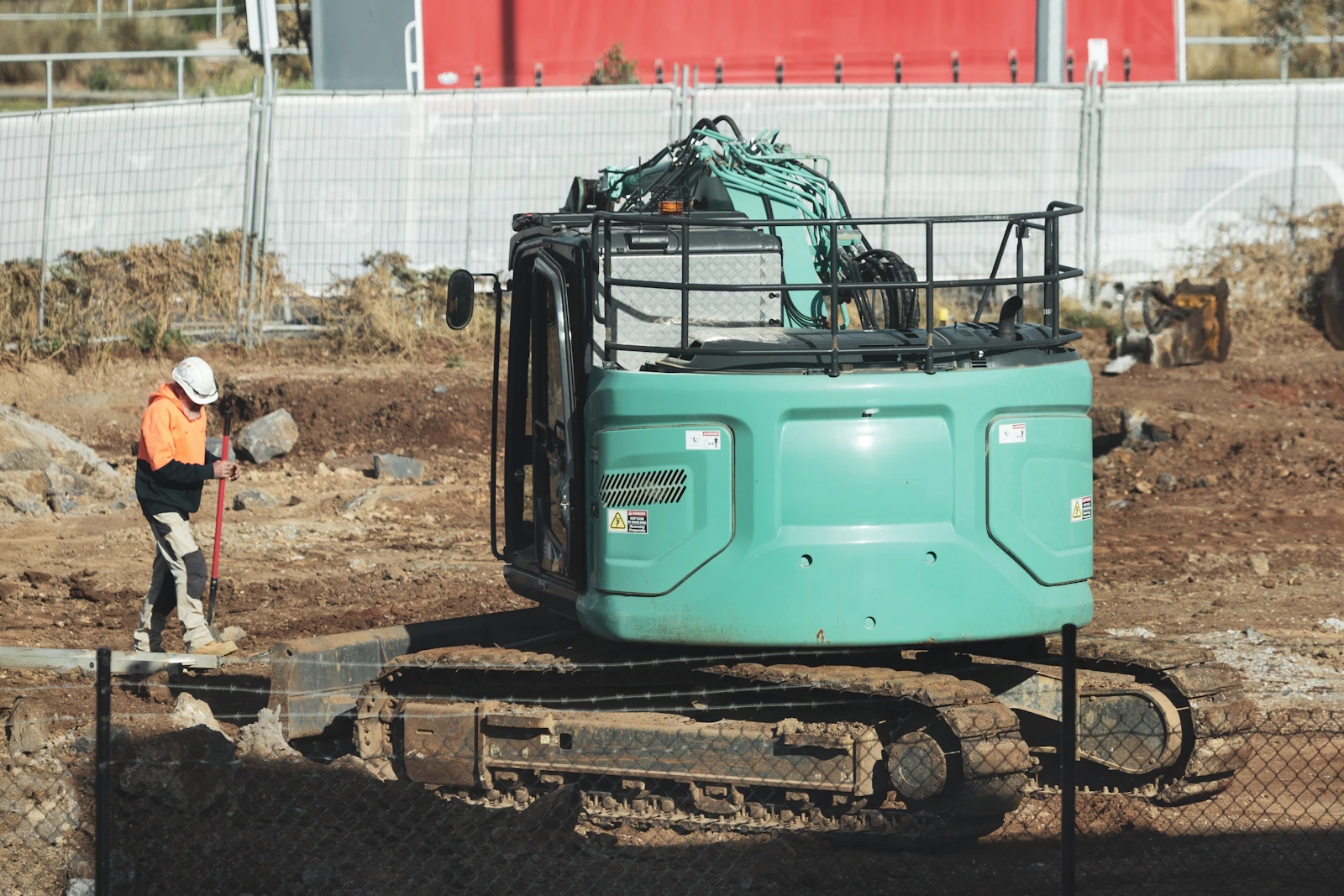
Excavator With Grapple Rental Rates Baltimore 2026
For 2026 planning in the Baltimore market, budget $800–$1,250/day, $2,200–$3,450/week, and $6,250–$8,450 per 4-week period for a tracked excavator with a grapple suitable for land clearing (typically a mid-size 35,000–45,000 lb carrier with a fixed grapple bucket or rotating grapple, depending on coupler and hydraulics). These are dry-hire planning ranges (no operator, no fuel) and assume a standard rental “day/week/4-week” structure with hour limits and normal wear. National fleets (United Rentals, Sunbelt Rentals, Herc Rentals) and regional yards along the Baltimore–Washington corridor can quote inside or outside these bands based on availability, delivery constraints, and whether you need a rotating grapple excavator hire package versus a simpler grapple bucket setup.
| Vendor |
Daily Rate |
Weekly Rate |
Review Score |
Website |
| United Rentals |
$1 050 |
$3 150 |
8 |
Visit |
| Sunbelt Rentals |
$1 000 |
$3 000 |
8 |
Visit |
| Herc Rentals |
$975 |
$2 925 |
7 |
Visit |
| Alban CAT (The Cat Rental Store) |
$1 150 |
$3 450 |
9 |
Visit |
How the range is built (so you can sanity-check quotes): published rate sheets show 35,000–40,000 lb excavators at roughly $500–$600/day, $1,500–$1,800/week, and $4,500–$5,400/month in a Maryland yard’s posted pricing while attachment rate cards show a rotating grapple commonly priced around $400/day and $950/week and a grapple bucket commonly priced around $280/day and $705/week When you combine carrier + attachment, then add Baltimore-specific logistics (tight delivery windows, limited staging, and return-condition expectations), your “all-in” equipment hire cost lands in the planning ranges above.
What Drives Excavator With Grapple Equipment Hire Costs on Baltimore Land Clearing Jobs?
Land clearing pushes a grapple excavator rental differently than trenching or basement dig work. The grapple is often on the stick all day, the machine is frequently traveling and slewing with material, and the undercarriage sees more abrasion from brush, stumps, and demolition debris. In Baltimore, the biggest cost drivers that show up on invoices and change the effective equipment hire cost are:
- Carrier class and weight (e.g., 18K mini vs 40K mid-size) and whether the yard will allow that unit into a residential neighborhood or tight city site without special hauling or escort constraints.
- Grapple type (fixed grapple bucket vs rotating grapple) and whether the excavator has the correct auxiliary hydraulics and coupler interface.
- Rental term optimization: daily rates punish you if the job runs 5–6 working days; weekly or 4-week terms are typically the estimator’s lever for equipment hire savings.
- Delivery/pick-up logistics: downtown access, beltway traffic, and limited receiving hours can create redelivery, standby, or “missed appointment” charges that are not visible in the base rate.
- Meter-hour overage: land clearing can quietly exceed standard hour caps if you double-shift, run weekends, or leave the excavator idling for dust-control, traffic control, or utility locates.
Base Machine Hire: Which Excavator Class Prices Out Best for Land Clearing?
Most Baltimore land-clearing scopes that truly benefit from an excavator grapple package are best served by a 35,000–45,000 lb tracked excavator (roughly “mid-size”), because it can lift and stack brush/wood efficiently while still being deliverable without exceptional planning on typical lowboys. Published examples show 35,000–40,000 lb excavators advertised around $500–$600/day, $1,500–$1,800/week, and $4,500–$5,400/month (posted as “month,” often aligned to a 4-week billing unit)
If your land clearing is lighter duty (fence rows, small lot clearing, limited stump handling), some teams downshift to an 18,000 lb class excavator for access and ground-pressure reasons, with posted examples around $325/day, $1,000/week, and $3,000/month then add the grapple as needed. Conversely, if you’re clearing heavy timber or dealing with large debris piles, you may be pushed into larger carriers where base hire rises; national pricing guidance shows typical published rates increasing by machine weight class (for example, mid-to-large excavator categories priced higher than 25,000–29,000 lb units)
Baltimore-specific estimating note: if the project is inside the I-695 beltway with narrow streets, limited curb space, or strict receiving hours (schools, healthcare campuses, Inner Harbor-adjacent work), it can be cheaper overall to keep the excavator size modest and spend on the right grapple style (rotation + correct tine profile) than to upsize the carrier and pay for more complex trucking and staging constraints.
Grapple Attachment Hire Adders, Couplers, and Hydraulics (Where Quotes Swing Fast)
The grapple is where “excavator with grapple hire costs” get confusing: some quotes assume a simple grapple bucket (good for brush and light sorting), while others quote a rotating grapple (more productive for stacking, log handling, and controlled placement). Published attachment rate cards illustrate the spread:
- Rotating grapple (excavator attachment): commonly posted around $400/day, $950/week, $1,950/month
- Grapple bucket (excavator attachment): commonly posted around $280/day, $705/week, $1,760 per 4-week
Practical cost driver: the grapple may require a specific coupler style and auxiliary hydraulic plumbing. If the yard must supply (or swap) a coupler, or if your carrier cannot run the required hydraulics, you can get hit with (a) a different machine class, (b) a different grapple, or (c) extra mobilization to change the setup. For estimating, carry a $75–$150/day allowance for “compatibility adders” (coupler, pins/bushings, or required hose protection) when you don’t control the carrier spec.
Delivery, Minimum Charges, and Baltimore Site Access Costs
Delivery is rarely “free” on heavy equipment hire and is one of the most common reasons the equipment hire cost outpaces the advertised day rate. For Baltimore-area land clearing, build your estimate around these real-world constraints:
- Delivery/pick-up base charges: carry $275–$650 each way (varies with distance, tractor availability, and whether the load is a single-machine move or a multi-stop route). If the yard prices by distance, also carry $5–$9 per loaded mile beyond an included radius.
- Minimum rental charges: many rate sheets and contracts effectively enforce a minimum (commonly 1 day) even if the machine is on site for a short window; for short-use situations, some policies treat ≤4 hours as a partial-day percentage (a published example uses 60% of the daily rate for ≤4 hours)
- Receiving windows and cutoffs: on Baltimore city sites, if your delivery must hit a 7:00–9:00 AM slot (to avoid peak congestion and to coordinate with gate staff), a missed window can cause $150–$300 in “redelivery/return trip” exposure plus lost production. Carry that risk as a contingency when your site can’t reliably receive.
- Street occupancy / staging constraints: if the delivery requires a lane block, police detail, or flagging, the rental invoice may not include it—but your true equipment hire cost should. Carry $450–$1,200/day as a job-level allowance when the lowboy must stage in the right-of-way.
Hidden-Fee Breakdown: Excavator With Grapple Hire Costs That Show Up After the Quote
For professional estimators and rental coordinators, the safest way to control excavator with grapple rental pricing is to pre-carry the “usual suspects” and then delete them only when your vendor confirms they don’t apply. Use the following as 2026 allowances (adjust to your company’s historicals):
- Damage waiver / rental protection plan: commonly 10%–15% of the rental charges when you do not provide acceptable equipment coverage
- Security deposit / credit hold: carry $1,000–$2,500 depending on machine class and credit terms (cash impact even when refundable).
- Environmental / shop / admin fees: carry $15–$45 per contract for “environmental,” “shop supplies,” or “admin” line items.
- Cleaning charges (undercarriage + cab + radiator screens): carry $150–$450 for “normal dirty return,” and up to $85/hour where contracts price cleanup labor by the hour
- Track-out and debris removal at return: carry $75–$200 if the yard requires you to remove wire, vine, and wrapped brush from the undercarriage before off-rent acceptance.
- Fuel / diesel expectations: plan “return full.” If returned short, carry $6.50–$8.50/gal plus a $35–$75 service charge for refuel processing.
- Grease and daily service consumables: carry $25–$60/week for grease, rags, and basic field service items (especially if the grapple is being used for constant sorting).
- After-hours / weekend delivery: carry a $150–$400 surcharge when the move must occur outside normal yard hours.
- Weekend billing rule exposure: some policies convert Friday-to-Monday into a discounted weekend block; published examples show a 1.5-day weekend rate structure in some fleets Others bill each calendar day—confirm in writing.
Meter Hours, Overage, and Double-Shift Billing (The Quiet Budget Killer)
Most dry-hire excavator rentals are priced assuming standard utilization (commonly aligned to something like 8 hours/day, 40 hours/week, 160 hours/4-weeks). When your clearing scope runs long days (storm cleanup, schedule recovery, or limited access windows), the overage can be billed at a multiple of the implied hourly rate. A published government contract example shows over-time rates billed at 1.5× the hourly rate derived from day/week/month pricing once you exceed included hours
Baltimore application: clearing projects near active roadways or campuses often push work into off-peak windows; if you must run 10-hour days to meet a traffic-control plan, carry an overage allowance of $35–$95/hour (depending on machine class and term) unless your quote explicitly includes extended hours.
Bare Equipment Hire vs Operated Excavator With Grapple in Baltimore (When “Hourly” Wins)
For land clearing, many GCs default to dry hire to control cost and staff the job with their own operators. However, Baltimore has an active market for operated equipment rentals (machine + operator billed hourly), which can reduce risk when the scope is complex, the site is tight, or you need guaranteed production without operator sourcing.
A Baltimore-based contractor’s published rental schedule lists straight-time hourly rates and includes multiple excavator and demolition configurations; for example, an excavator with grapple and related attachments is shown at $307/hour on their 2025 effective schedule (rates subject to change), alongside ordering/cancellation cutoffs and local labor adders Operated rentals can look expensive on paper, but they typically bundle the labor and reduce your exposure to misuse, undercarriage damage, and “wrong attachment” productivity loss.
Estimator’s rule: consider operated equipment hire when (a) the job has limited staging and you can’t afford rehandling, (b) the grapple work is specialty sorting, (c) you have tight schedule recovery needs, or (d) you expect disputes over damage/abuse on a dry-hire unit.
Term Strategy for 2026: How to Buy Down Your Excavator With Grapple Hire Rate
Land clearing is rarely a true “one-day” activity once you account for mobilization, locates, erosion controls, and debris handling. In Baltimore, the best savings usually come from term alignment:
- If you need 1–3 working days: daily can be fine, but only if delivery windows and return rules don’t force weekend billing.
- If you need 4–7 working days: price weekly; many published rate cards show weekly structures that materially reduce the effective day cost compared to stacking day rates
- If you need 15–20 working days: push for a 4-week / monthly term and negotiate delivery or attachment discounts as a package.
Key Baltimore tactic: confirm the vendor’s off-rent cutoff (e.g., whether calling off-rent after mid-morning triggers another full day) and align demob to avoid “one extra day” billing at the end of the job.
Budget Worksheet: Excavator With Grapple Equipment Hire (Baltimore, 2026 Allowances)
Use this as a field-ready budgeting artifact for excavator with grapple equipment hire costs on Baltimore land clearing scopes. Replace allowances with your negotiated quote values once the PO is ready.
- Base excavator hire (35,000–45,000 lb class): allow $550–$900/day (or $1,500–$2,500/week; $4,500–$6,500/4-week) depending on carrier spec and term
- Grapple attachment hire: allow $280–$400/day depending on fixed grapple bucket vs rotating grapple
- Mobilization (delivery + pick-up): allow $600–$1,300 total (two-way) plus $5–$9/mile beyond the included radius (if applicable).
- Damage waiver / RPP: allow 10%–15% of rental subtotal unless you provide a COI that meets the lessor’s equipment coverage requirements
- Deposit / credit hold: allow $1,000–$2,500 (cash-flow impact).
- Fuel (if dry hire): allow $180–$420/week depending on idle time and travel (carry higher if brush is wet/heavy and you’re loading trucks).
- Refuel exposure at return: allow $6.50–$8.50/gal plus $35–$75 service fee if returned short.
- Cleaning/undercarriage return condition: allow $150–$450; carry up to $85/hour if the lessor bills cleanup labor by the hour
- Wear/consumables (cutting edges, grapple tips, hose protection): allow $75–$250 for “job wear” and minor replacements (confirm what is considered damage vs wear).
- After-hours delivery / weekend moves: allow $150–$400 surcharge if the job requires it.
- Overage hours contingency: allow $350–$1,250 depending on expected double-shift exposure; overage can price at 1.5× the implied hourly rate once included hours are exceeded
- Traffic control / receiving support: allow $450–$1,200/day when delivery must stage in the right-of-way (downtown/campus constraints).
Rental Order Checklist for Baltimore Excavator With Grapple Hire
Use this checklist to avoid the “we assumed / you assumed” issues that inflate equipment hire costs.
- PO and quote alignment: confirm day/week/4-week rate, included hours, and any weekend billing rule (some fleets use a 1.5-day weekend rate; others bill calendar days)
- Equipment specification lock: carrier operating weight, stick length, auxiliary hydraulics, coupler style, and whether the grapple is fixed or rotating.
- Delivery plan: address, contact, delivery window, site constraints (overhead wires, low bridges, tight turns), and whether the driver needs a spotter or escort.
- Delivery receiving readiness: confirm there is a clear offload zone and that your site can accept at the planned time (avoid redelivery charges).
- Insurance: provide COI for rented equipment coverage or confirm damage waiver % and deductible approach (carry 10%–15% if waiver applies)
- Pre-rental documentation: photos/video of cab, boom/stick, undercarriage, grapple pins/hoses, and hour meter at delivery.
- Operational rules: fueling/DEF expectations, greasing schedule, prohibited uses (pushing trees over with boom, prying stumps sideways), and any indoor dust-control requirements if working near occupied facilities.
- Off-rent process: who calls off-rent, cutoff time, and written confirmation number (this is where “one extra day” bills happen).
- Return condition: what “clean” means (tracks, radiator screens, cab), and whether the lessor bills cleaning at a flat rate or by labor hour (examples exist at $85/hour)
Example: 5-Day Land Clearing Scope Near Downtown Baltimore With Tight Delivery Windows
Scenario: You have a 5-day land clearing push on a constrained site inside Baltimore with limited staging and a delivery window restricted to 7:00–8:30 AM. You want an excavator with rotating grapple hire package to reduce rehandling and speed loading.
- Carrier (mid-size excavator): budget $1,800/week (published examples for 40,000 lb class exist around this level)
- Rotating grapple attachment: budget $950/week
- Mobilization: allow $950 total for delivery + pick-up due to tight window and downtown staging risk.
- Damage waiver: assume 12% of rental subtotal (within typical 10%–15% band)
- Cleaning exposure: carry $250 (brush + mud in tracks and screens).
- Overage risk: if you run 10 hours/day for 5 days, you’re at 50 hours/week. If your contract includes 40 hours and bills overage at 1.5×, carry an overage allowance of $450–$900 depending on implied hourly rate and vendor policy
Operational constraints that change the bill: if delivery misses the window, you can lose the day and still pay the daily minimum; if you call off-rent after the vendor’s cutoff, you may pay an extra day even if the machine is idle. In Baltimore, those two items can be more expensive than negotiating $50/day off the base hire rate.
Cost Controls That Matter in Baltimore: Off-Rent Rules, Weekend Billing, and Return Documentation
- Off-rent timing: always get a confirmation number and confirm the cutoff time in the contract email chain. Schedule demob for early morning when possible.
- Weekend/holiday exposure: confirm whether Friday delivery triggers weekend billing, and whether the fleet uses a discounted weekend structure (published examples exist for a 1.5-day weekend rate)
- Return condition photos: take “final condition” photos at loading (tracks, screens, grapple) to reduce cleaning/damage disputes.
- Dust and debris control near occupied facilities: if clearing near hospitals, schools, or active industrial sites, budget extra idle time for dust suppression and controlled loading; idle time can push you into hour overage if your contract caps included hours.
Estimating Notes and Sources (For Rate Validation)
The planning ranges in this post are built from published rate examples for excavator carriers and grapple attachments, plus common rental contract mechanisms (damage waiver percentages, overage multipliers, weekend billing structures). Key published reference points include Maryland equipment rate postings for 35,000–40,000 lb excavators published grapple bucket and rotating grapple attachment rates industry damage waiver bands and an example overage multiplier approach (1.5× beyond included hours) For operated equipment, a Baltimore contractor publishes straight-time hourly rates and ordering/cancellation requirements that can be relevant when comparing dry hire vs operated hire