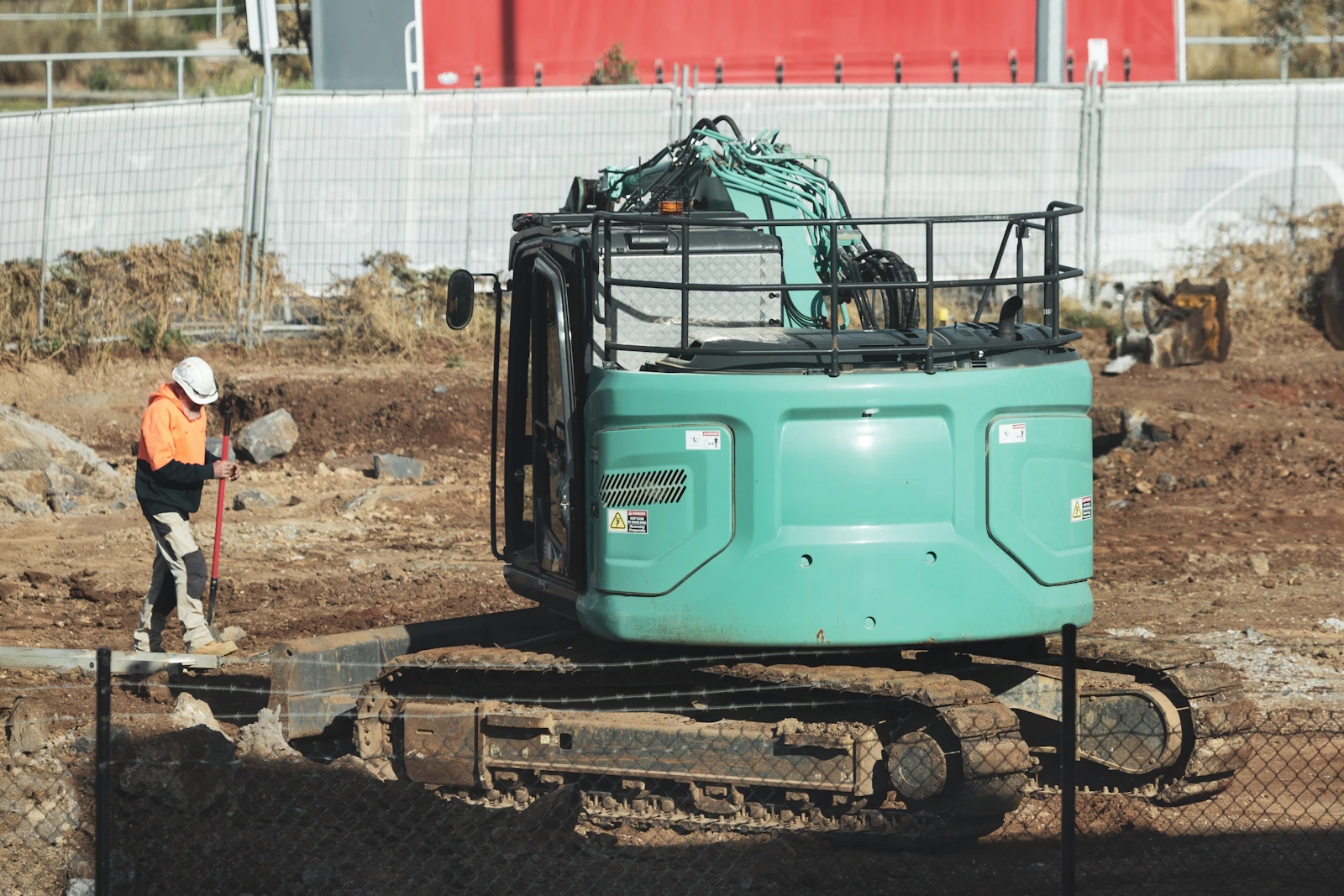
For Charlotte land clearing in 2026, budget an excavator with grapple equipment hire as a combined package (carrier + grapple attachment) at roughly $750–$1,450/day, $2,300–$4,300/week, and $6,200–$10,500 per 4-week “month” for common mid-size configurations (often 25,000–35,000 lb class). Your realized cost will swing based on whether you’re hiring a compact excavator with a non-rotating grapple bucket versus a 30–34K hydraulic excavator with a rotating grapple, plus delivery radius, damage waiver, and whether the rental house bills “monthly” as a 28-day cycle. In the Charlotte market, most coordinators price-check with large national houses (for availability and fleet depth) and at least one regional dealer/rental yard (for attachment options and transport responsiveness) before issuing a PO.
| Vendor |
Daily Rate |
Weekly Rate |
Review Score |
Website |
| United Rentals |
$1 750 |
$4 470 |
9 |
Visit |
| Sunbelt Rentals |
$1 580 |
$4 030 |
8 |
Visit |
| Herc Rentals |
$1 710 |
$4 370 |
9 |
Visit |
| Carolina Cat (The Cat Rental Store) |
$1 650 |
$4 200 |
10 |
Visit |
| EquipmentShare |
$1 610 |
$4 100 |
8 |
Visit |
Excavator With Grapple Rental Rates Charlotte 2026
The cleanest way to estimate excavator with grapple hire is to split the quote into two lines: (1) the excavator (“carrier”), and (2) the grapple (plus any coupler/aux-hydraulic requirements). The planning ranges below assume one shift utilization and the rate conventions many commercial rental agreements use: 8-hour day, 5-day week, and a 28-day (4-week) month.
Carrier (Excavator) Hire: Planning Bands That Map to Land Clearing
Compact / mini excavator hire (roughly 2,000–10,000 lb class) is often used for fence-line clearing, light brush, and tight-access clearing behind existing structures. For Charlotte planning, published ranges for mini excavator rental in 2026 run about $200–$465/day, $786–$1,313/week, and $2,249–$3,938/month (term and spec dependent).
Midsize excavator hire (roughly 25,000–35,000 lb class) is the workhorse for commercial site clearing when you’re loading roll-offs, staging logs, and pulling stumps at production speed. As a reference point for budgeting, one published rate sheet shows a 30–34K hydraulic excavator at $622.25/day, $1,596.00/week, and $3,367.75/month (before add-ons like waiver, taxes/fees, and attachments).
Upper midsize excavator hire (around 45,000–50,000 lb class) starts to show up in heavier clearing, larger timber handling, or when you need stability for bigger grapple loads. A published rate sheet example lists a 45–49K hydraulic excavator at $631.75/day, $1,952.25/week, and $4,759.50/month.
Regional rate sanity check (Southeast/Carolinas): independent yards often publish compact-to-mid excavator day/week/month numbers that sit in the same order of magnitude as national houses—e.g., published compact excavator rates around $325/day up to $750/day for larger compact units, depending on cab/spec and class. Use these as “floor/ceiling” checks when you receive a quote that looks misclassified by size.
Grapple Attachment Hire: Budget by Grapple Type and Coupler Interface
For land clearing equipment hire costs, grapples commonly price in two broad buckets:
- Grapple bucket (non-rotating): a simpler, lower-cost attachment line that often works well for brush and smaller logs when your operator can index the load with the stick/bucket curl. One published grapple bucket listing shows $280/day, $705/week, and $1,760 per 4-week (prices subject to change).
- Rotating grapple: higher production for sorting, log handling, and safer placement—typically higher day/week/month. A published rotating grapple rate example is $400/day, $950/week, $1,950/month.
Important estimating note: a grapple may require (a) the correct coupler style, (b) sufficient auxiliary hydraulics, and (c) the right hose protection/forestry guarding for brush. If the rental excavator doesn’t have the right setup, you can see last-minute swaps, extra mobilizations, and lost days—real costs that don’t show in the “daily rate” line.
Combined Package Ranges (Carrier + Grapple)
Using the published examples above as anchors and allowing for Charlotte-area term/availability variation, a practical 2026 budget range for midsize excavator + rotating grapple typically lands near:
- $1,000–$1,650/day (carrier + grapple)
- $2,500–$4,200/week
- $6,000–$10,500 per 4-week
For a compact excavator + grapple bucket configuration (tight access, lighter production), planning ranges commonly fall closer to:
- $450–$900/day
- $1,400–$2,500/week
- $3,500–$6,500 per 4-week
These are planning ranges—not a promise of any specific vendor’s price—and should be tightened with a written quote that lists: machine class/weight, grapple type, included buckets, delivery, waiver, and meter limits.
What Drives Excavator With Grapple Hire Costs on Charlotte Land-Clearing Scopes?
Charlotte clearing packages get expensive fast when the scope requires “production iron” but the site behaves like a tight urban infill job. The following cost drivers are the ones that most often change the final equipment hire cost after the initial quote:
- Machine class and stability: the jump from a 6–10K mini to a 30–34K excavator is not linear; it changes transport, undercarriage wear exposure, and grapple load size.
- Cab and guarding spec: enclosed cab, polycarbonate/mesh guarding, and limb risers can push you into a different fleet tier or require a special-order unit (often higher rate and longer minimum term).
- Rate convention (shift/hour meter limits): many contracts define day/week/month around 8-hour days, 5-day weeks, and 28-day months. If your land clearing pushes 10–12 hour days, expect overtime or a different shift schedule.
- Grapple choice: rotating grapples cost more but can reduce handling time and rework when sorting brush vs. logs vs. stumps.
- Transport and access: lowboy scheduling, jobsite turnaround, and “call ahead” windows can add soft costs (crew standby) and hard costs (redelivery / remobilization).
Hidden-Fee Breakdown
When estimating excavator grapple attachment rental rates for Charlotte land clearing, treat these as standard “check every quote” items. The dollar figures below are the ranges coordinators commonly carry as allowances; confirm in writing on the quote/contract:
- Delivery and pickup: commonly $150–$400 each way inside a metro radius, or a hybrid model such as $120 each way + $3.25 per loaded mile on published rate sheets.
- Minimum rental charge: many yards bill 1 full day minimum even if you only run a few hours; some do not rent in less than full-day increments.
- Damage waiver / loss damage waiver (LDW): carry 10%–18% of the rental rate as a planning allowance if you’re not providing equivalent coverage.
- Environmental / shop / admin fees: carry 2%–5% of rental as a planning adder (varies by vendor policy).
- Fuel and refuel convenience: if returned under-fueled, budget $6.00–$8.00/gal for convenience fueling (and confirm whether “off-road dyed diesel” is required by your vendor policy).
- Cleaning: Charlotte’s red clay can mean real wash cost; carry $150–$450 for standard wash-down and $500–$900 if the grapple/undercarriage returns packed and requires shop time.
- Wear / damage on grapple: bent tines, blown cylinder seals, or damaged hoses can trigger billbacks; carry an allowance of $250–$1,500 for “small damage” exposure on brush-heavy clearing if your controls are light.
- Overtime (hour meter): if your agreement is based on an 8-hour day, carry $75–$200/hour as a placeholder for overages on midsize units, or confirm the vendor’s formula (some calculate an hourly rate derived from the daily).
- Weekend/holiday billing: do not assume “free weekends.” If you need guaranteed Saturday work, plan for 1 extra day of charge or a negotiated weekend rate.
- Trip charges / re-delivery: wrong coupler, blocked access, or site not ready can trigger a re-trip; carry $125–$300 per occurrence.
- Service call: if a tech is dispatched and the issue is misuse/foreign object damage, carry $175–$250 plus $125–$175/hour portal-to-portal.
- Attachments you forgot: track mats often land at $10–$25/mat/week; extra buckets commonly $35–$95/day depending on width/coupler; tooth systems can be billed if returned missing/damaged.
Charlotte-Specific Cost Factors to Plan For
- Metro delivery windows and traffic: delivery/pickup slots that avoid I-77 and I-485 congestion can matter. If your site only permits delivery before 7:00 AM or after 4:00 PM, plan an after-hours coordination premium (often quoted as an added trip/handling fee or a higher delivery minimum).
- Red clay and storm cycle impacts: after a rain event, clay buildup increases undercarriage cleaning and may delay off-rent if the machine is not “transport clean.” Carry the cleaning allowances noted above, and document return condition with photos.
- Tight urban access: infill lots near existing utilities and curb constraints can force a smaller carrier than production would prefer, extending rental term (weeks instead of days). Your cost risk shifts from “rate” to “duration.”
Example: Two-Week Land Clearing Package in Charlotte (Operational Numbers)
Scenario: Clear and sort brush/logs on a 2.0-acre commercial pad in the Charlotte area. Access is gated; deliveries must arrive between 9:00 AM–2:00 PM. Crew plans 10-hour days for the first week to get ahead of a utility crew. You choose a 30–34K excavator with a rotating grapple (higher production for sorting piles and loading trailers).
- Excavator hire: carry $1,596/week as an anchor reference for a 30–34K excavator from a published rate sheet (actual Charlotte quote may differ by fleet/spec).
- Rotating grapple hire: carry $950/week as an anchor reference from a published rotating grapple rate.
- Two-week base rental (before fees): $1,596 × 2 = $3,192 (excavator) and $950 × 2 = $1,900 (grapple) → $5,092
- Delivery/pickup: plan $120 each way + $3.25/loaded mile. If the loaded mileage is 18 miles each way, that’s (2 × $120) + (36 × $3.25) = $357 as a reference-style allowance.
- LDW (planning): assume 14% of rental lines (excavator + grapple) → 0.14 × $5,092 = $713
- Environmental/admin (planning): assume 3% of rental lines → 0.03 × $5,092 = $153
- Cleaning exposure: carry $350 (red clay, brush debris in belly pans)
- Overtime exposure: because the contract “day” is commonly based on 8 hours, your 10-hour days can trigger overage depending on the vendor’s shift policy; carry $600–$1,200 as a placeholder until you confirm meter limits and overtime calculation.
Order-of-magnitude total for budgeting: $5,092 + $357 + $713 + $153 + $350 + ($600 to $1,200) ≈ $7,265–$7,865 for a two-week period, excluding fuel you supply and excluding any wear/damage billbacks. The controllable levers here are (1) delivery window readiness to avoid re-trips, and (2) confirming how the supplier handles overtime/shift hours before the machine hits the clock.
Budget Worksheet
- Carrier excavator hire: $500–$950/day or $1,600–$2,300/week (select class and lock the term)
- Grapple attachment hire: $280–$400/day; $705–$950/week; $1,760–$1,950 per 4-week (choose bucket vs rotating)
- Delivery/pickup allowance: $300–$900 total (or $120 each way + $3.25/loaded mile if quoted that way)
- Damage waiver (LDW) allowance: 10%–18% of rental lines
- Environmental/admin allowance: 2%–5% of rental lines
- Fuel allowance (if vendor refuels): $6.00–$8.00/gal convenience rate exposure
- Cleaning allowance: $150–$450 standard; $500–$900 heavy clay/brush contamination
- Overtime allowance: $75–$200/hour exposure until meter limits are confirmed
- Track mat allowance (if required): $10–$25/mat/week
- Small damage/wear allowance: $250–$1,500 (hoses, tines, teeth, windows/guards)
Rental Order Checklist
- PO scope language: specify “excavator with grapple for land clearing,” machine class/weight, and grapple type (rotating vs grapple bucket).
- Shift and meter limits: confirm the rate basis (8-hour day / 40-hour week / 28-day month) and the overtime method before mobilization.
- Delivery instructions: gate codes, contact name, delivery window, and laydown/turnaround plan; confirm who supplies ramps/spotter.
- Attachments and interfaces: coupler style, auxiliary hydraulics, hose protection; verify the grapple will pin/couple without field fabrication.
- Insurance/LDW decision: COI on file or accept LDW; confirm deductible and excluded damage types (undercarriage, glass, submerged).
- Condition documentation: intake photos (undercarriage, grapple tines, hoses, coupler), hour meter reading, and existing damage notes.
- Off-rent procedure: written off-rent notice method (email/portal), cutoff time, and pickup expectation; confirm whether weekend pickup is available.
- Return condition requirements: fuel level, “transport clean” standard, and whether you must remove debris from the grapple/belly pans.
How To Reduce Excavator With Grapple Equipment Hire Costs Without Cutting Production
On Charlotte clearing jobs, the most reliable savings usually come from reducing avoidable billed days rather than squeezing the day rate. A few coordination tactics that consistently show up as real savings in post-job cost reports:
- Match term to the real schedule: if you think it’s a 6-day clearing push, don’t book 3 dailies plus a week “just in case.” Many commercial agreements convert to the lowest interval once accumulated rates meet/exceed the next tier, but not all quotes do this automatically—confirm the conversion rule in writing.
- Book delivery when the site is truly ready: a single failed delivery/pickup attempt can burn $125–$300 plus internal standby. Have the access plan, gates, and laydown area prepared.
- Negotiate the attachment bundle: when you’re hiring the excavator for multiple weeks, ask for the grapple line to be held to a weekly/4-week tier from day one. Published attachment examples show that grapples often discount materially by term (e.g., $280 daily vs $705 weekly vs $1,760 per 4-week).
- Control hour-meter overages: if your agreement is based on an 8-hour day, schedule high-hour production days early and re-sequence lower-hour cleanup work later. This can trim $300–$1,000+ in overtime exposure on a two-week hire.
Attachments and Accessories That Change the Final Hire Price
Land clearing rarely runs “carrier + grapple only.” These adders frequently change your equipment hire cost and should be shown as explicit allowances in your estimate narrative (even when you expect them to be included):
- Hydraulic thumb (if used instead of grapple): some rate sheets show small daily pricing for thumbs (example line items exist as low as $22.80/day and $45.60/week on published schedules), but compatibility is the bigger risk—confirm class/fitment.
- Quick coupler upgrade: if not included, carry $35–$110/day for a dedicated coupler package and verify coupler pin size.
- Forestry guarding package: carry $75–$200/day when you need guarding beyond standard (or expect limited availability and higher base rate).
- Extra buckets: carry $35–$95/day per additional bucket (cleanup, ditching, grading), especially if the grapple is installed and you still need a digging bucket on site.
- Transport cleaning tools/materials: plan $50–$150 for disposable scrapers, absorbents, and a pressure washer rental if you’re trying to avoid vendor cleaning fees.
Off-Rent Rules, Documentation, and Return-Condition Controls
Most disputes on excavator-with-grapple hire are not about the base rate—they’re about off-rent timing and return condition. Protect your cost outcome with these controls:
- Off-rent notice: submit off-rent in writing and include “machine accessible and ready” language. Some commercial rental agreements state the rental ends when the customer notifies the contractor the equipment is ready for pickup (subject to accessibility).
- Pickup cutoffs: confirm the branch cutoff (commonly mid-afternoon). If you miss it, you may pay an extra day even if you stopped using the excavator at noon.
- Weekend billing and yard hours: if the branch is closed Sunday, pickup may slide to Monday—plan for a possible additional billed day unless your agreement explicitly excludes the closure period.
- Return photos: take close-ups of grapple tines, cylinder rods, hoses, coupler faces, and the undercarriage. This is your best defense against a $250–$1,500 “damage/wear” billback that was actually pre-existing.
- Transport clean: scrape out clay and brush from the belly pans and grapple before pickup. Avoiding even one heavy clean fee ($500–$900) can materially improve job margin.
2026 Planning Notes for Charlotte Rental Coordinators
For 2026 planning in the Charlotte region, the practical risks that move pricing and availability are (1) peak season fleet tightness (spring and early summer), and (2) weather-driven schedule volatility that extends rental term. If you’re building budgets months in advance, a conservative approach is to:
- Carry a 3%–8% escalation buffer versus last-year quotes if you don’t have a rate agreement locked.
- Assume a 28-day month for “monthly” equipment hire and verify whether your vendor uses a 4-week cycle or calendar month for billing.
- Pre-plan delivery mileage assumptions (metro vs exurban). Even on published schedules, mileage can be a meaningful adder (example: $3.25 per loaded mile plus base delivery each way).
If you want, share the intended excavator class (e.g., 6-ton vs 15-ton vs 30K–35K), grapple type (bucket vs rotating), and approximate jobsite location (Charlotte proper vs Gastonia/Concord/Matthews radius). I can tighten the planning range and flag the most likely cost traps for that specific land clearing scope.