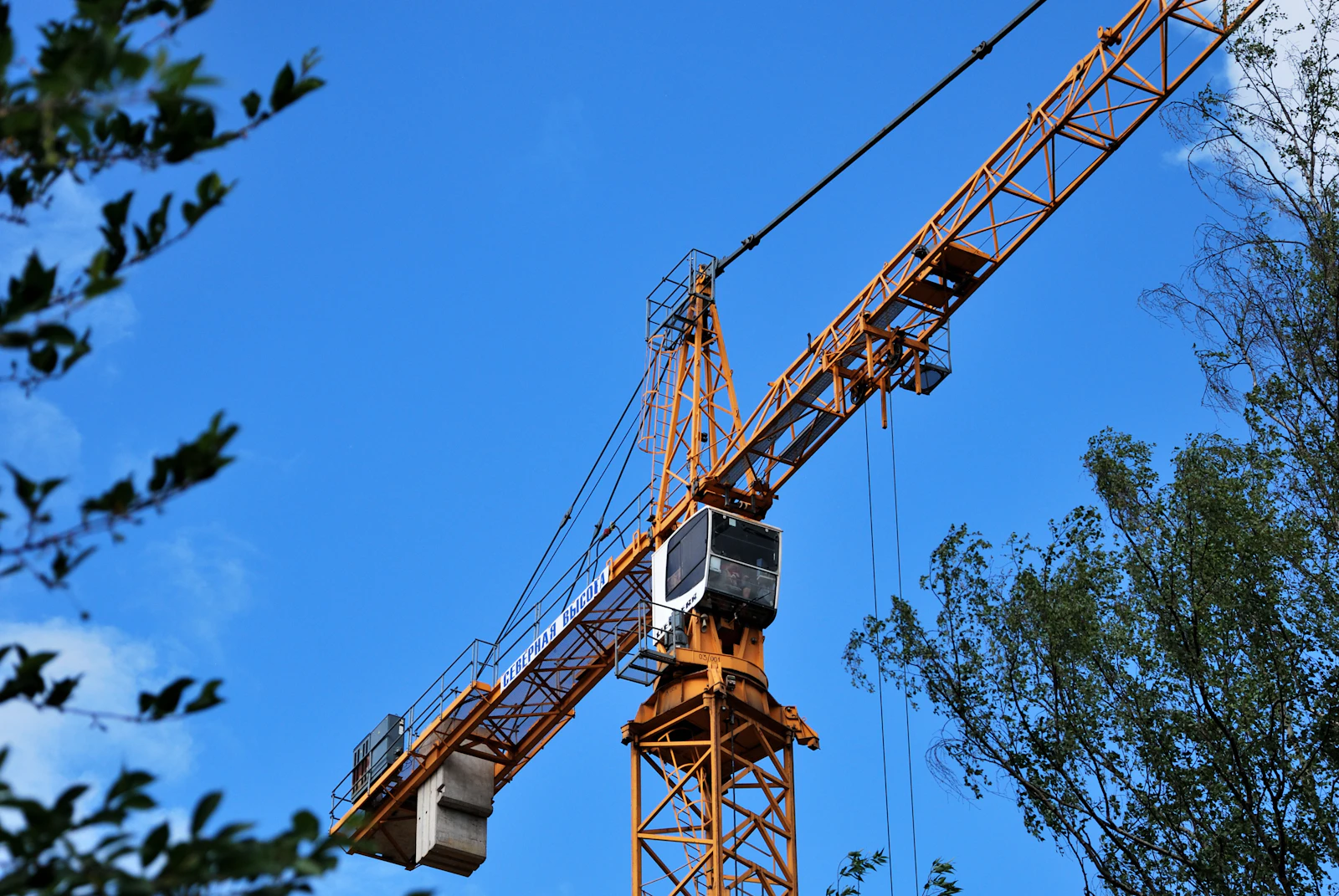
Mobile Crane Rental Rates in Mesa (Daily/Weekly) — 2026 Costs
Construction Cost Overview – Mesa, AZ
Price source: Costs shown are derived from our proprietary U.S. construction cost database (updated continuously from contractor/bid/pricing inputs and normalization rules).
Eva Steinmetzer-Shaw
Head of Marketing
Mobile Crane Hire Costs Mesa 2026
For mobile crane equipment hire in Mesa, Arizona supporting structural steel erection, 2026 planning budgets typically land in three tiers depending on tonnage class, rigging scope, and whether you’re buying a true “taxi-crane” (operated & maintained) package or a longer-term bare equipment hire. As a practical 2026 estimating range (single-shift work), plan $900–$2,200/day for a small boom truck/compact mobile crane, $1,800–$4,500/day for a 40–75 ton class crane, and $3,800–$9,500/day for 100–200+ ton all-terrain/hydraulic mobile crane coverage typical of multi-bay steel erection picks. Weekly planning ranges commonly run 3.5×–5× the day rate (depending on minimums and utilization), and monthly “held on site” pricing is usually quote-driven but often pencils as 2.2×–3.2× a weekly rate for bare equipment with separate operator/rigging labor. Mesa-area buyers usually source through national rental houses plus regional crane specialists serving the Phoenix/Mesa corridor, with availability and mobilization distance often impacting total hire more than the headline hourly.
Typical Rate Structures For Mobile Crane Equipment Hire (Steel Erection)
Most mobile crane rentals for steel erection in Mesa are quoted as operated and maintained (crane + certified operator, sometimes including basic rigging). You’ll generally see one of these billing structures:
- Hourly with a minimum: Common minimums are 3 hours, 4 hours, or an 8-hour minimum on larger tonnage. (Eight-hour minimums are frequently applied once you’re into heavier cranes and/or full-dress configurations.)
- 8-hour day rate (single shift): Often a cleaner way to buy steel picks when you expect travel, setup, fly-jib changes, and multiple pieces. Published examples show 8-hour day pricing in the $2,150 range for ~40-ton class and $3,400 for ~60-ton class under certain market conditions.
- Portal-to-portal / port-to-port billing: A frequent contract term where billable time starts when the crane leaves the yard (or prior job) and ends when it returns. This matters in Mesa because Phoenix metro traffic can turn a “half-day pick” into an invoiced minimum plus travel.
- Weekly/monthly held equipment: Less common for short steel packages, but it can apply when the crane is dedicated to one site, staged with mats, and working multiple short picks per day. Some published rate sheets show monthly figures for certain crane classes (market-dependent), but Mesa buyers should treat these as benchmarks and request written inclusions/exclusions (operator, fuel, permits, counterweight trucking, and standby rules).
What Drives Mobile Crane Hire Pricing In Mesa?
For structural steel erection, the lowest price crane is rarely the lowest total hire cost. The main cost drivers that change your invoice in Mesa include:
- Tonnage, radius, and boom configuration: Steel erection is often radius-driven. A 75-ton crane priced acceptably at a 30–40 ft radius can become non-viable (or require a jump in class) at 60–80 ft due to chart limits, especially with fly-jib installed.
- Counterweights and support trucking: Larger hydraulic/all-terrain cranes can require one or more support trucks to haul counterweights and rigging. Some providers price the counterweight truck as a separate hourly minimum (e.g., an additional truck billed at its own hourly rate/minimum).
- Rigging labor and supervision: If the crane company provides a rigger/signal, plan separate billed hours and minimums. Published rate sheets show rigger/signal pricing such as $95/hour with a 4-hour minimum in some markets; your Mesa quote may vary, but the structure (separate line item + minimum) is common.
- Matting and ground-bearing requirements: If you need outrigger mats, crane mats, or engineered bearing verification, cost can move quickly—especially on irrigated landscapes, utility corridors, or backfilled pads common on fast-track commercial sites.
- Site access and setup time: Tight ingress/egress, limited swing clearance, overhead lines, and “one-way-in” laydown yards add non-productive time that still bills (often portal-to-portal). If you require a street spot, expect additional traffic control and potentially right-of-way permitting.
- Scheduling windows and cutoffs: Many dispatch operations have same-day cutoff times and premium windows for early/late starts. One municipal contract example in Mesa includes an after-hours service charge of $250 (before 6AM / after 5PM weekdays and weekends) and $250 for emergency delivery under certain conditions—illustrating how premium windows can be priced as flat adders.
- Weather standby (wind/monsoon): Summer monsoon gusts can shut steel picks down. If the crane and crew are held, standby is often billable (either as crane time or per-person standby). Published examples show standby billed per man in some rate sheets.
Hidden-Fee Breakdown
Use this as a practical “equipment hire cost” checklist for mobile crane rentals in Mesa so the estimator doesn’t miss typical adders.
- Mobilization/demobilization: For short-duration steel picks, you may see a flat mobilization, mileage-based travel, or portal-to-portal travel hours. A Mesa contract example lists $125 for crane-truck delivery/pick-up in that contract context; real crane mobilization for 100–200 ton class units is usually higher and distance/configuration dependent.
- Minimum rental charges: Common minimums include 3-hour minimums for smaller cranes and 4-hour minimums for many hydraulic mobile cranes; larger cranes often move to 8-hour minimum structures.
- Fuel surcharges: Expect either a percentage (e.g., 7% applied to invoices in one published example) or a formula based on miles and crane-use hours. Another published pricing worksheet shows formulas such as $1.00/mile + $6.00/hour (up to certain tonnage classes) and $1.50/mile + $9.00/hour for larger cranes, often with a $25 minimum fuel surcharge.
- Road/permit fees: Permit line items may be billed as pass-through plus admin. On the state side, ADOT lists permit fees such as $15 for an oversize single trip and $75 for an oversize/overweight single trip (with other durations/annual options also posted). For routes off state highways or local streets, you’ll need the appropriate local authority permits as well.
- Pilot cars / escort / height pole (as required): If your crane moves or support loads trigger escort requirements, escort services can be a real line item. One Arizona pilot car rate sheet shows examples such as $225 for a local mini escort, $275 for a height pole local mini, $70–$80/hour for height pole service (by condition/region), plus adders like $75 for late-night starts and $125/night layover where applicable. Their website also notes a 10% fuel surcharge applied to totals.
- Rigging accessories: Common adders include spreader bars (example: $150/day in one published rate sheet), man baskets (example: $150/day in one sheet; $300 in another worksheet), shackles/softeners, and engineered below-the-hook devices if needed.
- Overtime and premium time: Premiums may kick in after 8 hours per shift, before 7:00AM, after 5:00PM, and on weekends. One published example adds $85/hour for Sunday/holiday rates; another shows overtime rates like $50/hour per man in that market. Treat these as structures to confirm in Mesa, not guaranteed local pricing.
- Standby time: You may be billed standby if steel trucks are late, bolt-up is behind, or wind shuts you down. A Mesa contract example lists $75/hour authorized stand-by time in that contract context.
- Cancellation/show-up time: Many terms allow billing for show-up or minimum hours if you cancel inside a window (often same-day or the evening prior). Confirm the cancellation clock in writing.
Mesa-Specific Cost Considerations For Structural Steel Erection
Beyond generic mobile crane rental pricing, Mesa has a few recurring practical realities that impact equipment hire cost forecasting:
- Phoenix/Mesa logistics and portal-to-portal exposure: Many cranes and counterweight trucks are dispatched across the metro. If your erection site is near constrained corridors, your portal-to-portal billed time can include real travel both ways.
- Heat management and early starts: Summer steel erection often targets early shifts. If your crane company prices premium time before 7AM or if your project demands a 5:00–5:30AM gate entry, plan a premium or minimum-day structure rather than “just a few early hours.”
- OS/OW permitting sensitivity: If you’re moving self-propelled mobile cranes or heavy support loads, Arizona’s oversize/overweight special permitting and continuous travel rules can matter. Arizona Administrative Code includes a Class A crane permit framework for certain self-propelled mobile cranes within posted maximums and conditions.
Budget Worksheet
Use these line items and allowances to build a Mesa mobile crane equipment hire cost estimate for steel erection. Adjust quantities to your lift plan and sequence.
- Mobile crane (operated) day rate allowance: $3,800–$9,500/day for 100–200+ ton class steel picks (8-hour planning); $1,800–$4,500/day for 40–75 ton class support picks.
- Minimum-hours exposure: Allow 4-hour minimum for smaller hydraulic classes; allow 8-hour minimum exposure for heavier cranes or full-dress configurations.
- Mobilization/demobilization: Allow $650–$2,500 per move for mid/heavy cranes (distance/config dependent). If your contract uses portal-to-portal, carry 1.5–3.0 hours of travel time each way as a sensitivity test.
- Counterweight/support truck(s): Allow $600–$1,800/day each when required (plus its own minimums).
- Rigging crew provided by crane company: Allow $95–$130/hour per rigger/signalperson with a 4-hour minimum (confirm Mesa local rates and minimums).
- Lift plan / site survey: Allow $250–$1,250 depending on whether it’s a basic site check or a stamped engineered lift plan. One published worksheet shows a $250 lift plan/survey line item in that market.
- Mats and cribbing: Allow $150–$450/day for light matting; $800–$2,500/week for heavier mat packages (site dependent).
- Man basket: Allow $150–$350/day where needed for bolt-up access, connectors, or decking verification.
- Spreader bar / below-the-hook gear: Allow $150–$400/day depending on size and certification requirements.
- Fuel surcharge: Carry 5%–12% of crane time, or apply a miles-and-hours formula (and confirm minimum fuel charge such as $25).
- Premium time / overtime: Carry a 1.25×–1.5× multiplier after 8 hours, and carry a weekend/holiday adder (example: +$85/hour in one published sheet) if your erection sequence needs Saturdays.
- Permits: Allow $75–$450 per move for permits and admin (plus pass-through); plus ADOT permit fees as applicable (e.g., $15 oversize single trip; $75 oversize/overweight single trip).
- Pilot car / height pole: Allow $225–$700/day per escort vehicle and add 10% fuel surcharge if applicable per provider tariff; allow $125/night layover if out-of-area movement is required.
Example: Two-Day Steel Erection Pick Plan In Mesa (120-Ton Class Crane)
Scenario: 2 days of structural steel erection for a single-story commercial shell in Mesa. Largest piece is 6,500 lb at a 55 ft working radius. Site has one constrained setup area; crane must be fully dressed and reposition once. Work window is 6:00AM–2:30PM to avoid peak heat; Saturday work is possible if steel delivery slips.
- Crane (operated) allowance: $5,800/day × 2 days = $11,600 (8-hour planning, includes setup, normal rigging).
- Mobilization/demobilization: $1,650 (includes counterweight/support logistics).
- Rigger/signalperson: $110/hour × 8 hours/day × 2 days = $1,760 (confirm whether 4-hour or 8-hour minimum applies).
- Spreader bar and softening gear: $250/day × 2 = $500.
- Man basket (contingency for connectors): $200/day × 1 = $200.
- Fuel surcharge: assume 8% of crane time = $928 (8% × $11,600) (confirm whether your provider uses a % method or miles+hours formula).
- Standby contingency: 2 hours/day × $175/hour = $700 (covers steel truck late arrival or wind holds).
- Total planned equipment hire budget (excluding steel contractor labor): $17,338.
Key operational constraints that change the final invoice: (1) if the vendor bills portal-to-portal, add the round-trip dispatch time to billed hours; (2) if Saturday becomes necessary, apply weekend/holiday premiums; (3) if the crane remains overnight, clarify whether morning/evening travel applies and whether the unit must start by a set time to avoid additional charges.
Rental Order Checklist
- PO scope language: Identify “mobile crane equipment hire (operated & maintained)” and specify whether rigging (rigger/signal), mats, spreader bar, and man basket are included or separate line items.
- Lift details for dispatch: Max piece weight (lb), max pick radius (ft), hook height (ft), number of picks, and whether there are critical lifts requiring engineered lift plans.
- Site constraints: Setup pad location, swing clearance, overhead utilities, underground utilities, soil condition, and required outrigger mat size.
- Delivery window and cutoffs: Gate time, escort needs, and any restrictions that could force after-hours arrival (and trigger a flat after-hours charge or premium time).
- Billing rules in writing: Portal-to-portal vs on-site only; minimum hours; overtime trigger after 8 hours; weekend/holiday multipliers; standby billing; cancellation window.
- Permitting responsibility: Confirm who obtains ADOT/local permits and who pays pass-through fees and escort costs.
- Insurance and documentation: COI requirements (GL/auto/umbrella), additional insured wording, operator certification expectations, and lift plan deliverables for closeout.
- Off-rent / end-of-shift: Define when time stops (crane ready-to-travel, load secured, demob complete) and what return-condition documentation is required (photos of mats, rigging returned, any damage noted).
How To Keep Mobile Crane Equipment Hire Costs Predictable On Mesa Steel Jobs
Steel erection crane rental pricing in Mesa becomes predictable when you manage three things aggressively: (1) utilization (minimize paid idle), (2) configuration changes (avoid mid-shift re-rigging surprises), and (3) travel exposure (portal-to-portal and support trucking). The best cost control isn’t “shopping hourly rates”; it’s issuing a lift plan that prevents up-sizing, re-mobilizing, or holding the crane while crews rework pick sequencing.
Off-Rent, Standby, And Weather Rules That Change The Invoice
- Standby time: If steel deliveries slip, the crane is often still billable. Carry a standby allowance such as 1–3 hours per day at the applicable crane/rigger standby rate. Standby can be priced per man (crew-based) or as crane time, depending on the agreement.
- Wind holds and monsoon storms: Build “weather float” into the rental term. If you’re buying an 8-hour day and you lose 2 hours to wind, you may still pay the full day unless your contract explicitly defines weather downtime treatment.
- Weekend/holiday billing: If the steel sequence is at risk, decide in advance whether you’ll accept Saturday work. Some published examples use explicit Sunday/holiday adders (e.g., +$85/hour in one market) and/or overtime rules outside weekday windows.
- Early/late starts: If your plan requires a 5:30AM start to beat heat, confirm whether the provider treats that as premium time. A Mesa-area contract example shows a flat $250 after-hours service charge in that contract context, which illustrates how dispatch windows can be monetized.
Permits And Escort Costs: When They Apply In Arizona
Even when your crane is self-propelled, moves can still trigger permit/escort costs based on dimensions/weights and route restrictions. ADOT posts a fee schedule showing items like $15 oversize single-trip permits and $75 oversize/overweight single-trip permits (with additional 30-day and annual options). If your move uses non-state routes, ADOT notes you must procure permits from the proper local authority for those routes. For specialty equipment, Arizona Administrative Code includes a Class A crane special permit framework for self-propelled mobile cranes under certain conditions and maximum dimensions (relevant when dispatch is trying to maintain continuous travel eligibility).
Escort pricing can also be non-trivial. One Arizona provider publishes example escort pricing such as $225 for a local mini, $275 for a height pole local mini, late-night start adders of $75, and layovers of $125/night, plus a published 10% fuel surcharge applied to totals. These are not “crane costs,” but they are real equipment hire project costs when your crane or support loads require escorts.
Insurance, Damage Waiver, And Contract Language That Impacts Total Hire
- Damage waiver vs contractor risk: Many operated crane hires don’t look like a typical “damage waiver %” model used for general rental equipment. Instead, risk is managed through terms (proper rigging direction, exclusions, and responsibility for ground conditions and underground hazards). Ask whether mats are mandatory and who is responsible for outrigger-induced damage.
- COI timing and dispatch holds: Late insurance certificates can cause a missed dispatch window. If the crane shows and cannot work due to documentation, you may still pay minimum hours/show-up time.
- Lift plan deliverables: For steel erection, confirm whether the provider expects you to supply lift plans and pick weights, or whether they provide a site survey/lift plan as a paid service (examples exist of $250 for site survey/lift plans in some published worksheets).
When Weekly Or Monthly Crane Hire Starts To Pencil For Steel Erection
Weekly or monthly mobile crane hire can reduce effective cost per pick if the crane is truly utilized and you can avoid repeated mobilizations. A simple planning test:
- If you’re doing 1–2 heavy pick days per week, a taxi-crane day rate often stays most economical (you avoid “held crane” standby days).
- If you’re doing 4–6 pick hours per day for 3+ consecutive weeks, explore weekly dedicated terms—especially if mobilization is expensive due to counterweight trucking and permits.
- If you must keep the crane set (mats down, crane positioned) due to tight access, ask about a “remain on site” arrangement and define: start-time rules, security expectations, and whether travel time is charged each day.
As external benchmarks only, published rate sheets in some markets include monthly numbers for certain crane classes and bare crane rates, but Mesa buyers should treat these as quote-only until inclusions (operator, rigging, fuel, permits, and premium time) are locked in writing.
Closeout Documentation That Prevents Back-Charges
- Daily tickets: Capture start/stop times, whether time was portal-to-portal, and note all delays (steel truck late, wind hold, GC access blocked).
- Accessory return condition: Document return of spreader bars, man baskets, mats, and rigging hardware (photos + sign-off) to avoid “missing equipment” charges.
- Permit/escort receipts: Keep all pass-through receipts (ADOT permits, local authority permits, escort invoices) and attach them to the crane ticket package for auditability.
If you want, I can convert your typical Mesa steel pick sequence (piece weights, radii, number of picks/day, and planned work windows) into a bid-ready equipment hire scope paragraph that reduces change orders by explicitly defining minimums, travel billing, standby, and premium time triggers.