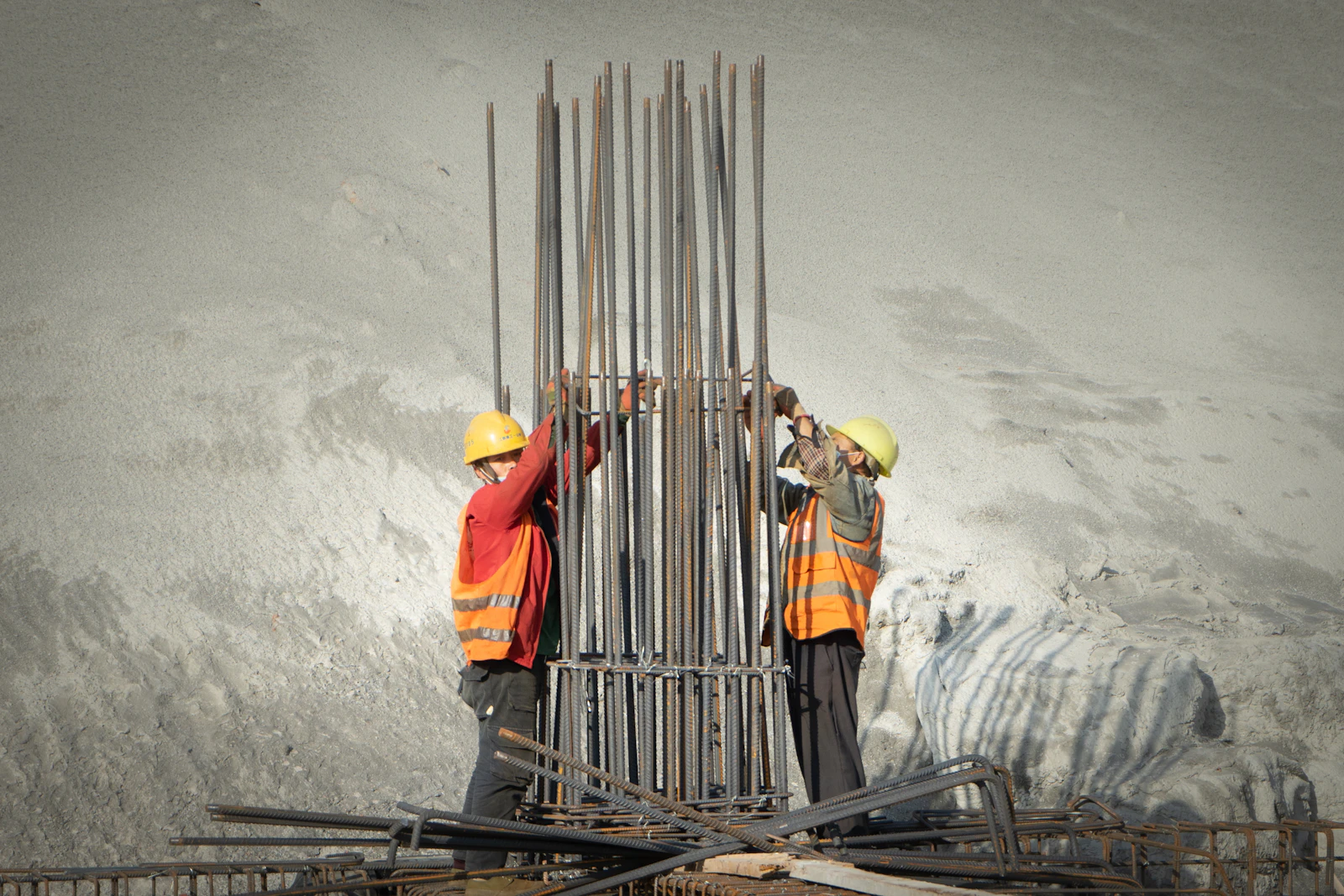
Rock Drill Rental Rates Dallas 2026
For Dallas retaining wall construction in 2026, rock drill equipment hire typically falls into two practical pricing bands depending on whether you are drilling with pneumatic tools (anchors, dowels, drainage penetrations) or breaking/drilling ledge with a hydraulic attachment. Budget $50–$120/day, $200–$450/week, and $600–$1,300 per 4-week period for a pneumatic rock drill tool-only rental (40–60 lb class), then add a 185 CFM towable compressor commonly posted around $205/day, $866/week, and $2,200/month in Dallas—pushing the all-in pneumatic package into roughly $260–$520/day before delivery, waiver, and consumables. For hydraulic rock drill / breaker attachments (350–500 lb class) used on skid steers/mini excavators, plan around $210–$320/day, $750–$1,100/week, and $2,150–$3,100/month for the attachment, plus the carrier if you are not already mobilized. Most crews will quote through national houses (Sunbelt Rentals, United Rentals, Herc Rentals) and local DFW yards; your final rate is driven by class/flow requirements, steels/bits, and billing rules (shift, weekend, off-rent cutoffs).
| Vendor |
Daily Rate |
Weekly Rate |
Review Score |
Website |
| United Rentals |
$525 |
$2 050 |
8 |
Visit |
| Sunbelt Rentals |
$495 |
$1 980 |
8 |
Visit |
| Herc Rentals |
$510 |
$2 040 |
7 |
Visit |
| The Home Depot Tool Rental |
$160 |
$640 |
7 |
Visit |
| Texas First Rentals |
$475 |
$1 900 |
8 |
Visit |
How Rock Conditions Around Dallas Change Rock Drill Hire Costs
In Dallas and the broader DFW footprint, retaining wall drilling and breaking costs swing when you hit limestone ledge, caliche layers, or mixed fill with concrete debris. The biggest rental-cost driver is production per shift: if your crew’s rock drill package is under-sized (CFM, breaker energy class, bit diameter), you burn extra days and trigger additional delivery, damage waiver, and weekend billing. Conversely, oversizing the package can force you into a heavier carrier class (larger skid steer/mini excavator flow and coupler requirements), which increases daily spend and often increases transport/handling charges.
For estimating, treat “rock drill” as one of these jobsite realities:
- Pneumatic rock drill package (air drill + 185 CFM compressor + hoses/oiler + steels/bits): best for short anchor/dowel patterns, tight access, and precise hole placement where you can stage the compressor safely.
- Hydraulic rock drill / breaker attachment on skid steer or mini excavator: best for intermittent ledge removal, boulder reduction, trench starts, and breaking keyways/benches at the footing line before wall base prep.
Because retaining wall work is often stop/start (survey, excavation, base, reinforcement, drainage, block/formed wall, backfill lifts), the off-rent timing matters as much as the day rate. A rock drill sitting idle through a Friday afternoon frequently turns into a billed weekend, even if you “only used it for an hour.”
Rock Drill Equipment Hire Packages Used on Retaining Wall Construction
To keep the estimate tied to real invoices, build your scope as a package and decide what you are supplying internally (carrier machine, fuel, operator) versus what the rental house is supplying (delivery, protection plan, consumables).
- Pneumatic rock drill (40–60 lb) tool-only hire: include drill, handle assembly, and basic chuck. Add-on charges commonly appear for steels/bits, oiler/lubricator, and whip checks.
- 185 CFM towable compressor hire: include pintle hitch, safety chains, and a minimum hose set. Dallas jobs regularly require longer hose runs for safe staging (behind barriers/fencing), which is where hose and fitting adders show up.
- Skid steer or mini excavator + hydraulic breaker hire: confirm quick-attach style, pin grabber dimensions, auxiliary hydraulics flow (GPM), and working pressure. Mismatches create swap charges and lost time.
What Affects Rock Drill Equipment Hire Pricing in Dallas?
Rock drill equipment hire costs in Dallas are most sensitive to the following factors (each one has a direct dollar consequence):
- Shift definition and hour-meter rules: many attachment and specialty-tool schedules price a “standard day” as an 8-hour single shift; running double shift can bill at 1.5× to 1.75×, and triple shift can approach 2×, depending on the rate program.
- Weekend and holiday billing: some programs use a weekend bundle (e.g., Fri–Mon) rather than pure daily math; if you cannot off-rent before cutoff, you may pay a weekend minimum. One published example shows Fri–Mon $436 and Sat–Mon $218 for a breaker attachment, illustrating how billing structures can deviate from “1 day = 24 hours.”
- Delivery radius and site congestion: DFW jobs often exceed a simple “in-town” radius; once you’re outside a base zone, per-mile transport or a second trip charge is common. Downtown Dallas access windows (traffic control, loading zones) can force after-hours delivery/pickup adders.
- Bits/steels wear and replacement: in limestone/caliche, you can chew through steels quickly. If your rental is “tool-only,” bit wear is frequently the largest unplanned cost line.
- Dust control expectations: drilling near occupied structures, storefronts, or indoor tie-in points can require a silica-compliant vacuum setup, which adds separate hire lines and cleaning requirements.
2026 Planning Allowances for “Hidden” Rock Drill Hire Costs
Use these as estimator-grade allowances for Dallas rock drill equipment hire. They are not universal, but they reflect the cost categories that most often move the final invoice for retaining wall construction:
- Delivery / pickup (each way): carry $175–$350 per trip inside a base radius, plus $4–$7 per mile beyond the base zone. Add $150 for after-hours or scheduled-window deliveries when required by site logistics.
- Minimum rental charges: allow a 4-hour minimum on specialty attachments (commonly $150–$250 equivalent), even when you “just need it for a quick hole pattern.”
- Damage waiver / rental protection: carry 10%–18% of time charges (attachment + compressor + tools). Clarify whether the waiver applies to the delivery line as well.
- Environmental / admin fees: carry 2%–5% of time charges or $5–$15/day as an equipment rental recovery line (varies by program).
- Fuel and refuel charges (compressor): if returned short, carry $6–$9/gal diesel, typically with a $25 minimum fuel service line. If the compressor is metered or fuel-billed, confirm whether you are charged by gallon or by a flat percentage.
- Hoses and air tool accessories: carry $10–$25/day for hose sets/whip checks when they are ticketed separately, plus $8–$15/day for an oiler/lubricator kit.
- Bits/steels wear: carry $15–$45/day for common carbide bit lines or a “wear” line, plus a contingency for replacement (often $150–$400 per lost/damaged steel, depending on length/diameter).
- Cleaning fees: carry $75–$250 for standard cleaning on mud/clay; allow $300–$450 when equipment returns with caked Dallas clay, concrete slurry, or requires pressure wash/detailing.
- Late return / non-notified off-rent: carry 1 additional day risk when off-rent calls miss the rental house cutoff (often mid-afternoon). This is especially common on Friday demobs.
Dallas-Specific Operational Constraints That Change the Rental Cost
These constraints regularly turn “good rates” into expensive rock drill equipment hire in the Dallas market:
- DFW sprawl and delivery sequencing: when the wall build is split across multiple addresses (staging yard, wall line, spoil site), you may pay multiple mobilizations unless you plan a single drop zone and keep the package together.
- Heat and utilization: during hot Dallas summer days, crews often compress drilling/breaking into early shifts. If you request a tight delivery window (e.g., before 7:00 a.m.) to beat concrete and traffic, carry the scheduled-delivery adder and confirm standby rules if the driver arrives and cannot access the site.
- Dust control near occupied property lines: retaining wall work near commercial edges can require HEPA vacuum or wet methods. A realistic allowance is $90–$160/day for a dust extractor and $55–$120/day for a HEPA vac, plus $35–$75 for filter/consumable charges when enforced by the GC or facility. (These lines are commonly missed in initial estimates.)
Budget Worksheet (Rock Drill Equipment Hire Allowances)
Use this as a field-ready budgeting artifact for Dallas retaining wall construction. Adjust quantities for your drill days vs standby days.
- Pneumatic rock drill hire (tool-only): allowance $60–$110/day for __ days
- 185 CFM towable compressor hire: allowance $205–$260/day for __ days
- Hoses/whip checks/oiler kit: allowance $18–$40/day for __ days
- Bits/steels wear allowance: $25–$75/day (limestone/caliche), plus replacement contingency $300
- Hydraulic breaker attachment hire (if using skid steer/mini-ex): allowance $210–$320/day for __ days
- Carrier machine hire (only if not owned/mobilized): skid steer allowance $240–$312/day for __ days
- Delivery and pickup: $175–$350 each way, quantity __
- Damage waiver / rental protection: 12%–18% of time charges
- Environmental/admin fees: 3%–5% of time charges
- Fuel/service allowance (compressor): $75–$180 per week (depends on run time), plus refuel min $25
- Cleaning/pressure wash allowance at return: $150 (standard) to $450 (heavy)
- Contingency for missed off-rent cutoff/weekend billing: 1 extra day of the highest daily line item
Example: 10-Working-Day Retaining Wall Build With Limestone Ledge in Dallas
Scenario: A 120-linear-foot retaining wall needs a keyway/bench cut and intermittent ledge reduction at the footing line. Drilling is required for dowels and a few drainage penetrations. Work runs 10 working days across two calendar weeks, with demob targeted by Friday.
- Attachment route (production-first): Hire a 500 lb class hydraulic breaker for a skid steer at $240/day and a skid steer at $280/day. If you keep both for 2 weeks, you likely hit weekly caps: carry roughly $830/week for the breaker and $998/week for the skid steer, plus delivery.
- Pneumatic drilling route (precision holes): Add a pneumatic rock drill tool-only at $70–$110/day and a 185 CFM compressor around $205/day. Plan 3 drill days for dowels/drain penetrations and off-rent immediately after to avoid weekend billing.
- Delivery plan: One drop at mobilization and one pickup at demob. Carry $250 each way (typical in-market allowance) and add $150 if you require a strict downtown window.
- Protection + fees: Carry 14% damage waiver and 3% environmental/admin recovery.
- Wear/consumables: Carry $60/day bit/steel wear on the 3 drilling days, plus $300 contingency for a damaged/lost steel.
Cost control note: the biggest preventable overrun is missing the off-rent cutoff on Friday. If the compressor and drill package sit through the weekend, you can easily add 2–3 billed days depending on the program. Write the off-rent cutoff time into the foreman’s plan and require return-condition photos at demob.
Rental Contract Terms That Commonly Move Rock Drill Hire Invoices
For Dallas retaining wall construction, most “rate disputes” come from contract mechanics rather than the base day rate. Before you issue the PO, confirm these terms in writing (or in the vendor portal):
- Day vs week vs 4-week conversion: confirm whether the contract automatically caps to weekly/4-week once accumulated dailies reach the cap, and whether the cap applies per line item (drill, compressor, hoses) or only to the primary unit.
- Off-rent rules: confirm the cutoff time to stop billing (commonly mid-afternoon). If pickup is “next day,” many programs continue billing until the unit is physically checked in.
- Weekend billing logic: some branches bill Saturday/Sunday if the equipment remains on rent, even if the site is closed. Others use weekend bundles (Fri–Mon). One published example shows a Fri–Mon bundle price structure for a breaker attachment; do not assume your daily rate times days is the cheapest structure.
- Shift multipliers for metered use: if your retaining wall schedule goes long (night pours, traffic control), confirm whether the breaker/compressor is “single shift included.” Published schedules show multipliers such as 1.5× (double shift) and up to 2× (triple shift), and another published example shows 1.75× for double shift on a hydraulic breaker program.
Bits, Steels, and Consumables: Where Rock Drill Hire Budgets Commonly Break
Rock drill equipment hire is unusually sensitive to “small” accessory lines. For retaining wall construction, you may not notice these lines until the invoice hits AP—so carry them deliberately.
- Rock drill bits/steels: confirm if bits are included, billed per day, or billed at replacement cost. Published rate sheets show separate carbide bit line items (example: $15/day for certain rock drill bit categories), which can stack quickly over multi-day drilling.
- Hydraulic breaker tool steels: confirm whether chisel wear is included. If not, carry a wear line of $35–$85/day on heavy limestone work, or a replacement contingency of $450–$900 for a lost/damaged steel depending on size.
- Hoses and fittings: missing whip checks, damaged couplers, or lost fittings often bill as replacement parts. Carry a small “lost/damaged accessories” allowance of $75 per rental cycle.
- Lubrication: pneumatic rock drills often require an inline oiler; if it is returned dry or contaminated, cleaning/service charges can appear. Carry $25–$75 as a maintenance exposure line when you are cycling multiple drills across crews.
Delivery, Access Windows, and Demobilization Discipline (Dallas Focus)
Dallas jobsite access frequently dictates equipment hire cost more than the equipment itself. To keep rock drill hire from ballooning:
- Book delivery with a realistic window: if your wall site has lane closures, school zones, or limited staging, coordinate a 2–3 hour delivery window. If the driver cannot access and must return, you can pay a failed delivery plus a re-delivery (carry $150–$350 risk per event).
- Plan a single demob day: demobbing the skid steer on Thursday and forgetting to off-rent the breaker attachment until Monday is a classic avoidable overrun. Assign one person (PM or superintendent) as the off-rent authority.
- Return condition documentation: require photos of hour meters (where present), overall condition, steels/bits count, and tie-down condition. This prevents “missing accessory” backcharges and reduces cleaning disputes.
Rental Order Checklist
Use this checklist to issue a clean PO and avoid the most common Dallas rock drill equipment hire backcharges.
- PO structure: separate line items for drill/attachment, compressor (if any), hoses/oiler, bits/steels, delivery, damage waiver, and fuel/consumables caps.
- Delivery requirements: site address, contact name/number, gate code, delivery window, truck restrictions, and where the unit can be staged without blocking access.
- Carrier compatibility: skid steer/mini-ex model, auxiliary hydraulics flow (GPM), coupler type, pin sizes, and whether a quick-coupler adapter is required (often $25–$60/day if rented separately).
- Billing rules: confirm single shift (8 hours) assumption, overtime/shift multipliers, weekend billing logic, and off-rent cutoff time.
- Protection and liability: damage waiver percentage (10%–18%), theft responsibility, and any deductible/chargeback rules.
- Fuel expectations: compressor fuel level at dispatch/return, refuel charge rate ($6–$9/gal) and minimum service charge ($25).
- Return requirements: cleaning standard (no caked clay/concrete slurry), required accessory count (steels, bits, hoses, whip checks), and photo documentation at pickup.
2026 Dallas Rock Drill Equipment Hire Market Notes for Planning
When you plan 2026 retaining wall construction, expect the following practical conditions in Dallas/DFW:
- Short-notice demand spikes: weather-driven schedule shifts and infrastructure work can tighten breaker/compressor availability. If you need guaranteed availability, expect a higher rate tier or longer minimum rental commitments.
- Bundles can be cheaper than à la carte: some yards publish package rates (for example, a posted package including a 185 CFM compressor and air tool set at $200/day, $800/week, $2,000/month in one published schedule). Where available, packaging reduces accessory scatter and missing-item disputes.
- Attachment pricing is transparent at local DFW yards: at least one DFW yard publicly posts hydraulic breaker attachment rates such as $240/day, $830/week, $2,300/month for a 500 lb class attachment; use these as an anchor for negotiations and to sanity-check quotes.
Ownership Versus Equipment Hire: When Buying Might Pencil Out
Most retaining wall contractors still prefer equipment hire for rock drills because utilization is spiky and accessory loss/wear can be unpredictable. As a rule of thumb:
- If you are renting a breaker attachment more than 8–10 weeks per year on multiple projects, evaluate ownership—especially if you already own the carrier machines and have a controlled yard for storage.
- If you only need a pneumatic rock drill package for 1–3 days per project, hire remains the most cost-controllable option (provided you off-rent cleanly and avoid weekend billing).
Even when you buy, you still end up “renting” around the edges (special bits/steels, dust control vacuums, spare compressors), so many Dallas crews keep hire relationships in place for surge capacity.