Build your next estimate with CountBricks
Create an itemized estimate for your project, with materials, labor, and quantities you can review and edit.
Create my estimateStart a 7-day free trial. Sign up, then enter your project details.
Roof Hoist Hire Costs Boston 2026
2026 Boston planning ranges (equipment-only) for a roof hoist typically land in three budgeting bands: (1) a standard 27–28 ft gas ladder hoist (“laddervator”) package at $120–$220/day, $350–$650/week, and $800–$1,650 per 4 weeks; (2) a lighter-duty shingle lift / conveyor style unit at $70–$130/day, $220–$450/week, and $700–$1,250 per 4 weeks; and (3) higher-capacity ladder/platform hoist configurations (when available) at $180–$320/day, $550–$950/week, and $1,400–$2,700 per 4 weeks. These ranges assume an unoperated rental (your crew runs it), normal business-hour pickup/return, and do not include delivery, setup/rigging, damage waiver, fuel, or rooftop accessories—items that commonly drive the real “all-in” roof hoist equipment hire cost on Boston tile roofing scopes. For sourcing, Boston crews commonly quote through national rental branches (e.g., United Rentals, Sunbelt, Herc) plus specialty access/scaffold yards; availability can tighten during peak reroof season, so written quotes and reservation lead time matter as much as the base rate.
| Vendor |
Daily Rate |
Weekly Rate |
Review Score |
Website |
| Sunbelt Rentals |
$220 |
$660 |
8 |
Visit |
| United Rentals |
$230 |
$690 |
8 |
Visit |
| Herc Rentals |
$210 |
$630 |
7 |
Visit |
| The Home Depot Tool Rental |
$200 |
$800 |
8 |
Visit |
Where the ranges come from (so you can sanity-check your budget): published ladder hoist pricing in the U.S. market shows meaningful spread even before metro adjustments—examples include a 27 ft ladder hoist posted at $165/day, $424/week, $715/month by one rental yard, with a note that pricing is subject to change. Another yard posts a 28 ft ladder/platform hoist at $100/day, $300/week, $900 per 4 weeks. Other published schedules show ladder shingle hoist pricing at $150/day, $600/7 days, $1,800/28 days. And a material-handling rental page shows a 27 ft shingle ladder hoist with $78/five hours, $95/day, $380/week, and $1,140/month. For Boston 2026 planning, many contractors carry the upper half of these published ranges to account for metro delivery constraints, jobsite access complexity, and seasonal demand.
What Type Of Roof Hoist Are You Hiring For Tile Roofing?
For tile roofing in Boston, “roof hoist” can mean different things in a rental request, and the equipment hire cost changes immediately based on which you actually need:
- Ladder hoist / laddervator (gas): common for bundles, tools, and lighter pallet-breakdown loads. Published examples commonly cluster around the low-to-mid hundreds per day for the base unit, with week and 4-week structures that are materially cheaper than stacking daily.
- Shingle lift / conveyor (lighter-duty): can be cost-effective for light reroof material handling, but for tile, the limiting factor is often load form factor (tile cartons/pieces) and cycle time (more trips). It may still be viable if the crew can stage smaller loads safely.
- Ladder/platform hoist (platform carriage): often priced above a basic shingle carriage because the platform hardware is an add-on and the unit may be rated for different loads. Published catalog pricing exists for this class.
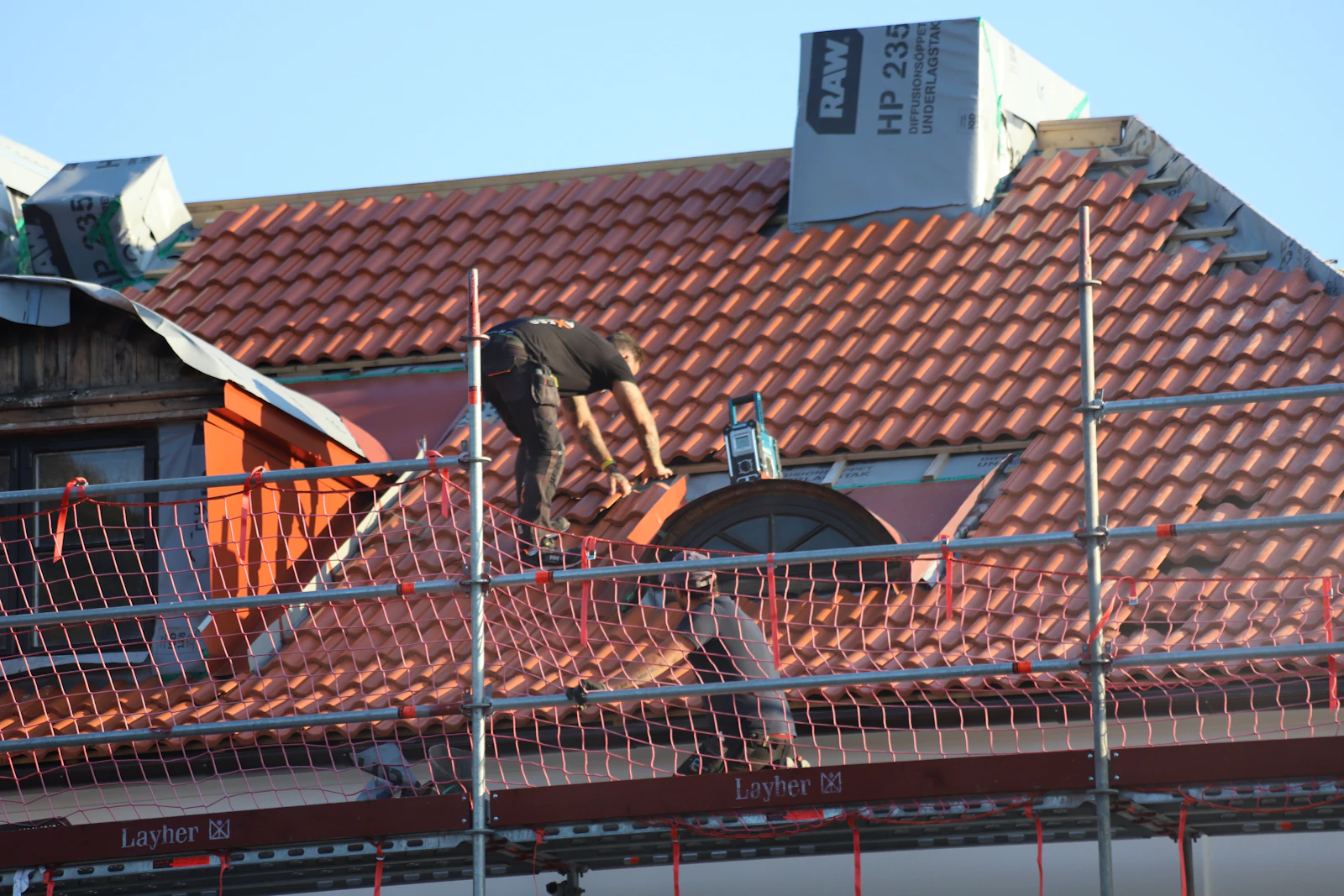
Tile roofing reality check: tile is heavier and more brittle than shingles. Even when the hoist can lift the weight, your roof staging plan (where loads land, how they’re distributed, and whether rooftop transport is by hand or with carts) can create additional accessory and labor needs that are billed through the rental contract (setup time, extra track sections, platform trays, and re-deliveries).
What Drives Roof Hoist Equipment Hire Pricing In Boston?
Boston roof hoist rental pricing is rarely “just the day rate.” The biggest cost drivers we see on tile roofing scopes are:
- Length and reach: 27–28 ft is common, but triple-deckers, steep setbacks, and staged delivery positions can push you into longer track needs. An estimator should plan an extra section allowance (often billed per section per day/week) if the final ladder path is not confirmed at takeoff.
- Capacity and carriage type: shingle forks vs. platform tray vs. tile carriers. Platform configurations usually add cost and sometimes drive a different base model.
- Power type and refuel expectations: gas units are common; many rental contracts require return full or they apply a refuel/service charge.
- Jobsite access: Boston’s narrow streets, alley access, and limited curb space can force smaller delivery vehicles, shuttle moves, or split drops—each one adds handling cost and schedule risk.
- Billing clock rules: “1 day” might mean 8–24 hours depending on the yard; some posted rates also show short minimums (example: $78 for five hours) that are useful for patch scopes but can surprise you if you assumed a full day was required.
Delivery, Street Access, And Boston-Specific Logistics
For Boston tile roofing, delivery and access is usually the largest non-obvious component of roof hoist equipment hire cost. Build your estimate around these realities (and push for them to be written into the quote/PO notes):
- Delivery/pickup charges: plan $175–$325 each way within a typical local radius, then $8–$12 per mile beyond the included miles (use your yard’s “free miles” rule if provided).
- Delivery windows and cutoffs: many Boston sites cannot accept a large truck during school drop-off or peak commuter windows; if you need a 6:00–7:30 AM delivery, carry an after-hours / priority window premium of $200–$350.
- Curb space management: if the delivery requires on-street staging, carry an internal allowance for a permit runner / traffic control assist ($125–$250) plus cones/barricades if required by GC.
- Historic and dense neighborhoods: Beacon Hill/Back Bay-style access often means you can’t place the hoist where the crew wants it. That can drive a re-delivery or on-site reposition charge—carry $150–$250 for one re-spot event if access is uncertain at bid time.
- Coastal wind exposure: Dorchester/South Boston/Harbor-adjacent roofs can see higher gusts. Expect more weather standby and plan for a schedule buffer because the rental clock typically does not stop for wind holds unless you off-rent the unit.
Operationally: confirm whether the rental branch bills delivery/pickup as flat, mileage, or truck-hour. Also confirm if the driver will place the unit where you need it or curb-drop only (some yards charge additional handling time if they assist beyond curb placement).
Hidden-Fee Breakdown
These are the line items that most frequently swing the invoice above the roof hoist base rate on Boston tile roofing projects:
- Damage waiver (DW): commonly 10%–15% of the rental charges (and it typically does not cover abuse, theft, or gross negligence). Treat DW as a separate line in the estimate—do not bury it.
- Deposit / credit card authorization: plan $500–$2,000 depending on hoist value and whether you have an approved account.
- Setup/rigging labor (if you request it): carry $95–$140/hour with a 2-hour minimum, plus travel time if the yard’s policy bills portal-to-portal.
- Lift-gate or specialty unload: if the delivery truck requires lift-gate service at a tight residential curb, carry $50–$90.
- Stair carry / hand truck handling: Boston stoops and split-level entries can trigger a manual handling adder; carry $75–$150 if the drop is not curbside.
- Fuel/refuel service: carry $25–$60 if returned short of “full,” plus possible shop minimums.
- Cleaning: mud, mortar dust, adhesive, or tar on the track/carriage can trigger $75–$250 in cleaning charges.
- Late return: common structures are either an additional full day or an hourly holdover; carry $35–$85 per hour after the due time if your yard uses an hourly penalty.
Accessories And Add-Ons That Change The Invoice
For tile roofing, accessories can matter more than for shingles because you’re often lifting smaller, heavier units with more cycles. Budget adders that rental coordinators commonly carry include:
- Extra track/ladder sections: $25–$60/day per section (or a weekly equivalent) when the roofline height or setback isn’t final.
- Ridge hook / roof tie-in kit: $15–$30/day, especially if you’re placing on steeper pitches or need additional securement.
- Platform tray / material carriage upgrade: $20–$45/day when the base “shingle forks” aren’t suitable for tile cartons or bundle geometry.
- Spare belt/cable wear allowance: not always charged up front, but if damaged, replacement parts are not cheap—carry $250 as an exposure allowance for a cable/belt incident plus labor if abuse occurs.
- Power cords and GFCI distribution (if electric accessories are used): $5–$10/day for cord/distro rentals where required by GC site rules.
Estimator note: treat accessories as probability-weighted adders. If you have a clean, wide driveway and a 2-story eave, your accessory stack can be minimal. If you’re on a tight Boston curb line with a 3-story eave and a deep setback, accessory + handling can rival the base rent.
Example: Two-Day Tile Roofing Load-Up On A South Boston Rowhouse
Scenario: Two-day tile roofing mobilization on a 3-story rowhouse. Crew wants a 28 ft roof hoist to stage tile and underlayment at the eave. Access is curbside only; delivery must be before 7:30 AM due to traffic and neighbor constraints.
- Base roof hoist rent (2 days): budget $260–$440 (using a $130–$220/day planning band for Boston).
- Priority delivery window premium: $200–$350 (early window).
- Delivery + pickup: $350–$650 total.
- Damage waiver (10%–15%): add $26–$66 on top of rental (exclude delivery if your vendor calculates DW on rent only).
- Accessory stack (likely for tile cartons): platform tray $40–$90 total for 2 days; ridge hook kit $30–$60 total.
- Return-condition risk: carry $75 cleaning allowance if the unit ends up in mortar dust or mud.
All-in planning total: $961–$1,781 for the two-day phase, before tax and before any permit/traffic-control requirements from the GC. The takeaway for a rental coordinator: on dense Boston tile roofing work, “delivery + time window + accessories” can exceed the base roof hoist hire cost.
Budget Worksheet
Use this as a no-table budgeting artifact for a roof hoist equipment hire request (Boston, tile roofing):
- Roof hoist base rent: $____/day × ____ days (or $____/week × ____ weeks; or $____/4 weeks × ____)
- Delivery: $____ each way × 2 (include early/late window premium if needed)
- Fuel/refuel allowance: $40
- Damage waiver: 12% × (rental charges)
- Deposit/authorization: $1,000 (cash flow placeholder; not always an expense)
- Accessories allowance: $150–$350 (platform tray, extra track sections, ridge hook kit)
- Setup/rigging labor allowance (if not self-performed): $120/hr × 2 hr minimum = $240
- Cleaning allowance: $100
- Late return buffer: 1 hour × $60/hr = $60
- Contingency (Boston access variability): 7%–10% of subtotal
Rental Order Checklist
- PO scope language: specify “roof hoist / ladder hoist length ___ ft, carriage type (shingle forks vs platform), power type, and any extra track sections.”
- Rate structure: confirm day vs week vs 4-week; confirm whether weekends are billed as calendar days.
- Delivery instructions: address, contact, required arrival window, curb placement point, and whether a lift-gate is needed.
- Site constraints: note narrow street, one-way access, height restrictions, and any GC-required delivery cutoffs.
- Documentation at drop: photo the unit condition (track, carriage, engine area), serial number, and accessories delivered.
- Safety & training: confirm operator briefing is done; keep manufacturer instructions on site.
- Off-rent rules: get the cutoff time for next-day pickup (e.g., “call off by ___ PM”).
- Return condition: clean, fuel level, accessory count, and photo documentation on load-out.
Compliance Note For Massachusetts Hoisting Rules (Budget Impact)
Massachusetts hoisting rules can affect how equipment is rented and who can operate certain categories of hoisting machinery; the state’s hoisting machinery regulations have been recodified (e.g., 230 CMR 6.00, previously 520 CMR 6). For compact hoisting machinery, the regulations also describe requirements around temporary permits and facilitator responsibilities (important when the “roof hoist” request turns into a forklift/telehandler substitution late in planning). This is not legal advice—treat it as a prompt to confirm licensing/permit needs early so you don’t pay for a no-start day on rent.
How To Structure Weekly Vs 4-Week Rates In 2026
For roof hoist equipment hire cost control in Boston, the biggest lever (after jobsite access) is selecting the right billing structure for the production plan. Published rate cards show that 4-week pricing can be close to (or only moderately above) two weekly charges in some cases, but can also be substantially higher depending on the yard and the class of hoist.
Practical guidance for tile roofing: if your tile scope is sensitive to weather and staging (common in Boston), you can unintentionally pay “weekly stack-up” while waiting for inspection windows, material availability, or wind holds. If you realistically need the hoist on site for more than ~10–14 days, ask for a 4-week structure up front and confirm whether the vendor’s “monthly” is 28 days or a calendar month.
Off-Rent, Weather Days, And Weekend Billing Rules
Roof hoist invoices get messy when the off-rent process isn’t managed tightly. Build these operational constraints into the plan and communicate them to the superintendent and coordinator:
- Off-rent cutoff: many rental operations require a same-day call by early afternoon to schedule next-day pickup. If you miss it, you can easily burn 1 extra day of rent plus another day’s DW percentage.
- Weekend billing: some yards treat a Friday delivery as starting the clock immediately; others offer a “weekend special” where Friday PM to Monday AM counts as 1 day. Do not assume—get it written on the contract notes.
- Weather standby: high-wind holds are common on exposed Boston roofs. Unless you off-rent (and the vendor picks up), you are typically still on rent. Budget a weather buffer day if the schedule sits on the shoulder seasons.
- Holiday billing: if pickup/return falls on a holiday closure, plan for a charge to roll into the next business day (or plan a pre-return the day prior).
Return Condition, Documentation, And Dispute Avoidance
Most “unexpected” roof hoist hire costs show up at close-out: cleaning, missing accessories, and damage assessment. Use a documentation-heavy closeout process to protect your budget:
- Photographs at pickup and return: track sections, carriage, controls, engine area, and any guards.
- Accessory count sheet: extra sections, ridge hooks, platform trays, pins, and straps.
- Fuel level documentation: photo the tank level (or note “full” on the driver’s ticket when possible).
- Dust-control reality for tile roofing: Boston tile tear-offs can generate fine dust; keep the hoist staged off bare soil where possible and wipe rails before load-out to reduce cleaning charges.
When A Roof Hoist Stops Being The Lowest-Cost Option
Staying focused on roof hoist equipment hire cost does not mean ignoring when the hoist is the wrong tool. Tile roofing can push you into a high-cycle, low-load workflow that inflates labor more than it saves. If you see any of these, it’s worth pricing an alternate lift plan (even if you still keep a small roof hoist on the PO for tools and detail materials):
- Deep setback + limited staging: the hoist can’t land close to where tile must be set, so rooftop hand-carry dominates.
- High breakage risk: if the hoist carriage isn’t well suited to tile packaging, breakage and re-handling can exceed equipment savings.
- Access allows better material placement: if you can place pallets closer to the workface with a different method, the roof hoist becomes a secondary tool rather than the primary.
Key Takeaways For Boston Roof Hoist Equipment Hire
- Budget the base rate and the “access stack” separately: delivery windows, access handling, and accessories commonly exceed the base rent on Boston tile roofing scopes.
- Use written assumptions: define day/week/4-week clock rules, weekend billing, and off-rent cutoffs on the PO.
- Carry realistic allowances: DW (10%–15%), cleaning, refuel, and a late-return buffer are predictable costs—treat them as planned line items, not surprises.
- Document condition both ways: photos and accessory counts reduce closeout friction and protect your equipment hire cost.