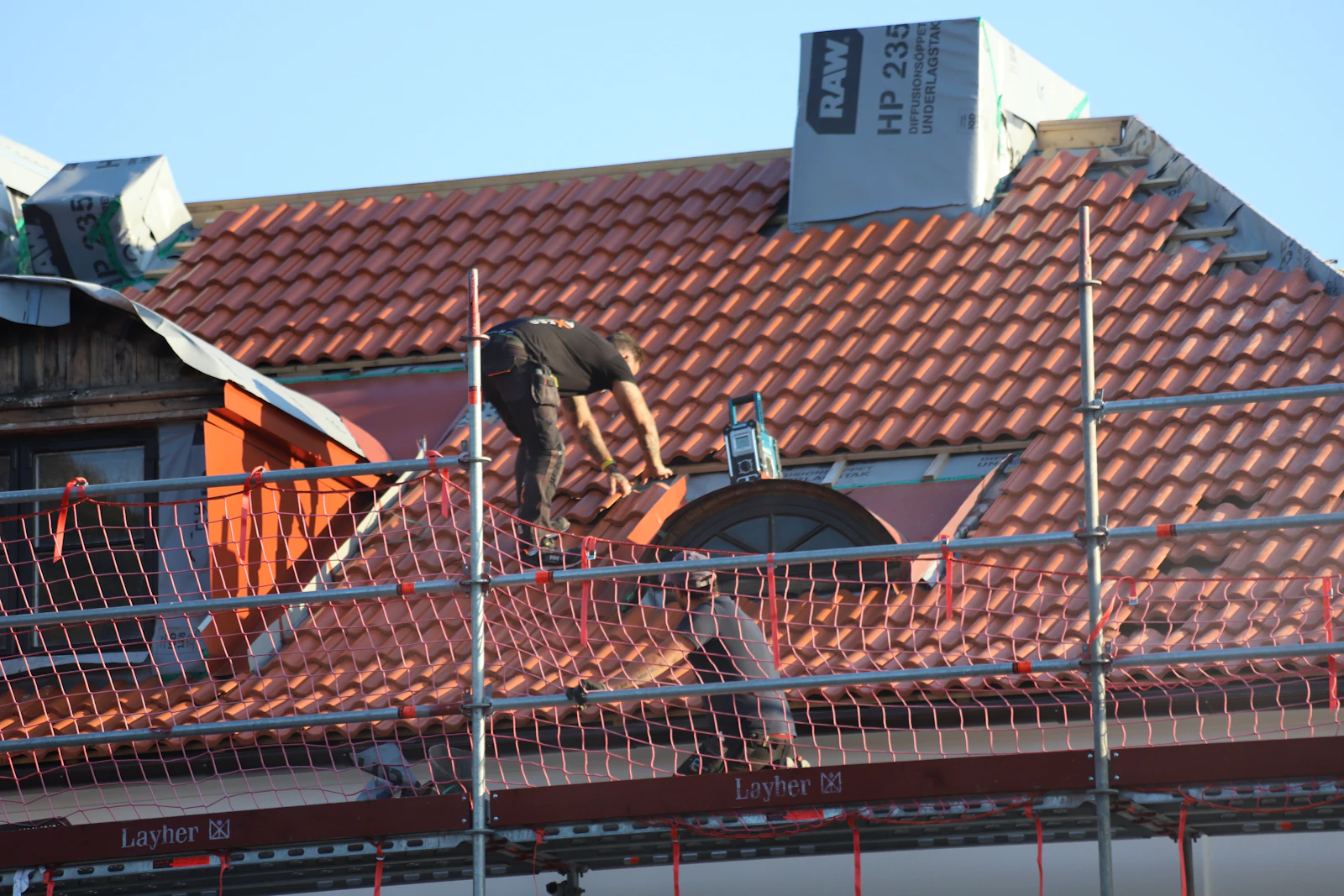
Roof Hoist Rental Rates Fort Worth 2026
For 2026 planning in Fort Worth, budget roof hoist equipment hire (typically a ladder hoist/shingle elevator used to stage tile and underlayment to the roof edge) at $110–$225/day, $450–$900/week, and $1,250–$2,600/28-day month for a standard 26–28 ft class unit appropriate for most two-story tile roofing scopes. Heavier-duty configurations (added track sections out to ~36–44 ft, higher-capacity carriage, or conveyor-style systems used where tile breakage risk is high) commonly plan at $175–$300/day, $700–$1,100/week, and $2,000–$3,200/28-day month. These are out-the-door rate ranges only; your total rental cost will move materially once delivery/pickup, damage waiver, tax, cleaning, late-return, and accessory adders are applied. In the DFW market, rental coordinators often source through national accounts (Sunbelt Rentals and United Rentals) plus local independents who publish rate cards for ladders/scaffold and can usually special-order roofing hoists when availability is tight.
| Vendor |
Daily Rate |
Weekly Rate |
Review Score |
Website |
| Sunbelt Rentals (Fort Worth) |
$110 |
$300 |
8 |
Visit |
| United Rentals (Fort Worth, Branch 06J) |
$120 |
$330 |
9 |
Visit |
| BrandSafway (DFW / Fort Worth service) |
$475 |
$1 350 |
7 |
Visit |
| Taylor's Rental Equipment Co. (Fort Worth) |
$95 |
$275 |
9 |
Visit |
What Drives Roof Hoist Equipment Hire Cost for Tile Roofing in Fort Worth?
Tile roofing changes the economics of roof hoist rental more than most crews expect. You are not only paying for lift height; you are paying for production protection (reducing breakage and manual handling), site logistics (tight drives, street parking constraints, and delivery windows), and duration risk (weather and off-rent rules). In Fort Worth specifically, the cost swing is usually driven by three levers: (1) whether you can run a single 26–28 ft ladder hoist from a driveway set-up or need extended reach due to setbacks/landscaping, (2) whether you need a tile-friendly carriage/platform to reduce edge impacts, and (3) whether the rental must be delivered/picked up on a specific day/time to match tear-off and dry-in sequencing.
Rate Bands by Roof Hoist Type Common on Tile Roofing Crews
Use the bands below to build your 2026 equipment hire estimate, then normalize to your contract’s shift definition (many weekly rates assume a 5-day/8-hour schedule) and your vendor’s “month” definition (often 28 days).
- Standard 26–28 ft ladder hoist (200–250 lb class): plan $110–$225/day, $450–$900/week, $1,250–$2,600/28-day. Published Texas examples for a 28 ft ladder hoist show $100/day, $500/week, $1,200/month (plus taxes/optional charges).
- Short-run/partial-day pricing (when offered): expect a “minimum” or 4–5 hour rate that is 70–90% of the day rate. One published example shows $72.56 per 4 hours on a 28 ft ladder hoist.
- Extended reach (track extensions to ~36–44 ft): plan an adder of $25–$60/day or $100–$240/week for additional sections and the required support bracing, depending on availability and whether extensions are rented as separate line items. (Extensions and telescoping support braces are commonly referenced as optional components on ladder hoist systems.)
- Tile-friendly carriage/platform and spare carriage: plan $15–$45/day per carriage style upgrade and $10–$25/day for a spare carriage if you are running continuous loading (this is a common way to keep the hoist moving while staging tile in batches).
- Conveyor-style roofing material lift (used when access is constrained or breakage risk is high): plan $250–$450/day, $850–$1,500/week, $2,400–$4,000/28-day. This category is often quoted rather than published because the configuration (incline, hopper, throughput) varies by job.
Hidden-Fee Breakdown
Most “roof hoist rental cost Fort Worth” surprises come from predictable contract charges. Build them in up front as allowances so your tile roofing estimate stays stable across schedule shifts.
- Delivery and pickup: plan $125–$225 each way inside a typical metro service radius, then $6–$9 per mile beyond the included radius. If you require a same-day or emergency dispatch, a published public-agency rate sheet shows an emergency delivery add fee of $250 (often paired with a short delivery time window).
- Damage waiver / rental protection: budget 10%–15% of rental charges (equipment only) as a realistic planning range. In public bid documents comparing large rental providers, 14%–15% damage waiver is shown on multiple line items.
- Environmental / admin fees: some contracts add an “environmental” line at about 2% of rental.
- Fuel and refuel charges (gas power units): if the hoist is gasoline-powered, plan refuel at $6.00–$10.95 per gallon plus a handling/service charge (varies by yard).
- Cleaning fees: set a minimum allowance of $50 for “excessively dirty” returns if your tile tear-off creates mud, mortar dust, or adhesive transfer on the ladder rails/carriage. One published rental FAQ explicitly references an additional $50 cleaning fee in that condition.
- Late-return / holdover penalties: if you do not extend in advance, plan a daily holdover penalty (one published example states an additional $35/day fee for equipment holdovers not extended in advance). Also expect late fees to accrue at then-current rental rates once past the due time.
- Deposit / credit card authorization: local rental yards commonly require deposit/waiver/tax on top of the listed rate; one DFW-area rate card states total price equals the rental rate plus applicable tax + damage waiver + deposit.
- Weather standby / rain-out clauses: if you are renting longer-term and negotiating custom terms, note that some published schedules include a $100/day rain-out fee (others show “NC”). Treat this as negotiable but possible.
Fort Worth-Specific Considerations That Commonly Move the Out-the-Door Cost
Fort Worth is usually “easy logistics” compared with dense downtown Dallas cores, but tile roofing sites still create cost triggers you can predict:
- Delivery windows vs. I‑35W congestion: if your site requires a firm delivery slot (e.g., HOA restrictions or school zones), build a $75–$150 scheduling premium for tight windows, and assume a cut-off where same-day delivery requests convert to “next route day.”
- Heat load and crew pacing: in peak summer weeks, tile staging often shifts earlier; if your rental week is defined as 5×8-hour shifts, verify whether “early start” still fits the shift definition or triggers overtime billing on support labor (some vendors bill labor at 1.5× after 8 hours).
- Driveway slope and set-up footprint: steep drives and narrow side yards push you toward longer sections, extra stabilizers, or a different set-up location—frequently adding $25–$60/day in accessories and $125–$300 in additional handling labor if a second trip is required.
Example: 5-Day Tile Roofing Run Using a 28 ft Ladder Hoist (Fort Worth)
Scenario: Two-story residential tile reroof (tear-off + dry-in + tile load), West Fort Worth. The crew wants a roof hoist to move tile bundles and underlayment to the roof edge, minimizing manual carries on a 7/12 pitch. The driveway set-up is viable, but the eave height requires a stable 28 ft class unit with careful staging.
- Base equipment hire: plan $650/week (typical 2026 planning mid-point for a 26–28 ft ladder hoist in DFW). For reference, published rates for a 28 ft ladder hoist show $100/day and $500/week in Texas (market differences and availability will shift DFW up/down).
- Delivery + pickup: $175 each way (allowance) = $350.
- Damage waiver: assume 14% of equipment hire = $91 on $650 (rounded), consistent with commonly published waiver percentages.
- Environmental/admin: assume 2% of equipment hire = $13.
- Accessory allowance: tile-friendly carriage + spare pins/hardware = $120 (allowance).
- Cleaning allowance: $50 if returned excessively dirty (plan it if you expect mud or mortar dust).
- Sales tax (Fort Worth typical): allow 8.25% on taxable lines (verify taxability by vendor/account structure) = ~$105 on $1,274 taxable subtotal (example only).
Estimated out-the-door (example budget): $650 + $350 + $91 + $13 + $120 + $50 + $105 = $1,379 for the week, assuming no extensions/late fees and that the unit is off-rented on time. If the crew slips and you forget to extend, a published rental FAQ warns of an additional $35/day holdover fee for non-extended equipment, on top of normal rental accrual—so a 2-day uncommunicated slip can add $70 quickly.
Operational constraints that matter: (1) confirm off-rent cut-off time for next-day pickup, (2) confirm weekend billing (Friday delivery to Monday pickup may bill extra days), (3) document return condition with photos of rails, carriage wheels, and control components, and (4) set a refuel/clean expectation in writing.
Budget Worksheet
- Roof hoist equipment hire (26–28 ft ladder hoist): $450–$900 per week (enter selected rate: _____)
- Additional track sections + support brace (if required): $100–$240 per week allowance
- Tile-friendly carriage/platform upgrade: $15–$45 per day allowance
- Delivery fee (each way): $125–$225 each way allowance (enter miles beyond radius at $6–$9/mi if applicable)
- Damage waiver: 10%–15% of equipment hire (use 14% default unless negotiated)
- Environmental/admin fee: 2% of equipment hire allowance
- Cleaning allowance: $50 minimum (add $100–$200 if heavy mud/mortar dust is likely)
- Fuel top-off (gas units): $6.00–$10.95/gal + handling allowance
- Emergency delivery contingency: $250 allowance if the schedule is high-risk
- Late/holdover contingency: $35/day + daily rate accrual if not extended (use if your PM expects slip risk)
- Tax: verify local rate and taxable lines (allow 8%–9%)
Rental Order Checklist
- PO and job identifiers: PO number, cost code, job name, and requested on-rent start date/time.
- Delivery details: exact Fort Worth site address, gate codes, delivery contact, acceptable delivery window, and preferred set-down location.
- Equipment spec confirmation: required reach (eave height + set-back), capacity requirement (tile load plan), power type (gas/electric), track extensions, support brace, and carriage type.
- Site constraints: driveway slope, overhead obstructions, street parking rules, and indoor dust-control requirements if staging through a garage.
- Commercial documentation: credit account number (if applicable), insurance/COI requirements, and who authorizes damage waiver.
- Off-rent plan: planned off-rent date/time, pickup cut-off time, weekend/holiday handling, and documentation process (photos at pickup/return).
- Return condition requirements: broom-clean rails, no mortar/adhesive transfer, fuel level expectations, and verification of all pins/sections/accessories returned.
Ownership vs. Equipment Hire: Break-Even for a Roof Hoist in 2026
Many tile roofing contractors consider buying a ladder hoist, but the break-even depends on utilization and the real cost of downtime. A practical way to model it:
- Assume purchase cost: $8,000–$18,000 (varies by capacity, length, motor type, and accessory package).
- Annual maintenance/repair reserve: 8%–12% of purchase price ($640–$2,160/year) for cables, wheels, motors, and controls.
- Rental alternative: if you are paying $650/week average and using the unit 12 weeks/year, direct hire spend is about $7,800/year before delivery/waiver/tax.
- Break-even: in many cases, 1–2 seasons of steady utilization can justify ownership—only if you can store/transport safely and avoid schedule gaps from breakdowns. If you frequently need extended reach, specialty carriages, or last-minute deliveries, rental remains the lower-risk option because you are buying availability and service response.
For Fort Worth tile roofing crews with uneven workloads, a mixed strategy is common: own one “standard” roof hoist package and rent a second unit or extensions during peak production windows.
How to Keep Roof Hoist Hire Costs Predictable on Fort Worth Tile Roofing Schedules
Roof hoist rental cost control is mostly contract discipline. Your estimator can price the base week correctly, but the rental coordinator prevents overages by managing off-rent timing, extensions, and return condition. The two biggest cost leak points on tile roofing are (1) weekend billing when tear-off slips into Monday and (2) accessory creep (extra track sections, braces, and replacement pins) when the original site walk did not capture setbacks and slope constraints.
Off-Rent, Weekend Billing, and Weather Standby Clauses
- Weekly rate assumptions: many agreements define a “week” as 5 days on a single-shift basis; if the hoist sits on rent over a weekend, confirm whether your vendor charges Saturday/Sunday as billable days or allows a weekend cap.
- Rain-out handling: if you are working a storm-prone week and the hoist cannot be operated safely, ask for a written standby plan. Some published schedules show a $100/day rain-out fee; others show no charge. Treat this as negotiable, but do not assume it is free unless written.
- Emergency swaps/deliveries: if a hoist goes down mid-run, same-day swaps can be billed as emergency dispatch (published examples show $250 emergency delivery adders). Use this number as a contingency when your schedule is “no float.”
Accessories and Scope Gaps That Commonly Add Cost on Tile Roofing Hoist Rentals
Tile roofing is less forgiving than asphalt; the accessories you choose can be the difference between smooth staging and steady breakage/back-charges.
- Extra track and support braces: if you extend a 28 ft system up to ~44 ft, plan both the extra sections and the required brace hardware. Track extensions in 4 ft and 8 ft sections are commonly referenced for ladder hoist systems, and support bracing may be required with extensions.
- Dedicated tile carriage: budget $15–$45/day to keep tile from riding directly on an abrasive platform surface (reduces chipping and reduces return cleaning time).
- Spare hardware kit: budget $25–$75 for spare pins/clips/fasteners; missing parts can trigger replacement charges and downtime.
- Site protection and dust control: if you are staging through a garage, plan $35–$90/day for negative air/HEPA and floor protection as a jobsite requirement; it can also reduce the chance of a cleaning back-charge on the hoist components.
Documentation Practices That Prevent Return Back-Charges
- Pre-rental inspection photos: rails, carriage wheels/rollers, control box, power unit, and all track section serials (if labeled).
- Daily condition notes: if tile mortar dust or rain exposure occurs, note it and perform a quick wipe-down to avoid “excessively dirty” classification (some published policies reference a $50 cleaning fee in that case).
- Extension/late-return prevention: set a calendar reminder 24 hours before scheduled return. A published rental FAQ warns about an additional $35/day holdover fee if the equipment is not extended in advance.
- End-of-rent closeout: take timestamped photos at pickup/return and confirm accessory count (extensions, braces, carriages). This is the fastest way to close tickets and release deposit/authorization holds.
Procurement Note for Fort Worth: Use Published Rate Cards to Sanity-Check Quotes
Even when roof hoists are “quote-only” in DFW, published regional rate cards for related access gear are useful to sanity-check day/week/month ratios and add-on structure. For example, a DFW-area ladder/scaffold rate card explicitly states that the total price equals the listed rental rate plus tax, damage waiver, and deposit, and it publishes day/week/month pricing for common ladders (e.g., a 40 ft extension ladder at $55/day, $155/week, $450/month). Use this to pressure-test whether a roof hoist quote’s week-to-day multiple (often ~3× to 5×) and month-to-week multiple (often ~3× to 4×) are in a reasonable band for your account structure.
If you want, I can also provide a Fort Worth-specific “out-the-door” calculator logic (no tables) you can paste into your estimating notes, using your preferred rental duration conventions (calendar days vs. 5-day weeks) and your company’s standard waivers/tax handling.