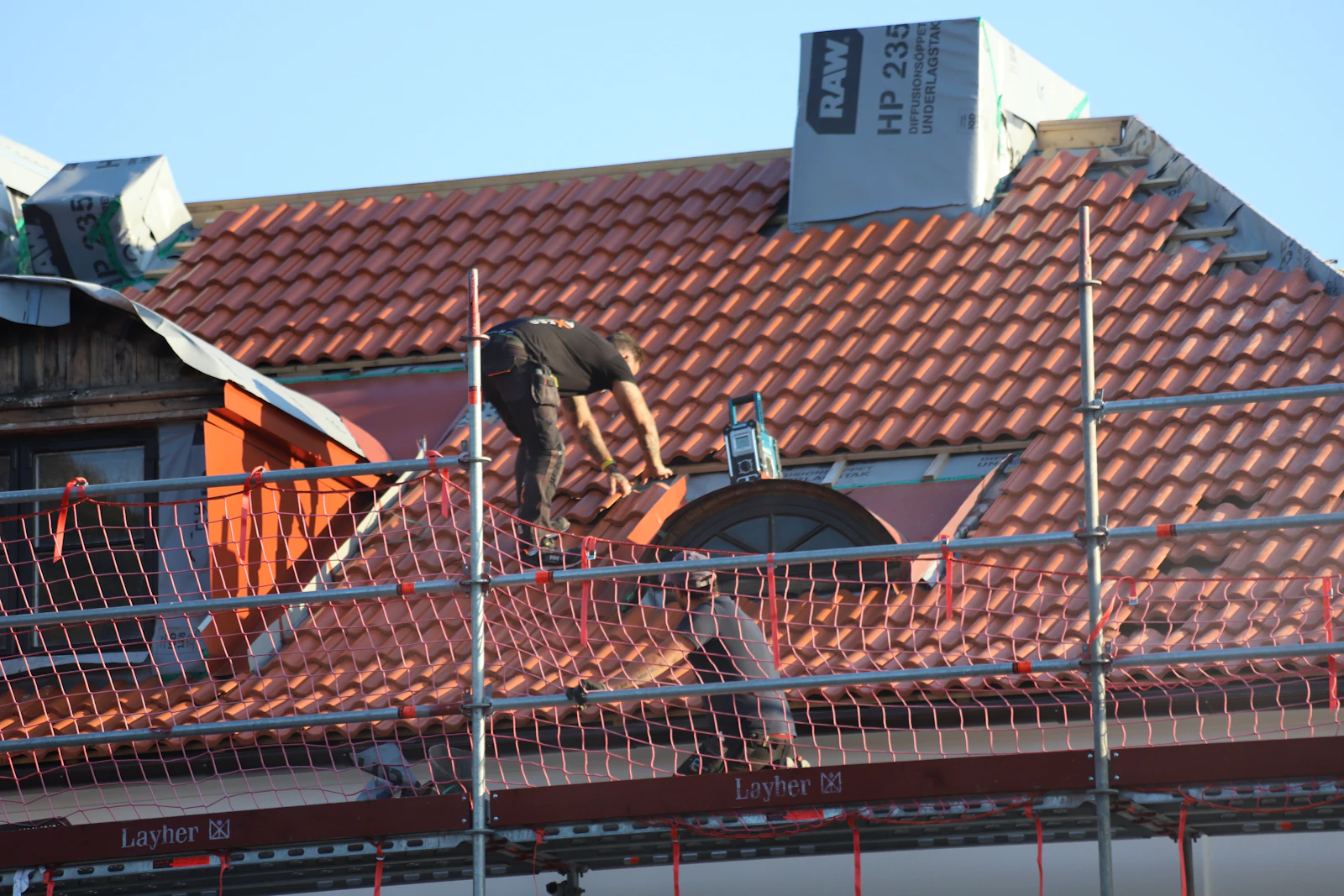
Roof Hoist Rental Rates Jacksonville 2026
For Jacksonville tile roofing work in 2026, plan roof hoist equipment hire budgets around $150–$320/day, $450–$950/week, and $1,500–$2,900 per 28-day month for common ladder-mounted platform shingle hoists/roofing conveyors sized for residential and light commercial rooftops (typically 27–44 ft class). These planning ranges assume single-shift use, normal wear, and either yard pickup or local delivery within the Jacksonville metro. National rental providers (e.g., Sunbelt Rentals, United Rentals) and local Jacksonville-area rental houses can source ladder platform hoists; the key cost swing is lift height/capacity and whether your tile handling requires extra platform/guarding to reduce breakage and re-handling time.
| Vendor |
Daily Rate |
Weekly Rate |
Review Score |
Website |
| Sunbelt Rentals |
$225 |
$1 000 |
9 |
Visit |
| United Rentals |
$210 |
$950 |
9 |
Visit |
| Herc Rentals |
$210 |
$950 |
9 |
Visit |
What Drives Roof Hoist Equipment Hire Costs On Tile Roofing Projects?
“Roof hoist” gets used loosely in roofing procurement. For tile roofing in Jacksonville, you’ll usually be hiring one of these categories (and the hire cost profile changes accordingly):
- Ladder platform shingle hoist / laddervator (27–44 ft class): The most common “roof hoist rental” request. Lift capacities vary—some models are around 200 lb, while larger platforms can reach 400 lb and 44 ft lift height. Higher capacity/height generally pushes you toward the top of the daily/weekly range and may increase delivery needs due to trailer requirements.
- Shingle conveyor / roofing conveyor: Similar application, often priced slightly higher than the smallest ladder hoists because of conveyor assemblies and control components; it can also reduce manual passes when you are staging tile boxes or underlayment rolls.
- Material lift (crank-up) used as a “roof hoist workaround”: Can be effective for moving smaller tile bundles/boxes to a landing, but it’s typically not a substitute for sustained roof loading. Use it for spot lifts, chimney flashing kits, or staging accessories—budget separately if you go this route.
Jacksonville tile roofing cost drivers that routinely change the final equipment hire invoice:
- Eave height and reach: A 1-story tile reroof may work with a ~27–28 ft class hoist; a 2-story with a steep pitch or parapet often pushes you into a 44 ft class. That shift can add $40–$90/day vs. smaller units (planning allowance).
- Tile handling method: Tile is fragile and heavy; if you’re lifting boxed tile or partial pallets, add the cost of a padded platform, side rails, or a plywood/roofing fork carrier. Plan $20–$55/day in accessory adders depending on what’s required.
- Site access (driveway length, gates, beach routes): Jacksonville Beach / Neptune Beach / Atlantic Beach jobs regularly introduce tighter delivery windows and longer carry distances. Expect a higher probability of smaller delivery vehicles or a second trip, which can add $75–$180 in logistics charges (planning allowance).
- Wind and weather downtime: Coastal afternoon sea breezes and storm pop-ups commonly pause hoisting for safety. If your off-rent rules require calling off by a cutoff time, weather can inadvertently add a billed day (more on off-rent below).
Current Published Benchmarks To Sanity-Check Your Jacksonville Roof Hoist Hire Quote
If you’re validating a Jacksonville roof hoist equipment hire quote for 2026, compare it to published benchmarks from rental rate sheets and rental house menus (then adjust for lift height/capacity and local delivery). Examples you can use as reference points:
- A published single-shift rate sheet lists “Ladder Platform Shingle Hoist” at $71/day, $194/week, $550/4-week (historical benchmark; not Jacksonville-specific and not a 2026 price, but useful for ratioing day/week/month and seeing how smaller-class hoists can price out).
- An independent rental house menu shows “Ladder Shingle Hoist” around $150/day, $600/7 days, and $1,800/28 days (a practical mid-market benchmark for a commonly requested ladder hoist class).
- A Southeast rental listing shows a shingle hoist/conveyor at $125/day and $375/week, with a $90 short-term (4-hour) option (helpful when your Jacksonville job only needs brief hoisting for a tile drop sequence).
How to use these benchmarks in 2026 planning: treat them as boundary checks, then add Jacksonville-specific delivery and policy costs (damage waiver, fuel, cleaning, return timing). Do not assume any benchmark equals your final local rate—availability and seasonality can move the quote materially.
Hidden-Fee Breakdown For Roof Hoist Equipment Hire
Roof hoist hire costs are rarely just “day rate × days.” Rental coordinators should budget the following line items explicitly, because these are common drivers of variance between estimate and invoice:
- Damage waiver / rental protection: commonly 10%–15% of the rental line items. One rental provider explicitly references a 14% damage waiver on a shingle hoist listing; treat that as a realistic planning anchor even if your Jacksonville vendor uses a different percentage.
- Delivery and pickup: plan $95–$185 each way for metro Jacksonville addresses, with a typical “minimum charge” assumption of $125 if the rental house uses flat-zone pricing. If mileage-based, carry $3.50–$6.00 per loaded mile beyond an included radius (planning allowance).
- After-hours / weekend logistics: if you need delivery after a cutoff (commonly 3:00–4:00 PM) or on Saturday, plan a $75–$150 surcharge or a 1/2-day equivalent billing uplift (varies by vendor policy).
- Fuel or refuel charge (gas hoists): if returned not topped-off, plan $25 service fee plus $6–$9 per gallon for fuel (planning allowance).
- Cleaning fee: tile roofing tear-off creates gritty debris; if the hoist returns with mortar dust, mud, or adhesive residue, plan $65–$150 cleaning.
- Missing parts / accessory loss: pins, tie-down straps, end stops, or remote pendants get lost easily. Carry a $35–$120 allowance for “small parts replacement” and $150–$450 for a damaged/missing pendant or control component (planning allowance).
- Late return / extra day exposure: many rental term sheets define day/week/month with strict return windows (example rules include Saturday return deadlines like 4:00 PM, and week/month multipliers like 3× day rate for 7 days and 9× day rate for 28 days). If your tile job slips by one day, the billing step can be larger than expected.
Delivery, Setup, And Off-Rent Rules That Affect Total Hire Cost
Jacksonville roof hoist equipment hire often turns into a logistics problem rather than a rate problem—especially on tile roofing where deliveries of tile, underlayment, and accessories must be sequenced to avoid double handling and breakage.
Operational constraints to confirm on the PO before dispatch:
- Delivery window: request a defined window (e.g., 8:00–10:00 AM) and confirm the vendor’s cutoff time for “next-day delivery.” Missed windows can create $0 work time but still produce a billed day if you took possession.
- Off-rent notice: confirm if off-rent must be called in by a specific time (often early afternoon) to stop the next day’s billing; carry a 1 extra day contingency in the estimate when weather is volatile.
- Weekend billing: many rental terms define special weekend/holiday billing. Example published rules show scenarios like 1.5-day charges for certain Friday pickups/Tuesday returns, and “holiday bridge” rules charging 1 day if picked up after 4:00 PM before a closure and returned by 8:30 AM next business day.
- Return condition documentation: require photos of serial plate, controls, cable/track condition, and accessories at pickup and at return. This reduces time spent disputing damage claims.
Jacksonville-specific note: if the project is at the Beaches, add travel-time risk (A1A congestion, limited staging, HOA restrictions). A tight 30-minute unload window can force “drop and go” placement that’s inefficient for a tile roof staging plan—often costing you more in crew time than the rental itself.
Accessories And Add-Ons Commonly Needed For Tile Roofing Roof Hoist Hire
Tile roofing changes what you need to hire with the roof hoist. A basic ladder platform hoist may be fine for shingles, but tile frequently requires additional handling controls to limit breakage and keep loading safe.
- Extra ladder/track sections: plan $25–$60/day per extension section when available as an add-on, or a step-up to the 44 ft class unit if extensions aren’t compatible.
- Tile-friendly platform / side rails / material stop kits: plan $15–$45/day to reduce spillage and breakage (and avoid the hidden labor cost of re-hauling cracked tile boxes).
- Wheel kit / outrigger kit / stabilization components: plan $10–$25/day where required by the manufacturer or by your safety plan for uneven ground.
- Power distribution: if you’re using an electric hoist/conveyor on a remodel, plan $20–$45/day for a jobsite distro/GFCI solution or heavy-gauge cord package (if not already on your general conditions).
- Dust-control accessory hire: if you’re staging indoors (tile cutting area, protected driveway), plan $40–$95/day for a HEPA air scrubber or vacuum package to comply with homeowner/HOA dust expectations (often a Jacksonville Beaches reality on premium tile projects).
Also confirm whether the unit is gas powered (common) and what the refuel expectations are; some rental houses explicitly state fuel responsibility on certain equipment and apply fuel charges if not refueled.
Example: 2-Story Tile Re-Roof With Limited Access In Jacksonville Beach
Scenario: 2-story home near the beach; driveway has limited staging; tile is delivered in boxes that must be staged on the roof in controlled drops to reduce breakage. Eave height and pitch drive a 44 ft class ladder platform hoist selection.
- Hoist hire: plan $275/day for 5 days = $1,375 (or a weekly conversion if your vendor uses a week cap). Include a contingency that weather may extend the hire by 1 day during storm season.
- Damage waiver: assume 14% of rental line items = $192.50 (planning allowance; confirm your vendor’s percentage).
- Delivery + pickup: $165 each way = $330 (beach access + limited unload window).
- Accessory adders: side rails/material stop kit $35/day × 5 = $175; stabilization/outrigger kit $15/day × 5 = $75.
- Cleaning allowance: $95 (tile dust and grit).
Planned equipment hire subtotal (before tax): approximately $2,242.50. The job-cost risk is not the base rate—it’s (1) an extra billed day due to off-rent cutoffs, and (2) broken tile from inadequate platform control driving both material waste and labor re-handling.
Budget Worksheet
Use this as a no-table estimator worksheet for Jacksonville roof hoist equipment hire on tile roofing projects:
- Roof hoist rental (ladder platform hoist / roofing conveyor): ____ days @ $150–$320/day allowance
- Weekly cap check: ____ weeks @ $450–$950/week allowance
- 28-day cap check: ____ months @ $1,500–$2,900/28 days allowance
- Delivery charge: $95–$185 (outbound) + $95–$185 (return)
- Beach/limited access surcharge allowance: $75–$180
- Damage waiver / rental protection: 10%–15% (use 14% as placeholder until quote is issued)
- Fuel/refuel allowance (gas): $25 service + $6–$9/gal (if returned low)
- Cleaning allowance: $65–$150
- Accessory adders (tile platform/rails, outrigger kit): $25–$80/day
- Weather/off-rent contingency: +1 day rental exposure
- Loss/damage small parts allowance: $35–$120
Rental Order Checklist
- PO includes: equipment type (ladder platform hoist vs roofing conveyor), lift height class (e.g., 27–28 ft vs 44 ft), and required lift capacity
- Confirm accessories on the contract: extension sections, side rails/material stops, stabilization/outriggers, remote pendant/control
- Delivery requirements: address, gate code, jobsite contact, delivery window, and unload location (driveway/side yard/back yard)
- Site constraints: overhead power lines noted; staging area defined; HOA or beach parking restrictions acknowledged
- Billing rules confirmed in writing: day/week/28-day definitions, weekend billing, holiday billing, and off-rent cutoff time
- Return requirements: refuel expectations, cleaning expectations, and photo documentation at pickup/return (serial, controls, track/ladder sections, accessories)
- Safety requirements: PPE expectations, operator training confirmation, and barricading plan for the ground loading zone
Safety Cost Note (Do Not Ignore In Tile Roofing Hoist Planning)
Ladder-mounted hoists and conveyors introduce serious overhead line and pinch-point risks. A documented fatal incident involved an aluminum ladder platform hoist contacting an overhead power line—use this as justification to budget time (and sometimes accessory hire) for barricades, spotters, and safe standoff planning rather than trying to “value engineer” safety out of the rental package.
How To Select The Right Roof Hoist For Tile Roofing Without Overpaying On Hire
When you’re hiring roof hoist equipment in Jacksonville for tile roofing, the cost control play is choosing the smallest system that (1) reaches the working height safely, (2) can be stabilized on the actual ground conditions, and (3) supports a tile-friendly loading method that prevents breakage. Over-spec’ing the hoist raises rental and delivery cost; under-spec’ing raises labor cost and often increases tile waste.
Use these decision points to avoid “wrong unit” re-dispatch charges (a common hidden cost):
- Height: if your roof edge is borderline for a 27–28 ft unit, moving to a 44 ft class hoist typically costs more per day, but it may eliminate unsafe angles or the need to reposition multiple times.
- Capacity: a higher-capacity unit (e.g., 400 lb) can reduce cycles if your tile comes in heavier cartons and you’re staging underlayment/plywood as well.
- Setup time: on short jobs, a $90 four-hour rate structure (where available) can beat a full-day charge if you’re only doing a controlled tile drop and then switching to hand placement.
Jacksonville-Specific Factors That Change Roof Hoist Hire Costs
Even when the base day rate is similar to other Florida metros, Jacksonville routinely adds cost through access and weather-related billing exposure:
- Beach communities logistics: Neptune Beach/Atlantic Beach/Jacksonville Beach sites often have limited staging and shorter unload windows. Expect higher delivery complexity and be prepared to pay for re-delivery if the unit can’t be placed on first attempt (carry $150 allowance for “missed delivery / re-dispatch” risk).
- Wind management: afternoon sea breezes can force intermittent hoist stoppage. If you’re paying by the day, that’s acceptable; if you’re rushing to return by a cutoff to avoid another day, wind delays are how you accidentally buy an extra billed day.
- Humidity and corrosion expectations: salt air accelerates corrosion on exposed metal. If the rental house expects “return in same condition,” add diligence (and small labor) for wipe-down/rinse. If you don’t, cleaning can land in the $65–$150 range already carried in the worksheet.
Local Jacksonville rental catalogs show clear day/week/month pricing behavior on related access equipment (ladders, scaffolding), reinforcing that you should always check the week and month cap before committing to multiple day rentals. For example, a local rental listing shows a 32 ft extension ladder priced at $49/day, $113/week, $225.03/month—a reminder that the week/month conversion can materially reduce effective daily cost when your tile roofing schedule stretches.
Billing Rules To Put In Writing (So Your Hire Cost Matches Your Estimate)
In equipment hire administration, rules matter as much as rates. Ask your Jacksonville roof hoist rental provider to confirm the following on the contract or email summary:
- Day definition: is it a strict 24-hour clock, or “one shift” during business days?
- Week definition: some published policies show a “week” billed as 3× the day rate for 7 consecutive days; others bill 5 business days. Get clarity before you assume your “5-day tile job” equals “one week.”
- Month definition: many rental programs use a 28-day month and apply a multiplier (example: 9× day rate for a 28-day month). That can be favorable if your project is phased or weather-delayed.
- Saturday rules: one published policy requires return by 4:00 PM Saturday to receive a day rate rather than rolling into additional charges.
When A Roof Hoist Is Not Enough: Hire Cost Implications Of Upgrading
Tile roofing sometimes outgrows a ladder hoist approach—particularly when tile arrives palletized and the jobsite can’t tolerate repeated box handling. If you’re consistently lifting heavier loads or staging higher volumes, your “roof hoist hire cost” estimate should include a decision gate:
- Roofing conveyor vs. ladder platform hoist: conveyors can reduce manual handling but may cost more to deliver and assemble. If your crew spends an extra 2 labor-hours/day on hand hauling because the hoist is too small, the labor delta can exceed the rental delta quickly.
- Telehandler / forklift alternative (only if access allows): not always viable in tight Jacksonville neighborhoods, but it can place staged loads faster. If you consider this, compare to your roof hoist scenario using a full “delivered + waiver + fuel + cleaning + off-rent risk” model, not just the sticker day rate.
Compliance And Safety Costs To Include In Roof Hoist Equipment Hire Planning
Tile roofing hoisting is high consequence. Budget (and enforce) the process items that prevent incident-related downtime and unplanned rental extensions:
- Ground-zone control: cones/tape/barricades plus a spotter during lifts (often 1 person during active hoisting cycles).
- Overhead power line planning: pre-task walk and defined standoff. Document this in your JHA so you’re not improvising under schedule pressure.
- PPE and training: at minimum, hard hats and gloves at the loading zone; confirm operator training per vendor requirements before dispatch.
These items don’t always show up as rental line items, but they directly affect hire duration and therefore your total equipment hire cost exposure.
Purchase Vs. Hire: A Practical Break-Even For Jacksonville Roofing Managers
If you routinely perform tile roofing in Jacksonville and adjacent coastal communities, you may be tempted to buy a ladder hoist. A simple break-even model can keep the decision grounded:
- If your all-in hire cost averages $2,000 per project (including delivery, waiver, and accessories) and you run 12 similar projects/year, annual hire spend is roughly $24,000.
- If ownership eliminates most delivery charges but adds maintenance, storage, and downtime risk, the “buy” decision can still be justified—but only if you can keep utilization steady and manage corrosion exposure near the coast.
- If utilization is seasonal (hurricane repairs, HOA scheduling), hire often remains the lower-risk option because you avoid carrying costs and idle equipment.
For most Jacksonville tile roofing contractors, the near-term win is improving rental administration (week/month caps, off-rent discipline, accessory completeness) before purchasing equipment.