

Create an itemized estimate for your project, with materials, labor, and quantities you can review and edit.
Create my estimateStart a 7-day free trial. Sign up, then enter your project details.
2026 Tucson planning ranges (USD, equipment-only, before tax/fees): For tile roofing support work (underlayment, battens, bundles, flashing, tools, and limited tile staging), budget $80–$150/day, $300–$550/week, and $900–$1,450/28-day month for a roof hoist (often rented as a “shingle lift” or “ladder hoist”), with the spread driven mainly by lift type (electric vs gas), track height, included ladder sections, and delivery logistics. These are planning ranges for 2026 assuming typical Southwest contractor demand and a 4-week billing month; confirm exact rates and availability with your Tucson branch because roof hoists are frequently a “specialty” item.
| Vendor | Daily Rate | Weekly Rate | Review Score | Website |
|---|---|---|---|---|
| Sunbelt Rentals (Tucson) | $175 | $700 | 9 | Visit |
| United Rentals (Tucson) | $185 | $740 | 9 | Visit |
| Sunstate Equipment (Tucson) | $170 | $680 | 10 | Visit |
| The Home Depot Rental (Tucson #410) | $150 | $600 | 9 | Visit |
Published rate references that anchor the above planning ranges include: a 2025 rental catalog showing a 28’ gas ladder/platform hoist listed at $100/day, $300/week, $900/4-week. A separate published rental guide lists a shingle lift at $61/day, $242/week, $968/month. An online rental listing for a TP250 28’ ladder hoist shows $72.56/4 hours, $100/day, $500/week, $1,200/month. (Rates vary materially by market, fleet age, and whether the hoist is bundled with track/ladder sections.)
For Tucson tile roofing crews, roof hoist equipment hire is usually justified when you need repeatable, controlled lifts to eave height all day (instead of intermittent forklift picks), or when site access limits boom truck placement. In practice, Tucson-area rental coordinators often source these through national rental houses (when stocked locally) or through specialty scaffold/ladder/hoisting suppliers; Sunstate (established in Tucson) and other large branches can support the surrounding logistics even when the hoist itself is specialty. Budget the hoist as a system (power + track + stabilization + carriage + delivery) and assume some back-and-forth on substitutions (electric vs gas drive) if your reservation lead time is short.
On rental POs, “roof hoist” usually appears as one of these categories:
Tile roofing impact: Tile is heavy, brittle, and often handled in smaller “workface” quantities than shingles. That pushes cost decisions toward (a) a hoist with a wider platform/carriage and better load control, (b) more time spent staging to protect tile, and (c) more accessories to stabilize the ladder/track and prevent point loading on eaves. Those accessories are where hire costs usually creep (and where return-condition charges show up).
1) Rental period definition (and how weekends bill). Many rental houses use 4-hour, 1-day, 1-week, and 28-day “month” billing. As a reference point, one listing prices a ladder hoist at $72.56 per 4 hours and $100 per day. For estimating in Tucson, treat these as common outcomes:
2) Track height and extension sections. If your eave height and pitch force you above a standard 28’ setup, costs rise quickly because you’re no longer renting a single “unit”; you’re renting additional track plus the support package. One manufacturer-oriented description notes ladder track extensions offered in 4 ft and 8 ft sections and that a telescoping support brace is required when extensions are used. For 2026 Tucson budgeting, typical adders to plan (non-binding allowances):
3) Power: electric vs gas, and what that does to “hidden” spend. Gas units are less dependent on rooftop power logistics but can trigger additional jobsite controls (fueling plan, hot work constraints, and noise hours). Electric units can shift cost to temporary power:
4) Delivery, pickup, and “loaded mile” charges. Tucson projects range from tight infill lots to longer runs out toward Vail, Oro Valley, Marana, and Green Valley. Even when the hoist is physically small, delivery is often handled as a scheduled dispatch with minimums. A published Sunbelt price sheet shows a common structure of $120 each way + $3.25 per loaded mile on certain categories, illustrating the type of formula you may see on rental invoices. For 2026 Tucson planning (allowance only):
Tucson-specific note: In summer, crews frequently shift to early starts. If your site requires delivery before 7:00 AM or after 4:00 PM, many dispatch desks treat that as an after-hours request—budget an additional $100–$250 or expect next-day delivery.
Roof hoist hire invoices commonly grow due to line items that are operationally “normal” but easy to miss in estimates:
Delivery cutoffs and off-rent rules: If your PM calls off-rent after a typical dispatch cutoff (often around 2:00–3:00 PM), you may get billed through the next business day. Build that into your project schedule, especially during monsoon season when weather can pause roof work late-day.
Return-condition documentation: Require foreman photos at (1) delivery, (2) installed condition, and (3) loaded-for-return condition. In disputes, a 5-minute photo set can protect you from a $200–$600 damage claim that is otherwise hard to contest (bent track, missing braces, cracked carriage rollers).
Recharge/refuel expectations: If you rent an electric unit plus batteries (or a battery accessory), budget a $25–$75 “recharge service” if returned depleted. For gas, budget $6–$9/gal if the branch refuels (plus a service minimum often $25+).
Indoor dust-control requirements (when staging tile in garages or enclosed patios): Some sites require dust containment and may force you to use a vacuum/HEPA setup. If you add a HEPA air scrubber as a compliance measure, a published catalog example lists a negative air/HEPA machine at $40/day, $120/week, $360/4-week. (Only include if your GC/owner mandates it—don’t auto-add.)
Scenario: Two-story tile reroof in the Catalina Foothills. Steep driveway limits boom truck positioning; crew needs controlled lifting of underlayment rolls, battens, tools, and small tile batches to an eave-height staging area. Hoist is delivered Thursday morning, returned Monday morning (weekend on-site).
Planning estimate (illustrative):
Expected all-in (equipment + common fees): approximately $1,175 (range $950–$1,450 depending on weekend billing, power plan, and delivery distance). This is the kind of “real” roof hoist equipment hire number that aligns to tile roofing constraints in Tucson (access limitations + heat-driven scheduling + monsoon downtime contingencies).
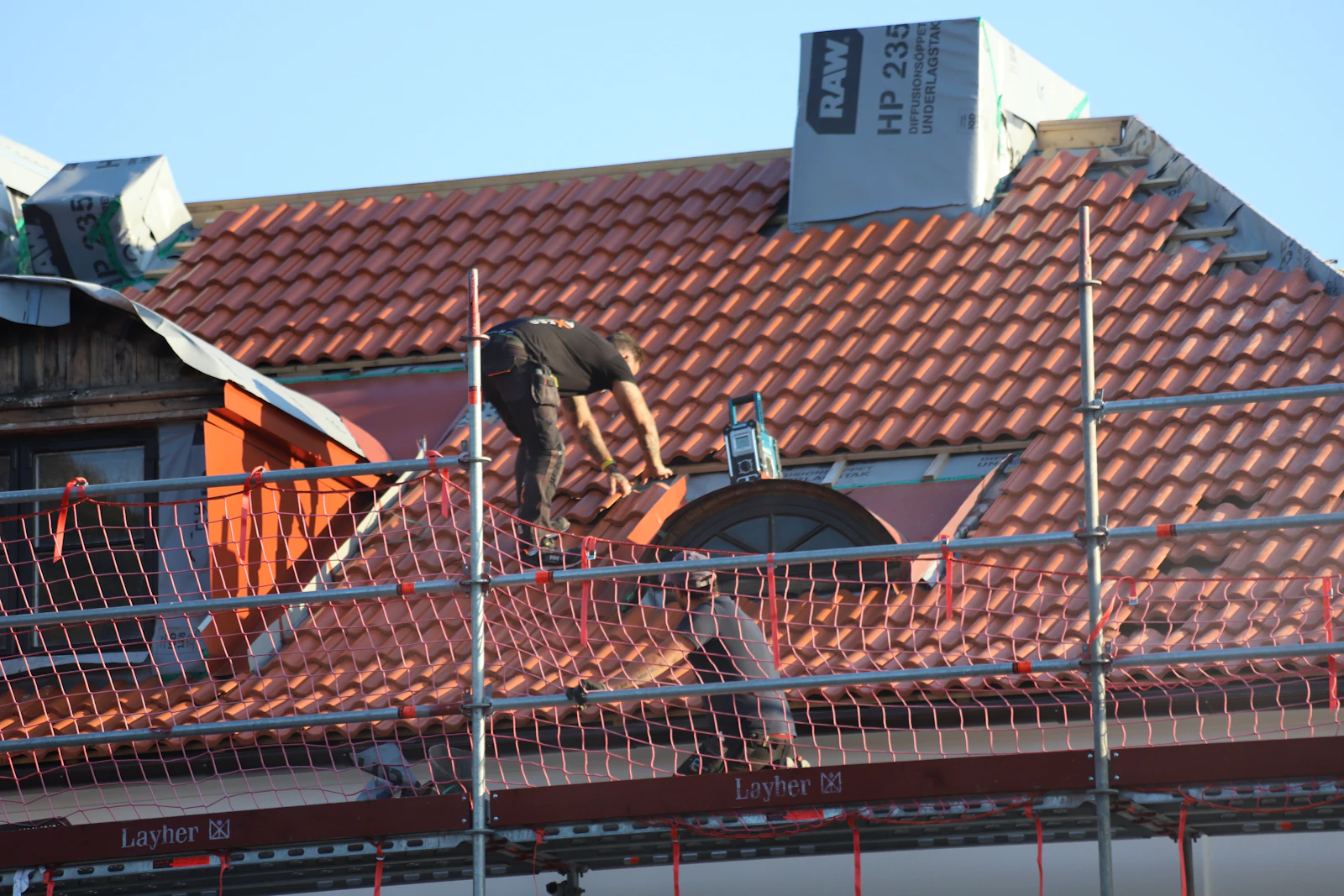
Most cost overruns on roof hoist equipment hire are avoidable if you select the package around roof geometry and material flow instead of just the headline day rate. For tile roofing, the hoist is frequently a “feeder” into a secondary staging method (roof jacks, walk boards, or scaffold), so you should price the system time, not only the lift time.
Right-sizing guidance (cost-focused):
1) Long delivery legs to outlying submarkets. Tucson metro jobs can quickly become “out of base radius” deliveries (e.g., far east, northwest, or south). If you’re coordinating multiple rentals (hoist + generator + scaffold), negotiate consolidated delivery to avoid paying 2–3 separate $150-ish dispatch fees.
2) Heat and schedule compression. When roof work shifts earlier to avoid peak heat, your install and tear-down may occur at the edges of dispatch hours. If the branch can’t pick up same-day, you can get pushed into an extra billed day (+$80–$150). Mitigation: pre-stage the hoist for pickup by 2:00 PM and confirm cutoff in writing.
3) Monsoon downtime risk (and off-rent timing). Short, intense storms can stop hoisting late in the day and prevent de-rigging. If you can’t safely lower/secure and stage for pickup, assume the hoist stays on rent another day. Carry a contingency of +1 day on any July–September schedule where the critical path depends on hoist availability.
Even when the hoist itself is a modest line item, it often triggers accessory equipment hire on tile roofing scopes:
Scenario: A maintenance program replaces broken tiles and underlayment sections across 6 homes over 4 weeks. You need a roof hoist on and off repeatedly, with short mobilizations.
Cost approach: Instead of paying repeated daily + delivery, you may be better off with a 28-day hire if you have secure storage and can keep the unit off the street. Using 2026 planning ranges, budget $900–$1,450 for the month plus a single delivery/pickup cycle ($250–$450), rather than 6–10 individual day rentals that can quietly exceed $1,800 once dispatch and waiver are added.
Bottom line for Tucson tile roofing: treat roof hoist equipment hire as a packaged logistics cost. The day rate might be $80–$150, but the real spend is driven by dispatch, extensions, power, and schedule discipline. If you estimate and manage those correctly, a roof hoist is usually a predictable line item rather than a change-order generator.
