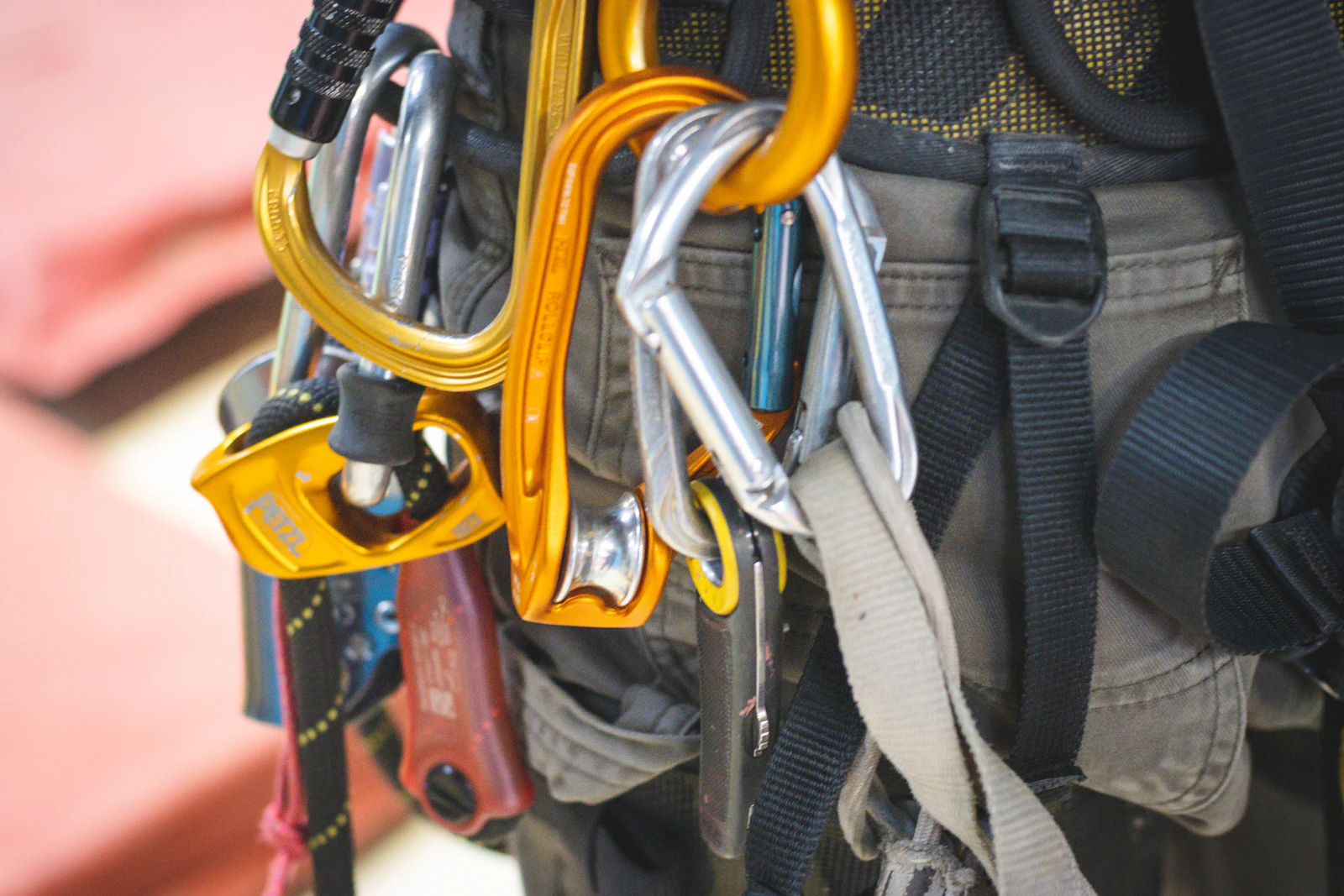
Safety Harness Kit Rental Rates in San Diego (Daily/Weekly) — 2026 Costs
Construction Costs San Diego
Price source: Costs shown are derived from our proprietary U.S. construction cost database (updated continuously from contractor/bid/pricing inputs and normalization rules).
Eva Steinmetzer-Shaw
Head of Marketing
Safety Harness Kit Rental Rates San Diego 2026
For boom lift rental work in San Diego, a safety harness kit is usually hired per operator (per kit) and billed on the same day/week/4-week cycle as the aerial. For 2026 planning, budget $20–$35 per kit per day, $55–$95 per kit per week, and $150–$225 per kit per 4 weeks for a basic full-body harness plus shock-absorbing lanyard kit, with higher totals when you add a self-retracting lifeline (SRL) or specialty anchorage connectors. These ranges align with published benchmark rates from multiple rental catalogs (e.g., $20/day, $60/week, $150/month in Southern California listings; and $25/day, $45/week, $105/month from safety-equipment rental providers). In practice, San Diego accounts often source PPE via United Rentals, Sunbelt Rentals, Herc Rentals, and regional safety-focused rental houses—typically as a boom-lift add-on so delivery, off-rent, and damage waiver rules match the lift contract.
| Vendor |
Daily Rate |
Weekly Rate |
Review Score |
Website |
| United Rentals (San Diego, CA) |
$45 |
$150 |
4 |
Visit |
| Sunbelt Rentals (San Diego, CA) |
$45 |
$150 |
5 |
Visit |
| Herc Rentals (San Diego, CA) |
$51 |
$142 |
9 |
Visit |
| EquipmentShare (San Diego/Chula Vista area) |
$45 |
$150 |
6 |
Visit |
Assumptions behind the 2026 ranges above (confirm on every PO):
- “Safety harness kit” = ANSI/OSHA-compliant full-body harness plus a 6 ft shock-absorbing lanyard (or equivalent). Some vendors price harness and lanyard separately.
- Does not include an SRL, leading-edge SRL, twin-leg Y-lanyard, beam clamp, or engineered anchorage—those are common adders on boom work.
- Rates assume standard wear-and-tear; cuts, chemical exposure, paint overspray, welding spatter burns, or a shock-load event can make gear non-returnable and billable at replacement cost.
What You’re Really Renting With A Boom Lift Safety Harness Kit
From a rental coordinator’s perspective, the “kit” matters less than the application. On a boom lift rental job, your costs shift based on whether operators are working straight vertical access (typical 45–80 ft articulating booms), moving between structure and basket, or working near leading edges where a standard lanyard may be rejected by site EHS. Most branches will provide an inspected harness with visible ID/inspection tag and compatible connectors; however, the kit may be limited to common sizes and general-purpose configurations. If you need a specific class of SRL or a leading-edge rated device, plan separate line items and longer lead times.
Benchmark rental rates you can use to sanity-check quotes (not San Diego-specific, but useful for 2026 budgeting):
- Safety harness (harness-only) published at $25/day, $45/week, $105/month by a safety-equipment rental provider.
- Safety harness published at $20/day, $60/week, $150/month in a Southern California rental listing (prices noted as subject to change and excluding delivery/fees).
- Safety harness & lanyard kit shown on a public pricing schedule at $27/day, $48/week, $146/month (helpful as a market anchor when you’re negotiating national accounts).
- Another rental catalog lists $27/day, $54/week, $81 per 4-weeks for “safety harness with lanyard,” highlighting how aggressively some markets price PPE to support aerial/telehandler rentals.
Cost Drivers That Move Safety Harness Kit Equipment Hire Pricing
Even when the “daily rate” looks small, total equipment hire costs for fall protection can spike when the rental is treated like a standalone delivery, when paperwork is incomplete, or when return condition is disputed. The biggest cost drivers for a San Diego boom lift rental package are below.
- Kit configuration (standard lanyard vs. SRL): SRLs can cost more than the harness itself. Published SRL rental pricing shows common 2026 rate points like $35/day, $75/week, $175/month (20–30 ft class), up to $50/day, $110/week, $250/month (50 ft class), and $95/day, $215/week, $475/month (100 ft class).
- Compliance class and labeling: Many GCs require ANSI Z359 labeling, inspection tags, and documented pre-use inspection. Missing/illegible tags commonly trigger “cannot re-rent” internal charges; for budgeting, carry an allowance of $10–$25 per kit for admin/retag/document processing if returns are messy.
- Quantity and sizing constraints: If your crew has mixed sizing needs, you may be forced into multiple SKUs (and sometimes “upgrade” SKUs). Avoid last-minute size swaps by confirming operator roster by 48–72 hours before delivery.
- Site access and delivery windows: If the harness kits are delivered with the boom lift, marginal cost is often minimal. If delivered as a separate trip, budget a standalone PPE courier/delivery charge of $85–$175 each way in metro San Diego, or an after-hours/site-restricted drop fee of $150–$250 when your delivery window misses the branch cutoff.
- Off-rent cutoff timing: Many contracts apply a same-day off-rent cutoff (commonly around 2:00 PM). Missing it can roll billing into the next day even if the kits are physically returned.
Hidden-Fee Breakdown For Safety Harness Kit Equipment Hire
Use this section to pressure-test a quote and prevent “PPE add-ons” from quietly exceeding the harness kit line rate.
- Delivery / pick-up: If not bundled with your boom lift rental delivery, expect either (a) a flat route charge (often $85–$175 each way for small items) or (b) mileage beyond a service radius (carry $3.50–$6.00 per mile beyond the included zone). If you’re downtown, add time for restricted loading zones and security check-in.
- Minimum billing: Many branches bill PPE on a 1-day minimum even if the lift is a same-day swap. If you pick up at 3:30 PM and return at 8:00 AM next day, you can still pay a full day—plan your pickup/return cadence accordingly.
- Damage waiver / rental protection: Budget 10%–15% of the PPE rental subtotal for damage waiver/RPP-type coverage when it’s mandatory on the account (coverage terms vary; confirm what’s excluded).
- Cleaning / decon: For dust-heavy work (concrete demo, drywall sanding, roofing tear-off), carry $15–$45 per kit for cleaning/sanitization. Marine environments can also require extra wipe-down to reduce corrosion risk on hardware.
- Late return penalties: If your branch uses strict return-time rules, a late return can bill as another day. For example, at least one San Diego-area rental policy states that equipment returned after 8:30 AM on the expected day of return is charged for that day at the standard daily rate—plan dispatch routes accordingly.
- Non-returnable events / replacement: Carry allowance for “write-off” risk: $250–$450 to replace a harness, $90–$180 for a lanyard, and $900–$1,600 for many SRLs depending on class and length (varies by manufacturer and spec). If any component is shock-loaded, it can be removed from service immediately under California rules.
San Diego-Specific Planning Notes For Boom Lift Rental PPE
San Diego is not “harder” than other metros, but a few local realities change total equipment and hire cost for safety harness kits on boom lift rental projects:
- Downtown/Coastal access control: High-rise, healthcare, and life-science sites often enforce scheduled receiving windows and badging. If you miss the window, you risk a redelivery (budget $85–$175 again) or an after-hours fee ($150–$250).
- Salt air and corrosion management: Coastal jobs (e.g., near the waterfront) can accelerate surface corrosion on metal components. Build in extra time for return inspection documentation (photos at pickup and return) to avoid disputes about “rust vs. damage.”
- Heat and UV exposure inland: East County summer conditions can shorten the usable life of webbing if crews store harnesses exposed in baskets or truck beds. Require storage in a bag and document condition at shift end to protect against avoidable replacement billing.
Example: 2 Boom Lifts, 6 Operators, 3 Weeks Downtown San Diego
Example (field scenario with real constraints): A façade punch-list runs 15 working days using (1) 60 ft articulating boom and (1) 80 ft articulating boom. The GC requires one harness kit per operator with documented inspection tags; two operators also need 50 ft SRLs for periodic leading-edge exposure at a setback. Receiving is restricted to 7:00–9:00 AM, and off-rent must be called by 2:00 PM to stop billing.
- 6 harness+lanyard kits at $70–$95/week (planning) for 3 weeks = $1,260–$1,710.
- 2 SRLs (50 ft class) at published pricing of $110/week for 3 weeks = $660 (plus taxes/fees).
- Damage waiver at 10%–15% allowance on PPE subtotal = $192–$356 (using the range above).
- Cleaning/decon allowance: 6 kits × $25 mid-case = $150.
- Delivery: if bundled with the boom lift rental delivery, carry $0–$50 incremental; if separate courier run due to receiving rules, carry $170–$350 round trip.
Coordinator note: The line-rate is not the risk—late return and “non-returnable” determinations are. Require operators to store kits in a bag, keep lanyards out of paint/epoxy, and photograph tags and condition at issue/return.
Budget Worksheet
- Harness + shock lanyard kit hire (qty ___ kits) @ $20–$35/day, $55–$95/week, or $150–$225/4-weeks (choose cycle to match boom lift rental term).
- SRL hire (qty ___) allowance by class: $35–$95/day, $75–$215/week, $175–$475/month depending on length/spec.
- Anchorage connector adders (basket strap/beam strap) allowance: $5–$12/day each (if not provided by site/GC).
- Beam clamp / specialty connector allowance: $18–$35/day each (only when required).
- Tool tether adders (tool lanyards) allowance: $2–$6/day per tether (helps prevent dropped-object incidents and can reduce damaged-gear disputes).
- Standalone delivery/pickup allowance: $85–$175 each way (or mileage $3.50–$6.00/mi beyond radius).
- After-hours / restricted-window delivery allowance: $150–$250.
- Damage waiver/RPP allowance: 10%–15% of PPE rental subtotal.
- Cleaning/decon allowance: $15–$45 per kit.
- Loss/damage contingency (job-specific): harness $250–$450, lanyard $90–$180, SRL $900–$1,600.
Rental Order Checklist
- PO includes: jobsite address, cost code, requested billing cycle (daily/weekly/4-week), and a clear “PPE to follow boom lift rental schedule” note.
- Specify kit configuration: harness size range, lanyard type (single/twin-leg), and whether SRLs are required (include length and leading-edge requirement if applicable).
- Delivery requirements: receiving window, onsite contact, gate codes, staging location, and whether the PPE must be delivered with the boom lift or can be will-call.
- Documentation at issue: photo of inspection tag/serial, condition notes, and acknowledgement of any prior cosmetic wear.
- Return rules: confirm off-rent cutoff (carry 2:00 PM assumption unless branch states otherwise), return time policy (some branches charge the full day if returned after a morning cutoff), and required return condition (clean/dry/bagged).
- Closeout package: return receipt, condition photos, and confirmation that no component was shock-loaded or removed from service due to loading.
When To Rent Vs. Purchase Fall Protection Kits For Aerial Work
For San Diego boom lift rental operations, renting harness kits makes the most sense when (a) you have short-duration peaks, (b) you need a specific configuration for a single project, or (c) you want the rental house to carry inspection/turnover burden. Purchasing can be better when you have steady utilization, stable operator sizing, and a defined internal inspection program. In either case, California rules emphasize that components subjected to in-service loading must be removed from service—so ownership doesn’t eliminate replacement risk; it just changes who pays and how fast you can swap gear back into the field.
Managing Off-Rent, Swap-Outs, And Inspection Holds
Most cost overruns on safety harness kit equipment hire happen at the end of the job, not the beginning. Common scenarios:
- “Off-rent called but not returned” gap: If the branch requires physical return (or scanned pickup) to stop billing, build a dispatch plan that returns kits the same day you off-rent the boom lift—especially ahead of weekends and holidays.
- Weekend billing traps: If kits are delivered Friday and returned Monday morning, some contracts effectively bill 2–3 days depending on cycle rules. Align your start/stop dates so you don’t rent PPE over idle days.
- Inspection holds: If a harness comes back wet, muddy, or heavily dusted, it may be quarantined for cleaning/inspection. That can create a charge and also disrupt availability for your next crew.
Add-On Fall Protection Components And Typical Hire Adders
On boom lift rental scopes, the harness+lanyard kit is often only one line on the PO. To keep estimates realistic, carry these adders where the site plan or JHA indicates they’re needed:
- SRLs (standard): published examples include $35/day, $75/week, $175/month for 20–30 ft units.
- SRLs (long-length): published examples include $50/day, $110/week, $250/month for 50 ft and $95/day, $215/week, $475/month for 100 ft.
- Anchorage connectors: basket straps/beam straps often price like small accessories; carry $5–$12/day each if not included by the aerial vendor.
- Special connectors: beam clamps and specialty hooks can add $18–$35/day per item depending on spec.
- Tool tethers: $2–$6/day per tether is a common allowance when working over public sidewalks or sensitive equipment.
Risk Controls That Reduce Total Hire Cost (Without Cutting Safety)
- Bundle delivery: Put harness kits on the same delivery as the boom lift rental to avoid the $85–$175 standalone PPE run.
- Standardize SKUs: If your program can accept one harness model and one lanyard type for most boom work, you reduce swap fees, re-deliveries, and “wrong gear” downtime.
- Issue-and-return discipline: Treat harness kits like calibrated instruments: sign-out by operator, bagged storage, and end-of-shift visual checks. This is the best way to prevent a $250–$450 harness write-off or a disputed “missing component” charge.
- Photo documentation: Take photos of tags/serials at issue and at return—especially for coastal work where surface corrosion can become a dispute topic.
Boom Lift Rental Coordination Notes (Harness + Lift On One PO)
When you’re building a combined boom lift rental + PPE order, make sure the rental house understands that PPE off-rent must match the aerial off-rent. If the harness kits are left in the job trailer after the lift is off-rented, you can keep paying weekly PPE while the boom is gone. Also confirm return-time rules: at least one San Diego-area policy states that returns after 8:30 AM on the expected day of return are charged for that day. Build the route so PPE returns happen before cutoff, not after.
2026 Market Outlook For Safety PPE Equipment Hire In San Diego
In 2026, most rental coordinators should expect harness kit base rates to remain relatively stable (because PPE is often priced to support lift rentals), while total cost is increasingly driven by: restricted delivery windows, documentation requirements, and configuration upgrades (SRLs and specialty connectors). Use published benchmark pricing as a guardrail—e.g., Southern California listings showing $20/day, $60/week, $150/month and other catalogs showing $25/day, $45/week, $105/month—then add realistic San Diego logistics/return-condition allowances so you don’t under-carry the true cost.
Compliance And Documentation Notes (California)
This is not legal advice, but your estimate and PO language should reflect California expectations that impact cost and returnability. California’s Title 8 fall protection rules include anchorage strength concepts such as 5,000 lb per employee attached unless the system is designed/used under specific criteria, and they note that components subjected to in-service loading must be removed from service. Those requirements are exactly why rental houses may bill replacement if gear is shock-loaded or otherwise compromised—plan the contingency accordingly.