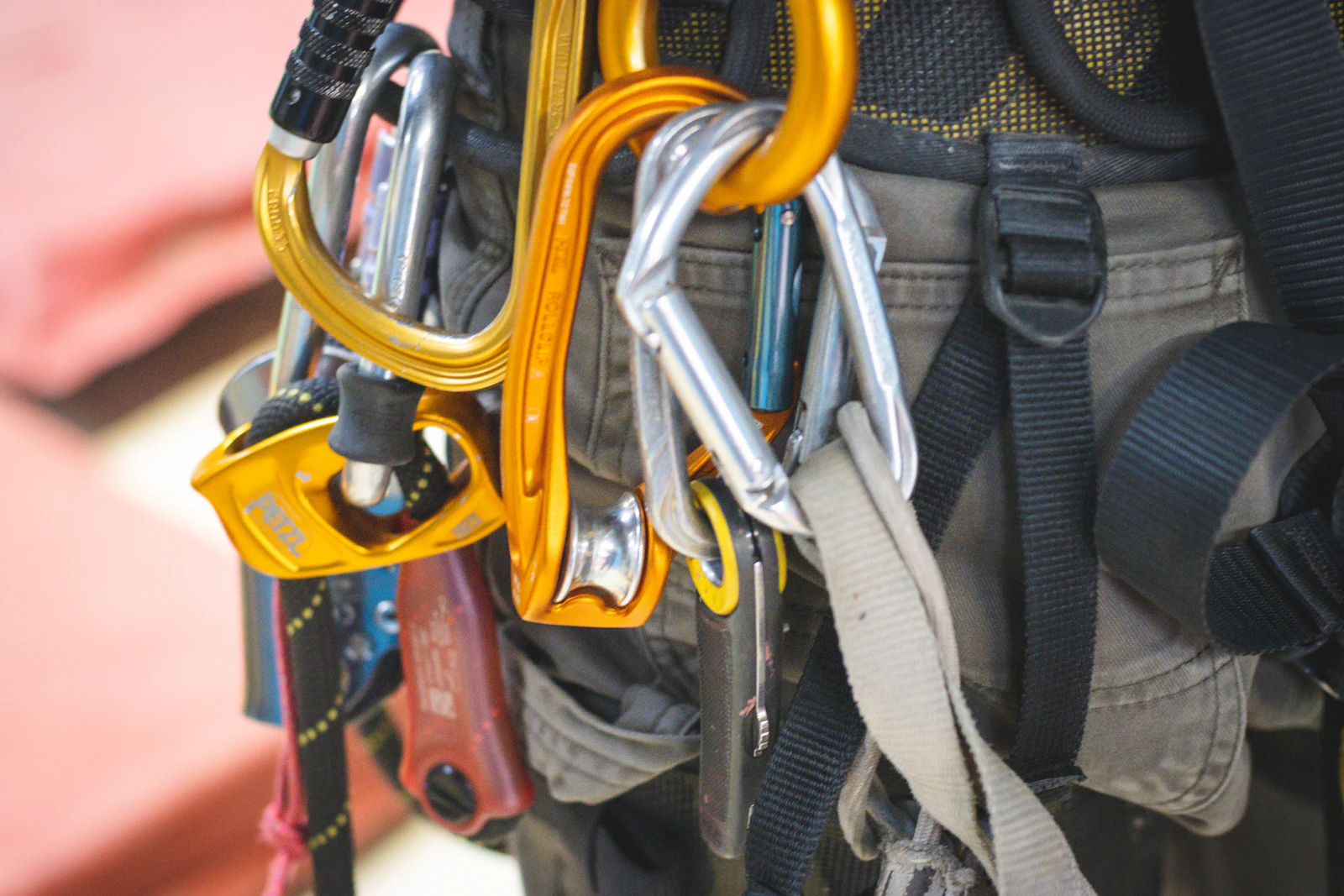
For safety harness kit equipment hire supporting boom lift rental work in Washington (assumed Washington, DC metro: District + close-in MD/VA), 2026 planning ranges typically land at $18–$40 per kit/day, $45–$95 per kit/week, and $140–$240 per kit/4-week month for a standard full-body harness + shock-absorbing lanyard + cross-arm/anchor strap package. Expect higher ranges when the site spec calls for a self-retracting lifeline (SRL) instead of a basic lanyard, or when you need serialized inspection documentation and tight delivery windows for federal or high-security facilities. Most DC-area coordinators source these kits through national rental networks (for example, United Rentals, Sunbelt, and Herc) or local safety suppliers that can bundle PPE with the boom lift delivery to reduce truck trips.
| Vendor |
Daily Rate |
Weekly Rate |
Review Score |
Website |
| United Rentals |
$45 |
$125 |
8 |
Visit |
| Sunbelt Rentals |
$44 |
$120 |
8 |
Visit |
| Herc Rentals |
$50 |
$140 |
8 |
Visit |
| Brandywine Rentals (Brandywine, MD — serves Washington, DC metro) |
$40 |
$110 |
9 |
Visit |
| TrenchTech, Inc. (Beltsville, MD — serves Washington, DC area) |
$42 |
$115 |
8 |
Visit |
Safety Harness Kit Hire Costs Washington 2026
Published rate examples from other U.S. rental yards and public contract schedules show why harness kit hire usually stays “small dollars” compared to the lift itself: you’ll see daily rates around $15/day in some markets and around $20/day in others, with steep weekly/monthly discounts depending on the yard’s policy and utilization. A statewide contract price schedule also shows an example line item for a “safety harness & lanyard kit” at $27 daily, $48 weekly, and $146 monthly (useful as a benchmark, not a DC quote).
What Is Included In A Safety Harness Kit For Boom Lift Rental?
For estimating fall protection kit hire costs, define the kit clearly on the PO. A common “construction kit” configuration includes a full-body harness, a 6 ft shock-absorbing lanyard, and a 6 ft cross-arm strap (anchorage connector). In practice, Washington, DC jobs often require additional items (either as add-ons or as a different kit class):
- Self-retracting lifeline (SRL) in lieu of the 6 ft lanyard (common for tighter tie-off control on certain specs).
- Adjustable restraint lanyard (preferred by some EHS teams in boom platforms to limit ejection rather than arrest a long fall).
- Beam/column anchor or choker strap sized to the structure.
- Extra lanyard leg (100% tie-off) if the method statement requires it.
- Inspection log / serialized asset ID documentation (often demanded for government/federal projects).
Operational note: OSHA guidance for aerial lifts commonly references using a body harness (or restraining belt) with a lanyard attached to the boom/bucket, and OSHA’s aerial lift rules include requirements around wearing a body belt and lanyard. That’s why many boom lift rental coordinators treat harness kit hire as a “must-have line item,” not an optional accessory.
2026 Planning Rate Ranges For Safety Harness Kit Equipment Hire In Washington, DC
Use these ranges as budgetary allowances for Washington, DC–area procurement in 2026. They assume ANSI/OSHA-compliant gear, contractor pickup at branch (no delivery), and normal wear/tear. They exclude sales tax, damage waiver, and any replacement charges for cut webbing, paint contamination, or missing tags.
- Standard harness + 6 ft shock-absorbing lanyard + cross-arm strap (one worker kit): $18–$40/day; $45–$95/week; $140–$240/4-week month. (Benchmarks: $15/day in one published yard example; $27/day on a public schedule.)
- Harness-only (no lanyard/strap): $10–$25/day; $25–$60/week; $80–$160/4-week month. (Benchmark: $19.99/day shown for a harness rental listing.)
- Upgrade to SRL (instead of basic lanyard): add $20–$55/day; add $55–$140/week; add $160–$420/4-week month (varies strongly by SRL length rating and whether the spec requires leading-edge type).
- Extra anchorage connector / beam strap add-on: add $5–$15/day; add $12–$35/week; add $35–$95/month.
- Quantity pricing: for 10+ kits on one account, it’s common to negotiate 10%–25% off the published branch rate (especially when bundled with boom lift rental volume).
DC-specific cost behavior to expect: (1) branch-to-site travel time can make “delivery” disproportionately expensive versus the low daily PPE rate; (2) security check-in at federal properties can trigger waiting-time charges; and (3) many downtown sites have strict receiving windows that push you into dedicated courier runs instead of next-day line-haul consolidation.
What Drives Safety Harness Kit Hire Pricing On Washington, DC Jobsites?
Harness kits are low-ticket items, so administration and compliance drive a surprising share of total cost. The following factors are the usual reasons your “$25/day harness kit” becomes a “$250 line item” on the final invoice:
- Documentation burden: requiring serialized kits with inspection history can add an extra $10–$25 per kit as a handling/inspection allowance (varies by provider and contract terms).
- Project constraints: night work or tight receiving (e.g., 6:00–8:00 AM) can add an after-hours service premium of $75–$175 even when the PPE itself is inexpensive.
- Bundled delivery with the boom lift: often the best outcome—one truck, one trip charge—if the harness kits are released on the same ticket as the boom lift rental.
- Spec class: basic lanyard kits price materially below SRL-based kits; write the spec as “harness + restraint lanyard” vs “PFAS with SRL” so you’re not accidentally paying SRL rates.
- Duration and billing minimums: many branches apply a minimum rental charge (commonly $25–$50) even if you only need the kit for a short task.
Hidden-Fee Breakdown For Safety Harness Kit Equipment Hire
For Washington, DC rental coordinators, these are the most common “small” fees that swing the total cost on fall protection equipment hire for boom lift operations:
- Damage waiver / rental protection plan: commonly 10%–15% of the PPE rental charge (confirm whether it applies to consumables and PPE). One published rental yard explicitly notes rates are “plus tax and damage waiver.”
- Cleaning / decon fee: $15–$45 per kit when returned with concrete dust, roofing tar, paint overspray, or mud—especially if the gear must be quarantined for deep clean before re-rent.
- Missing tag / illegible serial: $25–$60 per item if the kit comes back without required identification (this is common on multi-sub sites unless you control sign-out tightly).
- Lost equipment replacement (typical replacement-value exposure): harness $150–$350; shock-absorbing lanyard $40–$120; SRL $250–$650; anchor strap $25–$85. (Replacement values vary widely by brand and spec class; treat these as risk allowances.)
- Restocking/handling: $10–$35 when the branch is asked to pick, bag, and pre-label multiple kits for a controlled distribution plan.
- Deposits / holds: some providers require $50–$200 per kit on small accounts or one-off rentals (often waived for established credit accounts).
Practical control measure: issue harness kits like tools—sign-out by badge number—and require return photos showing the D-ring area, labels, and lanyard pack before off-rent. That reduces disputes and speeds credit processing.
Off-Rent, Weekend Billing, And Return Cutoffs That Move Your Total Cost
Because a harness kit’s daily rate is low, “extra days” can feel immaterial—until you have 20 kits. Watch these operational rules (they vary by company/contract, but they are common patterns):
- 24-hour clock: “1 day” frequently means 24 hours from time-out, not a calendar day. A 3:30 PM checkout can easily create an extra billable day if you return after 3:30 PM.
- Weekend counting: if your branch bills continuously, a Friday delivery with Monday off-rent can bill 3–4 days (Fri/Sat/Sun or Fri–Mon), even if no one used the kit Saturday/Sunday.
- Off-rent notice cutoff: many branches require same-day off-rent calls before a cutoff time (commonly around 2:00–3:00 PM) to stop billing that day.
- Partial-day minimums: short-term rentals may still trigger a 4-hour minimum or a minimum ticket charge of $25–$50.
- Return condition: if the kit must be re-inspected due to visible contamination, it may stay “on rent” until processed, or you may see a separate inspection/cleaning charge of $10–$45 depending on contract language.
Example: Harness Kit Hire For A 2-Week Boom Lift Rental In Downtown Washington, DC
Scenario: A GC has a 60 ft boom lift on rent for a façade punch list near downtown Washington, DC. The site requires one harness kit per operator, plus two spares for visitors and shift overlap. Work is 10 weekdays over two weeks, but the lift stays on-site through the weekend. Delivery is restricted to 7:00–9:00 AM due to loading dock rules, and the building requires a 30-minute security check-in at receiving.
- Quantity: 6 harness kits (standard lanyard kits).
- Planned hire rate allowance: $65/week per kit (budget midpoint).
- Base rental: 6 kits × 2 weeks × $65/week = $780.
- Damage waiver allowance (12%): 0.12 × $780 = $93.60.
- Dedicated courier add-on (tight DC delivery window): $95–$175 round trip if not bundled with the boom lift truck.
- Waiting time exposure: $90–$140/hour if the driver is held beyond the scheduled appointment (avoid by pre-clearing COIs and delivery contacts).
- Cleaning allowance: 6 kits × $25 = $150 (only if returned dusty/contaminated; avoidable with proper storage bags and a “no paint” rule).
Coordinator takeaway: even though the harness kits are “cheap,” DC receiving constraints can make logistics and compliance costs equal or exceed the base hire—so bundle PPE with boom lift delivery whenever possible and set a strict off-rent/return process.
Need-to-have reminder: national providers explicitly offer fall protection equipment for rent, so your best pricing is often achieved by keeping harness kits on the same account and delivery as your boom lift rental fleet.
Budget Worksheet For Safety Harness Kit Equipment Hire
Use the following as a no-table budgeting structure for Washington, DC safety harness kit equipment hire costs tied to boom lift rental packages. Adjust quantities to headcount and shift overlap.
- Harness kit rental (standard lanyard kit): ___ kits × ___ weeks × $45–$95/week allowance
- SRL upgrade (if required by spec): ___ SRLs × ___ weeks × $55–$140/week adder allowance
- Additional anchorage straps / beam anchors: ___ each × ___ weeks × $12–$35/week
- Damage waiver: 10%–15% of PPE rental subtotal
- Delivery/pickup (if not bundled with the lift): $95–$175 per run (downtown DC windowed delivery allowance)
- After-hours / restricted receiving premium: $75–$175 per occurrence
- Waiting time: $90–$140/hour (security check-in, dock delays)
- Cleaning/decon contingency: $15–$45 per kit
- Missing tag/ID contingency: $25–$60 per item
- Loss/damage contingency (replacement exposure): harness $150–$350; lanyard $40–$120; SRL $250–$650; anchor strap $25–$85
Rental Order Checklist For Fall Protection Kit Hire Supporting Boom Lift Rental
Use this checklist to keep your fall protection equipment hire clean on invoicing and avoid “held on rent” days.
- PO scope: explicitly state “full-body harness + shock-absorbing lanyard + cross-arm strap” (or “SRL kit”) and the intended use (boom lift rental support).
- Compliance requirement: request ANSI/OSHA-compliant gear and ask for serialized IDs on each kit if your EHS program requires traceability.
- Delivery instructions (DC-specific): receiving hours, dock address, security point-of-contact, and whether the driver needs COI pre-clearance.
- Delivery window: define appointment (e.g., 7:00–9:00 AM) and specify who signs the ticket; include a phone number that will be answered.
- Issue control: assign kits to named operators (or badge numbers) to reduce losses and missing tags.
- Off-rent protocol: same-day off-rent call before cutoff (commonly around 2:00–3:00 PM) and document the off-rent reference number.
- Return condition documentation: photos of labels/serials, lanyard pack, and D-rings at return; note any contamination before leaving the site.
- Closeout: reconcile the vendor’s kit IDs against your sign-out log within 48 hours of return to catch billing errors early.
Rent Versus Buy For Harness Kits In 2026 (When Purchase Wins)
Because harness kits are relatively low-cost to purchase compared to many rental categories, some contractors prefer to buy for hygiene control and eliminate repeated cleaning/waiver charges. As a reference point, one retail listing shows a construction fall protection kit (harness + 6 ft shock-absorbing lanyard + 6 ft cross-arm strap) priced around $153.99 per kit (purchase).
- Rule of thumb break-even: if your negotiated rental is around $65/week, purchase often wins after roughly 3 weeks (ignoring admin and replacement risk). If your rate is closer to $45/week, break-even can be closer to 4 weeks.
- When renting still wins: short-duration work (1–10 days), high turnover crews, or when the spec requires SRLs and your company does not want to own multiple SRL classes.
- Hybrid approach: buy standard lanyard kits for steady crews; rent SRLs and specialty anchors only when the lift plan demands them.
Procurement Notes For Multi-Site Contractors In The Washington, DC Metro
- Bundle PPE with the lift: the easiest way to cut total harness kit hire cost is reducing delivery runs—one boom lift truck drop can eliminate a separate $95–$175 courier line item.
- Standardize kit class: decide “standard lanyard kit” vs “SRL kit” and enforce it; mixing spec classes is the fastest way to inflate cost (SRL adders can be $20–$55/day).
- Downtown receiving reality: plan for constrained docks and security. If you routinely lose 30–60 minutes per delivery, a waiting-time line at $90–$140/hour becomes predictable—build it into the estimate or change the delivery plan.
- Indoor work considerations: in DC office retrofits, dust-control requirements (zip walls, negative air) can increase cleaning exposure—keep harness kits bagged and off the floor to avoid $15–$45 per kit decon fees.
Common Pricing Questions For Safety Harness Kit Hire
- Why is weekly pricing sometimes close to (or lower than) two daily charges? Many rental systems push utilization and reduce admin by discounting week/month terms (published examples show steep step-downs).
- Do we have to rent harness kits with a boom lift rental? Not always, but OSHA guidance and many contractor policies require appropriate PPE for aerial lift work; rental providers often remind customers of the requirement expectation.
- What is the most common avoidable cost? Separate delivery/courier runs for small PPE (often $95–$175 in dense urban logistics) and late/off-rent timing that adds extra billable days.
- What single control reduces losses? Kit sign-out plus return photos and serial reconciliation within 48 hours—it prevents “missing tag” fees ($25–$60) and replacement exposure.