Safety Netting Rental Rates San Jose 2026
For San Jose window installation projects in 2026, budgetary safety netting equipment hire typically lands in three common bands depending on how the net is deployed: (1) interior “catch-net” kits (small-span protection under a work zone) often plan at $150–$350/day, $450–$950/week, or $1,200–$2,800/4-week; (2) scaffold debris netting / facade mesh (netting supplied with ties, clips, and edge detailing) commonly plans at $200–$600/day, $600–$1,600/week, or $1,800–$4,800/4-week for a mid-sized elevation segment; and (3) engineered personnel safety nets (larger spans with engineered attachments/rigging) are frequently quoted as a package that, as a planning allowance, can equate to $600–$1,500/day, $1,800–$4,500/week, or $5,000–$12,000/4-week before labor and engineering. These are planning ranges (not guaranteed vendor pricing) and assume hire-only for netting and standard hardware; many South Bay providers route netting through scaffold services (e.g., local scaffold installers that also provide debris netting) or fall-protection specialists that rent netting hardware as a complete system.
| Vendor |
Daily Rate |
Weekly Rate |
Review Score |
Website |
| BrandSafway (San Jose / Santa Clara) |
$250 |
$750 |
8 |
Visit |
| Banton Scaffold, Inc. (Bay Area incl. San Jose) |
$180 |
$540 |
9 |
Visit |
| Pacific Scaffold Co., Inc. (Bay Area) |
$190 |
$570 |
8 |
Visit |
| National Construction Rentals (San Jose) |
$45 |
$135 |
9 |
Visit |
| Sunbelt Rentals (San Jose) — Privacy/Debris Screens |
$55 |
$165 |
8 |
Visit |
What Drives Safety Netting Equipment Hire Cost for Window Installation?
Safety netting hire cost for commercial window installation is less about “a roll of net” and more about coverage geometry, attachment method, and how the rental term is administered. In practice, the equipment hire portion of your quote can swing materially based on the items below (even before you price install/dismantle labor):
- Net type and duty rating: debris containment netting (mesh) versus personnel safety nets (fall arrest) versus specialty netting (e.g., skylight protection). Personnel systems usually drive higher equipment value, higher damage exposure, and tighter inspection requirements.
- Coverage area in real units: vendors may price by “bay,” by panel, by roll (e.g., 12 ft × 150 ft), or by square foot of protected elevation. A 10% overage for lacing/returns and penetrations is common in estimating.
- Hardware density: perimeter cable, clamps, stanchions, brackets, parapet clamps, and edge padding frequently cost more than the mesh itself on short-duration rentals.
- Jobsite access and logistics: downtown San Jose loading constraints (limited laydown, alley access, booked freight elevators) can increase delivery touches and “re-delivery” risk.
- Term structure: a “4-week” billing month is common in construction rentals; stacking daily rates is usually the most expensive way to carry netting if the work drifts.
- Bundled scaffold services: if netting is supplied as part of a scaffold enclosure or pedestrian canopy, the netting line can look low while the scaffold service line carries margin and mobilization.
Common Safety Netting Hire Configurations in San Jose (And How They Price)
For window installation scopes around office parks, labs, healthcare facilities, and mixed-use projects across the South Bay, the following hire configurations are typical. The key estimating move is to separate “netting material hire” from “complete netting system with hardware” and then confirm whether the provider expects to supply—and charge for—consumables (ties, lacing cord, edge tape) as non-returnable items.
1) Scaffold Debris Netting / Facade Containment Mesh
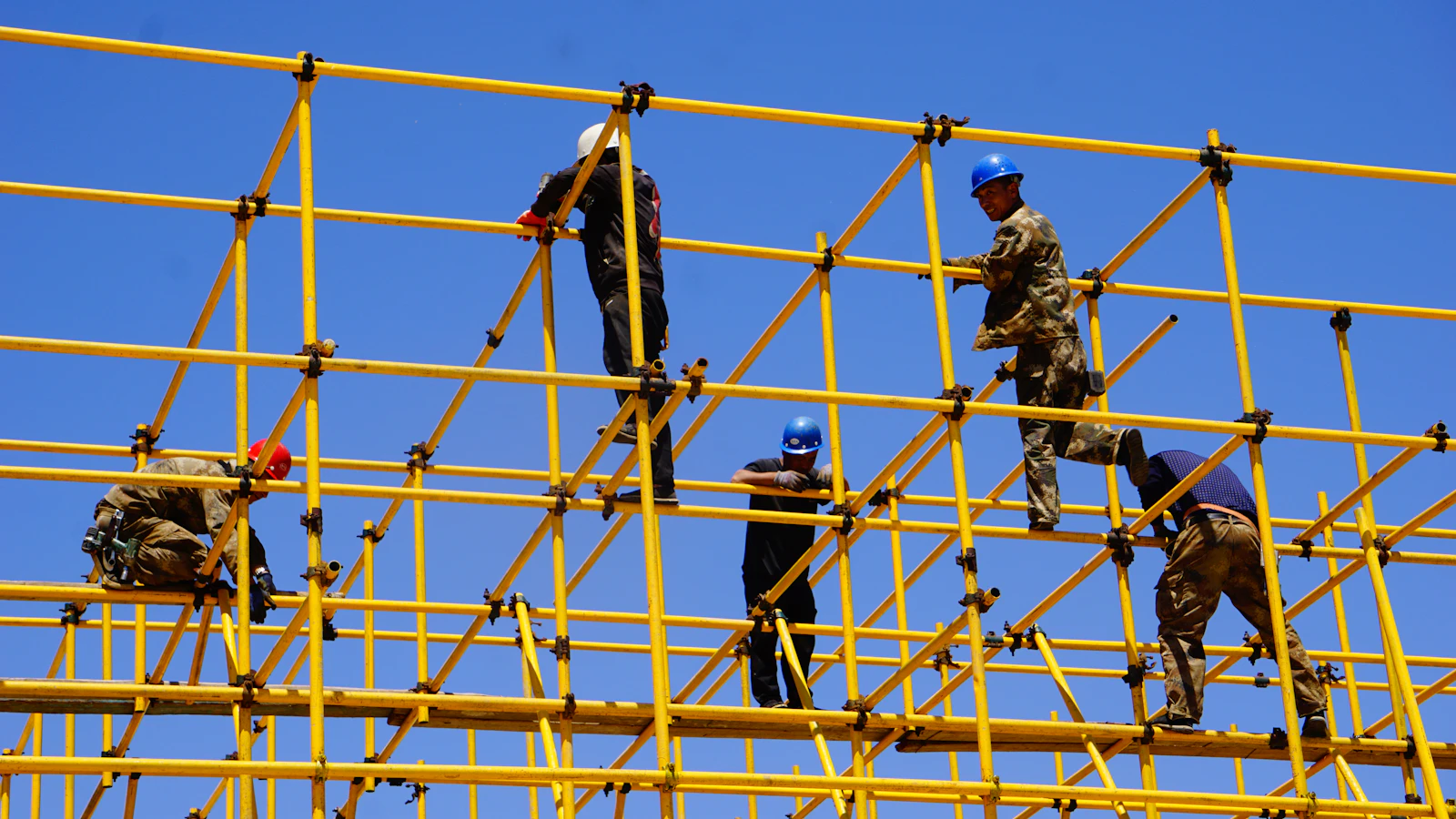
When your window installation requires overhead and perimeter debris control, debris netting is frequently provided through scaffold contractors that already furnish full exterior or interior scaffold and add debris chutes and netting as part of the safety/containment package.
2026 equipment-hire planning allowances (San Jose):
- Debris netting (roll-based rental): if you are renting netting by the roll from an equipment supplier, published examples show monthly rental pricing on a 12 ft × 150 ft debris netting roll around $225.60/month (verify availability and color/spec).
- Edge detailing hardware (allowances): budget $8–$18 per clamp/week and $6–$14 per anchor point/week where the rental company supplies rated hardware (counts vary with perimeter length and return conditions).
- Minimum billing: many scaffold-linked rentals effectively behave like a 1-week minimum even if the work is only 2–3 days, because mobilization and inspection cadence is weekly.
2) Interior Catch-Netting Under an Active Window Opening
Interior netting is commonly requested for occupied renovations (tenant improvements) and healthcare/clean environments when glass handling happens above finished floors. Costs typically rise in San Jose interiors because projects often require dust-control and documentation (photo logs, daily housekeeping sign-offs) that affect return condition and cleaning exposure.
- Kit-style hire (planning): $150–$350/day, $450–$950/week, $1,200–$2,800/4-week depending on span, included poles/frames, and whether edge padding is included.
- Cleaning/return-condition exposure: carry $75–$250 for “netting cleaning” if returned with silicone, sealant smears, drywall dust, or overspray; some suppliers treat this as a shop labor charge rather than a fee schedule item.
- Cut/modified net replacement: carry $3–$7/sf of damaged section (or $150–$450 minimum) if the net is cut to clear mullions, embeds, or MEP drops without pre-approval.
3) Specialty Protection Netting (Skylights, Roof Edges, Atriums)
Even if your primary scope is window installation, roof access and staging can trigger specialty protection. Published rental examples show niche safety systems (e.g., skylight netting system) offered on weekly rental around $30/week in some catalogs, which is useful as a budget check for small-area specialty netting lines (confirm rating and included hardware).
Hidden-Fee Breakdown (Netting Hire Lines That Change the Final Invoice)
To keep your safety netting equipment hire cost from drifting, confirm these commercial terms up front and carry explicit allowances in your estimate and PO notes:
- Delivery and pickup (South Bay): plan $175–$450 each way inside a ~10–20 mile service radius, or $6–$12/mile when the supplier itemizes mileage beyond a base zone.
- Downtown access premium: allow $85–$175 for limited curb time / call-ahead delivery windows (common where loading docks require COI submission and scheduled reservations).
- After-hours / weekend delivery surcharge: allow $150–$300 if the building only grants dock access early mornings, late evenings, or Saturdays.
- Damage waiver: many rental contracts add a waiver calculated as a percentage of rental; carry 10%–18% of the base rental as a planning placeholder unless your master agreement overrides it.
- Security deposit / authorization: carry $300–$2,000 depending on equipment value and whether you have established credit.
- Lost/damaged hardware: carry $25–$60 per missing clamp/tag/connector and $8–$22 per missing carabiner/quick link (small parts are the most common closeout surprise).
- Standby / wait time: allow $95–$165/hr if your crew or GC cannot receive the truck inside the scheduled delivery window (especially on sites with badge access).
- Late return / extra day: many suppliers bill a full extra day if off-rent is requested after a cutoff (commonly 10:00 a.m. or noon). Put the cutoff in the PO notes.
Budget Worksheet (San Jose Safety Netting Equipment Hire Allowance)
Use the bullets below as a practical estimating artifact for a rental coordinator or PM. Adjust quantities to match protected elevation length, number of drops, and window sequencing.
- Safety netting (primary hire line): allowance $600–$1,600/week (facade segment) or $450–$950/week (interior catch-net kit), depending on configuration.
- Specialty netting add-on: allow $30–$150/week for small specialty zones (skylight/opening protection) where required.
- Netting roll rental (if rented by roll): allow $225.60/month per roll (verify spec, quantity, and whether return is required in original packaging).
- Parapet clamps / edge clamps (if needed): allow $20 per 8 ft/week where parapet attachment is part of the solution.
- Delivery and pickup: allow $350–$900 total (2-way), plus $150 contingency for re-delivery.
- Damage waiver: allow 10%–18% of base rental.
- Cleaning/repair closeout: allow $150–$500 for net cleaning, minor repairs, and missing small parts.
- Engineering and documentation (if required): allowance $750–$2,500 for engineered details/shop drawings when spans or attachments are non-standard (often triggered by unusual parapets or atrium edges).
Example: Downtown San Jose Window Replacement With Strict Dock Times
Scenario: 6-story mixed-use building near downtown San Jose. Window replacement runs 18 working days but access constraints create a longer rental carry. Building allows deliveries only 6:00–8:00 a.m., and the GC requires debris containment along one elevation while a pedestrian path remains open.
- Selected approach: scaffold facade containment with debris netting for a 120 ft elevation segment, plus an interior catch-net kit for the lobby glazing line.
- Hire term carried: 6 weeks (window sequencing + inspection cadence), even though active swap work is ~4 weeks.
- Equipment hire (planning):
- Facade debris netting package: $900–$1,400/week × 6 = $5,400–$8,400.
- Interior catch-net kit: $550–$850/week × 6 = $3,300–$5,100.
- Logistics adders (typical):
- Delivery + pickup: $700 (2-way) plus an early-morning access surcharge allowance $150.
- Standby risk: 2 hours at $95–$165/hr = $190–$330 if the dock is blocked.
- Damage waiver: 10%–18% of rental (carry $870–$2,430 on the hire subtotal above).
- Closeout cleaning/repair: $250 allowance (silicone and dust on netting).
Estimator note: This is where San Jose-specific conditions matter. If your delivery window is missed, re-delivery can push you into another billed day/week. Put the receiving contact, window, and off-rent cutoff directly on the PO, and require photo documentation at return (net condition + hardware count) to reduce back-charges.
How Rental Duration, Off-Rent Rules, and Weekends Change Netting Hire Cost
On window installation scopes, the netting itself is rarely what breaks the budget; it’s rental carry. Safety netting often stays installed while glass lead times, punchlist, inspection sign-offs, or access coordination drags. Tighten these commercial points to keep equipment hire predictable:
- Off-rent cutoff: confirm the daily cutoff (commonly 10:00 a.m. or noon) and require same-day pickup scheduling if you want billing to stop. If the vendor can’t pick up for 48 hours, confirm whether billing continues or is capped after off-rent notice.
- Weekend/holiday billing: confirm whether weekends count as rental days for daily-rated items. If a system is priced weekly, assume weekends are included, but delivery/pickup outside business hours often triggers $150–$300 surcharges.
- Minimum term: carry a 1-week minimum unless your master agreement states otherwise. For small netting-only rentals, some suppliers still apply a minimum invoice value (often $150–$300).
- 4-week month logic: many construction rentals compute “monthly” as a 4-week (28-day) period. A 5-week calendar month can quietly add another week if you don’t align start/stop dates to the billing cycle.
Cost-Drivers That Are Easy to Miss on San Jose Jobsites
Local operating conditions in San Jose can add real cost to safety netting hire even when the equipment line rates look fine:
- Traffic and site congestion: South Bay traffic can compress delivery windows. If the vendor dispatch misses your booked dock time, you may see a re-delivery charge (carry $200–$450 as a contingency on tight downtown or campus sites).
- Occupied/clean environments: for labs, healthcare, and active office renovations, assume higher return-condition scrutiny. Carry $75–$250 cleaning and $150–$500 repair contingency if netting collects sealant, dust, or mortar smears.
- Heat/UV exposure in exterior staging: prolonged sun exposure can degrade some meshes and edge tapes; confirm whether the supplier restricts term length or requires a mid-term swap (carry $150–$400 for a potential “swap-out” handling charge on longer carries).
Bundled Fall-Protection Accessories That Affect the Netting Hire Budget
Window installation typically includes additional fall-protection equipment that may be sourced from the same vendor and billed on the same PO. If your GC requires complete fall-protection coverage (not just debris netting), you may see SRLs, harness kits, and anchors rented alongside netting. For example, published 2026 rental pricing for a 20 ft cable SRL shows $76.25/week and $227/month (list pricing), which is useful for budgeting adders when the safety plan shifts midstream.
Practical implication: if your netting package is delayed for 2–3 weeks, the “small” accessories can become a meaningful fraction of the invoice. Carry a line for accessories and enforce off-rent discipline on everything—netting, clamps, SRLs, and specialty kits.
Procurement Tips to Reduce Safety Netting Equipment Hire Cost
- Align rental start to actual install: schedule delivery for the same shift you install. Avoid “staging” netting onsite for 3–5 days before it’s used (those days often bill).
- Choose weekly over daily when the schedule is uncertain: if the window installation has inspection risk, a weekly rate often protects you from weather/coordination slippage better than stacking daily rentals.
- Consolidate deliveries: combine netting, clamps, and any fall-protection accessories on one truck to avoid paying two mobilizations (often $175–$450 each way per dispatch).
- Write the return condition into the PO: require the vendor to provide a hardware count sheet at delivery, then return against that count to minimize “missing parts” back-charges ($25–$60 per item adds up fast).
- Clarify what is consumable: zip ties, lacing cord, edge tape, and small fasteners are often non-returnable and should be treated as supply (not hire). Carry $40–$120 per mobilization for these consumables depending on perimeter length and penetrations.
Rental Order Checklist (What to Put on the PO for Netting Hire)
- PO line clarity: identify net type (debris vs personnel), mesh size/spec, flame resistance requirement (if applicable), and the exact coverage area or roll count.
- Rental term definition: confirm day/week/4-week structure, minimum term, and the off-rent cutoff time (e.g., 10:00 a.m.).
- Delivery requirements: site address, gate/dock instructions, COI requirements, badge access needs, and delivery window (e.g., 6:00–8:00 a.m.).
- Receiving plan: name/number of receiver, staging area, forklift/hoist responsibility, and what happens if the truck waits (standby billed at $95–$165/hr allowance).
- Condition documentation: require delivery photos and return photos; require hardware count sheets at both ends.
- Return condition: nets returned dry, debris-free, and not cut/modified without approval; list cleaning fee exposure ($75–$250) and damage replacement exposure ($3–$7/sf of damaged net area allowance).
- Fees: state whether damage waiver applies (carry 10%–18% if not waived), and whether a deposit is required ($300–$2,000 allowance).
When Buying Netting Beats Hiring (Rule-of-Thumb for 2026 Planning)
If you routinely perform window installation with recurring containment needs, the break-even can arrive quickly—especially for debris mesh that is inexpensive relative to recurring delivery and cleaning fees. As a planning approach:
- If you expect to carry the same netting configuration beyond roughly 4–5 months per year (or across multiple projects), compare annual rental carry (weekly/monthly + delivery + cleaning + missing parts) against purchasing and maintaining your own inventory.
- However, if your work routinely requires engineered attachments, rated personnel nets, or specialized hardware, hiring can still be favorable because vendors maintain inspection/traceability and carry the inventory risk.
For most San Jose contractors, a hybrid model is common: buy consumable debris mesh used for short drops and interior protection, and hire engineered systems and specialty hardware when the exposure and documentation requirements increase.