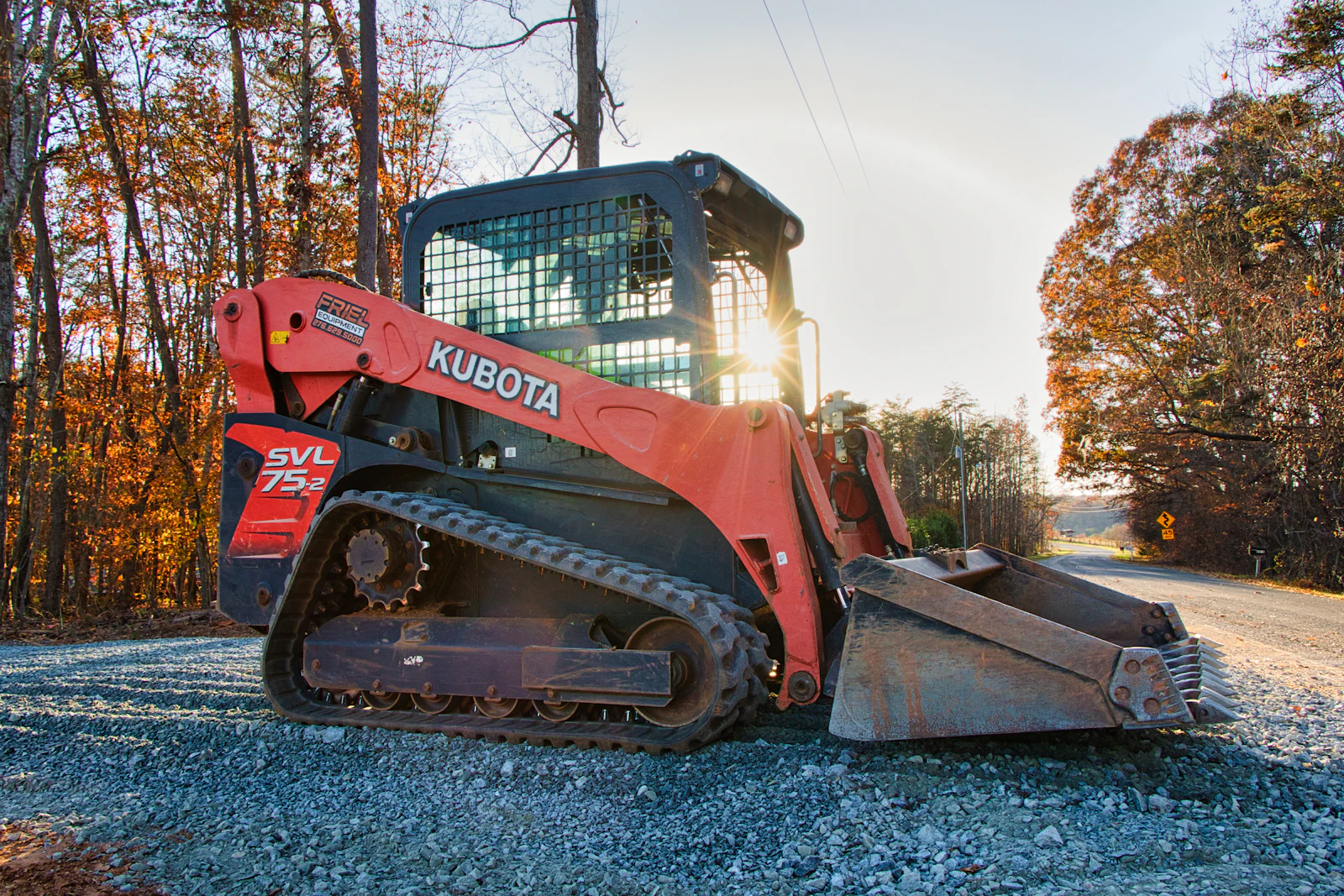
For Albuquerque-area projects planning in 2026, skid steer loader equipment hire typically budgets in three tiers: wheeled skid steers (general material handling) at about $225–$475/day, $850–$1,650/week, and $2,200–$4,200 per 28-day month; compact track loaders (better flotation/traction in caliche and disturbed subgrade) at about $300–$625/day, $1,050–$2,150/week, and $2,800–$5,300 per 28-day month; and high-flow/large-frame units for cold planers, heavy breakers, and high-demand attachments at about $500–$900/day, $1,800–$3,200/week, and $4,800–$8,200 per 28-day month. Those ranges assume one-shift use, standard bucket included, and normal wear; the biggest cost swings come from delivery/pickup, attachments, damage waiver/insurance, overtime hours, and cleaning/refueling. In the Albuquerque market, national chains (for example, United Rentals, Sunbelt Rentals, and Herc Rentals) compete with regional independents and dealer-rental yards, so negotiated long-term skid steer loader rental pricing is common for 4+ week terms.
| Vendor |
Daily Rate |
Weekly Rate |
Review Score |
Website |
| United Rentals |
$410 |
$1 004 |
9 |
Visit |
| Sunbelt Rentals |
$410 |
$1 004 |
8 |
Visit |
| Herc Rentals |
$410 |
$1 004 |
9 |
Visit |
| Sunstate Equipment |
$424 |
$1 004 |
9 |
Visit |
| Century Equipment Company |
$295 |
$835 |
8 |
Visit |
Skid Steer Loader Rental Rates Albuquerque 2026
The ranges above are meant for estimating and procurement planning rather than “sticker” web rates. Many vendors publish day/week/4-week structures online, but the delivered job cost in Albuquerque is usually driven by logistics and compliance details (delivery windows, off-rent rules, refuel expectations, and indoor dust controls). When you need an external benchmarking point, public procurement schedules are useful: one county equipment schedule shows a 25 HP rubber-tire skid steer at $190/day, $540/week, and $1,663/month and a 74 HP compact track loader at $307/day, $794/week, and $2,050/month, with $150 delivery and $150 pickup listed. Treat that as a reference point (not Albuquerque-specific), then adjust for Albuquerque availability, seasonality, and required configuration (cab/heat/AC, solid tires, high-flow hydraulics).
2026 Albuquerque planning assumptions used in this post:
- Billing month: 28 days (4 weeks) is a common rental “month” for equipment hire.
- Shift included: one-shift usage is typically baked into base rates (often up to 8 hours/day and 40 hours/week). Plan overtime if you expect double shifts or extended runtime.
- Configuration: base machine with a general-purpose bucket; attachments priced separately unless explicitly bundled.
- Site conditions: Albuquerque’s high-desert dust and caliche are assumed; indoor operation or silica-sensitive scope will add dust-control and cleaning allowances.
Skid Steer Loader Rental
If you need a clean internal structure for “skid steer loader rental” estimating across multiple job types, break the equipment hire decision into (1) machine class, (2) attachment package, and (3) logistics/fees. Keeping those three buckets separate in your PO notes prevents surprises when the yard substitutes an “equivalent” machine that changes hydraulic flow, coupler type, or track width.
What Drives Skid Steer Loader Hire Costs in Albuquerque?
In Albuquerque, the delta between a low daily rate and the true cost-to-complete is usually explained by operational constraints rather than the base machine rate. The following drivers are where rental coordinators most often see change orders or job-cost leakage on skid steer loader equipment hire.
1) Wheeled vs. Track (And What Albuquerque Soil Does to Your Costs)
Wheeled skid steers can be the most economical choice on paved yards, stabilized pads, and finished exterior work where surface damage is a concern and traction is predictable. However, for trench backfill support, subgrade remix, or wet monsoon-period access, compact track loaders reduce bog-down time and rework. The trade is higher rental and higher cleaning/undercarriage exposure. As a 2026 planning allowance in Albuquerque:
- Upgrade from wheeled to CTL: budget +$75 to +$175/day and +$250 to +$600/week when demand is tight or when you specify enclosed cab and high-flow.
- Track/undercarriage exposure: include a $150–$400 allowance for end-of-rent undercarriage clean-out if the machine is run in sticky clay pockets, caliche fines, or irrigation mud.
2) Machine Size, Cab Spec, And Hydraulics (Standard-Flow vs. High-Flow)
High-flow hydraulics is a cost multiplier because it typically forces a premium machine class and limits substitution options. A published rate card from an equipment yard shows a high-flow CAT 299D3 class skid steer at $650/day, $1,925/week, and $5,750/month (bucket included), illustrating the jump from standard earthmoving units to high-output packages. Use that as a reality check when budgeting for cold planers, rock saws, forestry cutters, and larger breakers.
Common Albuquerque spec adders to plan for:
- Enclosed cab with HVAC: +$25 to +$85/day vs. open ROPS, especially in summer heat and for dust-sensitive indoor scopes.
- Solid/non-marking tires: +$15 to +$40/day (often driven by warehouse/tilt-up slab requirements and puncture risk around demolition debris).
- Telematics/geo-fence requirement: $0 to $9/day (sometimes included; sometimes a charge line).
3) Attachments: Where Most “Skid Steer Loader Rental Pricing” Breaks
Attachment pricing varies dramatically by category (simple forks vs. hydraulic power tools). The cleanest procurement tactic is to quote the skid steer and each attachment as separate lines with separate minimums, because attachment billing often does not mirror the machine’s day/week/month discount curve.
Real-world published attachment numbers (useful as benchmarks) include:
- 48-inch heavy-duty forks: a rate card shows $80/day, $250/week, $650/month.
- Extra bucket (example add-on bucket): shown at $145/day, $440/week, $900/month on the same card.
- Brush cutter/mower: shown at $225/day, $650/week, $1,900/month (budget more if you require forestry package and guarding).
- Hydraulic breaker attachment: published examples range from $250/day to $350/day, with weekly figures such as $775/week or $1,095/week depending on breaker class and carrier requirements.
Practical estimator note: if your scope requires a breaker, cold planer, or trencher, confirm (1) coupler style, (2) required hydraulic flow and pressure, and (3) whether the yard includes the mounting bracket/coupler interface in the attachment rate. Missing brackets can burn a half day of standby and a same-day courier fee ($75–$175 typical) even if the attachment itself is on site.
Hidden-Fee Breakdown for Skid Steer Equipment Hire
Below are the fee categories that most often convert a “$300/day” skid steer loader rental into a materially higher delivered cost in Albuquerque. Add them as explicit allowances to reduce procurement churn.
- Delivery / pick-up charges: plan $150–$350 each way inside Albuquerque metro depending on yard location, jobsite access, and required trailer class. A public schedule example lists $150 delivery and $150 pickup on skid steers/CTLs.
- Minimum transportation: many yards apply a minimum trip even for short moves; budget $150 minimum plus $4–$8/mile beyond a radius (confirm in quote notes).
- Damage waiver (DW) vs. insurance: DW commonly runs 10%–18% of the rental rate line items (machine + attachments). Confirm whether glass, tires/tracks, and theft are excluded.
- Environmental/energy surcharge: budget 2%–6% on taxable rental lines where applied.
- Fuel/refuel: return “full to full” unless negotiated. If billed by the yard, plan $6–$10/gal equivalent for diesel make-up plus a $25–$60 service fee if they treat refueling as a separate labor line.
- Cleaning: for Albuquerque dust, caliche fines, and concrete slurry, plan a cleaning allowance of $75–$250 for normal exterior wash-down; published terms from one equipment yard show an excessive cleaning fee of $75 per hour.
- Late return / off-rent timing: many suppliers require off-rent notice by a morning cutoff (often around 9:00–10:00 a.m.) to stop billing that day; otherwise you may pay an extra day even if the skid steer is idle.
- Overtime hours: base rates are typically one shift; plan $35–$85/hour equivalent overtime (or a second-shift premium) if you expect extended runtime, especially on mass grading or emergency utility work. One published “one-shift” structure describes base entitlement as up to 8 hours/day, 40 hours/week, and 160 hours per 4 weeks.
Operational Constraints That Change the Real Rental Cost in Albuquerque
These are the jobsite rules that repeatedly impact skid steer loader hire costs for Albuquerque commercial, utility, and industrial work:
- Delivery cutoffs: same-day delivery is often only possible if PO and credit are cleared before 11:00 a.m.–1:00 p.m.. After-hours or weekend delivery commonly adds $100–$250.
- Site access and unloading: if the driver cannot safely unload (soft shoulder, no ramp clearance, gate locked), you may get billed a “dry run” fee of $150–$300 plus reschedule delivery.
- Indoor dust control: warehouses and operating facilities may require HEPA vac, floor protection, or wet-cut controls. Budget $40–$120/day for dust-control accessories (mats, silt socks, water feed) and $75–$200 for final cleanup documentation/photos.
- Battery/electric units (if specified): if you choose an electric skid steer for indoor work, plan for charger logistics and possible extra battery pack rental (often $75–$175/day if available).
- Weekend/holiday billing: confirm whether Saturday/Sunday are billable days even if the skid steer is idle on a closed site; if so, a “5-day week” vs “7-day week” assumption can move your effective weekly cost by 15%–40%.
Example: Two-Week Albuquerque Skid Steer Loader Rental With Forks And Breaker
Scenario: utility contractor in Albuquerque needs a CTL for a 10-working-day window (two calendar weeks), includes pallet fork handling and one week of concrete demo with a breaker. Site is fenced, delivery must occur between 7:00–9:00 a.m. due to traffic control, and off-rent requires a pickup call before 10:00 a.m. to avoid an extra day.
- Base CTL (mid-size): budget $1,250/week × 2 = $2,500 (planning range; negotiate if 4-week+ is possible).
- Forks: benchmarked at $250/week (published card example) for 2 weeks = $500.
- Breaker attachment: budget $775/week for 1 week = $775 (benchmark).
- Delivery + pickup: plan $225 each way = $450 (Albuquerque metro allowance; confirm gate code and unloading space to avoid dry-run fees).
- Damage waiver: assume 14% on applicable rental lines: 14% of ($2,500 + $500 + $775) ≈ $529.
- Cleaning/refuel allowance: $175 (high-desert dust plus breaker work typically pushes cleanup beyond “rinse and go”).
Planned hire cost subtotal (example): $2,500 + $500 + $775 + $450 + $529 + $175 = $4,929, before tax/surcharges. If pickup misses the cutoff and bills one extra day at, say, $400/day, the overrun is immediately material—so the off-rent process and return condition photos are just as important as negotiating base skid steer loader rental pricing.
Key takeaway for Albuquerque estimators: the attachment week and logistics lines can equal 30%–55% of the machine line on short-term rentals. Treat “skid steer loader hire cost” as a package price, not a single daily rate.
How To Quote Skid Steer Loader Equipment Hire Like A Rental Coordinator
For professional buyers, the goal is not to find the lowest published day rate; it is to lock the correct machine/attachment configuration, control liability exposure, and prevent time loss from substitutions. Use the checklist below to standardize quote requests for skid steer loader rental Albuquerque scopes.
Budget Worksheet (No Tables)
- Skid steer loader base hire (wheeled or CTL): allowance $225–$625/day depending on class and cab spec.
- Monthly conversion check: compare 10 working days vs. a 28-day month; if your site will hold the unit over weekends, monthly can beat two weeks + extra days.
- Attachments (separate line items):
- Forks: allowance $35–$90/day or $175–$400/week (benchmark example shows $80/day and $250/week).
- Breaker: allowance $250–$450/day or $615–$1,095/week depending on class and carrier.
- Sweeper/broom: allowance $200–$300/day when specified for clean-site requirements (confirm water kit if dust control is required).
- Delivery/pickup: allowance $150–$350 each way; add $100–$250 for after-hours windows.
- Fuel/DEF: allowance $75–$250 for short rentals; more if you expect high idle time during spotter-controlled work.
- Damage waiver / insurance: allowance 10%–18% of rental lines; confirm exclusions for tires, tracks, glass, and theft.
- Cleaning: allowance $75–$250 normal; escalation can be hourly (example published term shows $75/hour for excessive cleaning).
- Wear items risk allowance: $0–$300 depending on debris and demolition scope; align with your insurance/DW position.
- Standby / missed delivery window: allowance $150–$300 for a dry-run or re-delivery scenario on gated sites.
Rental Order Checklist
- PO content: list machine class (wheeled vs. CTL), rated operating capacity class, cab requirement, and whether high-flow hydraulics is mandatory.
- Shift and hour limits: state expected runtime and whether you need a second shift. Many programs define base “standard rental shift” around 8 hours/day, 40 hours/week, 160 hours per 4 weeks; confirm your supplier’s overtime rules.
- Attachments: list each attachment with coupler style and any required bracket/interface; confirm hoses/couplers are supplied.
- Delivery requirements: provide gate code, contact name, unloading area, and preferred delivery window; note if driver must call ahead 30–60 minutes.
- Site compliance: specify indoor requirements (non-marking tires, spill kit, dust suppression), and whether backup alarm restrictions apply.
- Off-rent process: include who is authorized to off-rent and the cutoff time to stop billing (many suppliers require morning notice).
- Return condition documentation: require “as-received” and “as-returned” photos: hour meter, all sides, couplers, forks tips, and any glass/door condition.
- Refuel/clean expectations: confirm whether unit must be returned full of fuel and broom-clean; clarify that concrete slurry, paint, and adhesive residue can trigger higher cleaning labor.
Albuquerque-Specific Cost Notes (What Changes Here)
Local operating conditions in Albuquerque affect hire costs in ways that don’t show up on generic national rate guides:
- Dust and silica control: high-desert fines can push cleaning time up, and some sites require active dust suppression. If your scope involves cutting, grinding, or brooming, budget $40–$120/day for dust-control accessories and $75–$250 for end-of-rent cleanup.
- Heat and cooling derates: summer temperatures and sustained high-flow attachment use can increase downtime risk; consider a contingency of 0.5 day in the schedule or negotiate a swap clause for same-day replacement.
- Geography of the metro: projects in Rio Rancho, Bernalillo, Los Lunas, or Tijeras often move you outside the “standard” delivery radius; plan $4–$8/mile beyond the included zone.
When Monthly Skid Steer Loader Hire Beats Weekly (And When It Does Not)
For Albuquerque jobs, monthly (28-day) equipment hire is usually the value point when you expect any of these:
- Site holds the machine across 2 weekends (idle days still billable on many rental agreements unless explicitly “5-day billing”).
- Multiple intermittent tasks (spot backfill, pallet moves, cleanup) where mobilizing a skid steer for short bursts would otherwise trigger repeated $150–$350 delivery/pickup cycles.
- Attachment rotation (forks full term, breaker for 3–5 days). You can often keep the carrier monthly and cycle attachments weekly to reduce total hire cost.
Monthly may not win if your project has strict off-rent discipline and you can truly return the unit within 5–7 calendar days (including pickup scheduling) without paying idle weekend days.
Contract Terms That Commonly Impact Equipment Hire Cost
Even when you are not using a national master agreement, many suppliers align to similar commercial constructs for standard shift limits and continued billing if equipment is not returned. Review these items before release:
- Standard shift definition: confirm what base day/week/4-week rates entitle you to in hours (often one shift).
- Continued billing after end date: ensure your internal demob plan includes pickup scheduling lead time and written off-rent confirmation.
- Fuel surcharge mechanism: transportation surcharges may be adjusted periodically; ask whether a fuel/transport surcharge applies on top of delivery.
Procurement Tips To Lower Skid Steer Loader Rental Costs Without Cutting Scope
- Bundle correctly: negotiate the carrier (skid steer/CTL) on a 4-week rate, then quote attachments separately so you can off-rent high-cost hydraulics (breaker/cold planer) the moment scope ends.
- Specify “equivalent allowed” carefully: allow equivalent ROC and hydraulic flow only; do not allow “equivalent” that changes coupler type or overall width if you have gate constraints.
- Reduce transport events: avoid job-to-job transfers that trigger extra mobilizations; if you must move mid-rent, pre-quote an intersite relocation at $150–$350 (or mileage) to control cost.
- Control cleaning exposure: require operators to avoid track packing, concrete washout zones, and wet slurry areas; a single “excessive cleaning” event at $75/hour can erase the savings of a negotiated rate.
Bottom line for 2026 Albuquerque estimating: treat skid steer loader equipment hire as a delivered, insured, compliant package. Base day/week/month rates matter, but delivery windows, attachment class, one-shift hour limits, and return-condition discipline are what usually decide the final cost.