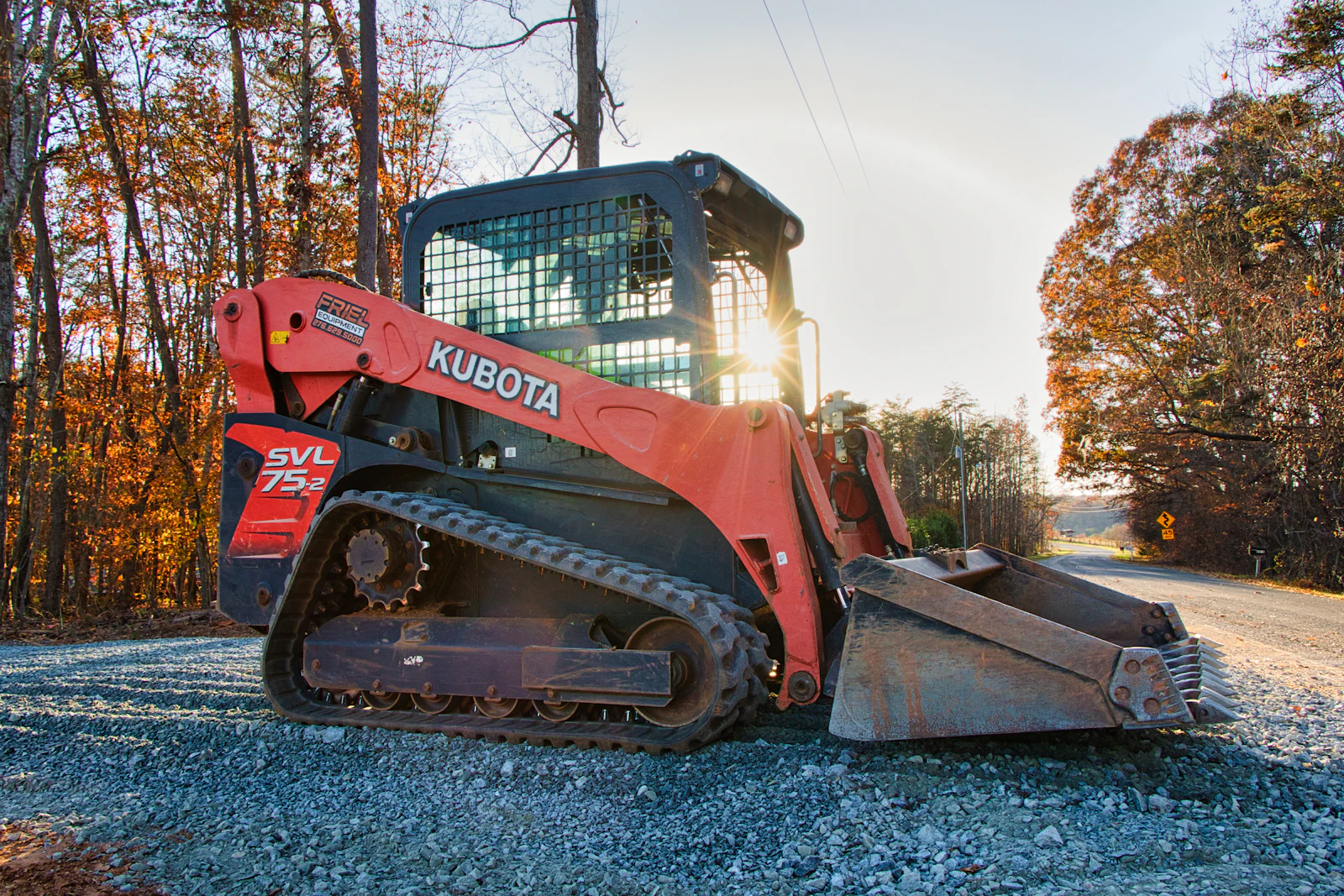
Skid Steer Loader Rental Rates Atlanta 2026
For Atlanta concrete driveway work in 2026, budget skid steer loader equipment hire using planning ranges (machine only, standard bucket, 8-hour shift) of $240–$420/day, $850–$1,350/week, and $2,100–$3,600/28-day month for common 1,500–2,200 lb ROC wheeled units. Track loaders and high-flow packages typically price higher at $320–$520/day, $1,150–$1,750/week, and $2,900–$4,800/28-day month, driven by demand, attachment requirements, and whether you need an enclosed cab. Large nationals (e.g., United Rentals, Sunbelt Rentals, Herc Rentals) and Atlanta-area independents can all be competitive, but actual quotes will swing based on delivery radius, off-rent rules, and availability around peak paving/utility seasons. United Rentals notes that online quotes show daily/weekly/monthly rates and that “monthly” is commonly a 28-day rate structure.
| Vendor |
Daily Rate |
Weekly Rate |
Review Score |
Website |
| United Rentals |
$317 |
$895 |
8 |
Visit |
| Sunbelt Rentals |
$225 |
$660 |
9 |
Visit |
| Herc Rentals |
$320 |
$741 |
9 |
Visit |
| Yancey Rents (The Cat Rental Store) |
$395 |
$1 160 |
10 |
Visit |
| Bobcat of Atlanta |
$390 |
$1 210 |
9 |
Visit |
Assumptions for these 2026 equipment hire cost ranges: 1 shift/day (8 hours), normal wear, operator provided by the customer, diesel fueled, no specialty attachments included, and standard wear items (tires/tracks) within normal use. If your driveway scope requires high-flow hydraulics (planer, broom, cold planer, heavy-duty breaker), or if access is tight inside I-285 with limited staging, expect to push toward the upper end of the range.
What Drives Skid Steer Loader Hire Cost for an Atlanta Concrete Driveway?
Concrete driveway work tends to be “short-duration, high-consequence” rental: you may only need the skid steer for 2–6 days, but schedule slips trigger extra billing days and remobilization costs. The biggest pricing drivers are (1) machine class (ROC/HP), (2) undercarriage choice (wheeled vs. tracked), (3) hydraulics (standard vs. high-flow), (4) attachment package, and (5) logistics (delivery windows, redelivery, and off-rent timing). In Atlanta, a common hidden driver is rain-to-mud exposure: Georgia red clay will cake on tires/tracks and buckets, and rental houses routinely charge cleaning when machines come back muddy or with concrete residue.
Machine class premium (planning adders): moving from a light 1,500–2,000 lb ROC wheeled skid steer into a higher-capacity or high-flow cab unit often adds $40–$120/day and $150–$450/week. A state contract rate sheet (Sunbelt, FY2026) shows an example 1,500–2,000 lb skid steer at $225/day, $660/week, $1,490/month and a high-flow cab unit at $280/day, $735/week, $1,510/month (these are not Atlanta-specific, but they’re useful as a 2026 benchmark for rate structure).
Wheeled vs. Tracked: Cost and Surface-Risk Tradeoffs
For concrete driveway prep, wheeled machines are often adequate on compacted subgrade and aggregate base, and they can be gentler on finished asphalt approaches when properly managed. Tracked machines (CTLs) usually rent higher but can prevent “spinning and rutting” when Atlanta thunderstorms soften the subgrade, which can reduce rework cost and schedule risk. From an equipment hire cost perspective, the CTL premium is usually justified when you have (a) wet clay, (b) slopes (common in north metro), or (c) tight tolerances where regrading twice costs more than the rental premium.
Surface protection allowance (recommended for driveway work): if you must cross an existing decorative concrete walk or paver border, add ground protection measures. Many contractors budget $150–$350 for plywood/mats and edge protection materials (even if mats are owned, the handling labor is real). This is not a rental line item in most quotes, but it materially changes your total “skid steer loader hire cost for concrete driveway” number.
Attachment Package Adders You Should Price Upfront
Most driveway scopes need more than the standard bucket. If you don’t pre-negotiate attachments, you’ll either (1) lose time swapping at the branch, or (2) accept last-minute adders at whatever is available. Using a 2026 rate-sheet example, pallet forks are shown at $40/day, $90/week, $185/month.
Common driveway-related attachment adders (2026 Atlanta planning ranges; confirm on quote):
- Pallet forks (forms, rebar bundles, sealer, bagged mix): $35–$75/day (benchmark example $40/day).
- Tooth bucket or rock bucket (demo/excavation in gravelly subgrade): $25–$65/day.
- 6–12 in. auger bits (posts/forms/stakes): small bits can be inexpensive on paper, but still require the drive head; a rate-sheet example shows a 6 in. auger bit at $11/day, $29/week, $73/month (bit only).
- Hydraulic breaker (if you’re breaking slab on-site instead of saw-cut + haul): $220–$450/day plus chisel wear; confirm if your skid steer needs high-flow.
- Harley rake / power box rake (fine grading base): $180–$380/day (often high-flow or higher hydraulic demand).
- Angle broom / pickup broom (cleanup before forming/pour): $150–$320/day; may require dust-control measures.
Attachment logistics cost: If you need 2 attachments concurrently (e.g., bucket + forks), some rental coordinators intentionally rent a second quick-attach plate or schedule a mid-week swap. Plan a swap charge or extra haul of $150–$350 if the branch won’t “drop” attachments with the machine on the first trip.
Delivery, Pickup, and Atlanta Access Constraints That Move the Number
Delivery is where Atlanta equipment hire budgets often blow up: traffic, narrow residential streets, and limited staging can turn a simple drop into driver wait time and redelivery charges. As a 2026 benchmark example, a rate sheet shows a skid steer delivery/mobilization charge of $290 (listed as “1st mile”) and $4 per additional mile.
Atlanta-specific considerations to include in your hire estimate:
- Inside I-285 delivery windows: many branches push for earlier delivery cutoffs (commonly before 2:00–3:00 PM) to avoid failed drops. A missed window can trigger a second trip and an additional $150–$350.
- Driveway jobsite access: if the lowboy/rollback cannot stage and must wait, carriers commonly bill wait time at $95–$150/hour after a short free period (often 15–30 minutes).
- HOA / neighborhood work-hour limits: if you can’t receive equipment early, you may lose a full paid day; negotiate “meter starts on delivery time” when possible.
Shift Limits, Meter Hours, and Overtime Charges
Most national rental terms treat the base rate as a one-shift entitlement. Herc’s published guidance is explicit: daily/weekly/4-week rates include a maximum of 8 hours/day, 40 hours/week, 160 hours/4 weeks, and excess use can be billed at 1/8 of the daily charge, 1/40 of the weekly charge, or 1/160 of the 4-week charge (plus taxes).
Estimator note for driveway pours: concrete work often compresses activity into long days (forming, base correction, cleanup). If your crew plans a 10–12 hour day, either (a) schedule a second machine for peak hours, or (b) explicitly price overtime hours so you don’t get surprised on invoice review.
Damage Waiver / Rental Protection: What It Costs and Why It Matters
On a residential concrete driveway project, exposure risk is real (fences, garage doors, utilities, and theft risk overnight). United Rentals’ Rental Protection Plan (RPP) states the RPP fee can be 15% of rental charges (plus applicable taxes) and references reduced exposure with caps such as the lesser of 10% of replacement value, 10% of repair cost, or $500 for certain losses (subject to terms/conditions). Sunbelt’s RPP terms similarly describe limiting collections for loss/damage to amounts such as 10% of FMV or repair charges up to $500 per piece of equipment (subject to conditions/exclusions).
Budget impact: If your bare rental is $1,200 for a week, a 15% protection plan is a $180 line item before taxes. Some firms decline RPP and use their own inland marine coverage—either way, you should treat “damage waiver vs. COI” as a decision that changes the true equipment hire cost, not an afterthought.
Hidden-Fee Breakdown
When you’re comparing skid steer loader equipment hire quotes in Atlanta, ask for an “all-in” recap that separates rental, attachments, and charges that often appear later:
- Delivery / pickup: typical metro drops often land in the $150–$350 range each way, but can be higher for same-day, restricted access, or special handling; some schedules apply a minimum haul (commonly $200).
- Mileage beyond base radius: planning range $3–$8/mile; benchmark examples include $4/mile on published rate sheets.
- Environmental / admin fees: frequently 2%–8% of rental (confirm if capped).
- Fuel / diesel surcharge: if returned not full, budget $6–$9/gal plus a service fee (commonly $35–$75).
- Cleaning: Atlanta clay and wet subgrade can trigger $75–$250 cleaning; concrete splatter removal can be higher if it requires chipping/pressure washing.
- Wear items: tires, tracks, buckets, fork tines—abnormal wear is billable; clarify what “normal wear” means in writing.
- Weekend / holiday billing rules: Friday delivery with Monday pickup is often billed as 2–3 days unless you negotiate “non-working weekend” terms.
- Off-rent timing: many branches require off-rent notice by a daily cutoff (often midday) to stop billing next day; missed notice can add 1 extra day.
Budget Worksheet (Atlanta Concrete Driveway Skid Steer Hire)
Use this as a practical allowance list for a rental coordinator building a PO (no tables—copy/paste into your estimating notes):
- Skid steer loader hire (wheeled, 1,500–2,200 lb ROC): $240–$420/day × ____ days (or $850–$1,350/week × ____ weeks)
- Attachment allowance: $60–$220/day (forks/bucket upgrades/broom as needed)
- Delivery + pickup: $300–$700 total (or higher if restricted access/after-hours)
- Additional mileage allowance: $0–$120 (e.g., 15 miles × $4–$8/mile beyond base)
- Damage waiver / RPP: 10%–15% of rental charges (confirm vendor policy)
- Fuel: $60–$180 (10–20 gallons @ $6–$9/gal) plus $0–$75 service fee if not topped off
- Cleaning risk allowance: $0–$250 (red clay, rain days, concrete splatter exposure)
- Traffic/control & protection materials: $50–$200 (cones, caution tape, driveway edge protection)
- Downtime / weather float: 1 extra day at your day rate (Atlanta storms and subgrade rework)
Rental Order Checklist (What to Put on the PO)
- PO and billing: job name, cost code, tax-exempt status (if applicable), “do not exceed” (DNE) amount, and approval contacts
- Jobsite: exact address, gated access instructions, delivery contact + phone, and preferred delivery window
- Machine spec: ROC range, wheeled vs. tracked, cab/open station, high-flow requirement, and quick-attach type
- Attachments: list each attachment by name and required width/capacity (e.g., 72 in. bucket, pallet forks, broom)
- Operating limits: confirm included shift hours (8-hour/40-hour/160-hour structure) and overtime billing method
- Delivery fees: confirm delivery + pickup charges, mileage, and redelivery policy
- Off-rent process: cutoff time for stopping billing, who can call off-rent, and required written confirmation
- Return condition: fuel level expectations, cleaning expectations (no concrete residue), and photo documentation required at pickup
- Insurance: COI requirements vs. RPP election and fee percentage (if elected)
Example: Atlanta Concrete Driveway Skid Steer Hire Cost (With Real Constraints)
Scenario: Replace a residential concrete driveway in Atlanta measuring 42 ft × 12 ft (about 504 sq ft). You’re removing 5 in. of slab and correcting base with 4 in. of graded aggregate base. You need a skid steer for demo support (loading broken concrete into a dump trailer), grading, and final cleanup before forming/pour.
Planned rental approach: 1-week hire to avoid weekend billing surprises, with forks + bucket upgrade. You schedule delivery Tuesday AM and pickup the following Tuesday AM to align to your crew calendar and avoid a Friday/Monday weekend trap.
- Skid steer loader (wheeled) weekly hire: $950 (within the $850–$1,350/week planning range)
- Pallet forks weekly: $90 (benchmark example)
- Bucket upgrade / tooth bar: $120 (allowance)
- Delivery + pickup: $520 total (assume $260 each way; confirm radius and traffic constraints)
- Wait time risk: allowance $0–$150 (1 hour at $150/hour if access isn’t ready)
- RPP / damage waiver: $160 allowance (assume ~15% of $1,070 rental/attachments)
- Fuel: $108 (18 gallons × $6/gal; if not returned full, add $35–$75 service fee)
- Cleaning risk: $150 (Atlanta clay + concrete dust; mitigate by pressure washing before pickup)
- Admin/environmental fees: $40 allowance (varies by vendor)
Estimated equipment hire spend (planning total): about $2,290 before taxes, assuming no redelivery and no overtime hours. Your main controllables are (1) preventing an extra billed day (off-rent timing), (2) avoiding a second delivery attempt, and (3) returning clean and fueled.
How Concrete Driveway Scope Changes Skid Steer Rental Duration
Skid steer duration is rarely dictated by how fast the machine can move material; it’s dictated by sequencing and dependencies. Driveway concrete work often has “dead time” between base correction and pour day. If you rent too early, you pay idle days. If you rent too late, you risk crew downtime and paying overtime shifts to catch up.
Productivity-driven planning tips:
- Demo day: if slab is already cut and broken, a skid steer can load out efficiently; if not, you may need a breaker (high-flow) or saw crew first—avoid paying for a machine that can’t start work.
- Base day: if aggregate is delivered by tandem and dumped, you can spread quickly; if access forces multiple small dumps, you’ll burn more machine hours and possibly exceed included shift hours.
- Forming day: the skid steer may only be needed for short lifts and housekeeping—consider a 2–3 day rental plus a swap (but budget swap delivery).
Ways to Reduce Atlanta Skid Steer Equipment Hire Cost Without Cutting Output
- Negotiate week vs. day rate strategically: if you’re near 4–5 paid days, weekly pricing is often cheaper than stacking daily rates, especially when weekend billing rules are unfavorable.
- Lock attachments on the same PO: add forks/broom/tooth bar at the time of order; mid-rental changes can trigger a second delivery and another $150–$350.
- Control meter hours: schedule the machine to work “front-loaded” (demo + base) and avoid long idle periods that still count toward calendar days.
- Pre-stage access: reserve a curbside spot or driveway apron so the driver can drop quickly; preventing 1 hour of wait time can save $95–$150.
- Return condition discipline: set a shutdown SOP—scrape bucket edges, remove concrete splatter before it cures, and pressure wash clay the evening before pickup to avoid $75–$250 cleaning charges.
Billing Mechanics to Confirm Before You Sign (Avoid Invoice Disputes)
Invoice issues are usually preventable if you confirm the mechanics up front and document them on the PO or in the order notes:
- Rate basis: confirm whether “monthly” is a 28-day rate (common in large-rental quoting workflows).
- Shift hours included: confirm included hours and overtime formula (example: 8/40/160 and fractional billing for excess).
- Off-rent rule: ask for the cutoff time (e.g., call off-rent by 12:00 PM to stop next-day billing) and require written confirmation (email/text) from the branch.
- Weekend/holiday policy: confirm whether Saturday/Sunday accrue charges if the machine remains on site but is not operated.
- Damage waiver vs. insurance: if you elect RPP, confirm the fee percentage and key caps/limits (United Rentals publishes a 15% fee in its RPP addendum; terms apply).
Atlanta-Localized Risk Notes (Why Your Costs May Run High)
- Rain + red clay: expect more cleaning and more time to achieve compaction/grade; carry at least 1 float day in the rental plan during stormy weeks.
- Heat and idle time: summer heat increases idle time (cool-down, operator breaks). If you’re close to included hours, this can push you into overtime billing.
- Traffic-driven delivery volatility: plan deliveries earlier in the day to avoid failed drops; a second trip can cost another $150–$350 plus schedule slip.
Documenting Return Condition (Protecting Your Equipment Hire Budget)
For driveway projects, “return condition” disputes (fuel, cleaning, damage) are common because the machine operates near structures and finished surfaces. Use a simple documentation routine:
- Delivery photos: 8–12 photos, including tires/tracks, bucket cutting edge, forks tines, and hour meter.
- Daily end-of-shift photos: focus on new scrapes, tire cuts, hydraulic leaks, and any fence/structure contact points.
- Pickup photos: fuel gauge, cleaned machine, attachment serial numbers, and any pre-existing damage you flagged.
- Sign-off: get driver pickup acknowledgment if available; if unattended pickup, email your photo set within 1 hour of pickup.
For rental coordinators and estimators, the key takeaway is that skid steer loader equipment hire cost on an Atlanta concrete driveway is not just the day rate—it’s the full package of delivery logistics, attachment strategy, shift-hour exposure, and return-condition discipline.