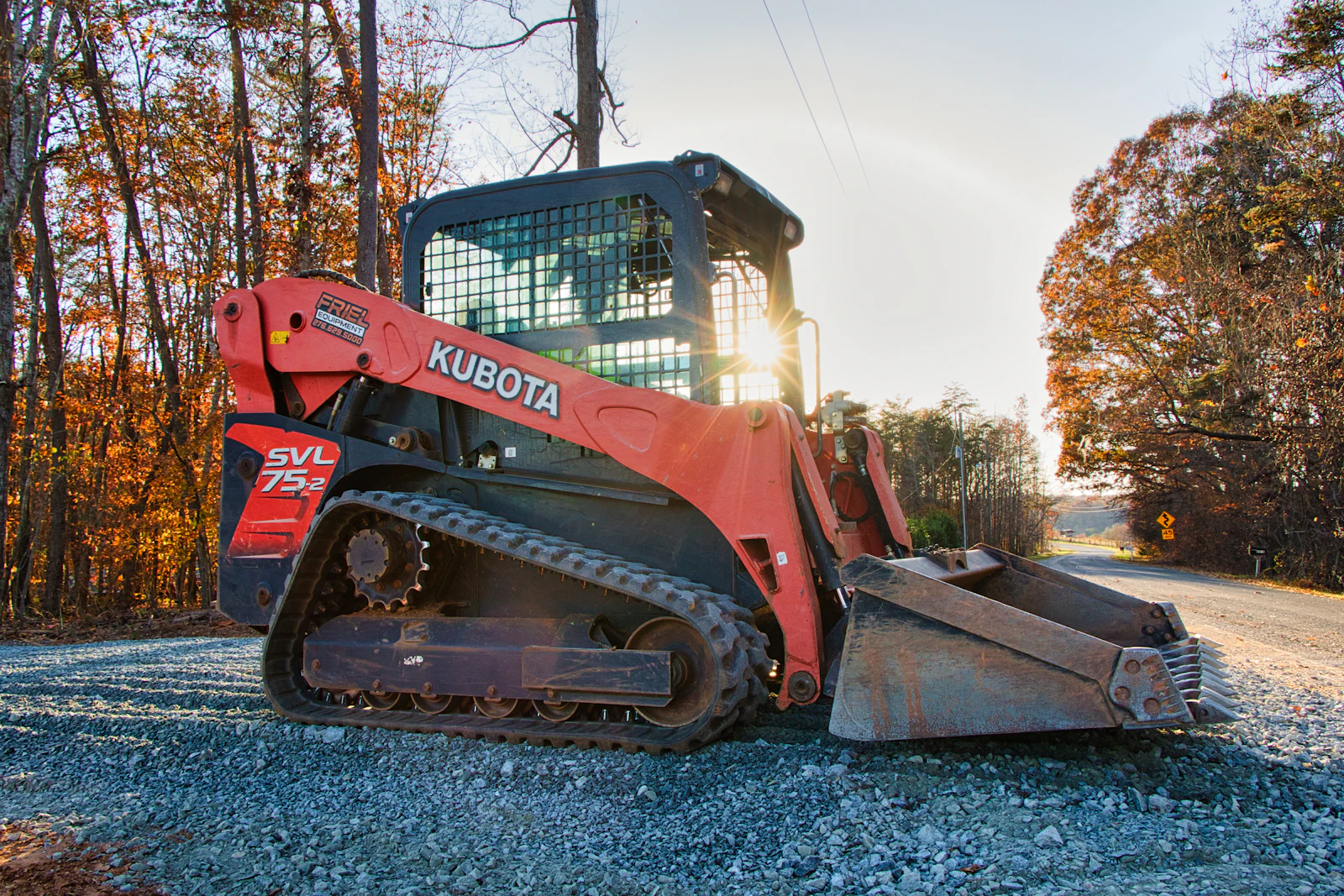
Skid Steer Loader Rental Rates Austin 2026
For Austin-area concrete driveway scopes (demo support, spoils handling, base prep, and backfill), 2026 planning ranges for skid steer loader equipment hire typically land at $200–$450/day, $640–$1,600/week, and $1,700–$4,300 per 4-week/month for a standard wheeled skid steer, before attachments, delivery, and protection products. In practice, the all-in cost for a driveway job is usually driven more by logistics (delivery windows, off-rent timing, weekend billing) and add-ons (hydraulic breaker, forks, grading bucket, cleaning) than by the base rate alone. Most Austin contractors source from national branches (for depth of fleet and dispatch capacity) and local independents (for flexible pickup/return and short-notice swaps), but pricing still tracks closely to machine class, hydraulics, and term length.
| Vendor |
Daily Rate |
Weekly Rate |
Review Score |
Website |
| United Rentals |
$330 |
$1 320 |
8 |
Visit |
| Sunbelt Rentals |
$320 |
$1 280 |
8 |
Visit |
| Herc Rentals |
$315 |
$1 260 |
8 |
Visit |
| Sunstate Equipment |
$310 |
$1 240 |
8 |
Visit |
| The Home Depot Tool Rental (Compact Power Rentals) |
$299 |
$1 195 |
7 |
Visit |
What Drives Skid Steer Hire Cost on an Austin Concrete Driveway?
When you are hiring a skid steer loader for a concrete driveway in Austin, the rental branch is pricing (1) machine capability, (2) utilization risk, and (3) dispatch friction. For estimating, the quickest way to avoid change orders is to scope the driveway conditions and access constraints first, then match the smallest machine that will safely do the work with the right attachment package.
- Operating capacity and frame size: A 1,500–1,800 lb ROC wheeled skid steer is usually the cost floor; higher ROC machines often rent at the top of the daily range and can push toward the higher end of monthly pricing.
- Wheeled vs. compact track loader substitution: For driveway work on finished subgrades or wet lots, some crews swap to a CTL (often higher day/week rates and higher damage exposure). If you must protect finished landscaping, budget ground protection separately rather than oversizing the loader.
- High-flow hydraulics: If your concrete driveway plan includes a severe-duty planer or higher-energy breaker, high-flow can shift you into a higher rate class and may constrain availability on short notice.
- Cab and HVAC: Austin summer heat materially affects productivity and operator endurance; enclosed cab with A/C often costs more per day but can reduce overtime charges if you are trying to finish before weekend billing starts.
- Access and transport: Tight residential streets, gated communities, and alley access in Central Austin can force smaller delivery trucks, longer on-site unload times, or delivery windows that trigger after-hours fees.
2026 Planning Ranges by Term (And the Assumptions Behind Them)
Use the day/week/4-week pricing bands above as a planning baseline, then apply the following standard assumptions so your internal estimate reflects how rental contracts are actually billed in the field:
- “Monthly” is often a 4-week (28-day) rate rather than a calendar month.
- One-shift utilization is typically included: many rental terms define one shift as 8 hours/day, 40 hours/week, and 160 hours per 4 weeks. Overage hours are commonly billed at a pro-rated hourly fraction of the base rate (for example, 1/8 of the daily rate per extra hour on a daily rental, and 1/40 of the weekly rate per extra hour on a weekly rental).
Those “included hours” and overtime billing mechanics are explicitly stated in common rental terms used by national providers.
Attachment and Accessory Adders for Concrete Driveway Productivity
Concrete driveway work usually fails on productivity when the hired skid steer shows up without the correct interface, coupler, or wear package. Treat attachments as first-class cost items. For Austin estimating, carry these 2026 planning adders (availability and condition drive variance):
- Hydraulic breaker/hammer: budget $275–$425/day or $650–$1,100/week depending on energy class and tool diameter. Published rate sheets for comparable hammers show day/week charges in this band (then escalate for 2026 planning as needed).
- Grapple bucket or debris grapple: budget $90–$140/day when you are staging broken driveway sections or handling rebar-laced chunks.
- Forks/pallet forks: budget $25–$60/day (often the cheapest way to keep labor from hand-moving forms, base material pallets, or barricades).
- 4-in-1 bucket: budget $60–$110/day when you need a single attachment to clamp, grade, and back-drag around a garage apron.
- Tooth bar / cutting edge / wear teeth package: budget $15–$35/day if you are cutting into caliche or crushed limestone base and you want to avoid chargeable wear at return.
Austin-specific note: Many driveway removals encounter hard limestone fragments and rebar dowels at the sidewalk/approach tie-in. Plan the breaker for at least 1 full day even if your demo contractor thinks the slab will “pop” cleanly—because a half-day failure tends to turn into overtime and weekend billing.
Delivery, Pickup, and Dispatch Rules That Change the Real Hire Cost
On paper, the skid steer loader hire rate is simple; in reality, your concrete driveway job cost is highly sensitive to transport and off-rent timing:
- Metro delivery charges: Austin-area delivery is commonly budgeted at $75–$200 each way within the metro depending on distance and dispatch queue.
- Waiting time: if the driver cannot access the driveway (blocked street, gate code missing, no spotter), carry $95–$150/hour for standby/wait time.
- After-hours / tight-window delivery: for constrained sites (school zones, downtown congestion), carry a surcharge allowance of $150–$350 per event if you must hit a specific time window.
- Weekend and holiday billing: many branches will not credit Saturday/Sunday as “off-rent” unless the unit is physically returned and checked in; plan demob so you are not paying for an idle weekend.
- Off-rent cutoffs: a common operational constraint is a branch receiving cutoff (often around 3:00–4:00 p.m.) after which the unit is effectively billed through the next day—confirm at time of order and schedule labor accordingly.
Hidden-Fee Breakdown
To keep your skid steer loader equipment hire costs in Austin predictable on a concrete driveway scope, carry explicit allowances for the most common “not-in-the-base-rate” charges:
- Damage waiver / loss damage waiver: budget 8%–15% of rental charges as a planning range; 10% is commonly seen on rate lists (applied before sales tax).
- Certificate of insurance (COI) alternative: some suppliers require a damage waiver unless you provide a COI with rented equipment coverage and appropriate additional insured wording—verify before dispatch to avoid a last-minute add-on.
- Environmental / recovery fee: carry $5–$15/day as a common admin add-on in equipment rental invoices.
- Fuel / refuel service: if returned below the agreed level, carry $6–$10/gal (pump price plus a service margin). If the job is short, it is often cheaper to top off yourself before return.
- Cleaning fees: carry $75–$250 for standard mud/dust cleaning; for concrete slurry/cementitious residue in the undercarriage or coupler area, carry $200–$500 depending on severity.
- Tire damage exposure: for driveway demo around rebar and sharp aggregate, carry a contingency of $300–$1,200 for tire repair/replacement risk if your contract pushes responsibility to the renter.
- Late return penalty: carry 0.5–1.0 additional day of rent if return misses cutoff and cannot be checked in same day.
Example: 3-Day Austin Concrete Driveway Tear-Out With Breaker and Tight Access
Scenario: 1,100 sq ft driveway replacement in South Austin. One-lane street, neighbor parking pressure, and a hard stop to clear the approach by Sunday night to avoid Monday morning traffic conflict. Crew wants a wheeled skid steer with breaker for slab edge release and a general-purpose bucket for load-out and base grading.
- Skid steer loader hire: $335/day x 3 days = $1,005 (planning rate within Austin 2026 band).
- Hydraulic breaker: $325/day x 2 days = $650 (planning allowance based on typical published hammer day rates, escalated for 2026).
- Delivery and pickup: $175 each way = $350 (assumes metro dispatch plus tight window).
- Damage waiver: 10% of rental charges ($1,655) = $165.50.
- Overtime hours: crew runs 12 hours on Day 2 to beat weekend billing. With one-shift included, extra 4 hours can bill at 1/8 of daily rate per hour: ($335 / 8) x 4 = $167.50 (method aligns with common rental overtime terms).
- Fuel: 18 gallons of diesel equivalent at $8/gal = $144 (avoid refuel service charges by topping off before return).
- Cleaning: allowance $200 due to concrete dust and slurry buildup around the quick coupler.
Illustrative all-in equipment hire subtotal (before tax): approximately $2,882.50. Key takeaway for Austin driveway work: a single long shift to avoid weekend idle charges can cost less than carrying the machine through a non-productive Saturday/Sunday—but only if you plan for overtime billing and confirm the branch off-rent cutoff.
Budget Worksheet (No Tables)
- Skid steer loader equipment hire (base unit): $200–$450/day; $640–$1,600/week; $1,700–$4,300/4-week
- Attachment package allowance (forks + bucket upgrades): $40–$170/day
- Hydraulic breaker allowance (if driveway demo): $275–$425/day
- Delivery/pickup (Austin metro): $150–$400 round trip (two-way)
- Standby/wait time risk: $95–$150/hour (carry 1 hour minimum)
- Damage waiver or insured alternative: 8%–15% of rent (often 10%)
- Environmental/recovery fee: $5–$15/day
- Refuel/recharge true-up: $6–$10/gal (carry 15–25 gal for 3-day driveway work)
- Cleaning and concrete residue: $75–$500 depending on condition at return
- Tire damage contingency (rebar/aggregate): $300–$1,200
Rental Order Checklist (PO, Delivery, Return)
- Confirm machine class: ROC, wheeled vs tracked, standard vs high-flow, and coupler type (so attachments fit on arrival).
- Provide exact jobsite address and delivery constraints: gate code, street parking restrictions, and unload area dimensions.
- Lock delivery window and cutoff times: ask for branch receiving cutoff (often 3:00–4:00 p.m.) and weekend check-in rules.
- Document protection choice: damage waiver percent and cap, or provide COI showing rented equipment coverage and additional insured wording.
- Confirm included hours and overtime billing formula (8/40/160 hours are common one-shift inclusions).
- Pre-acceptance inspection: photos of tires, coupler, hydraulic lines, bucket cutting edge, hour meter, and any existing leaks.
- Return condition requirements: fuel level expectation, broom-clean vs pressure wash, and how concrete dust/slurry is treated.
- Off-rent procedure: who calls off-rent, required notice, and whether pickup request time or physical return time stops billing.
Estimator note for Austin: If you are scheduling around I-35 congestion and dense neighborhoods, build a “delivery friction” contingency. A skid steer that arrives 2 hours late can cascade into overtime and missed cutoff, effectively adding 1 billable day even though the crew only used it briefly.
How to Reduce Skid Steer Loader Equipment Hire Costs Without Reducing Production
For concrete driveway scopes in Austin, the highest leverage savings typically come from eliminating non-productive billed time rather than chasing a slightly lower base day rate. The tactics below are procurement-friendly and align with how branches bill equipment hire.
- Match the term to the critical path: If your driveway work is weather-sensitive, a weekly rate often protects you from a surprise rain delay better than stacking daily rentals. Conversely, if you can guarantee a clean off-rent before cutoff, daily hire prevents paying for idle days.
- Package attachments on the same PO: Ordering the breaker, forks, and a bucket upgrade up front reduces “same-day add” dispatch charges and avoids losing a half shift waiting on an attachment transfer.
- Plan spoils handling so the skid steer is not a forklift: If trucks are not cycling, the skid steer sits billed. Budget a loader-to-truck ratio and enforce it. If your trucking gap is more than 30–45 minutes repeatedly, you are paying skid steer rent to idle.
- Schedule return before weekend billing starts: If the branch will not check in on weekends, a Friday afternoon return miss can add 2 extra days of billing. Confirm rules during the order call and put the cutoff time on the superintendent schedule.
Austin Operational Constraints That Commonly Add Cost on Driveway Jobs
These are not “nice-to-know” details—each one can move your equipment hire total materially on a concrete driveway project:
- Heat and hydraulic performance: In peak summer, extended high-load breaker operation can force additional idle time for cool-down. If you are trying to finish in a single day to avoid weekend billing, consider budgeting an A/C cab upgrade rather than paying for overtime plus an additional day.
- Dust control near occupied homes: Concrete driveway demo creates fine dust that can migrate into garages and HVAC intakes. If the GC requires wet suppression and end-of-day cleanup, carry a cleaning allowance at the high end ($200–$500) and consider adding a bucket baffle or debris containment accessories.
- Delivery radius realities: Many Austin dispatches originate from North Austin, Pflugerville, or along US-183 corridors; if the job is in Dripping Springs, Buda, or beyond, delivery may shift from a flat metro fee to distance-based pricing. Carry a mileage allowance of $3–$6 per loaded mile beyond the standard zone.
Interpreting “Included Hours” and Overage Charges for Better Forecasting
A common budgeting miss is assuming a daily hire rate equals “unlimited use for 24 hours.” Many rental terms define one-shift use and charge overages using a pro-rated fraction of the base rate (daily: 1/8 of daily per extra hour; weekly: 1/40 of weekly per extra hour; 4-week: 1/160 of 4-week per extra hour).
Practical forecasting rule for driveway work: if you expect to run 10–12 hours to complete demo and base prep in one day, carry 2–4 overtime hours for the skid steer and 2–6 overtime hours for the breaker. The breaker attachment is often billed on the same overtime logic as the host machine.
When “Cheaper Delivery” Becomes More Expensive
Some Austin teams try to self-haul to eliminate delivery fees. That can work, but only if you price the internal burden honestly:
- Trailer hire or internal trailer cost allocation: $90–$125/day equivalent burden (if not already owned and depreciated).
- Yard load/unload time: carry 1.0–2.0 hours of foreman time for check-out and check-in.
- Two-way travel fuel and labor: in Austin traffic, 20–35 miles each way can become 1.5–2.5 hours round trip during peak congestion.
- Risk: if the unit is not properly chained down and the branch documents transport damage, savings disappear immediately.
If you do self-haul, insist on written pre- and post-inspection photos: hour meter, tire condition, quick coupler face, attachment pins, and any hydraulic seepage points.
Recommended Allowances for 2026 Austin Skid Steer Equipment Hire Estimates
- Minimum rental period: assume 1 day minimum for skid steers and most attachments unless your MSA states otherwise.
- Round-trip delivery: $150–$400 (metro) and escalate for distance or tight windows.
- Damage waiver: 10% baseline unless your COI is accepted and waiver is removed.
- Cleaning: include $150 baseline; bump to $350 when concrete slurry is likely.
- Weekend billing risk: carry 1 additional day on short driveway jobs that end on a Friday unless return logistics are confirmed and scheduled.
- Consumables and wear: carry $50–$125 for tooth wear, cutting edges, or breaker tool point wear if your agreement pushes “excess wear” to the renter.
Closeout: Documenting Return Condition to Protect Your Cost
On concrete driveway work, returns are where invoices swing. Require the superintendent to collect a return package the same day the skid steer is off-rented:
- Time-stamped photos of all four tires (or tracks if substituted) and sidewalls.
- Photos of the coupler, bucket cutting edge, and any attachment serial tags.
- Hour meter at return and fuel level gauge reading.
- Branch check-in receipt showing date/time (this is what prevents accidental weekend billing).
This closeout discipline typically saves more money across a year than negotiating a small reduction in base day rates—because it prevents the most common post-rental disputes: late return, excess cleaning, and tire damage.