Build your next estimate with CountBricks
Create an itemized estimate for your project, with materials, labor, and quantities you can review and edit.
Create my estimateStart a 7-day free trial. Sign up, then enter your project details.
Skid Steer Loader Rental Rates Baltimore 2026
For Baltimore-area concrete driveway scopes (demo support, spoils loading, stone placement, rough/finish grading), plan 2026 skid steer loader equipment hire budgets in three practical classes: (1) compact wheeled units for tight access at roughly $200–$325/day, $750–$1,150/week, and $2,000–$3,300/28-days; (2) mid-size tracked units for mixed terrain and turf/asphalt protection at roughly $250–$400/day, $900–$1,450/week, and $2,400–$3,900/28-days; and (3) high-flow / larger-frame units (common when pairing a breaker, planer, or heavy-duty broom) at roughly $350–$600/day, $1,300–$2,200/week, and $3,800–$6,000/28-days. These are planning ranges assuming one-shift meter limits (typical 8-hour day / 40-hour week / 4-week month) and exclude delivery, damage waiver, fuel, cleaning, and attachment adders. National rental houses serving Baltimore (for example, United Rentals, Sunbelt Rentals, and Herc Rentals) plus regional yards typically price within these bands depending on availability, machine age, and access constraints.
| Vendor |
Daily Rate |
Weekly Rate |
Review Score |
Website |
| United Rentals |
$500 |
$1 700 |
9 |
Visit |
| Sunbelt Rentals |
$490 |
$1 650 |
9 |
Visit |
| Herc Rentals (ProResources) |
$475 |
$1 600 |
8 |
Visit |
| Carter Rental (The Cat Rental Store) |
$570 |
$1 430 |
9 |
Visit |
To anchor the ranges with published Mid-Atlantic datapoints: Maryland Pipe & Supply lists a Kubota SSV65 skid loader at $250 for 8 hours, $825 weekly, and $2,300 monthly (as posted online), which is a useful baseline for a common driveway-capable class. Separately, CTS Rental Equipment posts typical market pricing such as $250/day, $1,000/week, and $3,000/month for a skid steer, and $275/day, $1,100/week, and $3,300/month for a track skid steer—helpful as a cross-check when you’re sanity-testing a Baltimore quote.
What Drives Skid Steer Hire Pricing on Baltimore Concrete Driveway Jobs?
Concrete driveway work in Baltimore tends to push skid steer hire costs above “general dirt work” because the scope is usually schedule-sensitive, access-constrained, and hard on undercarriage/tires (slurry, rebar fragments, brick/concrete rubble, and sharp stone). The cost drivers below are the ones that most often explain why two otherwise similar rental quotes can land hundreds of dollars apart on a 2–5 day driveway program.
- Machine configuration: track vs wheels, standard-flow vs high-flow hydraulics, enclosed cab vs open ROPS, and tire/track style (non-marking, severe-duty, etc.).
- Access width and neighborhood logistics: alley access and rowhome drive lanes often force a narrower machine, smaller bucket, or delivery vehicle changes, which impacts both rate and delivery fees.
- Surface protection expectations: driveway replacement often requires working on existing asphalt, pavers, or finished sidewalks; some GCs will require ground protection mats (rented) and a tracked unit to reduce scuffing and rutting.
- Metered usage / shift hours: heavy loading days can exceed standard shift-hour assumptions and trigger overtime billing.
- Attachment mix: forks for palletized pavers/stone, a heavy-duty bucket, a breaker for thick sections/edges, or a power broom for final cleanup.
Tracked vs Wheeled Skid Steer: Cost and Surface Impact
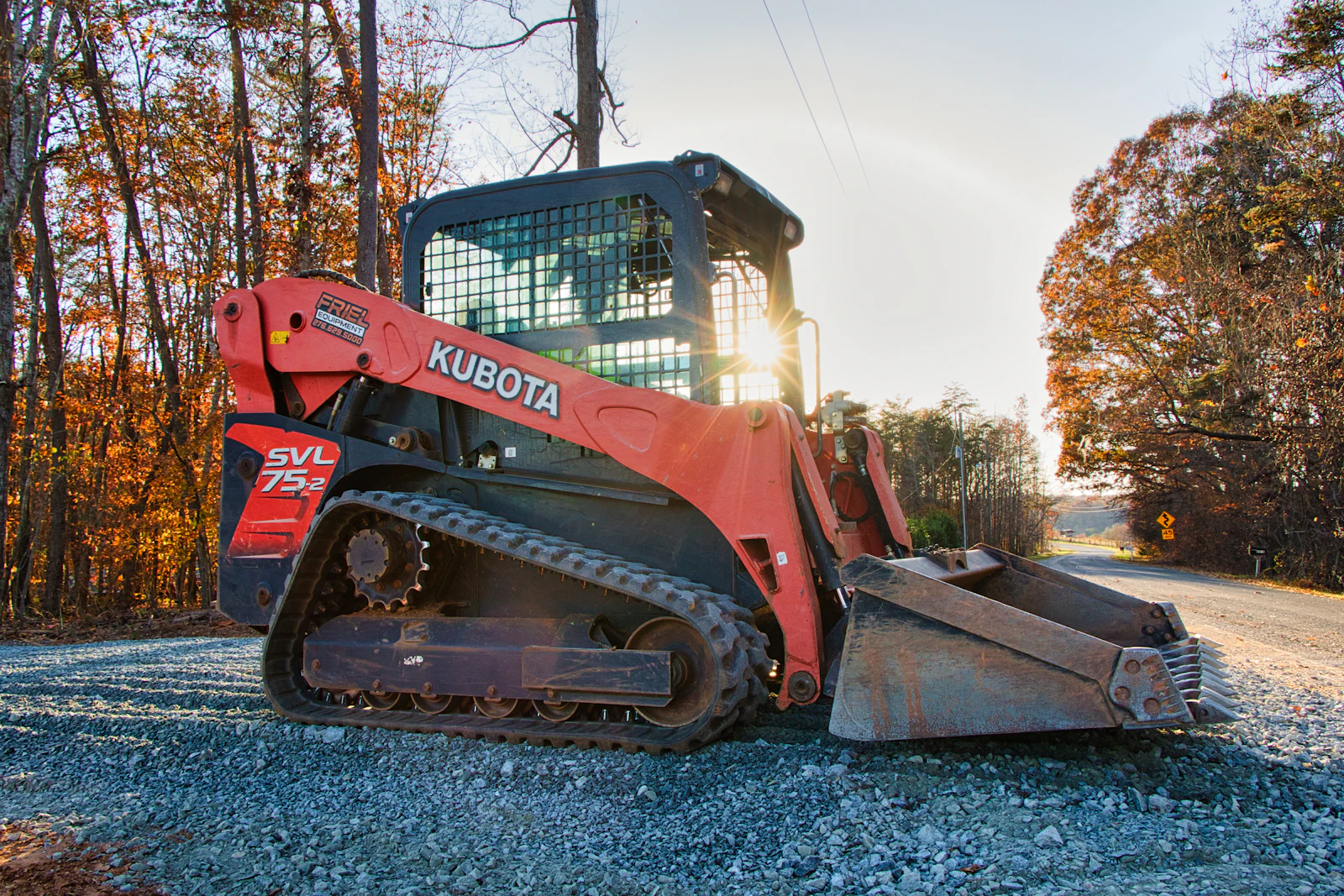
For concrete driveway operations, the track-vs-wheel decision is often more about total job cost than the base daily rate. Tracked skid steers typically rent at a premium (often 5–20% in local quotes) because they cost more to own and maintain, but they can reduce surface damage and rework when you’re traversing soft subgrade, wet clay, or landscaped edges after rain. In Baltimore’s humidity and summer storms, subgrade moisture swings can be significant—if you’re loading out broken concrete and hauling base stone across a soft yard strip, a tracked machine can prevent rut repair that would otherwise consume labor and material allowance.
From a rental coordination standpoint, confirm these “driveway-specific” details before you lock the equipment hire selection:
- Overall width: many driveway gates and tight side-yard runs are 48–60 inches. If you need a ~60-inch class machine, expect fewer units available on short notice and occasional rate uplift.
- Bucket edge type: a smooth edge helps final grading, while a toothed bucket helps in subgrade manipulation. Swapping bucket type can be an add-on charge or a “subject to availability” substitute that changes productivity.
- Travel path protection: if the machine must cross an existing sidewalk or finished asphalt, budget mats and a cleaning allowance (see Hidden-Fee Breakdown).
Attachment Adders That Usually Show Up on Driveway Work
Driveway scopes frequently require more than the “standard bucket included” package. For equipment hire estimating, treat attachments as their own line items with both time-on-rent and damage exposure. While rates vary by fleet and region, older published rate cards illustrate how attachments can stack up: for example, a skid steer fork attachment has been listed around $45/day, a grapple bucket around $100/day, a pickup broom around $118/day, and a skid steer/mini-ex breaker around $170/day on a published United rate list (use as a reference point only; confirm current Baltimore pricing). (g
For a Baltimore concrete driveway, the most common attachment-related cost adders to plan for are:
- Pallet forks: typically used for palletized pavers, bagged cement, or bundles of rebar chairs. Plan $35–$75/day in 2026 budgeting (plus a damage waiver percentage on the attachment in many contracts).
- Breaker/hammer (standard-flow or high-flow): used to pop thickened edges and slab corners. Plan $150–$275/day plus tool bit wear if billed separately, and confirm whether the skid steer must be high-flow (often a higher base machine rate).
- Power broom / sweeper: used for final curb line cleanup and stone tracking control. Plan $125–$225/day.
- 4-in-1 bucket or heavy-duty bucket: helpful for grading and moving mixed debris. Plan $40–$110/day depending on width and duty class.
Hidden-Fee Breakdown for Skid Steer Equipment Hire
Most disputes on skid steer loader equipment hire costs come from “non-rate” charges that weren’t budgeted at buyout. For Baltimore driveway projects, build a standard hidden-fee allowance pack into your estimate and then adjust once the rental house confirms the branch rules.
- Delivery / pickup charges: commonly $150–$275 each way inside a typical metro radius, with a frequent minimum trip charge around $125 even for short hauls. For longer runs, some yards add $4–$7 per loaded mile beyond a base radius. (Downtown Baltimore access windows can also force timed delivery—see below.)
- Timed delivery / restricted window surcharge: if you need delivery between, say, 7:00–9:00 AM only, or a hard “call-ahead” slot due to alley access, budget an extra $75–$150.
- Damage waiver / rental protection plan: if you elect a protection plan, it can be a meaningful percentage of rent. Sunbelt’s Rental Protection Plan terms, for example, describe a fee of 15% of gross rental charges for the plan, and then limit certain customer responsibility amounts when conditions are satisfied.
- Environmental / shop / admin fees: many contracts add an environmental recovery-style fee; budget 5%–10% of the rental charges unless your MSA caps it.
- Fuel / refuel charges: most skid steers are delivered full and must return full. If not, expect pump price + service; a common planning allowance is $25–$50 service plus fuel at $6–$9/gal depending on the vendor’s posted rate and timing.
- Cleaning fees: if you return the unit with concrete slurry, caked mud, or stone packed into the undercarriage, budget $150–$350 for cleaning; severe cases can be more if it requires significant labor time.
- After-hours/weekend return penalties: if your yard closes early and you miss cut-off, some vendors will roll to an additional day. Build a 1-day contingency if the schedule is weather-sensitive.
Billing Rules That Change the Real Weekly Cost
When you compare equipment hire quotes, confirm the time basis. Many rental agreements and catalogs define a “shift” of metered use and then charge overtime above it. Examples in published terms include definitions such as one day = 24 hours up to 8 hours of use, one week = 7 days up to 40 hours of use, and one month up to 176 hours of use (exact figures vary by lessor).
Also confirm how overtime is computed. One published rental terms example states overtime charges equal to 1/8 of the daily rent per hour beyond daily hours, 1/40 of the weekly rent per hour beyond weekly hours, and 1/160 of the 4-week rent per hour beyond monthly hours. If your Baltimore driveway program includes long load-out days (multiple dump truck turns), that overtime line can be a real cost center.
Finally, confirm shift multipliers if your project runs extended hours. Sunbelt’s published U.S. terms define “one shift” hour limits and indicate double shift = 150% and triple shift = 200% of the rental charge on metered equipment. Even if you don’t plan double shift, late concrete demo days can drift into it if the crew is trying to hit a pour window.
Example: Two-Day Concrete Driveway Demo and Base Prep in Baltimore
Scenario constraints: 900 sq ft driveway replacement in a Baltimore rowhome neighborhood with an 8-foot alley approach, no on-site equipment parking overnight, and a strict “keep sidewalk passable” requirement. Work plan is two long days: sawcut and demo support day 1, base stone placement and rough grading day 2. Equipment is delivered at 7:30 AM and must be picked up by 4:00 PM day 2 because of alley parking enforcement.
2026 planning budget (illustrative):
- Tracked skid steer (mid-size): assume $325/day × 2 days = $650 (within the 2026 planning band).
- Breaker attachment: assume $200/day × 2 days = $400 (budget as a separate attachment line).
- Forks (1 day only): assume $60/day × 1 day = $60.
- Delivery + pickup: assume $225 each way = $450 (alley/timed window adds risk).
- Timed delivery surcharge: assume $100 (hard 7:30–8:00 AM slot).
- Rental protection plan (if elected): assume 15% of rent on applicable items. If applied to $1,110 of rental charges (machine + attachments), that’s about $167. (Confirm the vendor’s program and exclusions.)
- Fuel/refuel allowance: assume $75 (either top-off on return or vendor refuel with service).
- Cleaning allowance: assume $200 due to concrete slurry risk.
Illustrative all-in equipment hire subtotal: $650 + $400 + $60 + $450 + $100 + $167 + $75 + $200 = $2,102 (taxes and any environmental/admin fees not included). This is why experienced estimators treat skid steer loader hire for concrete driveway work as a “package” cost, not just a day rate.
Budget Worksheet (Skid Steer Equipment Hire)
Use this as a no-table estimating checklist (adjust to your rental house’s branch terms and your MSA).
- Skid steer loader (wheeled or tracked): ____ days at $____/day, or ____ weeks at $____/week.
- Attachment 1 (forks): ____ days at $____/day (allow $35–$75/day).
- Attachment 2 (breaker/hammer): ____ days at $____/day (allow $150–$275/day), plus bit wear allowance $____.
- Attachment 3 (broom/sweeper): ____ days at $____/day (allow $125–$225/day).
- Delivery: $____ (allow $150–$275 each way; add $4–$7/loaded mile beyond base radius if applicable).
- Timed delivery / restricted window: $____ (allow $75–$150).
- Damage waiver / rental protection: ____% of rental charges (allow 10%–15%; some programs list 15%).
- Environmental/admin fees: ____% of rental charges (allow 5%–10% unless capped).
- Fuel & refuel service: $____ (allow $25–$50 service + $6–$9/gal fuel equivalent).
- Cleaning/pressure-wash: $____ (allow $150–$350; higher for heavy slurry/undercarriage packing).
- Overtime/meter overage contingency: $____ (allow 10% of base rent if you’re doing multiple truck turns per day).
- One extra day weather/return-risk contingency: $____ (especially for rain delays and yard cut-off windows).
Rental Order Checklist (PO to Off-Rent)
- PO and COI: confirm PO number, job address, and whether the lessor requires proof of property/physical damage insurance or purchase of a rental protection plan.
- Machine spec lock: track vs wheel, overall width, bucket type, auxiliary hydraulics (standard vs high-flow), quick-attach type.
- Accessories: forks, breaker, broom, extra bucket, couplers, and any required safety items.
- Delivery details: contact name/number on site, delivery window, alley restrictions, and whether a smaller delivery truck is needed.
- Start time and billing start: confirm whether billing starts at dispatch time even if the crew receives it later (avoid losing a half day). Some published rental FAQs note rental periods can begin at a set time such as 7:00 AM regardless of pickup time.
- Off-rent rules: confirm how to place equipment off-rent (phone/app), required notice, and cut-off time for same-day off-rent.
- Return condition documentation: take timestamped photos of tires/tracks, undercarriage, bucket edges, and attachment serial numbers at delivery and at pickup.
- Fuel and cleaning expectations: confirm “return full” and whether concrete slurry requires a wash before pickup to avoid cleaning charges.
Delivery Logistics in Baltimore That Affect Total Hire Cost
Baltimore-specific logistics can materially change skid steer loader equipment hire costs even when the base rate is competitive. For concrete driveway projects, delivery is often the swing factor because machines are heavy, access is tight, and street enforcement is active.
- Rowhome blocks and alley access: if the delivery truck can’t stage safely, the rental house may require a tighter window or charge for a second trip. Budget a second mobilization risk of $150–$275 if site access is uncertain.
- Downtown/Inner Harbor timed constraints: some projects require delivery before commuter peaks. If you need a hard window, carry a $75–$150 timed delivery allowance to avoid surprises.
- Distance and toll routing: if a yard routes via tolled corridors, you may see pass-through charges; confirm whether tolls are included in the quoted delivery.
Insurance, Damage Waiver, and Responsibility Limits
Most national lessors require you to either provide proof of insurance or purchase a protection plan product; United Rentals’ published Rental Protection Plan page, for example, states you must show proof of property insurance in line with their rental terms or purchase their plan. On the Sunbelt side, published Rental Protection Plan terms describe a fee of 15% of gross rental charges and then outline capped customer responsibility amounts for certain types of loss/damage when conditions are met (and exclusions don’t apply).
Practical budgeting guidance for Baltimore driveway scopes:
- Assume 10%–15% protection cost unless your MSA waives it with COI.
- Confirm tire/track clauses: protection programs may still leave you responsible for certain tire/track damage beyond a threshold; one published Sunbelt RPP excerpt references charges above $50 per tire for tire repairs in its limitation language (confirm applicability to your rental).
- Concrete rubble risk: driveway demolition frequently creates sharp debris that accelerates tire damage—this is a real cost driver for wheeled units on these scopes.
How to Reduce Skid Steer Hire Cost Without Under-Scoping
Cost control on skid steer hire is mostly about removing preventable charges while protecting productivity.
- Match bucket width to access and truck bed: if your dump truck is a small single-axle with high sides, a smaller bucket may cycle faster and reduce spillage cleanup.
- Plan the attachment days: if the breaker is only needed for 3–4 hours on day 1, schedule it as a 1-day attachment (not a 2-day “just in case” rental) and keep the machine for both days.
- Pre-stage a washdown plan: budget $30–$60 for a quick pressure wash token or onsite wash setup to avoid a $150–$350 rental yard cleaning charge.
- Use “off-rent” discipline: place off-rent immediately when you’re done. If your vendor requires notice by a daily cut-off, missing it can add an extra day.
- Prevent overtime: if you’re doing high truck turns, rotate operators or schedule load-out to avoid exceeding shift-hour limits that trigger overtime charges.
Meter Limits, Overtime, and Shift Multipliers (Why Two “Same” Weeks Price Differently)
Even experienced PMs sometimes compare two weekly quotes without checking whether “weekly” means 5 business days, 7 calendar days, or a meter-limited shift week. Some procurement language states monthly rental is commonly treated as 28 days and weekly as a defined shift/week basis, which reinforces why you must reconcile the basis before award.
Operationally, you should assume the lessor will track hours via an hour meter and bill overtime if exceeded. Published rental agreement examples show overtime formulas like 1/8 of daily rent per extra hour or 1/40 of weekly rent per extra hour. And if your project goes into extended shifts, some published lessor terms indicate double shift = 1.5× and triple shift = 2.0× for metered equipment.
Estimator tip: For driveway replacements, carry a “peak day” overtime allowance if you expect concentrated loading (e.g., multiple trucks in a short window). A simple planning allowance is 2 overtime hours/day for 2 days on demo-intensive scopes, priced at the vendor’s published overtime formula.
Off-Rent, Returns, and Condition Documentation
To keep equipment hire costs clean and auditable, treat off-rent and condition documentation as part of the scope.
- Start/stop times: confirm what time the rental day starts for billing. Some published rental FAQs state rental periods can begin at a defined time such as 7:00 AM on the agreement date, regardless of pickup time.
- Return condition photos: capture bucket cutting edge, quick-coupler, forks, breaker body, hoses, and undercarriage.
- Concrete slurry management: do not let slurry cure on tracks/tires; it increases cleaning time and can create damage claims.
- Refuel confirmation: photo the fuel gauge at pickup and at return, and keep receipts if you top off within 5 miles of the yard.
2026 Planning Allowances and Contingencies for Estimators
If you need a fast 2026 budgeting framework for Baltimore concrete driveway work, these allowances typically keep you from getting caught:
- Delivery + pickup: $300–$550 total (typical metro), plus $75–$150 if timed.
- Protection plan / damage waiver: 10%–15% of rental charges (use 15% if you commonly rent from yards with that program structure).
- Cleaning: $200 standard allowance, $350 if demolition slurry risk is high.
- Fuel/refuel: $50–$125 per 2–3 day event, depending on usage and return logistics.
- One extra day contingency: price 1 additional day on the base machine when weather and pickup windows are uncertain.
Rental Coordinator FAQ (Baltimore Skid Steer Equipment Hire)
- Should I rent tracked or wheeled for a concrete driveway? If you must cross wet subgrade, soft clay, or finished surfaces, tracked often reduces rework and surface repair, even if the base daily rate is higher.
- What’s the most common “missed” cost? Delivery/pickup plus protection plan percentage; together they can add $400–$900 on a short rental.
- What should I confirm about billing? Shift-hour limits, overtime formula, off-rent cut-off time, and whether weekend/after-hours returns roll into another day.
- What documentation prevents back-charges? Delivery/return photos, attachment serial verification, and written confirmation of fuel level and visible damage at receipt.