Build your next estimate with CountBricks
Create an itemized estimate for your project, with materials, labor, and quantities you can review and edit.
Create my estimateStart a 7-day free trial. Sign up, then enter your project details.
Skid Steer Loader Rental Rates Baltimore 2026
For skid steer loader equipment hire in Baltimore focused on digging footings, 2026 planning budgets typically land in these ranges (bare machine, before delivery/taxes/waivers): $250–$425/day, $950–$1,650/week, and $2,800–$4,500 per 4-week month, depending on wheeled vs. tracked, rated operating capacity, cab/heat/AC, and whether specialty buckets or hydraulic attachments are included. These ranges are consistent with published daily/weekly/monthly skid steer and compact track loader rate sheets (e.g., posted pricing around $250/day for a wheeled unit and $275/day for a tracked unit, with weekly/monthly breakpoints) and with 4-hour/24-hour options shown on some rental menus. In Baltimore, national providers (United Rentals, Sunbelt Rentals, Herc Rentals) and local yards will all quote; your final equipment hire cost will be driven as much by logistics (delivery windows, alley access, off-rent rules) as by the sticker day rate. Assumptions used in this article: one shift is 8 machine hours/day, 40 hours/week, and a 160-hour/4-week month; overtime and over-hour billing are covered below.
| Vendor |
Daily Rate |
Weekly Rate |
Review Score |
Website |
| United Rentals |
$410 |
$1 435 |
9 |
Visit |
| Sunbelt Rentals |
$395 |
$1 385 |
9 |
Visit |
| Herc Rentals (ProResources – Baltimore) |
$405 |
$1 420 |
8 |
Visit |
| The Home Depot Rental (Large Equipment / Skid Steers) |
$335 |
$1 170 |
8 |
Visit |
| Bay Country Rentals of Pasadena (Baltimore/Curtis Bay) |
$360 |
$1 260 |
10 |
Visit |
How Skid Steer Loader Equipment Hire Is Quoted for Footing Work in Baltimore
Most Baltimore-area rental coordinators will see skid steer hire requests for footings fall into one of three “spec buckets,” and each spec changes the hire cost materially:
- Wheeled skid steer (good for paved access, tighter turning on hardstand): often the lowest equipment hire cost, but can lose productivity in wet clay or after thunderstorms common in the Mid-Atlantic.
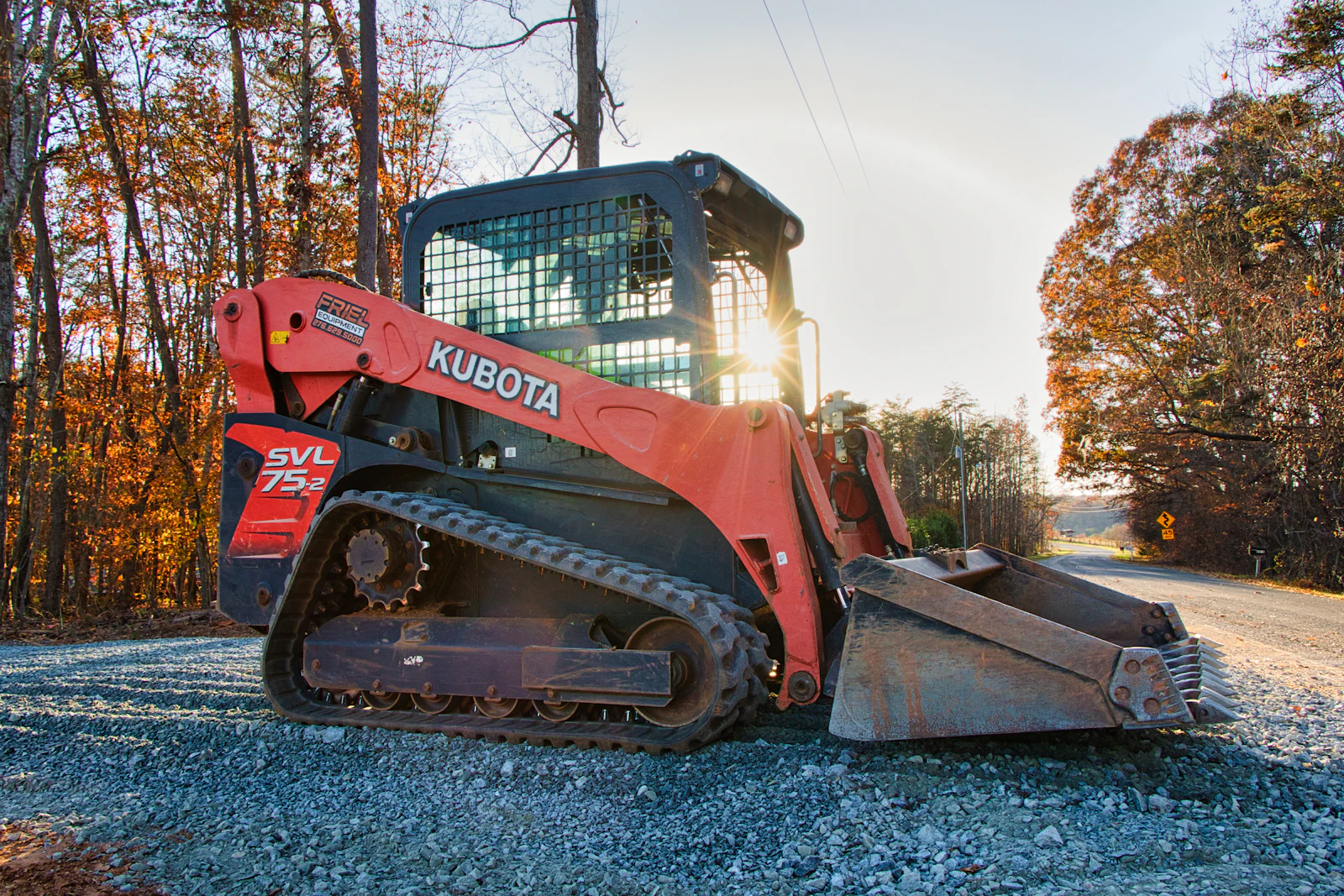
- Compact track loader (CTL) / tracked skid steer: higher base rate, but better traction and lower ground pressure—often worth it when you’re cutting footing trenches in soft subgrade, working on disturbed fill, or staging spoils on lawns that can’t rut.
- Mini skid steer (stand-on or walk-behind): typically selected when access is constrained (rowhouse side yards, gated rear pads, narrow alley approaches). It can reduce hand labor but may require more cycles (smaller bucket) and may increase total rental days if production drops.
To ground the range, published examples in the U.S. market show skid steer/CTL pricing points such as $250/day, $1,000/week, $3,000/month for a wheeled unit and $275/day, $1,100/week, $3,300/month for a tracked unit on one posted list. Another published menu shows a tracked loader at $350/24 hours, $1,400/week, and $3,500/month, with a $280/4-hour option and an “8 work hours per 24-hour period” inclusion note. Treat these as reference points only—Baltimore availability, union constraints on some sites, and delivery constraints routinely move the effective rate.
What Drives Skid Steer Hire Costs on Baltimore Footing Jobs?
For digging footings, the base daily/weekly/monthly equipment hire rate is only the starting line. The following cost drivers are what typically separate a “low day rate” from a “low total cost” on Baltimore jobs:
- Hydraulic performance requirements: If you need high-flow for an auger, planer, or breaker, expect a higher class of machine and a higher hire bracket.
- Undercarriage selection (wheels vs. tracks): Tracks reduce downtime from getting stuck, but track machines may carry higher cleaning expectations and higher repair exposure if you run them over demo debris.
- Attachment mix for footings: A general-purpose bucket may be included; a trenching/footing bucket, toothed bucket, or grading attachment often adds a daily line item.
- Site access and ground protection: In Baltimore’s denser neighborhoods, you may need ground mats, plywood roadway, or tracked units to protect pavers/asphalt. That affects both delivery approach and potential cleaning/damage fees.
- Billing rules for hours and weekends: Even if the unit sits idle, many contracts bill calendar time until off-rent is processed; weekend/holiday billing can become a hidden multiplier if you miss cutoffs.
Delivery, Access, and Cutoff Rules That Change Real Hire Cost in Baltimore
Delivery logistics are a first-order cost item in Baltimore—especially when you’re coordinating excavation/footings around inspections and concrete placement windows. Some rental operations publish strict order and cancellation cutoffs (for example, a 2:00 P.M. order cutoff for next workday delivery and an early-morning cancellation cutoff on the rental date). For Baltimore, plan your equipment hire request around:
- Delivery window constraints: Downtown/Inner Harbor traffic patterns, I-83/I-695 congestion, and limited staging space can make “AM delivery” effectively a premium service if you require a tight arrival slot.
- Alley and rowhouse constraints: Rear-yard footing work may require a smaller machine class (mini skid steer) or an alternate drop point plus on-site repositioning, which can add labor and time.
- Street occupancy and permits: If the unit must be offloaded on-street, you may carry permit administration and signage costs; some rental programs explicitly note permits as excluded and charge adders/surcharges.
- Delivery pricing structures: Some published delivery policies combine a flat mobilization plus a per-mile component (e.g., $100 + $4/mile for delivery and pickup in one example). Baltimore quotes may be similar in structure even if the exact numbers differ by yard and distance.
How Rental Time Is Billed (And Where Footing Jobs Get Overrun)
On footing work, cost overruns often come from timekeeping and off-rent mechanics rather than from the base day rate. Confirm the following in writing on the PO or rental agreement:
- Included hours per day/week/month: Many programs align to an 8-hour shift basis (and a 40-hour week / 160-hour 4-week month).
- Overtime / excess-use formula: One published policy example bills excess use at 1/8 of the daily charge per hour (daily rental), 1/40 of the weekly charge per hour (weekly rental), and 1/160 of the 4-week charge per hour (4-week rental). That framework is common enough that it’s a useful estimator assumption when you don’t yet have a branch-specific rate sheet.
- Weekend and holiday billing: If you take delivery Friday afternoon and off-rent Monday morning, verify whether Saturday/Sunday are billed at full day rate, a reduced “weekend rate,” or captured inside a weekly minimum. Missing this detail is one of the fastest ways to turn a 2-day footing dig into a 4-day invoice.
- Off-rent cutoffs: Many yards require off-rent notice before a daily cutoff; otherwise you may be billed another day even if the machine is idle behind temporary fence.
Hidden-Fee Breakdown
Use this section as a line-item checklist when you’re validating skid steer loader equipment hire quotes for Baltimore footing packages. These are the most common adders that change total cost:
- Delivery and pickup: Expect either (a) flat each-way mobilization, (b) a flat fee plus mileage, or (c) zone pricing. Published examples in the market show structures like $100 + $4/mile for delivery/pickup combined.
- Minimum rental terms: Some suppliers offer 4-hour pricing (example: $280/4 hours) but still require “one-day minimum” once the unit is on-site or if delivery is used.
- Rental Protection Plan / damage waiver: A commonly published fee is 15% of gross rental charges (not insurance), with customer responsibility caps under specific conditions and exclusions.
- RPP deductibles / caps (important for footing work near rebar, stakes, and utilities): One published set of RPP terms limits what the rental company collects to 10% of repair charges (up to $500) for incidental/accidental damage, and 10% of FMV (up to $500) for loss, subject to conditions/exclusions.
- Cleaning and return condition: Budget a cleaning allowance when you’re cutting wet trenches or working after rain. A common internal allowance used by coordinators is $125–$350 for pressure-wash/undercarriage cleaning if returned with caked clay; confirm branch policy.
- Fuel / DEF: Most diesel rentals are “return full.” If not, plan a refuel service charge (often priced at a marked-up per-gallon rate) plus a fueling labor fee. For estimating, carry $6–$10/gal as a conservative placeholder for invoiced diesel on small equipment and $25–$65 for a fueling service line, pending vendor confirmation.
- Ground damage and tire/track wear exposure: If you’re working over crushed concrete or demo rubble, confirm whether track damage, punctures, or abnormal wear are billable back to the renter.
- After-hours and weekend delivery premiums: If you require delivery before a 7:00 A.M. inspection window or after a city noise cutoff, budget an “expedite” allowance of $75–$200 depending on yard policy and distance.
- Administrative / environmental fees: Some invoices include percentage-based environmental or energy recovery fees; carry 3%–7% until your supplier confirms.
Attachments and Add-Ons That Commonly Appear on Footing POs
Digging footings with a skid steer is rarely “machine-only.” The bucket/attachment selection changes both production and equipment hire cost.
Common attachment pricing signals (published examples):
- Auger attachment: published example pricing shows $150/day, $400/week, $900/4-week (regular skid steer).
- Breaker (hydraulic hammer): published example pricing shows $250/day, $775/week, $2,000/4-week.
- Compaction wheel (18 in.): published example pricing shows $125/day, $500/week, $1,250/4-week.
- Broom / sweeping attachment: one Baltimore-area rental program shows an add-on of $25 (listed as an add-on charge).
- Hammer / grinder / milling head style add-ons: a Baltimore-area program shows examples of add-ons at +$70 for certain specialty heads.
Footing-specific note: If your scope includes stripping topsoil, cutting trench lines, managing spoils, and backfilling, you may need two buckets (tooth bucket for digging + smooth-edge bucket for grading) and forks for palletized rebar/forms. If you don’t lock down “included attachments” on the PO, you can end up paying an extra day simply waiting for the correct bucket to arrive.
Rate Assumptions to State Upfront (Estimator Notes)
To keep skid steer loader equipment hire cost predictable for Baltimore footing packages, include these deal-point assumptions in your requisition:
- Hour basis: 8 hours/day included; identify the hourly overage method (many contracts follow the 1/8 daily, 1/40 weekly, 1/160 4-week pattern).
- Damage waiver election: accept/decline RPP explicitly; if accepted, confirm the fee basis (commonly 15% of gross rental) and the cap mechanics.
- Delivery commitments: delivery date/time window, site contact, and delivery constraints (alley width, overhead lines, street closure). Add a note for “call ahead 60 minutes” to reduce redelivery charges.
- Off-rent instruction: state the cutoff time for off-rent requests and require written confirmation of off-rent time to avoid weekend accrual.
- Return condition documentation: require pre- and post-rental photos of the machine, bucket cutting edge, and tracks/tires; note existing dents/scrapes to reduce back-charges.
Example: Digging Footings With a Skid Steer Loader in Baltimore (Costed Scenario)
Scenario: You’re cutting continuous strip footings for a small commercial addition in Baltimore with constrained staging. The excavation subcontractor needs a tracked unit to avoid rutting, with delivery Friday afternoon after traffic, work Saturday, inspection Monday AM, and concrete Tuesday.
Operational constraints that drive hire cost:
- Weekend accrual risk: If off-rent is not processed until Monday, you may carry Saturday/Sunday billing even if the machine is idle Sunday.
- Delivery structure: If your supplier uses a structure similar to the published example $100 + $4/mile (delivery + pickup), a 15-mile one-way distance would imply a planning delivery allowance of roughly $160 total on that structure (your vendor may differ, but the estimator should carry a mobilization placeholder).
- Shift-hour control: Keep machine hours near the included 8-hour/day basis (many programs explicitly state 8 work hours included in a 24-hour rental). If you exceed shift hours, expect hourly billing rules comparable to the 1/8 daily-charge method used in at least one published “services and associated charges” schedule.
- Protection plan decision: If you elect RPP at 15% of gross rental charges, carry it as a separate line so it doesn’t disappear into “misc.”
Budget example (planning math, not a quote): If you budget a CTL at $325–$475/day and you end up billed 3 days due to weekend/off-rent mechanics, the delta versus a “2-day plan” can be one additional day rate plus taxes/fees—often larger than the attachment cost. This is why Baltimore coordinators typically spend more time negotiating billing rules than haggling $25/day on base rate.
Budget Worksheet
Use these bullet line items (no tables) as an estimator-ready worksheet for skid steer loader equipment hire costs in Baltimore for digging footings. Adjust quantities to your schedule and vendor terms.
- Skid steer loader / CTL base hire: ___ days at $___/day (carry $250–$425/day planning range depending on wheels vs. tracks).
- Weekly conversion option: if duration ≥ 5–7 days, request weekly rate to avoid paying 6–7 separate daily charges (carry $950–$1,650/week planning).
- 4-week / monthly conversion option: if duration ≥ 20 workdays, request 4-week rate (carry $2,800–$4,500/4-week planning).
- Delivery + pickup allowance: $___ (carry a placeholder based on a flat + per-mile structure; published example shows $100 + $4/mile).
- Damage waiver / RPP: 15% of gross rental charges (if elected).
- Attachments (select as needed):
- Auger attachment: $___/day (published example $150/day).
- Breaker: $___/day (published example $250/day).
- Compaction wheel: $___/day (published example $125/day).
- Broom: $___ add-on (published example add-on $25).
- Specialty heads: $___ add-on (published example +$70 for certain heads).
- Fuel/DEF/charging allowance: $___ (carry $6–$10/gal placeholder for invoiced fuel plus a $25–$65 fueling service line pending supplier policy).
- Cleaning allowance: $___ (carry $125–$350 when working in wet clay or when returning with caked undercarriage).
- Overage hours allowance: $___ (if you expect >8 hours/day, carry at least 2–4 hours of overage using the 1/8-of-daily-charge method as an estimating proxy).
- Permits / street occupancy admin: $___ (if you expect on-street unloading; some programs note permits excluded and may add surcharges).
- Environmental/admin fee allowance: $___ (carry 3%–7% of rental subtotal until confirmed).
Rental Order Checklist
Use this checklist to prevent common Baltimore footing-job surprises that inflate skid steer equipment hire cost:
- PO details: machine class (wheeled vs. tracked), ROC/HP requirement, cab requirement (open vs. enclosed), high-flow requirement, and included attachments (bucket type, forks).
- Billing terms: confirm day/week/4-week rate, included hours per period, and the exact excess-use formula (hourly overage).
- Damage waiver/RPP election: accept/decline in writing; if accepted, confirm fee basis (often 15% of gross rental) and cap terms.
- Delivery requirements: site address, delivery contact, delivery time window, and site constraints (alley access, overhead lines, limited curb space). Add “driver must call 60 minutes prior.”
- Cutoffs: confirm order cutoff for next-day service and cancellation cutoff to avoid “dispatch and return” charges; at least one Baltimore-area program publishes a 2:00 P.M. order cutoff for the following workday and an early-morning cancellation cutoff.
- Off-rent process: document who is authorized to request off-rent, what time cutoff applies, and how confirmation is provided (email/text) to stop time charges before weekends/holidays.
- Return condition: fuel level requirements, cleaning expectations (especially tracks/undercarriage), and photo documentation at pickup/return.
- Safety/compliance: operator qualification, jobsite rules, underground utility locate status, and any indoor dust-control requirement (if working in a partially enclosed structure) including wet suppression or vac attachments.
When to Upsize (Or Switch Equipment) to Reduce Total Hire Cost
For digging footings, a skid steer can be cost-effective when you’re primarily managing spoils, shallow trenching, and backfill/grade. However, your total equipment hire cost can drop if you switch equipment rather than adding rental days:
- Deep or narrow footings: If trench depth/width forces repeated repositioning and rework, a mini excavator may reduce total days even if its day rate is similar.
- Wet subgrade: If a wheeled skid steer loses half-days to recovery and rut repair, a CTL premium is typically justified.
- Hard digging / demolition in the trench line: If you’re renting a breaker anyway (published example: $250/day), confirm your skid steer has the hydraulic spec to run it efficiently; otherwise you may pay the breaker rate but underutilize it.
Ownership Versus Equipment Hire (Quick Break-Even Lens for Baltimore Crews)
If you dig footings weekly, it’s natural to compare equipment hire versus ownership. For many Baltimore contractors, the break-even hinges on utilization consistency and support costs rather than purchase price alone:
- Hire advantages: predictable short-term cash flow, swap-outs if a unit goes down, and the ability to select wheels vs. tracks per job (dense city infill vs. suburban greenfield).
- Ownership advantages: eliminates delivery/pickup on small jobs, avoids weekend billing exposure, and ensures the right attachment set is always on hand.
A practical approach is to track your last 10 footing jobs and tally: (1) base hire charges, (2) delivery/pickup, (3) cleaning/fuel adders, and (4) unplanned “extra day” billing caused by schedule changes. If the “extra day” category is consistently material, your procurement fix may be improved cutoff/off-rent discipline rather than buying iron.