Build your next estimate with CountBricks
Create an itemized estimate for your project, with materials, labor, and quantities you can review and edit.
Create my estimateStart a 7-day free trial. Sign up, then enter your project details.
Skid Steer Loader Rental
For Baltimore, Maryland (Baltimore City + the I-695 beltway market), 2026 planning ranges for skid steer loader equipment hire typically land in three tiers: (1) standard wheeled skid steers in the ~1,500–2,000 lb rated operating capacity (ROC) class at $250–$425/day, $825–$1,295/week, and $2,250–$3,250 per 4-week period; (2) larger vertical-lift or higher-ROC units (often better for pallet forks and truck loading) at $350–$525/day, $1,150–$1,650/week, and $2,900–$4,100 per 4-week period; and (3) high-flow / premium packages (and many compact track loader “upgrade” quotes) at $425–$650/day, $1,395–$2,100/week, and $3,350–$4,600 per 4-week period. These ranges assume a contractor account with standard utilization caps (commonly 8 hours/day, 40 hours/week, 160 hours/4-weeks), return with fuel topped off, and normal wear (no track/undercarriage abuse, no punctured solids/foam fills). In Baltimore, you will typically see these rates quoted by national rental networks (Sunbelt Rentals, United Rentals, Herc Rentals) as well as local/regional yards serving Rosedale, Dundalk, Essex, Glen Burnie, and the city core—then the true “all-in” cost is driven by delivery access, attachments, waiver/insurance, and closeout condition.
| Vendor |
Daily Rate |
Weekly Rate |
Review Score |
Website |
| United Rentals |
$375 |
$1 250 |
9 |
Visit |
| Sunbelt Rentals |
$360 |
$1 200 |
9 |
Visit |
| Herc Rentals |
$350 |
$1 150 |
8 |
Visit |
| The Home Depot Rental (Compact Power) |
$330 |
$1 100 |
8 |
Visit |
| Alban CAT (Caterpillar Dealer Rental) |
$395 |
$1 350 |
9 |
Visit |
How Baltimore Skid Steer Loader Hire Is Actually Priced (Day vs Week vs 4-Week)
Most Baltimore equipment hire quotes for skid steer loader rental follow a “rate ladder” rather than a strict calendar model. The day rate is the most expensive per-hour option, the week rate becomes economical once you pass a short threshold, and the 4-week (often called “monthly”) rate is usually priced as a multiple of the weekly. Many rental rate sheets also include utilization caps (for example, 8 hours/day, 40 hours/week, and 160 hours/month) and apply overage meter charges if you exceed those thresholds.
For practical estimating, treat “monthly” as 28 days (4 weeks) unless your supplier explicitly bills by calendar month. This matters in Baltimore because deliveries and pickups often get pushed by I-95/I-83 congestion, downtown access windows, and jobsite staging constraints—if your off-rent notice misses a cutoff, you can accidentally buy another day or weekend.
Published Local Reference Points You Can Use to Sanity-Check a Quote
You should not assume any single vendor’s posted rate will match your negotiated contractor pricing, but published examples are useful to validate whether your 2026 budget is in the right band. As reference points: one Baltimore-area yard lists a wheeled skid steer at $325/day and $1,195/week (with model examples such as Bobcat S570). Another Maryland supplier posts a skid loader rate shown as $250 for 8 hours, $825/week, and $2,300/month. A separate 2026 rate sheet from a multi-category rental store shows a skid steer class at $280/day, $965/week, and $2,895/month (and also publishes several common skid steer attachment adders). Use these as checkpoints when a bid request comes back materially outside your internal allowance.
What Drives Skid Steer Loader Hire Pricing in Baltimore?
Skid steer loader rental rates in Baltimore move primarily with configuration, not just “skid steer vs skid steer.” When rental coordinators see the same base machine requested with a different tire package, coupler, or hydraulic flow, the quote can jump quickly.
- ROC and lift path: A vertical-lift, higher-ROC unit generally costs more but may reduce labor hours when loading trucks or setting pallets—important on tight Baltimore infill sites with limited laydown.
- Tires and job surface: Standard pneumatic tires are cheapest; solid tires or foam fill (often requested for demolition nails and curbside debris) commonly add $25–$60/day or a one-time tire surcharge depending on the yard’s policy. If you are working around port-adjacent scrap, alley debris, or demolition lots, price this risk up front.
- High-flow hydraulics: If you need a planer/milling head, cold planer, forestry cutter, or heavy brush cutter, expect the base skid steer rate to step up (or be forced into a track loader class) and add attachment pricing (see below).
- Cab specification: Enclosed cab + heat/AC typically costs more. In Baltimore’s humid summer and muddy shoulder seasons, enclosed cab can reduce downtime, but it can also raise cleaning expectations on return (mud in cab, concrete dust, interior staining).
- Emissions tier and site rules: Some Baltimore institutional sites (hospitals, universities, certain GC standards) require newer emissions packages and documented maintenance. Newer machines often rent at a premium and may come with stricter damage/maintenance terms.
Attachments and Adders That Move the Quote Fast
Attachment pricing is where skid steer loader hire totals often get underestimated. A base bucket machine might look inexpensive, but a forks + auger + breaker package can double the effective weekly cost—especially when each attachment has its own delivery handling, cleaning exposure, and damage waiver charges.
2026 published rate sheets show typical attachment costs in these ranges (use as planning allowances, not guaranteed local pricing):
- Pallet forks: commonly $40–$50/day, $120–$200/week, and $360–$600/month.
- Hydraulic auger drive: commonly $105–$170/day and $450–$525/week; add auger bit/extension charges where applicable (for example, $25/day for an extension on some rate sheets).
- Hydraulic breaker (skid steer class): commonly $140/day, $215/week, and $755/month on published sheets.
- Hydraulic sweeper / hopper broom: commonly $120–$150/day, $165–$450/week, and $1,350–$1,525/month depending on broom style and width.
- Trencher attachment: commonly $200/day, $600/week, and $1,800/month on published attachment schedules.
Estimator note: When you quote forks, confirm whether the coupler style (universal quick-attach vs brand-specific) is included, and whether fork tines are expected back straight with no twist. In high-production pallet work (pavers, CMU, bagged material), plan for $8–$15/hour in meter overage if the job runs longer each day than the included utilization cap, especially if the skid steer is also being used for site cleanup at close.
Hidden-Fee Breakdown (What Commonly Changes the “All-In” Hire Cost)
To keep your Baltimore skid steer loader rental budget realistic, break the hire total into base rent plus predictable “line-item friction.” The following charges are the usual drivers:
- Delivery and pickup: common structures are a flat minimum plus mileage. Budget $150–$300 each way for metro deliveries when access is straightforward, and add a mileage allowance if the yard bills per mile. Some published policies in the market show mileage-based delivery like $3.50/mile with a $100 minimum delivery and $100 minimum pickup. Separately, some suppliers publish a minimum round-trip delivery charge around $200. If you are going Downtown/Inner Harbor, add allowance for driver wait time when the site cannot receive on arrival.
- Damage waiver / rental damage waiver (RDW): commonly 10%–15% of rental charges (or of the daily rate) unless you provide a compliant certificate of insurance (COI). Treat waiver as not liability insurance; it typically only limits certain physical-damage exposure and has exclusions.
- Environmental / admin fees: many yards add 2%–5% as an environmental, shop, or admin line. If your internal cost code requires “clean” equipment-only numbers, capture this separately.
- Fuel/return-to-full: diesel units are commonly required back full. Some published rental policies show a refuel surcharge example of $7.00/gal if returned not full. Even when the per-gallon number differs, you should budget both a per-gallon premium and a service fee (often $25–$75) if the yard has to refuel.
- Cleaning: if returned with wet clay, concrete splatter, asphalt millings, or interior dust, plan for $150–$400 in cleaning or a “minimum wash” charge. Indoor dust-control jobs (demo in occupied spaces) can trigger higher cleaning standards.
- Late return / extra day: many branches effectively bill an additional day if the machine misses the agreed return time. For Baltimore, this is often tied to driver routing and yard receiving hours—missing cutoff can also roll into weekend billing.
- Meter overages: when rental is based on included utilization (often 8/40/160 hour caps), budget $6–$15 per excess hour depending on machine class and contract terms.
- After-hours / weekend logistics: if you need a delivery inside a narrow downtown receiving window (e.g., before 7:00 a.m. or after 3:00 p.m.), plan an after-hours premium of $75–$150 or a driver wait-time charge (commonly $85–$125/hour in many markets).
Baltimore-Specific Cost Considerations (Do Not Skip These in the PO)
- Delivery access and staging: rowhouse blocks, tight alleys, and limited curb space mean you may need a specific drop orientation. If the delivery truck cannot safely unload on arrival, you risk driver wait time or a redelivery charge. Build in a $100–$250 “delivery friction” allowance for city-core access issues.
- Street occupancy and barricades: if you are unloading into a travel lane, price the traffic-control/barricade needs separately. Even when the rental yard does not supply barricades, the equipment hire schedule still gets impacted by when you can legally receive and return the unit.
- Moist soils and storm events: Baltimore’s wet periods can turn disturbed soils into heavy clay. If you anticipate mud, consider whether you should be budgeting the upgrade to tracks (compact track loader) to avoid getting stuck (and paying for idle days plus a potential extraction/cleanup charge).
Example: Two-Week Skid Steer Loader Rental in Baltimore With Real Constraints
Scenario: GC running a streetscape package near the city core needs a wheeled skid steer for base stone handling and daily cleanup. Site has a strict receiving window (deliveries between 7:00–9:00 a.m.), no overnight laydown on street, and must off-rent by Friday noon to avoid weekend billing risk.
- Base skid steer hire: budget $1,150/week × 2 weeks = $2,300 (or use your negotiated rate). For sanity-check, published local examples show week rates around $825–$1,195 for a wheeled skid steer class.
- Pallet forks: budget $200/week × 2 = $400 (planning allowance).
- Delivery + pickup: budget $225 each way = $450 (metro access, no jobsite unloading issues).
- Damage waiver: budget 12% of rental charges (base + attachments) = roughly $324 on a $2,700 rental subtotal.
- Environmental/admin: budget 3% = roughly $81.
- Fuel closeout risk: budget $75 (service + premium) unless your foreman returns it full.
- Cleaning allowance: budget $200 because stone dust plus mud is common on streetscape work.
Resulting all-in planning budget: approximately $4,105 for two weeks, excluding sales tax, toll/parking reimbursements, and any meter overages. If the crew runs long and exceeds included hours by 15 hours at $10/hour, add $150. If the machine misses the Friday return cutoff and rolls into a billed weekend (commonly treated as 2 billed days in some rental policies), you can easily add another $250–$500 depending on your day rate.
Budget Worksheet
Use this as a no-table estimating worksheet for skid steer loader equipment hire in Baltimore. Convert each bullet into a PO line item with a not-to-exceed (NTE) allowance where appropriate.
- Skid steer loader base rent (day/week/4-week) allowance: $__________
- Attachment 1 (pallet forks) allowance: $__________
- Attachment 2 (auger / trencher / breaker) allowance: $__________
- Delivery charge allowance (each way): $__________
- Mileage/zone delivery overage allowance: $__________
- Driver wait-time allowance (city-core access): $__________
- Damage waiver / RDW allowance (10%–15%): $__________
- Environmental/admin fee allowance (2%–5%): $__________
- Meter overage allowance (excess hours): $__________
- Fuel closeout allowance (return-to-full risk): $__________
- Cleaning allowance (mud/concrete dust): $__________
- Consumables allowance (cutting teeth, broom wear, auger bits if billed separately): $__________
- Permits/traffic control allowance (if unloading impacts street): $__________
Rental Order Checklist
Use this checklist to reduce change orders, redeliveries, and closeout charges on skid steer loader rental in Baltimore.
- PO includes: machine class (ROC), lift path (radial/vertical), tires (pneumatic/solid), cab (open/enclosed), required hydraulics (standard/high-flow).
- Attachments listed by name + coupler compatibility confirmed (universal quick-attach vs proprietary).
- Delivery address + on-site contact name + mobile number + gate code + receiving hours (include Baltimore city-core delivery window constraints).
- Confirm delivery method: tilt-deck vs rollback; verify jobsite has clearance for truck length and turning radius.
- Define drop location: must be level, not blocking hydrants, and not in a tow zone; confirm whether street placement is allowed.
- Insurance: provide COI naming lessor as additional insured and loss payee (if required) or explicitly approve damage waiver/RDW line item.
- Utilization caps confirmed (example published structures: 8 hours/day, 40 hours/week, 160 hours/month) and meter overage rate confirmed in writing.
- Fuel requirement confirmed (return full) and refuel surcharge policy acknowledged (budget if the site cannot refuel easily).
- Off-rent process documented: who can call off-rent, required notice period, and cutoff time to stop billing.
- Return condition documentation planned: pre-use photos, end-of-rent photos, and written notes on existing damage at delivery.
Off-Rent Rules: The Fastest Way to Save 10%–20% on Skid Steer Hire
On skid steer loader equipment hire, your best savings are often administrative: stop billing cleanly and on time. For Baltimore, the operational risks are (a) missing a branch cutoff, (b) not having the machine accessible for pickup when the driver arrives, and (c) getting caught in weekend/holiday billing. Some published rental policies treat weekends as a 2-day rental block and treat 3 days as a week for pricing conversions—so if you “almost” finish Friday but actually finish Monday morning, the cost impact can be disproportionate.
Practical controls rental coordinators use:
- Off-rent notice target: call off-rent 24 business hours before you need billing to stop, and schedule pickup for a time when the machine can be accessed immediately (no pallets stacked in front, no locked gates).
- City-core pickup discipline: confirm whether the driver needs an escort, loading zone, or a specific arrival window. If the driver fails pickup due to site access, you may incur a “dry run” fee (budget $100–$250 as an exposure).
- Weekend avoidance: if the job is close to complete, it can be cheaper to keep the skid steer one extra weekday than to risk a weekend billing minimum triggered by a missed cutoff.
Insurance vs Damage Waiver (RDW): Cost Planning You Can Defend
Most rental houses will accept your insurance or charge a damage waiver. For estimating, treat RDW at 10%–15% of rental charges as a common planning allowance unless your company consistently provides a compliant COI. Some published RDW addenda show a 10% fee structure. Also note that damage waiver is typically not liability insurance, and exclusions are common (tires, undercarriage, misuse, unsecured theft, etc.).
To avoid paying for waiver you do not need (or to avoid being forced into waiver at the counter):
- Send COI before delivery day, not at delivery.
- Confirm the equipment value range with the yard so your inland marine / rented equipment limit is adequate.
- Confirm whether attachments are covered under your policy or billed as separate scheduled items.
Return Condition, Cleaning, and Documentation (Closeout Cost Control)
Skid steer loader rental closeout is where Baltimore jobs can take surprise hits, especially after rain events or when machines were used for concrete demo cleanup. Build your closeout process like you would a subcontract closeout:
- Pre-delivery condition: have the receiving foreman take 10–15 photos at drop (tires/tracks, coupler face, lift arms, cab, bucket cutting edge).
- Daily housekeeping: spend 10 minutes/day knocking out packed mud and removing rebar tie wire from the axle area; this reduces cleaning and prevents seal damage allegations.
- Concrete and grout: if the machine is used near fresh concrete, require a protective protocol (plastic wrap on hoses, immediate rinse). Otherwise the cleaning bill can easily exceed a $150 minimum.
- Fuel and fluids: top off fuel and document it (photo of gauge and receipt). Where refuel surcharges apply, published examples can be as high as $7.00/gal if returned not full, and many yards add a service fee on top.
When to Upgrade the Rental Plan (Wheeled Skid Steer vs Track Loader)
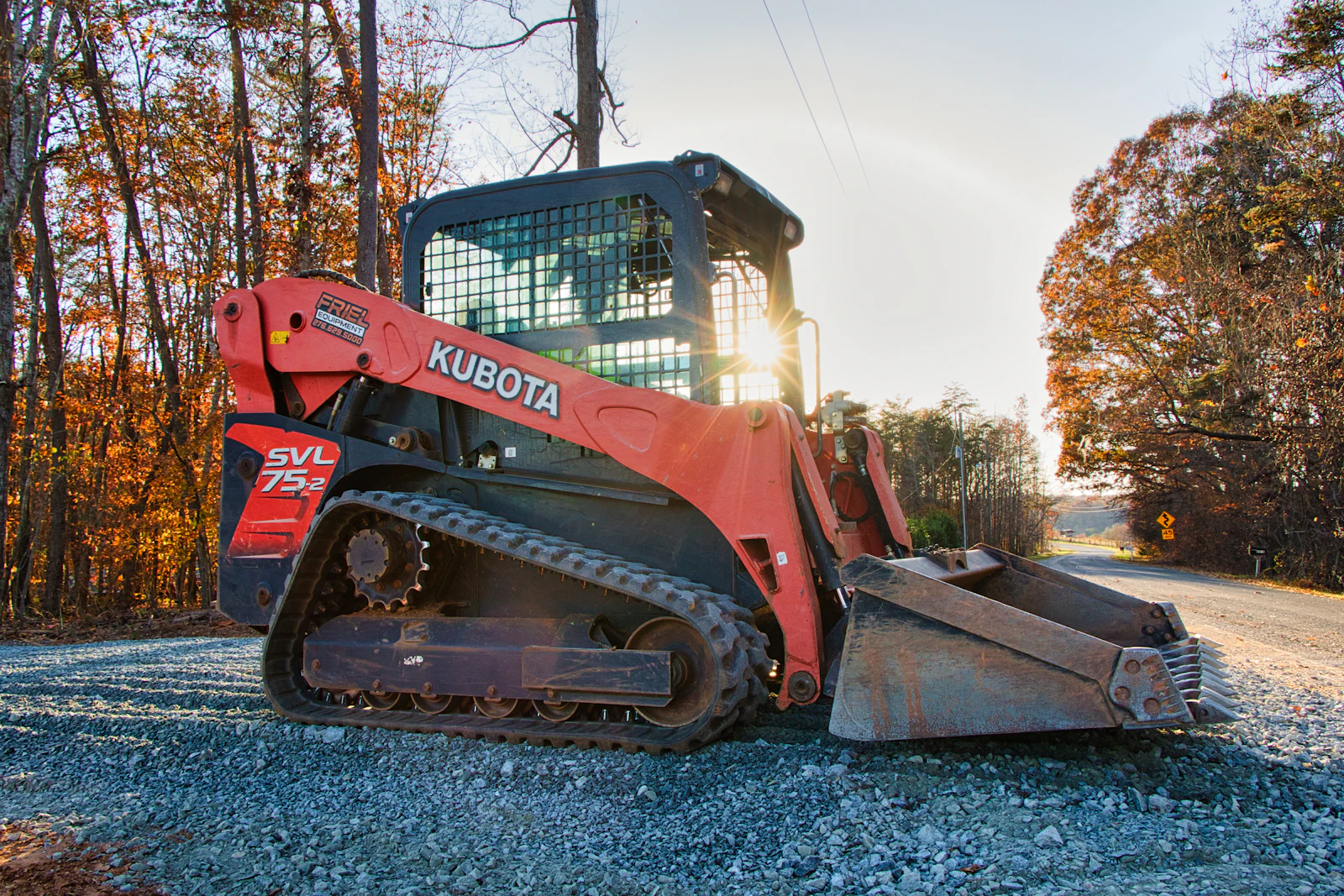
Even if your scope says “skid steer loader,” Baltimore sites with wet subgrade, utility trench spoils, or demolition rubble often perform better with a compact track loader (CTL). The decision is not just traction—it is financial: a stuck wheeled skid steer can generate paid idle days, extra delivery moves, and potential tow/extraction charges. If you expect repeated rain days or soft soils, it can be cost-effective to budget the track upgrade from the start rather than paying for disruptions.
As a planning comparison, published 2026 rate sheets show track loader classes (e.g., Bobcat T590 category) at higher weekly costs than wheeled skid steer classes, and many rental brochures publish separate “track loader” tiers at a premium. Use that differential as your allowance when the site has a credible stuck-risk.
Quick 2026 Planning Allowances (No Surprises)
- Minimum delivery/pickup exposure (if not included): $200–$600 round trip
- Mileage-based delivery exposure (where billed): $3.50/mile with $100 minimum each way (example policy)
- Damage waiver / RDW: 10%–15%
- Environmental/admin: 2%–5%
- Cleaning closeout: $150–$400
- Meter overage: $6–$15/hour beyond included utilization
- After-hours / constrained-window logistics: $75–$150 premium plus possible wait time $85–$125/hour
- Refuel surcharge exposure (example): $7.00/gal if returned not full