Build your next estimate with CountBricks
Create an itemized estimate for your project, with materials, labor, and quantities you can review and edit.
Create my estimateStart a 7-day free trial. Sign up, then enter your project details.
Skid Steer Loader Rental Rates Boston 2026
For Boston-area concrete driveway scopes in 2026, budgeting skid steer loader equipment hire typically lands in the $300–$400/day range for mid-size wheeled units and $400–$475/day for compact track loaders when you need more flotation or traction; weekly and monthly commitments commonly compress the effective day-rate to roughly $1,000–$1,500/week and $3,000–$3,950/month, before delivery, damage waiver/physical damage protection, fuel, and cleaning. As a reality check on posted local rate sheets, one Boston-servicing New England dealer lists wheeled skid steers at $300/day (S510), $350/day (S64/S66), and $400/day (S76), with corresponding monthly figures of $3,000, $3,400, and $3,800; their compact track loader day-rates show $400/day (T64/T66 class) up to $475/day (T76/T770 class), with monthly figures up to $3,950. National rental houses with Boston metro coverage (for example, United Rentals, Sunbelt Rentals, and Herc Rentals) can price similarly but will vary by branch, spec (cab/heat/AC), and availability; for estimating, treat the numbers in this article as planning ranges unless your quote is in hand.
| Vendor |
Daily Rate |
Weekly Rate |
Review Score |
Website |
| United Rentals |
$400 |
$1 250 |
8 |
Visit |
| Sunbelt Rentals |
$390 |
$1 230 |
8 |
Visit |
| BigRentz |
$413 |
$1 279 |
4 |
Visit |
| Ahearn Rents |
$375 |
$1 200 |
9 |
Visit |
| 48 Peaks Equipment (Bobcat of Boston) |
$350 |
$1 150 |
2 |
Visit |
Important Boston planning assumptions (confirm on your quote): (1) “Monthly” may mean a 4-week (28-day) cycle at national fleets, while some local houses publish a 30-day month; (2) “Weekly” is often a 7-day period; and (3) “Daily” is commonly a 24-hour clock starting at delivery or pick-up. One Boston-rate sheet spells out that weekend rentals are dropped Friday and picked Monday, that weekly is based on 7 days, and that monthly is based on 30 days.
What Drives Skid Steer Hire Cost for a Concrete Driveway in Boston?
Concrete driveway work is one of the fastest ways to turn a “simple skid steer rental” into a higher all-in equipment hire cost, because the scope tends to require (a) higher hydraulic power for breakers/planers, (b) frequent material handling (demo debris, subbase aggregate), and (c) tighter site constraints common in Boston neighborhoods (limited staging, narrow curb lanes, strict delivery windows).
- Machine class and rated operating capacity (ROC): The spread between a small wheeled skid steer and a larger wheeled unit is often $50–$100/day in Boston-area rate sheets (and can be more in peak season). Example posted day-rates move from $300/day (small wheeled) to $400/day (larger wheeled).
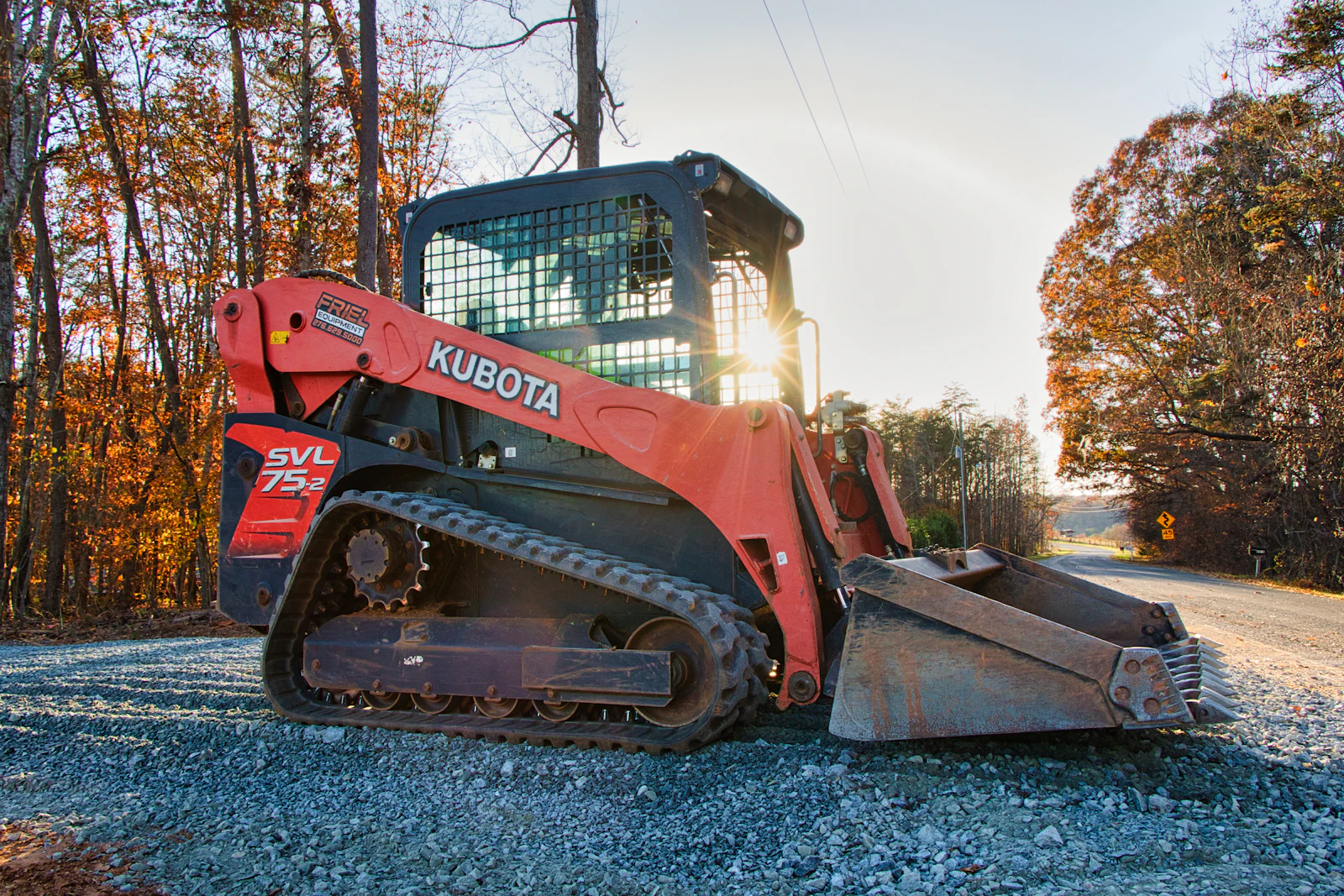
- Wheels vs tracks: For driveway demo and base prep, contractors often prefer a compact track loader (CTL) for stability and traction on disturbed base; the trade is higher hire cost and higher cleaning/undercarriage risk. Local posted CTL day-rates show $400–$475/day in the Boston-servicing market.
- Cab configuration: Enclosed cab with heat/AC helps on multi-day urban jobs (noise/dust exposure, winter weather), but typically pushes you toward higher-spec units; budget a 10%–20% premium versus open cab when you have a choice (verify with the branch).
- Standard bucket included vs specialty buckets: Some local rate sheets note the base machine includes one bucket, but specialty buckets or attachments are separate line items.
- High-flow hydraulics: If your driveway scope includes cold planing, heavy brooming, or a larger breaker, high-flow is frequently required; treat high-flow as a spec that narrows availability and can add $25–$75/day depending on the fleet.
Posted Boston-Area Rate Examples You Can Use to Anchor a 2026 Budget
Use posted local rates as “guardrails” for your Boston skid steer loader equipment hire estimate, then apply allowances for attachments and logistics.
Example 1 (Boston-focused dealer sheet): Wheeled skid steer day-rates shown at $300/day, $350/day, and $400/day (model class dependent), with $1,000–$1,300/week and $3,000–$3,800/month.
Example 2 (Massachusetts rental price list with track vs tire): A published 2026 list shows a tire skid steer at $300/day and $2,995 (28 days), while a track skid steer is shown at $375/day and $3,695 (28 days) (with additional multi-day options and specific return timing).
Example 3 (alternate regional benchmark): One published rate page (outside Boston proper but in the region) shows skid steers spanning $329/day (1,650 lb class) up to $429/day (2,900 lb class), with weekly and monthly options.
These are not “the” market price for every Boston job; they’re useful because they illustrate what changes the invoice: class/size, tracks, and duration. Your procurement target in 2026 is to get the machine right-sized for cycle time and attachment compatibility, not necessarily the lowest day-rate.
Attachment Adders That Commonly Hit Driveway Jobs
Concrete driveway scopes frequently need at least one add-on beyond the standard bucket. If you don’t include these in the requisition, you often lose a day waiting for a swap—turning a 5-day plan into a 6-day invoice.
Typical attachment hire costs (posted example rates):
- Hydraulic breaker/hammer: posted at $250/day and up to $1,200/week on a Boston-servicing sheet (confirm carrier bracket and coupler type).
- Pallet forks: posted at $100/day / $300/week / $900/month for unloading block, base, or bundles.
- Grading bucket: posted at $65/day / $250/week / $600/month for fine shaping subbase and shoulder tie-ins.
- Rock bucket: posted at $100/day / $300/week / $900/month for screening or handling coarse material.
- Auger & bit: posted at $250/day (bit-only adders also exist) if you’re setting forms/guard posts or drilling for bollards.
- Box sweeper/broom: posted at $400/day / $1,800/week / $3,950/month for final clean on urban streets (often requires high-flow).
- Cold planer (example 24-inch class): posted at $450/day / $1,500/week / $4,200/month when you need to match grade at a garage threshold or mill asphalt at the apron (verify flow requirements).
Practical procurement note: If your driveway job includes a breaker, confirm you also have a plan for (a) haul-off equipment, and (b) steel protection on finished surfaces. It’s common for the machine hire cost to be acceptable, but for the return-condition charges (chips in glass, bent couplers, damaged cutting edge) to be the budget miss.
Hidden-Fee Breakdown for Skid Steer Equipment Hire in Boston
Most “rate” discussions miss the invoice items that matter most to a rental coordinator: delivery, time-based overages, surcharges, and return condition. Build these as allowances so you don’t have to seek change orders late.
- Delivery and pick-up: Boston delivery is rarely “free.” For planning, carry $150–$350 each way within a local radius, plus potential mileage beyond the included zone. Add a $75–$125 minimum dispatch charge if you’re moving small attachments separately (assumption; confirm). Boston-specific issue: if you need a truck-mounted forklift or liftgate, add $75–$200 per trip.
- Transportation surcharge (example policy): Some national providers apply a transportation surcharge that includes a fixed component of 9% (or a minimum of $9) plus a variable fuel component; a published example shows the surcharge totaling 16% in a sample month.
- Shift/usage limits and overtime: A common structure is one shift included: 8 hours/day, 40 hours/week, 160 hours/4-week. Overages may be billed at 1/8 of the daily, 1/40 of the weekly, or 1/160 of the 4-week rate per excess hour (plus tax). This matters on driveway pours when you run the machine longer for staging and cleanup.
- Preventative maintenance (PM) charges (example): Some contracts apply PM as a per-hour charge in the $1–$6/hour range, adjusted to actual meter hours at closeout.
- Fuel/refueling service: If returned not full, expect a refueling service line item (often at a posted rate at the branch) plus time for the yard to service the unit. A published fueling policy notes a refueling service charge applies when equipment is not returned full. Carry a $75–$250 fuel/DEF closeout allowance for skid steers on multi-day driveway work (assumption; confirm).
- Cleaning charges: Concrete slurry, mortar splatter, and cured material in the bucket are common triggers. One published policy explicitly assigns responsibility for cleaning costs when equipment is returned with excessive dirt, concrete, and/or paint. For planning, carry $150–$500 for wash/cleaning risk on driveway demo (assumption; confirm), and require pre-return photos.
- Damage waiver / rental protection: Commonly priced as a percentage of base rent; budgeting 10%–15% of the rental rate is a typical estimating allowance when you can’t obtain an exact quote.
- Taxes: Massachusetts sales tax is 6.25% on the rental charge of tangible personal property (including equipment rentals), unless an exemption applies.
- Key/fob recovery, toll admin, and incidentals: If you’re working downtown and a rental vehicle/trailer uses cashless tolling or incurs recovery, plan an administrative add-on. One published charge schedule calls out replacement cost plus admin fees for lost keys/fobs and includes toll management services concepts.
Boston-Specific Constraints That Change the Final Skid Steer Hire Cost
- Street occupancy and staging: In dense neighborhoods (South Boston, Back Bay, North End), you may need to stage the skid steer on a tight footprint. If your delivery truck can’t legally stop, you risk a failed delivery and a second mobilization. Carry a $100–$250 re-delivery allowance (assumption) and require the superintendent to confirm curb space.
- Delivery windows and cutoffs: Many Boston sites only accept deliveries before 7:00 a.m. or after 3:00 p.m. due to traffic control and school zones (typical practice; confirm per site). If you miss the window, you often lose the day’s productivity but still pay the daily clock.
- Winter and freeze-thaw impact: Boston winter conditions can force you into tracked units for traction on icy base, but the undercarriage cleaning requirement (salt, frozen mud) increases closeout risk. Budget extra time for end-of-day washdown and carry a $200 cleaning contingency on winter driveway jobs (assumption).
Example: Boston Concrete Driveway Demo and Base Re-Grade (Costed Rental Scenario)
Scenario: Remove a small residential concrete driveway and re-grade base in Dorchester with limited staging. Work planned for 7 calendar days with two days of heavy breaker use and one day of sweeping/cleanup.
- Machine hire (planning): Compact track loader for one week at a posted example of $1,200/week.
- Breaker attachment (2 days): $250/day x 2 = $500 (or quote weekly if you need it longer).
- Grading bucket (1 week): $250/week.
- Delivery + pick-up (allowance): $250 each way = $500 (assumption; confirm by radius and truck type).
- Damage waiver allowance: 12% of base rental (machine + attachments) (assumption).
- Overtime/overage allowance: Plan for 4 extra meter hours beyond the included shift limits if cleanup runs long; apply the provider’s excess-hour formula if your contract uses one (example policies use a one-shift structure).
- Cleaning allowance: $250 to cover concrete residue risk if the crew can’t wash out the bucket and tracks fully (assumption; cleaning responsibility is commonly assigned to the renter).
- Sales tax: 6.25% on taxable rental/fees (confirm taxability of specific surcharges).
Operational constraint that changes the number: If your site can only accept delivery after 3:00 p.m., you may lose Day 1 productivity but still start the 24-hour clock at delivery—so consider scheduling delivery for early morning Day 1 or negotiate a “start billing on next business day” note in writing.
Budget Worksheet (Skid Steer Equipment Hire Allowances for Boston)
Use this as a no-table estimating artifact for a rental order tied to a concrete driveway scope. Adjust quantities to match your plan (calendar days vs meter hours) and your vendor’s billing cycle.
- Skid steer loader (wheeled) base rent allowance: $300–$400 per day (Boston planning range) or $1,000–$1,300 per week for a 7-day week.
- Compact track loader base rent allowance: $400–$475 per day or $1,200–$1,400 per week (Boston planning range).
- Breaker/hammer attachment allowance: $250/day; if multi-day, carry $1,000–$1,200/week depending on the sheet/branch.
- Pallet forks allowance: $100/day (or $300/week).
- Grading bucket allowance: $65/day (or $250/week).
- Street sweeper/broom allowance (if required by site/GC): $400/day; confirm high-flow requirement.
- Delivery + pick-up allowance: $300–$700 total round trip (typical Boston planning range; confirm by mileage, access, and truck type).
- Transportation surcharge allowance (if your supplier applies it): 9% fixed component (min $9) plus variable fuel component; carry 12%–18% for planning if not known.
- Preventative maintenance charge allowance: $1–$6 per operating hour if included in your vendor’s terms.
- Damage waiver / rental protection allowance: 10%–15% of base rent (use vendor-specific rate if quoted).
- Refuel/DEF closeout allowance: $75–$250 if you cannot guarantee “return full” on the last shift; many policies charge when not returned full.
- Cleaning allowance (concrete driveway risk): $150–$500; concrete residue is a known trigger for cleaning charges.
- Overage/extra shift allowance: Carry 2–6 excess hours and price per your contract. One common structure includes 8 hours/day, 40 hours/week, 160 hours/4-week, with excess-hour formulas tied to the base rate.
- Tax allowance: Massachusetts sales tax at 6.25% on the rental charge (unless exempt).
Rental Order Checklist (What to Confirm Before You Dispatch)
- PO and billing: PO number on contract; agreed billing cycle (24-hour day vs “business day”); weekly definition (often 7-day); month definition (28-day vs 30-day).
- Delivery requirements: Exact address, contact phone, delivery window, curb/staging plan, and whether a liftgate/forklift is required for attachments.
- Access constraints: Gate width (many skid steers are 60–70 in class); overhead clearance; noise restrictions; indoor dust-control requirements if entering a garage (HEPA vac attachment or wet-cut rules if applicable).
- Machine spec: Tracks vs wheels; enclosed cab vs open; high-flow required (yes/no); coupler type; bucket type; auxiliary hydraulics and electrical connector compatibility for attachments.
- Included tools/accessories: Confirm “one bucket included” (if applicable), spare key, operator manual, backup alarm, and any required safety decals.
- Insurance: Certificate of insurance (COI) requirements; damage waiver/rental protection elected (yes/no) and rate confirmed.
- Condition documentation at delivery: Photo set of cab glass, cutting edge, coupler, tracks/tires, hour meter, and existing dents; note it on the ticket before signing.
- Off-rent and return: Off-rent notice method (email/portal/phone), cutoff time (often early afternoon), return “full fuel” expectation, and cleaning standard (especially concrete residue).
How to Control Skid Steer Equipment Hire Cost Without Slowing the Driveway Schedule
- Match rental duration to the real calendar: If your job runs Monday–Friday but the vendor’s “week” is 7 days, consider whether two 2-day blocks plus a day is cheaper than a full week, or vice versa—some 2026 price lists publish multiple options (2-day, weekend, 5-day, 7-day, 28-day).
- Bundle attachments up front: A $250/day breaker plus $150–$350 mobilization can be cheaper than “swap mid-week” with an extra trip and lost production.
- Stay under shift-hour thresholds: If your terms include 8-hour days and excess-hour formulas, schedule cleanup within the shift to avoid billable overages.
- Plan for washdown and documentation: For concrete driveway work, assign 30–45 minutes end-of-shift to remove concrete residue from bucket corners and steps, and capture photos to reduce cleaning charge disputes (cleaning responsibility is commonly assigned to the renter).
Closeout Notes for Boston Driveway Jobs (Avoiding the Surprise Invoice)
Before the skid steer leaves site, confirm (1) attachment count matches the contract, (2) fuel level is documented, (3) the hour meter is recorded, and (4) you’ve sent off-rent notice early enough to meet the branch cutoff. Boston sites with limited curb access should also confirm the pick-up truck can stage legally; otherwise, failed pick-ups can add another day to the rental clock.