

For concrete driveway work in Charlotte, 2026 planning budgets for skid steer loader equipment hire typically land in three bands: wheeled skid steers at roughly $350 to $450 per day, $900 to $1,150 per week, and about $2,400 to $3,100 per 4-week (28-day) month; compact track loaders (CTLs) at roughly $280 to $500 per day, $840 to $1,700 per week, and about $2,490 to $3,950 per 4-week month; and high-flow track units for breaker or production attachments at roughly $500 to $650 per day, $1,500 to $1,925 per week, and up to about $5,750 per 4-week month. These ranges assume a standard single-shift rental basis and exclude freight, fuel, damage waiver/RPP, and attachment adders. In Charlotte, rental coordinators commonly source from national accounts (United Rentals, Sunbelt Rentals, Herc) plus local independents that publish online rates or quote by job and delivery zone.
| Vendor | Daily Rate | Weekly Rate | Review Score | Website |
|---|---|---|---|---|
| United Rentals | $415 | $1 245 | 9 | Visit |
| Sunbelt Rentals | $405 | $1 215 | 8 | Visit |
| Herc Rentals | $410 | $1 230 | 8 | Visit |
| The Home Depot Rental (Compact Power) | $319 | $957 | 9 | Visit |
| Carolina Cat Rental Store (The Cat Rental Store) | $430 | $1 290 | 10 | Visit |
Use the ranges below as estimating allowances for skid steer loader hire in Charlotte when the scope is concrete driveway demo support, base rework, drainage trenching support, loading spoils, and finish grading. Where possible, I am anchoring the planning bands to published 2026 marketplace averages and Charlotte-area posted rates (example CTL day/week/month and common attachment day/week/month).
Wheeled skid steer (typical 1,300 to 2,200 lb ROC class): plan $331 to $450 per day, $1,004 to $1,100 per week, and $2,438 to $2,900 per 4 weeks when sourced through marketplace programs or comparable fleet classes. This class is cost-effective for driveway base spreading on stable subgrade and for loading pallets (forms, rebar, bagged material) with forks.
Compact track loader (CTL) for Charlotte clay and weather risk: plan $280 to $500 per day, $840 to $1,700 per week, and $2,490 to $3,950 per 4 weeks depending on size and cab configuration. Example posted Charlotte-area CTL rates include $280 per day / $840 per week / $2,490 per month for a smaller CTL class and $359 per day / $1,149 per week / $3,125 per month for a larger CTL class.
Skid steer loader (vertical-lift production unit) day and week specials: plan around $275 per day and $1,100 per week for a vertical-lift skid steer class when available on promo pricing, with track loader variants closer to $370 per day and $1,500 per week. Treat specials as opportunistic and not guaranteed for bid carry.
High-flow track skid steer for heavy hydraulic demand (breaker, brush cutter, high-flow planers): plan $550 to $650 per day, $1,700 to $1,925 per week, and $4,500 to $5,750 per month. A published rate sheet example shows $650 per day / $1,925 per week / $5,750 per month for a high-flow track unit with cab and AC.
For concrete driveway packages, the biggest rate driver is not the bucket; it is undercarriage selection and whether you need a CTL to stay productive in Charlotte’s rain cycles and clay subgrade. CTLs commonly price higher than comparable wheeled skid steers, but they can prevent schedule creep (and extension days) when the driveway subgrade turns soft. As a budgeting assumption, it is reasonable to carry CTLs at about 10% to 20% above wheeled units in many markets, then validate with your account pricing and branch availability.
Capacity class also matters. If the work is primarily driveway base placement and rough grade, a smaller or mid-frame unit can be adequate; if you are loading demo debris into a dump trailer or managing stone deliveries with forks, you may need the additional ROC and lift height of a larger frame. The cost impact is usually a step change (one fleet class up) rather than a smooth curve. Budget for at least one “swap risk” event: if the first unit arrives without the hydraulic flow, coupler type, or tire condition your driveway scope requires, you can lose a half-day in offloading and re-delivery unless you preconfirm the spec sheet and attachments in the PO.
Charlotte-specific considerations that routinely change real hire cost on driveway scopes include (1) red clay and intermittent storms that favor CTLs (to avoid ruts and avoid adding an extra compaction day), (2) tight residential subdivisions where a rollback cannot stage and you incur $125 to $250 re-delivery or wait-time charges if access is not pre-cleared, and (3) protecting existing asphalt or decorative concrete near the driveway tie-in (often requiring ground protection mats or plywood, which is a separate line item if you hire it rather than supply it).
Skid steer loader hire for concrete driveway scopes is rarely “machine only.” The estimator should carry attachment adders explicitly, because attachment availability is often the constraint that drives which yard you use and whether you pay for a higher-flow unit. Below are common adders with published examples from a Charlotte-area rental site and a separate published rate sheet for a high-flow track class; use these as planning anchors and then normalize to your account discounts and freight.
Hydraulic breaker (skid steer mounted): plan about $300 to $400 per day, $800 to $1,100 per week, and $2,000 to $2,990 per month depending on class and carrier requirements. Example posted breaker pricing shows $369 per day / $1,099 per week / $2,990 per month.
4-in-1 bucket (with teeth): plan $45 to $145 per day, $135 to $440 per week, and $399 to $900 per month depending on width and duty class. Example posted rates show $45 per day / $135 per week / $399 per month for a 72-inch class 4-in-1 bucket, and a separate published sheet shows $145 per day / $440 per week / $900 per month for an 80-inch 4-in-1 bucket.
General purpose bucket with teeth: plan $25 per day / $75 per week / $225 per month for a smaller bucket class when itemized (often included with the machine, but not always if you are swapping specialty buckets).
Severe duty or grading bucket: plan $60 per day / $179 per week / $539 per month for a larger grading or severe duty bucket class where listed separately.
Pallet forks (material handling for driveway forms, bundles, bagged cement, pavers): plan $59 to $80 per day, $180 to $250 per week, and $399 to $650 per month depending on fork class.
Auger drive (holes for edge forms, signage, or drainage inlets depending on design): plan $75 to $250 per day, $299 to $500 per week, and $550 to $1,000 per month depending on whether bits are included and the torque class. A posted Charlotte-area example lists $75 per day / $299 per week / $550 per month.
Trencher attachment (for driveway drain or conduit crossings): plan $75 to $250 per day, $205 to $675 per week, and $675 to $840 per month depending on trench depth and chain class. Example posted pricing shows $75 per day / $225 per week / $675 per month for a trencher class on a Charlotte-area list; another published 2026 price list shows $120 per day / $205 weekend / $280 week / $840 month for a 48-inch trencher class.
Power rake / soil conditioner (driveway base blending and finish prep): plan about $200 to $250 per day, $500 to $675 per week, and $800 to $1,400 per month depending on width.
Most cost overruns on skid steer loader equipment hire are not from the base day rate. They come from freight, billing rules, and return condition. For Charlotte concrete driveway scopes, carry the following as explicit allowances so your project team does not “discover” them on the closeout invoice.
Delivery and pickup (freight): carry $100 to $400 each way as a national planning allowance, then validate the Charlotte branch zone and any fuel surcharge on transport. If the site is in Uptown, South End, or dense subdivisions with no turnaround, also carry a potential $95 to $150 per hour wait-time or redelivery charge when the driver cannot offload within the scheduled window.
Minimum rental term and shift basis: many contracts assume an 8-hour day, 40-hour week, and 160-hour 4-week period. If your driveway schedule needs 10 to 12 hour days to hit a pour, plan for overtime billing rather than assuming “daily” means unlimited use.
Double-shift and triple-shift multipliers: a published set of rental terms shows double shift (16 hours per day) charged at 1.75 times the daily, weekly, or 4-week rate, and triple shift (24 hours per day) at 2.75 times. This matters when you run late-day base trimming and want to keep the skid steer for night cleanup on a driveway replacement.
Damage waiver / RPP: planning allowances of 10% to 15% of rental charges are common in many markets; one set of published rental terms shows an RPP fee of 16% to 17% depending on the rental division. Confirm whether it applies to attachments and whether it excludes tires, tracks, and undercarriage wear.
Fuel and fluids: carry a refuel charge if returned below full (often billed at a posted per-gallon rate plus service). On Tier 4 units, also plan for DEF handling; if you return a machine with low DEF and warning history, some fleets bill a shop service event rather than just fluid. Put a $25 to $75 “fuel/fluids closeout” allowance in the budget for short rentals where the crew does not have onsite diesel handling.
Cleaning and concrete residue: published rate sheets show cleaning billed at $75 per hour in some fleets; for driveway scopes, the risk is concrete slurry, clay packed into undercarriage, and adhesive or geotextile residue. Carry $75 to $300 for cleaning on short-term rentals, and more if you are using the skid steer near wet concrete operations or demo rubble.
Tracks and tire damage exposure: a rental guide notes track replacement can be $1,500 to $3,000, which is why many fleets require undercarriage photo documentation at delivery and at pickup. On driveway demo, rebar and sharp rubble are the most common track cutters; if you cannot segregate debris, consider carrying a sacrificial ground protection layer or switching to wheeled tires on stable surfaces.
Two rules affect concrete driveway equipment hire costs more than most field teams expect: the “4-week month” convention and the off-rent cutoff time. Many national programs publish monthly pricing as a 28-day rate, and your invoice clock may not stop until you have formally off-rented the machine and the yard has issued a return receipt. That means you should (1) treat monthly as 28 days in your estimate and (2) write off-rent procedures into the superintendent’s closeout plan.
Operationally, coordinate these items before the machine hits the driveway: confirm the delivery window (for example, first drop 7:00 to 10:00 AM versus mid-day), confirm whether “off-rent by 2:00 PM” is needed to avoid a next-day charge, and confirm whether weekend possession (even if not used) creates billing exposure. If you are pouring the driveway on a Friday and intend to return Monday, get the weekend billing policy in writing and ensure the attachment is not left installed if the rental terms meter usage or telematics indicate movement.
Scenario: Replace a 12 ft by 60 ft residential concrete driveway in Charlotte (720 sq ft). Scope includes removing soft spots in subgrade, importing and spreading #57 stone, trimming grade to forms, and breaking a short section of old slab at the garage apron. Access is a tight subdivision with limited staging; delivery must be before school traffic.
Machine selection: CTL (to manage clay and avoid rutting). Example posted rate for a larger CTL class: $359 per day / $1,149 per week / $3,125 per month (tax excluded).
Planned rental term: 2 days CTL time for stone placement and grading: 2 x $359 = $718 equipment hire.
Attachments: 72-inch class 4-in-1 bucket at $45 per day (2 days = $90) and a hydraulic breaker at $369 per day (1 day = $369).
Freight allowance: carry $250 delivery + $250 pickup = $500 (Charlotte metro). Use $100 to $400 each way as the broader planning band if you do not have zone pricing yet.
Damage waiver allowance: carry 12% of time and attachment rent as a planning number: 0.12 x ($718 + $90 + $369) = about $141 (rounded).
Closeout allowances: fuel/fluids $50, cleaning $75 (one hour), and a $125 access/redelivery contingency if the rollback cannot stage on first attempt.
Estimated hire total (planning): $718 + $90 + $369 + $500 + $141 + $50 + $75 + $125 = about $2,068, excluding tax and excluding imported stone/material. The key operational constraint is avoiding a third billable day by coordinating off-rent and pickup immediately after final grading (do not wait for the next morning “just in case”).
Skid steer loader or CTL equipment hire (base machine): $280 to $500 per day allowance depending on undercarriage and size class.
Breaker attachment hire (if any slab demo or apron removal): $300 to $400 per day allowance.
4-in-1 bucket or grading bucket hire (if not included): $45 to $145 per day allowance.
Pallet forks hire (material handling): $59 to $80 per day allowance.
Freight (delivery + pickup): $200 to $800 total allowance ($100 to $400 each way).
Damage waiver / RPP: 10% to 17% of rental charges allowance (confirm rate and exclusions).
Cleaning allowance: $75 to $300 (carry at least one hour on driveway scopes with clay).
Fuel and fluids closeout allowance: $25 to $75 (short-term rentals) plus any onsite diesel handling cost.
Access contingency (tight neighborhoods): $125 to $250 (redelivery, wait time, or alternate offload).
PO includes: machine class (ROC and lift path), undercarriage (wheeled or CTL), cab type (open or enclosed), and hydraulic flow requirement (standard vs high-flow).
Attachments listed by coupler type and required hoses: 4-in-1 bucket, grading bucket, breaker, forks, trencher, auger (include bit sizes).
Delivery requirements: site contact, exact drop point, gate codes, delivery window, and confirmation that rollback can access and turn around without HOA violations.
Billing controls: confirm rate basis (8-hour day and 4-week month conventions), overtime multipliers, and weekend/holiday billing policy in writing.
Condition documentation: photos of tracks/tires, undercarriage, bucket cutting edge, and any existing damage at delivery and at pickup; meter reading at delivery and off-rent call.
Return requirements: refuel expectation, cleaning standard, key return process, and off-rent cutoff time for next-day billing avoidance.
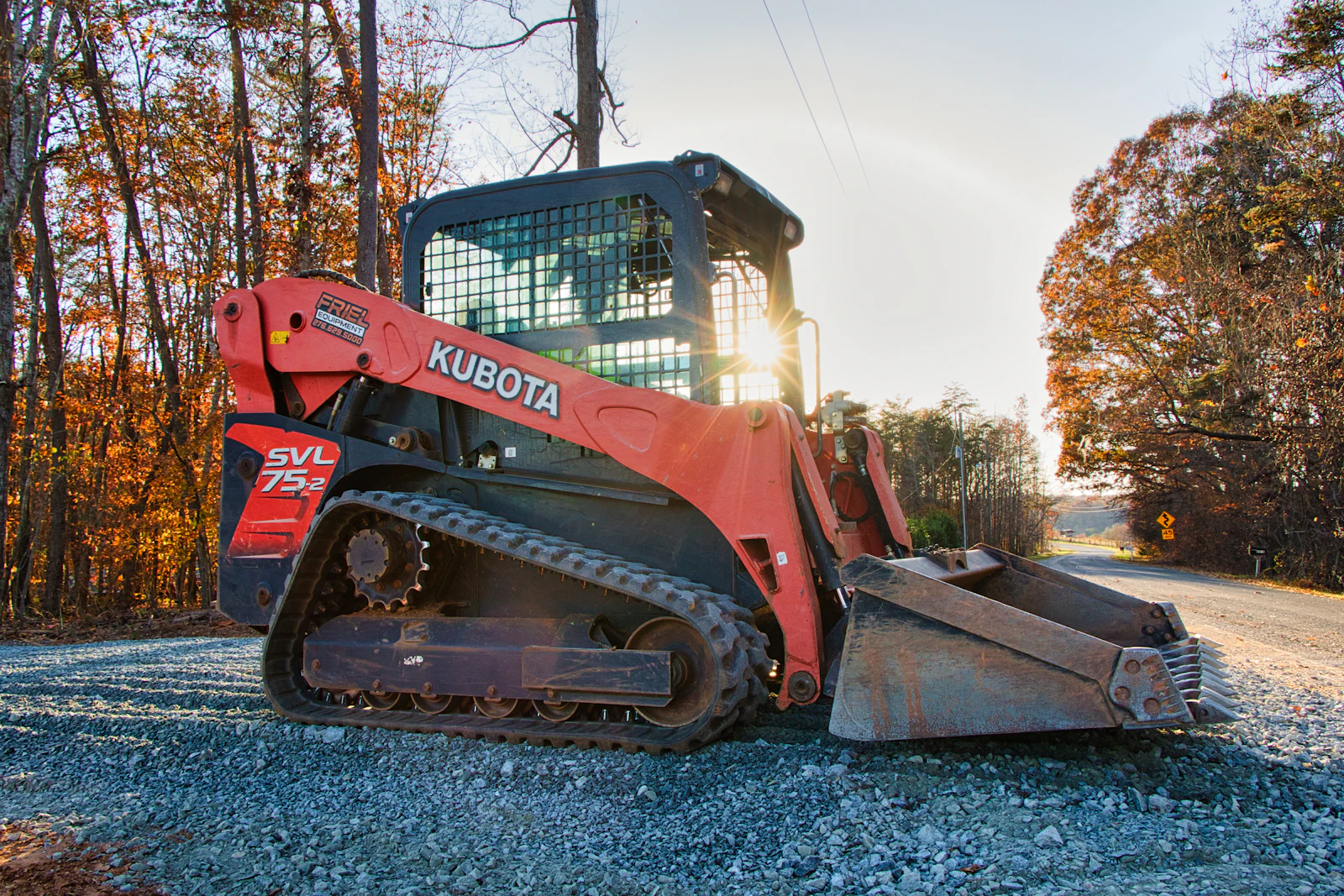
On concrete driveway scopes, skid steer loader equipment hire cost is usually controlled by preventing “extra days,” not by negotiating $20 off the day rate. The Charlotte market reality is that weather, access, and inspection hold points can extend possession. Treat the hire package as a production system: match the machine class to the driveway production constraint, pre-stage attachments, and lock delivery/pickup windows around pour milestones.
Right-size the carrier: If you only need stone spreading and fine trimming, avoid paying for high-flow. If you need a breaker for slab removal, confirm whether the breaker requires high-flow hydraulics; paying for the wrong flow class can cause a mid-rental swap and an extra freight bill.
Bundle the right attachments up front: A common driveway cost leak is a next-day attachment run (or second delivery) for forks, a 4-in-1 bucket, or a trencher. Published attachment rates show these can be meaningful adders (for example, forks at $59 per day and a 4-in-1 bucket at $45 per day in one posted Charlotte-area list), so treat them as planned line items and reserve them with the machine.
Schedule for the 4-week month definition: National rental programs often define monthly as a 28-day rate. If your driveway package is one of many in a neighborhood program, do not assume “calendar month” pricing; align your procurement plan to the 28-day billing cycle.
Prevent overtime billing: Many rental terms assume an 8-hour day, 40-hour week, and 160-hour 4-week period, with double shift billed at 1.75x and triple shift at 2.75x. If your driveway team works 12-hour days to hit a pour, decide whether you accept overtime charges or split tasks with alternate equipment (for example, a smaller loader for cleanup).
Rental coordinators should treat return condition as a cost control activity, not a housekeeping item. Concrete driveway work creates three predictable closeout risks: (1) undercarriage packed with clay, (2) breaker and bucket damage from rebar and rubble, and (3) fuel and fluid closeout charges.
Cleaning exposure: Published rate sheets show cleaning billed at $75 per hour in some fleets. If you are working in wet clay, build a 1 to 2 hour cleaning allowance into the job and plan a washdown location that does not violate stormwater rules.
Tracks and undercarriage exposure: If the driveway demo area has rebar, wire mesh, or sharp stone, require a delivery inspection photo set and a pickup photo set. A rental guide notes a single rubber track can cost $1,500 to $3,000, so undercarriage documentation is a real financial control, not paperwork.
Fuel closeout: If you do not have onsite diesel handling, designate a refuel plan (fuel truck, local station run with approved cans, or a controlled closeout charge). Carry $25 to $75 as a minimum fuel/fluids closeout allowance for short rentals where the machine cannot practically be returned “full.”
Key and accessory reconciliation: Confirm you are returning all items that shipped with the machine (keys, manuals, any lockouts). Missing items can create admin charges that are hard to dispute after the fact.
For Charlotte concrete driveway prep, CTLs are often a cost saver even at a higher day rate because they reduce the chance of ruts, rework, and additional stone. Example posted CTL rates in the Charlotte area include $310 per day / $950 per week / $2,899 per month for one track loader class and $359 per day / $1,149 per week / $3,125 per month for a larger CTL class. If you are working immediately after rain, that premium can be cheaper than adding a day of subgrade remediation or re-compaction.
Conversely, if the driveway scope is mostly hard-surface loading (on concrete or asphalt) and the site is tight, a wheeled skid steer may reduce surface marking and speed up travel cycles. Marketplace averages for Charlotte wheeled skid steers show an average daily price around $415 and a 4-week figure around $2,438 for some fleet classes, which is a useful benchmark when you are comparing quotes.
From a hire-cost standpoint, you are usually choosing between (a) supplying your own insurance and (b) paying an RPP/damage waiver line item. A rental guide cites damage waivers commonly running 10% to 15% of the rental rate. Separately, published rental terms from one heavy equipment provider show an RPP fee of 16% to 17% of total rental charges (with limitations and deductibles). Your procurement workflow should decide which approach is standard for driveway packages, because changing the decision after delivery can trigger re-papering delays and, sometimes, a higher walk-in rate.
In 2026, the practical drivers of skid steer loader hire cost in Charlotte remain availability (especially CTLs after rain events), attachment scarcity (breakers and trenchers), and freight capacity during peak mornings. The most reliable cost control is operational: reserve the attachment package early, specify the exact machine class (ROC and flow), and enforce an off-rent process that stops the clock as soon as the driveway base is trimmed and cleanup is complete. Finally, remember that national programs often display and bill monthly as a 28-day rate, so schedule and budget using that convention when you are forecasting multi-driveway production across a neighborhood program.
