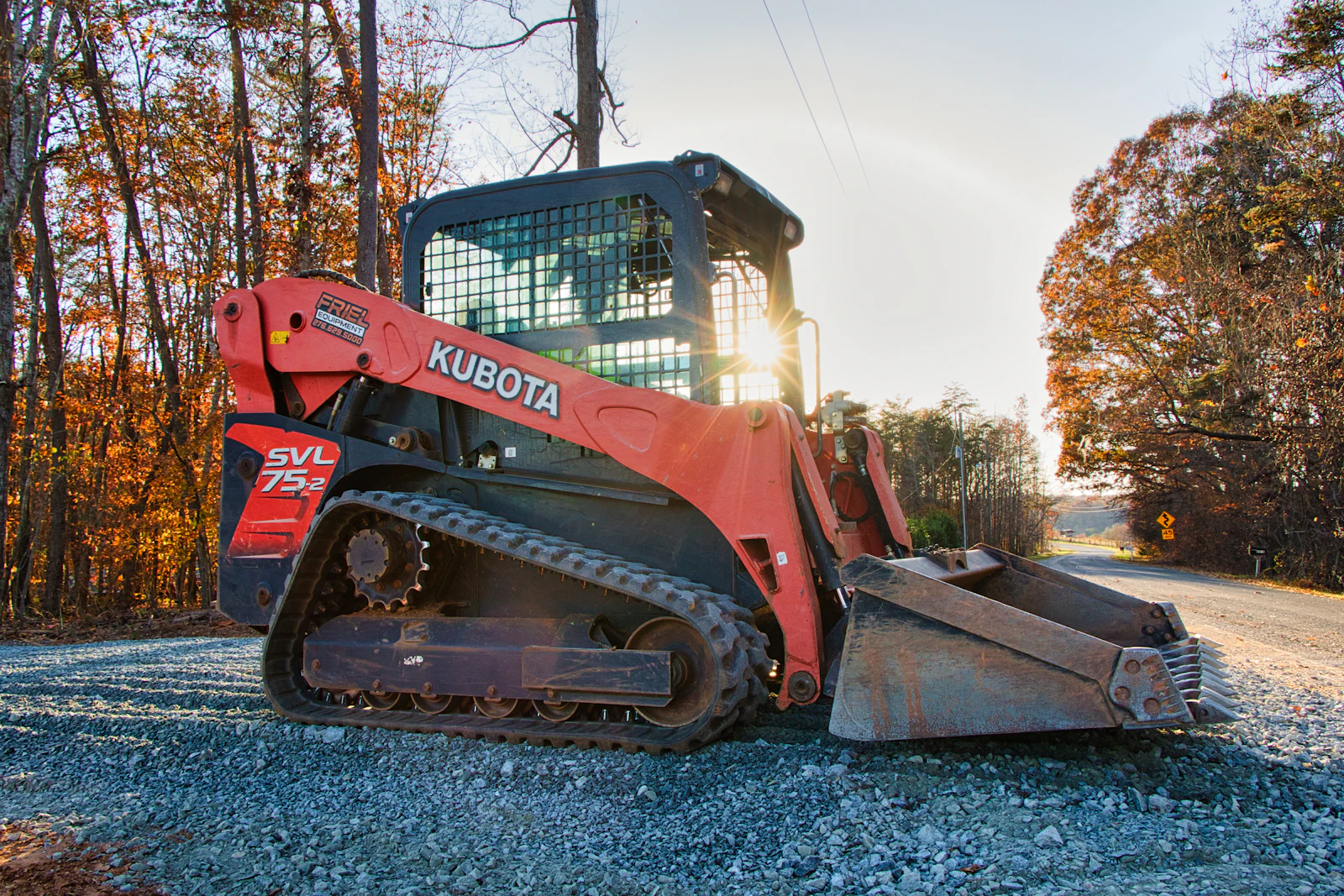
Skid Steer Loader Rental Rates Charlotte 2026
For Charlotte-area skid steer loader equipment hire planned in 2026 (bare machine, no operator), budget $330–$475/day, $1,000–$1,350/week, and $2,400–$3,600 per 28-day month for a wheeled skid steer in the 1,500–2,500 lb rated operating capacity class, with higher pricing for enclosed cabs and high-flow hydraulics. Compact track loaders (CTLs) typically run a premium for soft yards and wet clay conditions common around the Charlotte metro; plan $400–$575/day, $1,200–$1,650/week, and $2,800–$4,200 per 28-day month depending on spec and availability. National branches (e.g., United Rentals, Sunbelt, Herc) and local independents will quote differently by ZIP, delivery window, and attachment package; most will display daily/weekly/monthly rates online, with “monthly” commonly defined as 28 days, not a calendar month.
| Vendor |
Daily Rate |
Weekly Rate |
Review Score |
Website |
| Carolina Cat Rental Store (Charlotte/North Charlotte) |
$413 |
$1 265 |
10 |
Visit |
| Next Level Rental (Greater Charlotte) |
$339 |
$1 099 |
10 |
Visit |
| Wheaton Equipment Rental (Charlotte Metro) |
$450 |
$1 300 |
10 |
Visit |
| Sunstate Equipment (Charlotte branch in Concord, NC) |
$410 |
$1 079 |
7 |
Visit |
What You Need to Dig Footings With a Skid Steer on Charlotte Sites
“Digging footings” with a skid steer loader is usually a combination of excavation (bucket work), spoil handling (loading into a dump trailer or stockpiling), and grade control (backdragging and trimming). On Charlotte infill lots and suburban additions, the machine is often used for: (1) stripping topsoil, (2) cutting shallow footing trenches where depth tolerances are modest, (3) moving spoil to a truck access point, and (4) backfilling/rough grading after inspection. Skid steers can be effective for short runs and tight access, but you will pay more in total hire cost if the scope needs clean vertical cuts or deeper excavation—because you’ll add attachment days, extra haul-outs, and sometimes extra billing days due to slow production.
For footing work, the must-have items that impact hire cost are usually: a general-purpose bucket (often included), a tooth bucket or bolt-on tooth bar for compacted red clay, and a method to manage spoil (forks, grapple, or a trailer). If the plan set calls for pier footings, you may shift spend from bucket time to auger drive + bit hire. If the site is wet or the access is across finished landscaping, track loaders reduce rutting risk but raise daily/weekly rates and can trigger undercarriage cleaning fees if returned packed with clay.
Cost Drivers That Change Skid Steer Loader Hire Rates in Charlotte
Charlotte skid steer loader hire cost is mainly driven by machine class and risk allocation. The biggest rate levers rental coordinators should budget for are:
- Wheels vs. tracks: plan a $40–$120/day premium for CTLs when you need flotation on wet yards or when you’re trying to avoid rut remediation costs.
- ROC and horsepower: stepping up from a 1,500–1,800 lb ROC unit to a 2,500–3,000 lb ROC unit commonly adds $25–$90/day depending on cab and hydraulics.
- Enclosed cab / HVAC: expect $20–$65/day higher base rate versus open cab (plus higher damage exposure if glass is involved).
- High-flow hydraulics: if you’re pairing with a trencher, mulcher, or some auger packages, budget $35–$110/day above standard-flow.
- Utilization and lead time: last-minute requests (same-day or next-day) tend to push you into “whatever is available,” which is often a higher-spec (higher-rate) unit for the same scope.
- Site conditions in the Charlotte region: Mecklenburg County’s clay-heavy soils can increase time-on-machine and increase cleaning time at return, which is a real cost driver if your contract has strict return-condition standards.
Attachment Hire Pricing for Footings, Piers, and Spoil Handling
Attachment adders are where skid steer loader equipment hire costs escalate on footing work. For 2026 planning in Charlotte, typical attachment pricing allowances (not a quote) look like:
- Tooth bar / bolt-on teeth: $25–$60/day or $90–$200/week.
- 4-in-1 bucket: $70–$160/day, often justified if you need clamp/carry and better backdragging control.
- Pallet forks: $25–$55/day or $80–$160/week (useful for rebar bundles, form lumber, and moving palletized materials).
- Hydraulic auger drive: $95–$175/day or $300–$550/week.
- Auger bit (9–24 in.): $35–$90/day per bit size (budget extra for rock or carbide-tooth bits).
- Trencher attachment: $175–$325/day or $600–$950/week (only if the footing layout is trench-friendly and utilities are cleared).
- Breaker/hammer: $200–$450/day plus wear charges if specified in the rental terms (relevant if you hit old concrete or rock).
If your “digging footings” scope includes export, plan for ground protection mats (commonly $25–$60/mat/day) when access crosses finished concrete, pavers, or sensitive turf—this can be cheaper than restoration back-charges.
Hidden-Fee Breakdown
To keep your skid steer loader hire cost in Charlotte from overrunning budget, carry explicit allowances for the charges that frequently show up after the base rate:
- Delivery / pick-up: commonly $125–$275 each way inside a standard service radius; outlying drops may add $4–$9 per loaded mile (and some providers set a minimum route charge).
- Minimum rental charge: many branches enforce a 1-day minimum, even if you only use the machine for a few hours.
- Damage waiver / rental protection: often budgeted at 10%–15% of the base rental (varies by account and equipment class). If you waive it, confirm your insurance certificate meets their requirements.
- Environmental / admin fees: plan 3%–7% of rental and certain services, depending on contract terms.
- Cleaning / decon: if returned muddy (common after Charlotte storms), budget $150–$450 for pressure wash, cab cleanup, and undercarriage removal.
- Fuel / refuel: diesel units are typically “return full.” If not, plan a refuel service charge plus fuel; for budgeting, carry $50–$175 per event depending on tank size and site logistics.
- Battery recharge (electric mini skid steer): if applicable, plan $25–$85 if returned under required state-of-charge.
- After-hours / weekend dispatch: if you need Saturday delivery or after-cutoff pickup, carry $150–$350 as a scheduling premium.
- Not-ready pickup / trip charge: if the unit is blocked in or not accessible at pickup, carry $75–$200 for a failed attempt.
Delivery, Pick-Up, and Site Access Costs in the Charlotte Metro
Charlotte delivery costs are highly sensitive to traffic corridors and time windows. If your site is inside I-485 but requires a tight morning window (e.g., before school traffic or before concrete deliveries), you may pay more for dispatch priority. Conversely, flexible windows often reduce logistics premiums. Practical Charlotte considerations that affect total equipment hire cost:
- Delivery window cutoffs: many yards have next-day cutoff times (commonly early afternoon). Missing cutoff can add 1 extra billed day if you can’t start until the following day.
- Access constraints: gated communities and tight side-yard access can force smaller machines (or a mini skid steer), changing both the daily rate and the number of rental days needed.
- Soil and weather risk: after heavy rainfall, CTLs can prevent getting stuck, but they may also come back with packed clay that triggers cleaning charges—budget both the track premium and the cleanup allowance.
Market check examples show Charlotte-area list pricing that can anchor your 2026 planning range. DOZR reports an average in Charlotte around $410/day, $1,004/week, and $2,438/month for a wheeled skid steer, with a low-end example around $331 depending on availability. A local independent in the Charlotte region advertises a Bobcat T66 at $450/day, $1,300/week, and $3,600/month, and notes a $500 damage deposit requirement. Another regional rate card near Charlotte lists a track skid steer at $400/day, $1,200/week, $2,813/month with a $400 deposit.
Off-Rent Rules, Weekend Billing, and Hour-Meter Overage
Your total skid steer loader equipment hire cost is often more about billing rules than base rates. Before issuing the PO, confirm these items in writing:
- Metered time included: common planning assumption is 8 hours/day, 40 hours/week, and 160 hours per 28-day month. If you exceed it, budget $6–$14 per excess hour depending on machine class.
- Off-rent notification: many suppliers require you to “call off” by a specific time (often mid-day) to stop billing; otherwise you can get billed for the next day even if the work is done.
- Weekend rules: some branches offer “Friday to Monday” programs; others bill calendar days. For budgeting, assume a weekend can add 1–2 extra billed days unless you have written weekend terms.
- Standby / weather days: rain delays do not automatically stop billing—carry contingency days if your schedule is weather-sensitive.
Budget Worksheet
Use this estimator-style worksheet to build a realistic Charlotte 2026 equipment hire budget for a skid steer loader on footing work (line items + allowances; adjust quantities to your schedule):
- Base skid steer loader hire: ___ days at $330–$575/day (select wheel vs track) = $___
- Weekly conversion check: if >3–4 days, price as $1,000–$1,650/week = $___
- Delivery + pick-up: $250–$550 round trip allowance (add mileage if outside standard radius) = $___
- Damage waiver / protection: 10%–15% of base rental = $___
- Environmental/admin fees: 3%–7% allowance = $___
- Attachments: tooth bar $25–$60/day; forks $25–$55/day; auger drive $95–$175/day; bits $35–$90/day = $___
- Cleaning/return condition: $150–$450 allowance (Charlotte clay/mud risk) = $___
- Fuel/refuel contingency: $75–$200 allowance = $___
- Overtime/meter overage: 10–20 hours at $6–$14/hr allowance = $___
- Failed pickup / reschedule risk: $75–$200 allowance = $___
Example: Skid Steer Hire for Digging Footings on a Tight South Charlotte Lot
Scenario: 16 in. wide shallow footing trenches for a small addition, limited access (single driveway), clay soil, and spoil must be stockpiled at the front for later hauling. You plan 3 working days of machine time and want to avoid rutting. You choose a compact track loader instead of wheels.
- CTL base hire: 3 days × $485/day (planning midpoint) = $1,455
- Delivery + pick-up: $395 round-trip allowance (tight window delivery)
- Tooth bar: 3 days × $45/day = $135
- Forks (moving forms/material): 2 days × $40/day = $80
- Damage waiver: 12% × $1,455 = $175
- Cleaning allowance: $250 (mud-packed undercarriage risk after rain)
- Fuel/refuel allowance: $125
Planned hire total (pre-tax, pre-permit, no operator): approximately $2,615. The two biggest swing items are (1) whether you get billed over a weekend (potentially +$485–$970) and (2) whether you return the machine clean enough to avoid a wash/decon charge over your allowance.
Contract Terms That Usually Reduce Total Equipment Hire Cost
On commercial and high-volume residential work, the best savings are typically created by tightening the PO language and utilization plan rather than chasing a lower day rate. For Charlotte skid steer loader equipment hire, the following terms often reduce total cost exposure:
- Specify rate structure: confirm whether the supplier uses a 3:1 or 4:1 day-to-week conversion and whether “monthly” is a 28-day cycle (common on national accounts).
- Cap meter overages: request written included hours and the $ per excess hour before you mobilize.
- Bundle attachments: negotiate attachment package pricing (e.g., tooth bucket + forks) so you’re not paying top-of-card daily adders for every accessory.
- Clarify off-rent process: put the off-rent contact method (email/portal/phone), cutoff time, and “clock stop” definition on the PO to avoid accidental extra days.
Return-Condition Standards That Trigger Charges (Charlotte Clay and Mud)
Charlotte-area footing work frequently produces sticky clay buildup. If your supplier expects “broom clean” or “pressure-washed” return condition, the cheapest path is usually to plan the cleanup time on site rather than paying shop rates. Budget and control these return-condition triggers:
- Undercarriage packed with clay: often results in additional wash time; carry $150–$450 cleaning allowance (or schedule your own wash-off on the last day).
- Tracks/wheels with embedded rebar tie wire, debris, or wrap: can lead to labor charges; carry $95–$250 risk allowance if the site is messy.
- Cab interior dirt / wet concrete residue: can add $75–$200 cleanup depending on severity.
- Missing accessories: lost bucket pins, coupler parts, or attachment hoses can become replacement charges; carry $25–$150 small-parts allowance unless your field teams document everything at delivery and return.
Documentation tip: take time-stamped photos of the hour meter, attachment serials, and machine condition at delivery and pickup. This is often the difference between a controlled closeout and a contested invoice.
Rental Order Checklist
Use this checklist to prevent the most common administrative issues that inflate equipment hire cost on skid steer loader rentals for digging footings:
- PO scope: list machine class (ROC/HP), wheels vs tracks, cab type, and required hydraulics (standard vs high-flow).
- Attachments: specify bucket type (smooth vs tooth), forks, auger drive, and bit sizes (e.g., 12 in., 18 in.) with agreed day/week adders.
- Delivery requirements: jobsite address, on-site contact, gate codes, delivery window, and where to stage the machine so the truck can safely unload.
- Utility clearance: confirm 811 is complete and marked before the rental start time; idle rental days are still billed.
- Insurance: COI on file, damage waiver decision documented, and any additional insured requirements confirmed.
- Billing rules: included hours (8/40/160 or as contracted), excess-hour rate, weekend policy, and off-rent cutoff time written on the PO.
- Fuel/return condition: “return full” expectation, acceptable cleanliness standard, and who is responsible for wash-down.
- Pickup plan: pickup request method, earliest ready time, and confirmation that the unit will be accessible (avoid $75–$200 not-ready trip charges).
2026 Planning Notes for Charlotte Utilization and Scheduling
For 2026 budgets, treat skid steer loader hire as a utilization problem: if you’re paying for the day, keep it producing. In Charlotte, productivity losses often come from weather, access conflicts, and inspection timing. Practical planning guidance:
- Rain contingency: carry 0.5–1.5 contingency days on footing schedules during wet periods; idle days can cost $330–$575 each in base rental alone.
- Inspection holds: if you can’t backfill until inspection, consider off-renting the skid steer during the hold; otherwise you may pay $1,000–$1,650/week while waiting.
- Staging and haul: if spoil export is delayed, you can end up renting longer just to keep the site moving; sometimes adding a dump trailer day ($150–$250/day planning allowance) is cheaper than an extra skid steer day.
When Skid Steer Loader Hire Is the Right Spend for Footings (and When It Isn’t)
Skid steer loader equipment hire is usually cost-effective for footing work in Charlotte when access is tight, excavation depth is modest, and the machine can also support material handling and backfill. It becomes a higher-risk cost choice when the job needs deep vertical excavation, high production in hard material, or long trench runs—because attachment adders and extra billed days can outrun the cost of hiring a dedicated excavator.
If you proceed with a skid steer plan, the cost-control levers are straightforward: choose the smallest capable machine class, lock in weekend/off-rent terms, bundle the minimum attachments required for production, and document condition at delivery/return to prevent closeout surprises.