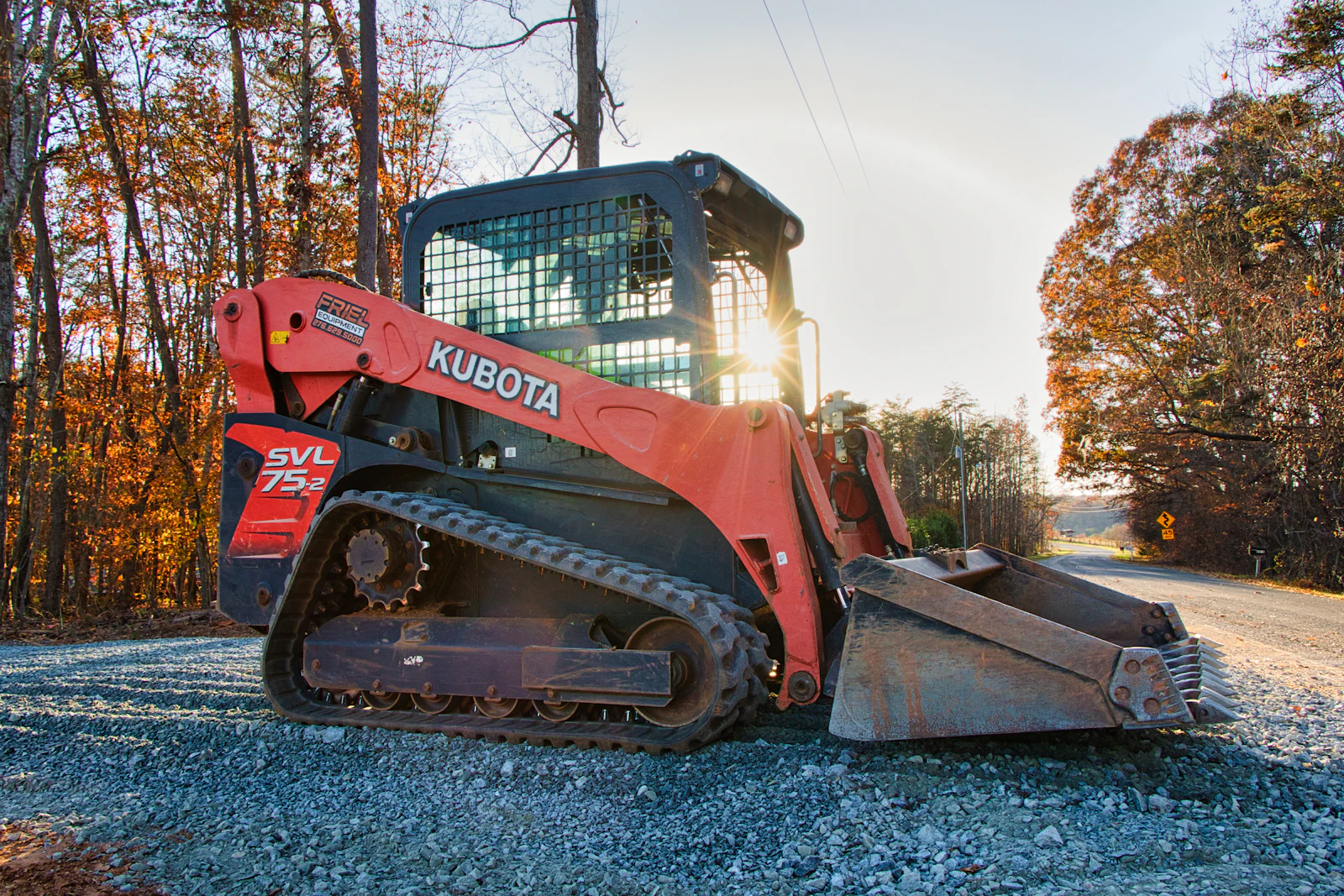
Skid Steer Loader Rental
For 2026 planning in Charlotte, NC, budget skid steer loader equipment hire costs (wheeled skid steers) at roughly $295–$450 per day, $898–$1,200 per week, and $2,053–$3,060 per 4-week period depending on rated operating capacity (ROC), tire vs. track demand, and whether you need high-flow hydraulics for specialty attachments. Recent Charlotte market listings show daily pricing around $295 for smaller classes and about $410/day for common mid-classes, with 4-week pricing around $2,053–$2,438 for typical wheeled skid steer classes. For larger/high-flow units, published rate guides commonly push 4-week totals into the low-$3,000s even before delivery, waiver, and attachments. In Charlotte you’ll typically source from national fleets (e.g., United Rentals, Sunbelt, Herc, Sunstate) and dealer-affiliated rental houses; however, the “real” hire cost is driven by transport windows, off-rent rules, and attachment mix as much as the base day/week/28-day rate.
| Vendor |
Daily Rate |
Weekly Rate |
Review Score |
Website |
| United Rentals |
$415 |
$1 079 |
9 |
Visit |
| Sunbelt Rentals |
$415 |
$1 079 |
8 |
Visit |
| Herc Rentals |
$415 |
$1 004 |
8 |
Visit |
| Carolina Cat |
$337 |
$944 |
9 |
Visit |
| Sunstate Equipment |
$410 |
$1 079 |
9 |
Visit |
Charlotte Skid Steer Hire Rate Benchmarks (What Your Quotes Will Resemble)
Use the ranges below to sanity-check Charlotte skid steer loader rental pricing before you request formal quotations. These are budgetary 2026 ranges that assume a standard-duty wheeled skid steer (roughly 1,450–2,350 lb ROC) with a general-purpose bucket, normal wear-and-tear, and return in broom-clean condition. Published rate guides for skid steers by lift class commonly show $230/day for small-frame units up through $360–$370/day for larger or high-flow units, with weekly rates commonly $690–$1,110 and 4-week rates commonly $2,070–$3,330.
- Small frame (about 700–1,099 lb lift class): plan around $230/day, $690/week, $2,070/4-week as a published benchmark; Charlotte online marketplace availability may come in higher or lower by week.
- Mid frame (about 1,450–1,999 lb lift class): plan around $240–$250/day, $720–$750/week, $2,160–$2,250/4-week as a published benchmark, with Charlotte market averages often clustering closer to the low-$400s/day for certain classes depending on supply.
- Large frame (about 2,675–2,999 lb lift class): plan around $340/day ($365/day high-flow), $1,020/week ($1,095/week high-flow), and $3,060/4-week ($3,285/4-week high-flow).
Note on “monthly” pricing: many rental systems treat “monthly” as 28 days / 4 weeks (not calendar month). Charlotte quotes may show “4-week” explicitly, as some listings do.
What Drives Skid Steer Equipment Hire Costs in Charlotte?
In Charlotte, your skid steer loader equipment hire costs will swing based on four practical variables: (1) machine class/ROC (which influences fuel burn and tire/track wear), (2) tires vs. compact track loader substitution (rainy weeks and red clay can push teams to track units), (3) attachment hydraulics (standard-flow vs. high-flow), and (4) logistics (downtown access, delivery windows, and how your team manages off-rent and return condition). Published pricing schedules show a clear step-up for compact track loaders versus wheeled skid steers (for example, a compact track loader around 74 HP can list around $370/day and $1,110/week in some rate guides, while a wheeled skid steer in many common classes lists closer to $240–$260/day on the same guide).
Charlotte-specific cost pressure points to plan for:
- Delivery and staging constraints in dense corridors (Uptown / South End): tighter delivery windows can trigger after-hours fees (commonly budget $75–$150 for scheduled after-hours coordination) and may require smaller trucks or liftgate coordination if the laydown area is restricted.
- Red clay + rain cleanup risk: wet clay packed in tires/undercarriage is a common reason for cleaning back-charges. Some published rental sheets note “excessive cleaning” billed at $75 per hour after a threshold.
- Heat and dust control in summer: higher ambient temps increase idling as crews manage cab comfort and cooldown; dust-control requirements for interior work often add a broom/cleanup attachment and stricter return condition documentation.
Rates Assume a Standard Rental Shift (Confirm Hours and Overage)
When you compare quotes, confirm the time basis. Some published rate sheets state pricing is based on an 8-hour day, 44-hour week, and 176-hour month, with additional charges possible for overages. That matters in Charlotte because crews frequently run split shifts (early concrete placement + late cleanup) that can quietly push actual billable hours above the assumed day-rate shift even if the machine never leaves the site.
Typical “rate-structure” items to validate on the PO:
- Minimum charge: budget a 1-day minimum in most cases, even if you off-rent same day (many branches will still book the full day once dispatched).
- Weekend and holiday billing: many rental contracts count weekend days if equipment is on rent; if you need true “5-day week” billing, negotiate it before delivery.
- Late return / cut-off: if your branch cut-off is, for example, 2:00 pm for same-day off-rent processing, missing it can add another day (confirm branch-specific rules).
- Overtime hours: if billed hourly, a planning allowance of $45–$85 per hour equivalent (depending on base class) is common when the daily rate is prorated beyond the standard shift.
Hidden-Fee Breakdown for Skid Steer Loader Hire (Budget Adders)
Base skid steer loader rental prices are only the starting line. For Charlotte equipment hire cost estimating, carry explicit allowances for the most common adders below so your “all-in” number doesn’t get surprised after the first invoice.
- Delivery / pick-up: budget $125–$250 each way inside a typical metro radius; outside metro, add mileage (often $4–$8 per loaded mile) and/or a longer-haul minimum.
- Damage waiver / rental protection plan: commonly priced as a percentage of rental charges; industry examples include 14% (LDW) and 15% (RPP) programs depending on provider and contract structure.
- Environmental / service recovery fees: often a small percentage line item (carry 2%–5% as a planning allowance unless your MSA caps it).
- Fuel / refuel: many units go out full; budget a refuel back-charge of $6–$9 per gallon equivalent if returned short, plus a possible service fee. (Confirm your provider’s policy; do not assume pump price.)
- Cleaning: budget $75–$250 for normal jobsite cleanup risk; for heavy clay, concrete spatter, or demolition dust, carry a contingency tied to an hourly cleaning back-charge such as $75/hour where published.
- Tire/track wear and damage: plan a deductible-style exposure if you decline a protection plan; if you accept a plan, confirm exclusions (tires, tracks, glass, misuse) and document existing condition at delivery.
- Loss-of-use exposure: if you damage the unit, many contracts allow charging for downtime while the unit is repaired; treat that as schedule risk, not just repair cost.
Attachment and Accessory Hire Costs (Where Skid Steer Rentals Get Expensive Fast)
Most Charlotte skid steer rentals include a general-purpose bucket, but the moment you add production attachments, your equipment hire cost can move materially. Published rate guides show common skid steer attachment pricing such as:
- 24-inch asphalt cold planer (high-flow only): about $425/day, $1,275/week, $3,825/4-week.
- Trencher (8-inch x 60-inch, high-flow): about $275/day, $825/week, $2,475/4-week.
- Brush cutter / mower: about $300/day, $900/week, $2,700/4-week (and heavy-duty/high-flow versions around $400/day, $1,200/week, $3,600/4-week).
- Hydraulic power rake (72-inch): about $190/day, $570/week, $1,710/4-week.
- Pickup hopper broom: about $215/day, $645/week, $1,935/4-week, plus wear charges in some programs (example wear line: $100 per 1 inch).
- Skid steer trailer (if you self-haul): published examples show about $130/day, $390/week, $1,170/4-week.
Charlotte operations note: if you are working in constrained commercial lots or active traffic corridors, a broom/cleanup attachment plus dust-control consumables can be cheaper than repeated cleaning back-charges at return—especially when red clay is tracked onto paved surfaces.
Compact Track Loader Substitution (When Tires Cost More Than Tracks)
Charlotte estimators often default to wheeled skid steers for cost, then get burned on schedule when rain hits and the machine can’t maintain traction in red clay subgrades. If you anticipate poor underfoot conditions, compare the incremental cost of a compact track loader (CTL) against the cost of downtime. For reference, a published procurement fee schedule lists rubber tire skid steers around $245–$249/day and compact track loaders around $460–$514/day depending on horsepower. Even if your Charlotte branch pricing differs, the ratio is a useful planning signal: tracks can be 1.8x–2.1x the day rate, but may protect the schedule (and reduce site restoration costs) when conditions are soft.
Rule of thumb for budgeting: if a weather delay would cost you one crew-day, it can easily exceed the incremental weekly delta between a wheeled skid steer and a CTL—so treat traction as a cost driver, not an operator preference.
How to Build an “All-In” Skid Steer Hire Budget for Charlotte (2026)
To convert quoted skid steer loader rental prices into an all-in Charlotte equipment hire cost, you need to budget the commercial realities: dispatch timing, add-on fees, attachment hydraulics, and return-condition standards. The worksheet and checklist below are written for rental coordinators and project engineers who need clean PO language and predictable invoice outcomes.
Budget Worksheet
- Base skid steer loader hire (wheeled): allow $325–$450/day depending on class; or lock a weekly rate when utilization will exceed ~3 days.
- Weekly conversion: allow $950–$1,200/week for common mid-frame classes when Charlotte availability is tight (confirm if weekend days are included).
- 4-week / 28-day: allow $2,050–$3,060 depending on class and high-flow requirement.
- Delivery + pick-up allowance: $250–$500 round-trip inside metro Charlotte; add $4–$8/mile outside the typical radius.
- Damage waiver / protection plan: carry 14%–15% of rental charges unless your insurance certificate is accepted in lieu.
- Environmental/service recovery: carry 2%–5% of rental charges (unless contract-capped).
- Fuel and refuel exposure: carry $75–$200 per rental cycle if you cannot guarantee “return full” compliance; if back-charged, assume $6–$9/gal equivalent plus service.
- Cleaning / mud management contingency: baseline $100; heavy clay or demolition dust contingency $250–$600. Published sheets may apply “excessive cleaning” billed at $75/hour after thresholds.
- Attachment adders (choose what the scope truly needs):
- Pallet forks: allow $45–$115/day depending on program and capacity.
- Auger power unit: allow $95–$175/day; auger bit: allow $50/bit/day where charged separately. (g
- Trencher (hi-flow): allow $275/day.
- Breaker/hammer: allow $205–$320/day depending on class.
- Brush cutter: allow $300–$400/day (hi-flow variants).
- Pickup hopper broom: allow $215/day plus brush wear (example: $100 per 1 inch).
- Traffic control / access constraints: allow $150–$500 if delivery must occur in restricted windows or requires a spotter/flagging plan (site-dependent, but common in tighter Charlotte corridors).
Example: Charlotte Mid-Rise Site With Tight Off-Rent Rules
Scenario: You’re supporting a South End (Charlotte) mid-rise project. The skid steer is needed for backfill, rough grade, and daily site cleanup. Laydown is constrained, and the GC requires all deliveries between 7:00–9:00 am only. The branch cut-off for off-rent is 2:00 pm, and anything called off after that books another day.
- Equipment: mid-frame wheeled skid steer (budget $410/day market average for certain Charlotte classes, or lock $1,079/week if you will run it more than 3 days).
- Term: 2 calendar weeks on site, but only 8 working days of actual use (weather + inspections).
- Cost decision: weekly rate is safer than daily due to weekend billing risk—assume 2 x $1,079 = $2,158 base hire if weekly billing applies.
- Delivery/pick-up: allow $180 each way due to windowed delivery and downtown coordination ($360 total allowance).
- Protection plan: assume 15% of rental line ($2,158 x 0.15 = $323.70) if your COI is not accepted.
- Attachment: pickup hopper broom $215/day for 5 days of concrete dust and street-sweep compliance ($1,075), plus brush wear allowance $100.
- Cleaning contingency: carry $150 baseline; if red clay is present, carry an “excessive cleaning” contingency (published examples show $75/hour).
Operational takeaway: the broom attachment and delivery windows can cost as much as (or more than) the base skid steer hire in a tight Charlotte corridor. The estimator’s job is to carry those known job constraints explicitly instead of hoping they disappear on the invoice.
Rental Order Checklist
- PO must state: agreed billing basis (daily / weekly / 28-day), included hours (confirm if 8-hour day or other), and whether weekends/holidays are billable if the unit stays on rent.
- Delivery details: site address, point of contact, gate codes, laydown location, and the required delivery window (e.g., 7:00–9:00 am). Include any site requirement for a spotter or escort.
- Attachments: list every attachment with hydraulic requirement (standard-flow vs. high-flow). Call out quick-attach type and hose/coupler compatibility.
- Condition documentation: require delivery photos (tires, bucket cutting edge, couplers, hour meter) and return photos (cleanliness, damage check) to control disputes.
- Off-rent procedure: specify how to call off (portal/email/phone), required notice, and the branch cut-off time for same-day off-rent processing.
- Fuel/return standard: “return full” expectation, acceptable fuel type, and who is responsible for refueling if equipment is picked up after hours.
- Indoor / dust-control rules (if applicable): HEPA vac requirement, broom attachment requirement, and “no silica dust” controls if working around grinding/cutting operations.
- Insurance: confirm whether your COI can waive the protection plan, and list additional insured / loss payee requirements if the provider requests them.
Cost-Control Moves That Work in Charlotte (Without Cutting Scope)
- Match the machine to the attachment: high-flow hydraulics can move you into a higher rate class (and availability can tighten). Only specify high-flow if the attachment truly needs it (cold planer, some brush cutters, some trenchers).
- Negotiate transport once: when you know you’ll swap attachments mid-term, schedule attachment delivery/pickup alongside the machine route to avoid multiple dispatch charges.
- Control the return condition: plan a 30–45 minute end-of-rent cleanup task and photo set; it is frequently cheaper than post-return cleaning back-charges.
- Use weekly rates when utilization is uncertain: in Charlotte’s stop-start schedules, weekly pricing often reduces the penalty of weekend days and weather slips versus stacking daily rates.
Skid Steer Loader Hire Summary for 2026 Planning
For Charlotte equipment managers, the dependable way to estimate skid steer loader rental costs is to start with the correct class (small/mid/large frame), then explicitly add logistics, protection plan percentage, and at least one attachment line item if the scope includes cleanup, trenching, drilling, or milling. Charlotte-specific constraints—delivery windows, tight staging, red clay cleanup, and off-rent cut-offs—are usually the difference between a “quoted” rate and your actual all-in equipment hire cost.