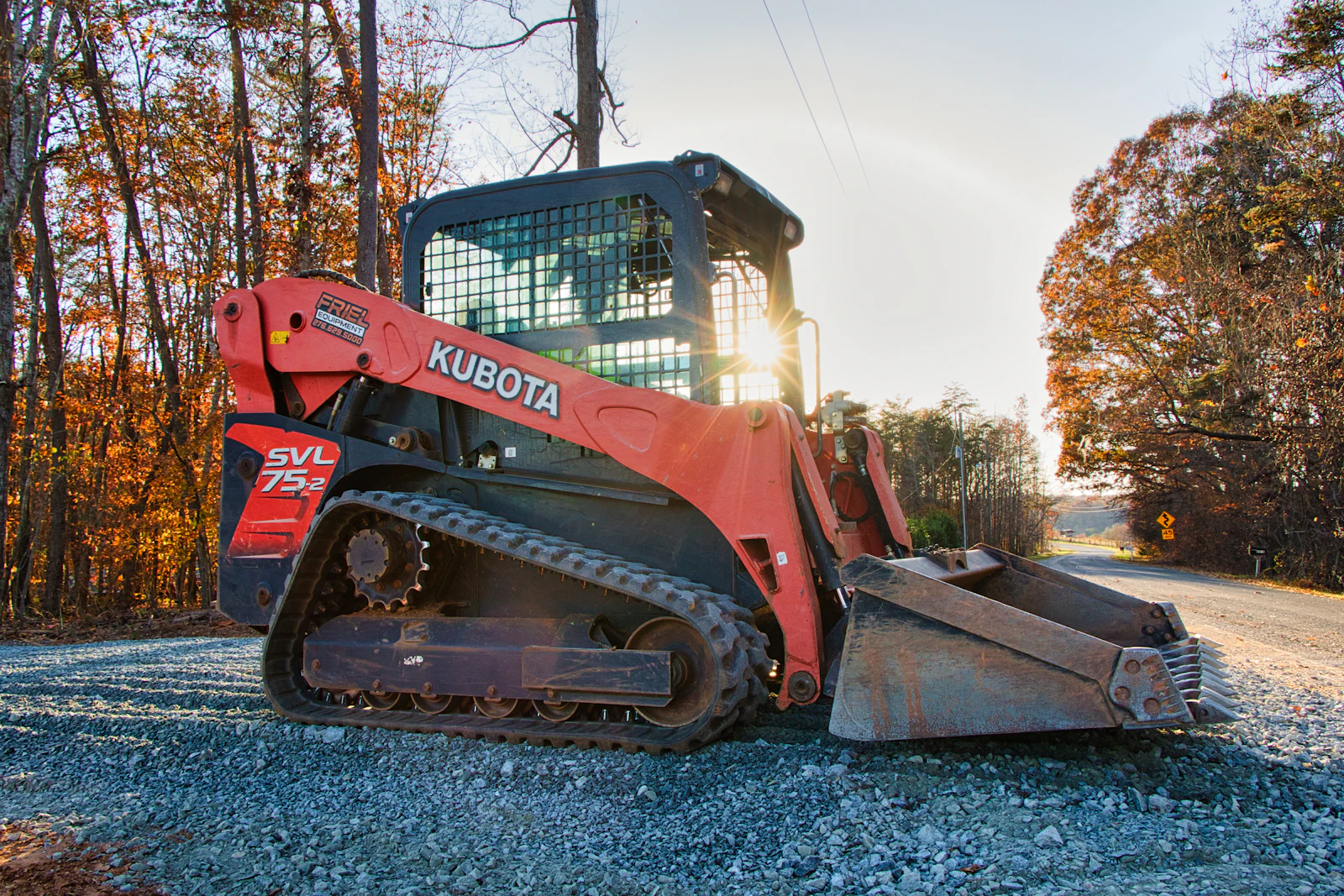
Skid Steer Loader Rental Rates Chicago 2026
For Chicago skid steer loader equipment hire tied to concrete driveway removal and base prep in 2026, plan on $200–$450 per day, $650–$1,700 per week, and $1,800–$3,900 per 28-day month for a standard wheeled skid steer with a general-purpose bucket. Compact track loaders (tracked skid steers) typically price higher for comparable power, but may reduce “stuck time” and surface damage when you are working in wet clay subgrade or shoulder seasons. These are budgeting ranges (not quotes) and assume a typical rental construct of an 8-hour meter day, 40-hour week, and 28-day month. In Chicago, you will see rates published by local heavy-equipment dealers and independents (including Bobcat-focused houses and local construction-rental counters) plus national providers with multiple yards and delivery fleets; the spread is driven by class/ROC, cab/heat, and whether the job needs hydraulic attachments for concrete driveway demolition.
| Vendor |
Daily Rate |
Weekly Rate |
Review Score |
Website |
| United Rentals |
$350 |
$1 250 |
8 |
Visit |
| Sunbelt Rentals |
$340 |
$1 200 |
8 |
Visit |
| Herc Rentals |
$330 |
$1 175 |
7 |
Visit |
| McCann Industries |
$360 |
$1 300 |
9 |
Visit |
| Altorfer Cat |
$370 |
$1 350 |
8 |
Visit |
What Drives Skid Steer Equipment Hire Cost on Concrete Driveway Work in Chicago?
Concrete driveway scopes push skid steers in ways that change real hire cost: you are often running hydraulic attachments (breaker/hammer, broom, planer), loading dense debris repeatedly, and operating in tight residential access with curb-lines, parked vehicles, and limited staging. In Chicago neighborhoods, access constraints (alley drops, gate widths, and “no-block” rules for sidewalks/driveways) can force smaller-frame machines that rent cheaper but take longer to load and grade. Conversely, stepping up one class to a 1,900–2,000 lb ROC machine can reduce cycle time on demo spoils and base aggregate, lowering total hire days even if the daily rate is higher.
Seasonality matters locally: spring thaw and fall rains raise the probability that a wheeled skid steer will rut lawns or spin on subgrade. If you are scheduling driveway replacement in wetter months, a compact track loader can be the difference between a 2-day rental and a 4-day rental (and between “normal cleaning” and expensive undercarriage cleanup on return).
Published Chicago-Area Rate Benchmarks (Use as Anchors, Not Guaranteed Quotes)
To sanity-check your 2026 budget, it helps to compare multiple published anchors (then apply your delivery, protection, and attachment adders):
- Small-frame skid steer examples: Burris Equipment lists a Case 1825B class at $220/day, $660/week, $1,980/month.
- Small wheeled skid steer in Chicago/Summit: Wirtz Rentals lists an S70 diesel at $220/day, $880/week, $2,200/month.
- Bobcat dealer rate card in the Chicago market: Atlas Bobcat posts skid-steer day rates that step by class (for example, an S70 at $195/day and larger frames up to $325/day, with month rates shown up to $3,150/month for those classes).
- Independent weekly bundle pricing: Blue Line shows a week bundle of $1,700 and a month at $3,900, and explicitly states the rental day includes 8 hours of seat time with additional hours charged.
Use the anchors above to set a realistic baseline, then apply (a) the correct class for your driveway demo production target, (b) attachment pricing, and (c) Chicago logistics rules (delivery windows, alley access, and return timing). The outcome you want is not the lowest day rate; it is the lowest fully burdened equipment hire cost per driveway section completed.
Skid Steer Class Selection: Cost vs. Throughput for Driveway Demo and Base Prep
On concrete driveway work, the “right” skid steer is usually defined by bucket width/access plus hydraulic capability for attachments:
- 44–48 in. wide small-frame machines (often around S70 class) fit tight gates and narrow side yards; they can be cost-effective when the job is constrained, but expect more load cycles and slower grading. Atlas Bobcat posts this class with a day rate around the high-$100s.
- Mid-frame wheeled skid steers (e.g., S64/S570 class on some rate cards) often hit the best balance for residential driveway replacement when you need a 68 in. bucket and enough breakout to keep spoils moving.
- High-flow and specialty configurations (planer/milling heads, high-flow cold planer setups) are in a different cost bracket; Atlas Bobcat shows a high-flow planer configuration priced materially higher on a day and month basis.
For bidding, treat “moving material” (loading concrete chunks, hauling base rock, rough grading) as a standard-flow need; treat “breaking concrete” and “surface finishing/cleanup” as attachment-driven. That separation makes it easier to price hire days and adders cleanly.
Attachment and Accessory Hire Adders for Concrete Driveway Scopes
Attachments are where driveway budgets typically drift. Many rental counters price the base skid steer competitively, then recover margin on hydraulic tools, wear items, and cleaning risk. Typical adders you should carry (as allowances unless you have a written quote):
- Hydraulic hammer/breaker: Wirtz Rentals shows hydraulic hammer items at $160–$200/day depending on size.
- Concrete breaker (alternate benchmark): A 2026 rental guide shows a $225/day concrete breaker attachment and $900/week as an example attachment schedule.
- Pallet forks: An example attachment schedule shows forks at $60/day and $240/week (helpful when staging forms, rebar bundles, or palletized base material).
- Trailer (if you self-haul): Wirtz lists skid steer trailers at $60–$80 as related rental items, which can be cheaper than delivery if you have compliant tow capacity and jobsite access.
Chicago-specific note: self-haul can look cheaper on paper, but if you cannot guarantee alley clearance, safe offload space, and compliance with parking/standing restrictions, the “savings” often evaporate via waiting time, failed delivery attempts, or an extra rental day when the machine arrives late.
Delivery, Pick-up, and Site-Access Costs (Where Chicago Jobs Commonly Add 15–30%)
In Chicago, driveway work often happens on occupied properties with narrow staging and strict timing. Build your hire budget around the assumption that delivery/pick-up will be required unless you are running a fleet trailer and have verified towing requirements.
- Delivery and pick-up fees: A Sunbelt contract fee schedule shows delivery fees commonly in the $125–$150 range for skid steers and compact track loaders (contract-specific, not Chicago-specific, but a useful benchmark for national-fleet pricing mechanics).
- Per-mile structures also exist: A 2026 rental policy example shows skid loader delivery at $3.00 per loaded mile with a $48.00 minimum.
- On tight urban drops: carry $75–$125/hour as a standby/wait-time allowance if the driver cannot access the drop because of parked cars, locked gates, or insufficient turning radius (especially on alley deliveries).
- Failed delivery / re-delivery: carry $95–$175 as a contingency if the first attempt cannot be completed and the unit must be re-routed the next day (this is one of the most common “unbudgeted” costs on residential concrete driveway replacements).
Operational constraint to price: confirm the rental house’s cutoff time for next-day delivery requests and same-day off-rent calls. A one-day miss on off-rent (because the site forgot to call, or the pickup could not access the machine) is often the single largest avoidable cost driver on a 2–4 day driveway scope.
Hidden-Fee Breakdown
When equipment managers compare skid steer loader hire costs in Chicago, the delta is rarely the advertised day rate. It is usually one of the items below:
- Fuel / make-up fuel: Some rental policies charge very high make-up fuel if returned short. A 2026 policy example shows $10 per gallon to fill on return if not returned full.
- Cleaning and concrete residue: If you return with concrete slurry splatter, hardened mud, or rebar tie-wire wrapped in the undercarriage, cleanup can be billed hourly. One published rate sheet shows $140/hour cleanup. Another published heavy-equipment rate sheet lists $75/hour for excessive cleaning.
- Metered hours / overtime: Blue Line states a 1-day rental includes 8 hours and bills additional hours at $100/hour. Another 2026 policy example lists $40/hour after 8 hours. Price this risk if the driveway demo runs long or if you are loading out debris late to beat a concrete pour schedule.
- Rental protection / damage waiver: Many rental protection plans are calculated as a percentage of the rental fee (often around 15%). Even with protection, deductibles/first-loss amounts may apply (example language shows a first-loss structure up to $1,500 in one plan).
- Weekend and holiday billing: If the vendor cannot pick up Saturday, or if your site is closed to access on weekends, you may carry additional calendar days even if you did not use additional meter hours. (Confirm whether your “week” is billed as 7 calendar days.)
Budget Worksheet
Use the worksheet below to build a practical skid steer loader equipment hire cost for a Chicago concrete driveway replacement. Adjust quantities to match your schedule and access constraints (alley drop vs. street drop, and whether you need a breaker).
- Base skid steer loader hire: 2–4 days at $200–$450/day (class-dependent) plus any weekly conversion if you cross the rate break.
- Hydraulic breaker allowance: 1–3 days at $160–$225/day (or carry $900/week if running a full week).
- Forks / material handling adders: 1–4 days at $60/day if pallets/forms/rebar are in scope.
- Delivery and pick-up: carry $250–$500 total as a Chicago urban allowance (or use $125–$150 each way as a benchmark and adjust for distance/access).
- Damage waiver / protection plan: carry 10%–15% of time rent (plus any deductible/first-loss exposure).
- Fuel and fluids: carry $60–$180 for make-up fuel on short rentals, or more if the unit runs long days and returns below full. Use $10/gal as a conservative penalty benchmark if you do not control refueling.
- Cleaning contingency: carry $150–$420 (1–3 hours) for mud/concrete cleanup exposure at $140/hour or similar hourly terms.
- Standby / failed access contingency: carry $95–$175 for re-delivery or dispatch changes, plus $75–$125/hour for on-site waiting time risk.
Rental Order Checklist
- PO and job identifiers: include job address, Chicago neighborhood/ward (helps dispatch), and site contact phone.
- Delivery instructions: specify drop zone (street vs. alley), preferred delivery window (e.g., 7:00–9:00 a.m.), and any gate codes/lockbox steps.
- Access constraints: note gate width (in inches), alley clearance, and whether a rollback can stage without blocking traffic.
- Attachments: list breaker/hammer, forks, broom, tooth bucket, and any quick-coupler requirements; confirm hydraulic flow needs if using high-flow tools.
- Protection and insurance: confirm whether you will provide COI or purchase a rental protection plan; document any deductible/first-loss terms.
- Off-rent process: confirm required call-in method and cutoff time; set an internal reminder to off-rent immediately after final load-out/grade is complete.
- Return condition documentation: take photos at delivery and at pickup-ready time (bucket, tires/tracks, undercarriage, cab) and record the hour meter reading.
How to Forecast Total Skid Steer Equipment Hire Cost for a Chicago Concrete Driveway
To forecast total skid steer loader hire cost (not just the base rental rate), separate the job into production phases and price each phase with the correct risk adders:
- Demo support and load-out: loading broken concrete and base material is usually a standard-bucket task, but you may need a tooth bucket to pull out subbase and compacted fines.
- Concrete breaking: if the slab is reinforced or thickened at the apron, a hydraulic breaker is the schedule driver. If you under-budget the breaker days, you often end up paying overtime hours or additional calendar days.
- Final grading and cleanup: driveways that tie into sidewalks/curbs demand clean edges and tidy site conditions; poor cleanup commonly leads to chargeable cleaning on return.
Chicago reality: narrow lots and alley work tend to reward smaller footprints and tighter turn radius, but the smallest frames can increase labor time. Your best hire-cost outcome is usually a mid-frame machine that fits access and keeps cycle time down.
Example: Two-Day Concrete Driveway Removal and Base Prep (Chicago Alley Access)
Scenario assumptions (operational constraints included): 1,200 sq ft driveway replacement behind an occupied 2-flat; alley delivery only; no Saturday pickup; crew wants the site cleared for a forming crew on Day 3. The rental day is treated as 8 hours and any hours beyond that are billable.
- Base skid steer (mid-frame) hire: budget $275/day x 2 days (rate-card anchor from Chicago dealer schedules varies by class).
- Hydraulic hammer: budget $200/day x 2 days (published attachment pricing examples vary by house and hammer size).
- Delivery + pick-up: carry $150 each way baseline, then add a $75 alley-access dispatch premium if your site requires a specific smaller truck or tight window (benchmark delivery fees are often shown in the $125–$150 range on fleet schedules).
- Overtime exposure: Day 2 runs 2 extra hours to finish load-out; carry $100/hour x 2 hours where your supplier’s terms match an 8-hour day construct with hourly overage.
- Fuel return control: crew returns the unit 6 gallons short; if you do not refuel on-site, a conservative penalty benchmark is $10/gal x 6 = $60.
- Cleaning exposure (mud + concrete residue): carry 2 hours at $140/hour = $280 if the machine is returned with concrete splatter or heavy undercarriage packing.
- Protection plan: carry 15% of time rent if you elect an RPP-style waiver rather than relying solely on your own physical damage coverage (confirm your exact contract terms).
Takeaway: on short driveway rentals, the non-rate items (delivery, overtime, fuel, cleaning, protection) can rival the base hire cost. This is why equipment coordinators should price the full “rental event” and not just day rates.
Off-Rent Timing, Weekend Billing, and Metered Hours
Concrete driveway schedules often force “finish today” behavior that collides with rental billing mechanics:
- Meter day vs. calendar day: many suppliers define a daily rate around an 8-hour usage day, and then charge hourly overage. Blue Line publishes $100/hour over 8 hours. A separate 2026 policy example lists $40/hour after 8 hours. Your contract could be either model; price an allowance if your crew is prone to late load-out.
- Week definition risk: some fleets define a week as 7 calendar days and a month as 28 days. If pickup is not available Saturday (a published example explicitly states no pickup/delivery on Saturdays), you may carry extra days even if work is complete Friday.
- Off-rent cutoff: confirm cutoff time (commonly mid-afternoon) for a same/next-day pickup request. Missing the cutoff can add another full day of hire, even if your crew is finished.
Damage, Wear, and Return-Condition Cost Controls for Driveway Jobs
Driveway work is hard on skid steers because you are handling heavy broken concrete and operating around rebar, wire, and sharp edges. To keep equipment hire costs predictable:
- Cleaning: assign a crew member to scrape the bucket, remove wire from axles/undercarriage, and pressure-wash if allowed. Hourly cleanup rates published in the market include $75/hour for excessive cleaning on one rate sheet and $140/hour on another policy example.
- Fuel discipline: if you do not refuel, you can be billed at punitive make-up prices (example benchmark $10/gal). If you do refuel, document fuel level at pickup-ready time with a photo.
- Attachment handling: breakers and hydraulic tools are the fastest path to chargebacks (hoses, couplers, and tool points). Budget a $150–$300 “wear and tear exposure” allowance on short breaker rentals unless your contract clearly includes consumables.
- Protection plan choice: if you buy an RPP-style plan, treat it like a line item. Published examples show pricing around 15% of the rental rate and may include first-loss or deductible structures (example first-loss language at $1,500).
2026 Chicago Planning Notes That Change Skid Steer Hire Cost
- Urban delivery reality: traffic and alley constraints make delivery windows critical. If you cannot provide a reliable access window, carry $75–$125/hour for driver wait time and $95–$175 for re-delivery risk.
- Dust and debris control: if the driveway is adjacent to occupied units, plan time for debris management; rushed cleanup can convert into chargeable cleaning on return.
- Weather buffering: carry 1 extra day of hire contingency in shoulder seasons if subgrade is likely to be saturated (a single rain day can keep a wheeled skid steer from safely loading out without rutting or spinning).
If you want, share (a) driveway square footage, (b) access width, (c) whether you’re breaking slab in-place or loading pre-broken debris, and (d) whether you need a breaker, forks, or broom. I can turn the above into a tighter 2026 equipment-hire allowance for your Chicago concrete driveway schedule (still without vendor tables).