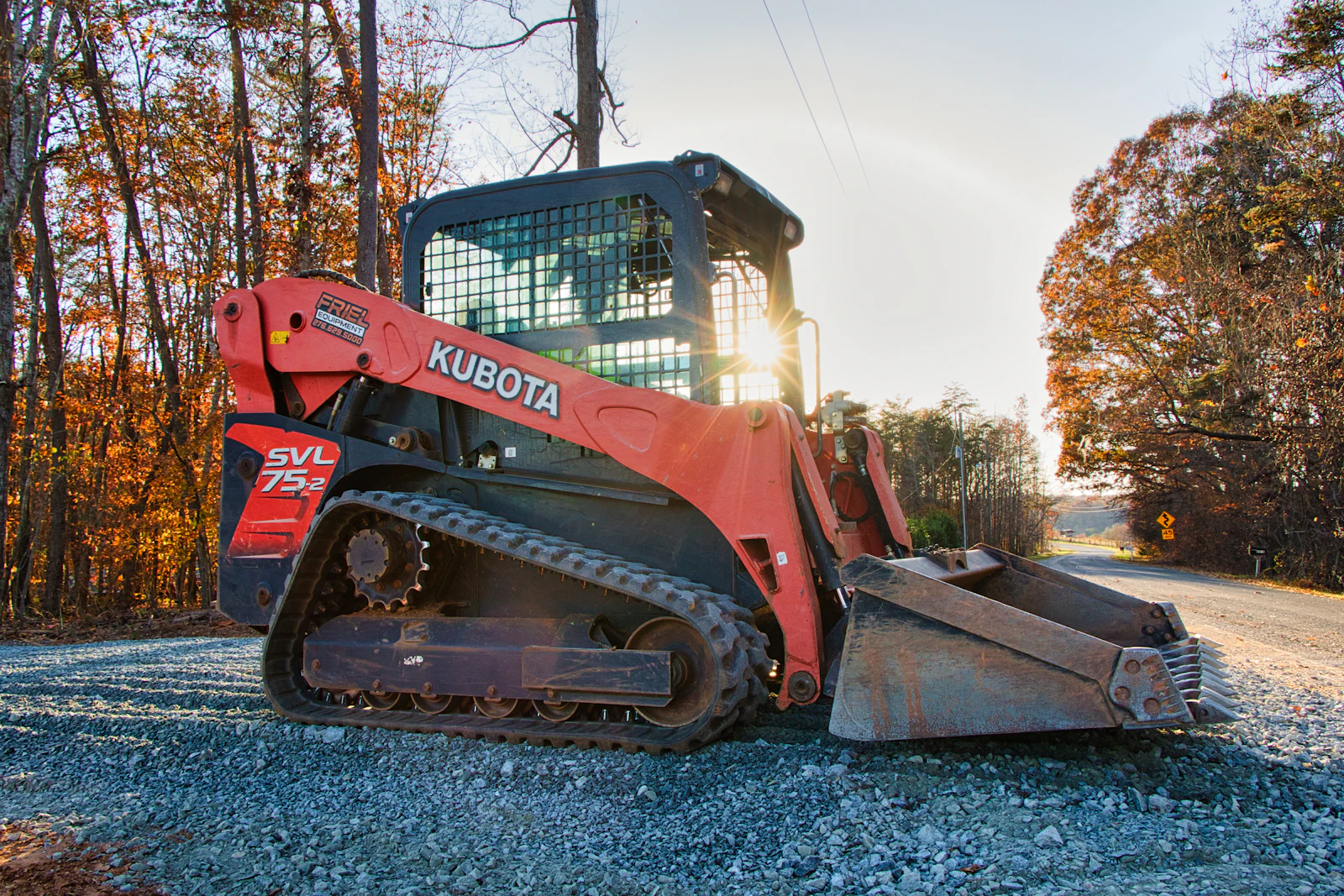
Skid Steer Loader Hire Costs in Chicago for 2026 (Daily, Weekly, Monthly)
For 2026 budgeting in Chicago, a practical planning range for skid steer loader equipment hire (dry hire, no operator) is $225 to $375 per day, $675 to $1,200 per week, and $1,900 to $3,500 per 4-week period for a mid-size wheeled skid steer (roughly 2,100 to 3,400 lb operating capacity). Those ranges align with published Chicago-area rate sheets showing examples like $225/day for a 2,100 lb wheeled unit and $250/day for a 2,800 lb wheeled unit, plus 4-week pricing in the $1,925 to $2,500 range for comparable capacity classes. For compact track loaders (CTLs) in the same market, plan higher: $300 to $500 per day, $900 to $1,500 per week, and $2,700 to $4,500 per 4-week period, with high-flow CTLs at the top end. These are budgetary ranges; final pricing will move with seasonality (notably winter snow work), availability, and delivery constraints inside the city. National providers and regional Chicago yards typically quote on the same time-basis (8-hour day, 40-hour week, 160-hour month) and then add delivery, waiver/insurance, and attachment lines that often drive the “real” hire cost.
| Vendor |
Daily Rate |
Weekly Rate |
Review Score |
Website |
| Wirtz Rentals Co. |
$310 |
$1 240 |
9 |
Visit |
| Atlas Bobcat |
$325 |
$1 300 |
10 |
Visit |
| Illinois Lift Equipment |
$325 |
$750 |
8 |
Visit |
| Five Star Equipment Rental & Supply |
$350 |
$1 225 |
8 |
Visit |
Skid Steer Loader Rental
When you request skid steer loader rental in Chicago, confirm what the base “machine” line includes before you compare rates. Many published Chicago-area terms define use as 8 hours per day, 40 hours per week, and 160 hours per month, and “month” may be treated as 4 weeks or a 28-day period depending on the yard. Also confirm whether the base machine includes:
- Standard bucket (some rate sheets price buckets separately as an attachment line).
- Enclosed cab vs open canopy (enclosed cab commonly prices higher in winter-heavy markets).
- Standard-flow hydraulics vs high-flow (high-flow can be the difference between “can run it” and “can’t couple it”).
- Tracks vs tires (and whether it ships with standard pneumatic tires, non-marking, or solid/hard rubber).
- Quick-attach type and couplers (confirm universal quick attach and hydraulic coupler compatibility to avoid a wasted mobilization).
In Chicago specifically, the most expensive skid steer rentals are often not caused by the day rate; they are caused by dispatch and return-condition friction: downtown delivery windows, alley access limitations, and winter mud/salt cleanup expectations that trigger cleaning or damage lines at closeout.
What Changes the Hire Price Most on Chicago Jobsites?
Use these cost drivers to explain pricing variance internally (estimating) and externally (GC / owner) when you’re building a defensible equipment hire cost:
- Capacity class and lift geometry: Published Chicago-area rate sheets step up meaningfully from 2,700 lb class to 3,000 lb class machines (for example, $325/day vs $375/day on one local sheet).
- Seasonality: Snow and freeze-thaw conditions increase demand for enclosed cabs, track units, and snow-specific attachments. If you bid winter, carry a premium allowance for short-notice extensions.
- Downtown delivery complexity: Tight streets, staged deliveries, and limited on-site storage can turn a “weekly” rental into a more expensive pattern of short rentals and multiple mobilizations.
- Surface protection and indoor restrictions: Interior slab work may require track mats, non-marking tires, or a specific tire compound; exterior landscape restoration may require low ground pressure CTLs.
- Attachment necessity: Many Chicago scopes (demo support, site cleanup, material handling) only pencil with forks, grapple, broom, or breaker. Published attachment day rates can be large relative to the base machine (for example, $35/day for pallet forks, $150/day for a pickup broom, and $200/day for a brush cutter on a Chicago-area sheet).
Tracked Vs. Wheeled: When CTL Pricing Wins (Or Fails) in Chicago
Chicago estimating teams often default to a wheeled skid steer for cost control, then get burned by productivity loss in soft subgrade, demolition rubble, or winter conditions. A CTL typically costs more per time unit, but may reduce total hire cost by reducing rental duration and/or rework.
Wheeled skid steer budget anchors (Chicago-area examples): $225/day for a 2,100 lb class wheeled unit; $250/day for a 2,800 lb class wheeled unit; and up to $350/day for a 3,400 lb high-flow wheeled unit on one local schedule. Another local schedule lists $325/day for a 2,700 lb class skid steer and $375/day for a 3,000 lb class skid steer (with weekly $1,100 to $1,200 and monthly $3,000 to $3,500).
CTL budget anchors (Chicago-area examples): One local schedule lists CTLs at $300/day (2,700 lb capacity) through $475/day (high-flow 3,800 to 4,500 lb classes), with weekly $900 to $1,425 and 4-week $2,700 to $4,275. Another local schedule lists CTLs at $450/day to $500/day with weekly $1,350 to $1,500 and monthly $4,000 to $4,500 for 2,700 to 3,000 lb capacity classes.
Chicago-specific operating note: If you are crossing salted streets and staging on finished surfaces, carry an allowance for additional cleaning and documentation at return, especially for track undercarriage and sprockets. The “cheaper” unit can close out more expensive if it returns with packed clay, mortar droppings, or frozen debris in the undercarriage.
Attachment Adders That Move the Budget
Attachment pricing is where many skid steer loader hire budgets fail. Use sourced attachment pricing to build a realistic “all-in” equipment hire estimate instead of assuming attachments are incidental:
- Pallet forks: $35/day, $100/week, $300/4-week on a Chicago-area schedule; another published contract schedule shows forks at $40/day, $90/week, $185/month for a large skid steer class.
- Hydraulic auger (with one bit): $125/day, $300/week, $900/4-week on a Chicago-area schedule; plan extra bits at $50/day and extensions at $15/day when hole counts or depths are uncertain.
- Hydraulic breaker/hammer: $195/day ($585/week) for one hammer class and $250/day ($750/week) for a larger hammer class on a Chicago-area schedule; another local sheet lists a breaker line at $300/day ($900/week).
- Pickup broom / sweeper: $150/day, $450/week, $1,350/4-week on a Chicago-area schedule; another local sheet lists a broom at $200/day, $650/week, $1,950/month.
- Brush cutter: $200/day, $585/week, $1,750/4-week on a Chicago-area schedule (high wear risk; carry damage and downtime contingencies).
- Hard/solid tire package: $75/day, $225/week, $675/4-week on a Chicago-area schedule, often worth it on demo debris where punctures can create lost shifts and tire chargebacks.
- Snow push box: a published line item example shows $695 for an 8 ft snow push box; use this as a signal that snow packages can dominate winter skid steer hire budgets.
Chicago estimator tip: if the scope includes forks “just for unloading” or a broom “just for housekeeping,” put those lines in the estimate anyway. Attachment lines are small enough to get overlooked, but large enough to swing margin on short-duration rentals.
Hidden-Fee Breakdown for Skid Steer Equipment Hire
Below are the most common “non-rate” charges that impact skid steer loader equipment hire cost in Chicago. These are planning allowances; confirm your yard’s exact terms on the rental contract and PO:
- Delivery and pickup: carry $175 to $350 each way inside a typical metro radius (often 15 to 25 miles), with after-radius mileage commonly budgeted at $4 to $8 per mile. Downtown or restricted-access sites often justify an added $75 to $150 congestion/limited access allowance if a smaller truck, special timing, or a second trip is required.
- Minimum transport: many dispatches effectively have a $200 minimum even if the mileage is short, because truck time dominates cost.
- After-hours or weekend dispatch: carry $150 to $300 if you require delivery/pickup outside standard yard windows, or if you need a timed delivery that forces a driver wait.
- Damage waiver / rental protection: budget 12% to 18% of time-and-material lines unless your corporate insurance and contract terms remove it.
- Environmental / admin fees: budget 5% to 10% as a blended allowance if your vendor applies shop, environmental, or admin surcharges.
- Fuel service: if returned short, carry $6.50 to $8.50 per gallon for diesel service billing and $7 to $10 per gallon for DEF (where applicable), plus a possible service labor minimum.
- Cleaning: carry $150 to $450 for concrete splatter, excess mud, or interior cab cleanup; carry an additional $250 allowance for CTL undercarriage cleanout in wet/freeze conditions.
- Lost key / lockout: budget $25 to $75 for replacement keys and $150+ for a field service call if the unit is disabled.
Chicago-specific note: downtown sites often have strict delivery cutoffs (for example, “before 7:00 AM” or “after 6:00 PM”) to avoid traffic and staging conflicts. If your plan requires these windows, treat that as a real cost driver, not a scheduling footnote.
Billing Rules That Create Surprises (Hours, Weekends, Off-Rent)
Even when the published day rate looks competitive, the billing rules determine whether you actually realize “daily,” “weekly,” or “monthly” economics:
- Hourly limits: multiple Chicago-area sources publish the standard basis as 8 hours/day, 40 hours/week, 160 hours/month. If your crew runs 10-hour shifts, you need an overtime plan (either accept overage or pre-negotiate a different basis).
- Monthly overages: many heavy equipment programs charge additional hours as a fraction of the “monthly” rate (for example, 1/125th of the monthly rate per extra hour is explicitly stated on one Illinois equipment schedule for monthly rentals). Use that structure as a budgeting model if your yard does not publish overage rules up front.
- Weekend/holiday billing: if the unit delivers Friday and you cannot off-rent until Monday due to site access rules, you may get billed through the weekend depending on contract language. Don’t assume a “5-day week” unless it is explicitly stated in your agreement.
- Off-rent timing: carry a process allowance for off-rent calls. A missed off-rent cutoff can add a full day (or a weekend) to the bill.
- Meter documentation: protect closeout by capturing start and end hour-meter photos, plus wide shots of the unit condition and attachment serials at delivery and return.
Budget Worksheet (Chicago Skid Steer Hire)
Use the following line items as a field-ready budgeting artifact for a Chicago rental coordinator. Adjust quantities to match your duration and delivery pattern (single mobilization vs phased work):
- Base skid steer (wheeled, 2,700 to 3,000 lb class): allow $250 to $375/day or $750 to $1,200/week (select the basis you expect to hit).
- Alternative base unit (CTL, high-flow if required): allow $425 to $500/day or $1,250 to $1,500/week when ground conditions or attachment needs justify tracks and high-flow.
- Attachment package (choose what your scope truly needs): forks ($35/day), broom ($150/day), auger ($125/day), hammer ($195 to $250/day), brush cutter ($200/day).
- Delivery + pickup: allowance $350 to $700 round trip (add $75 to $150 if downtown timing/access is constrained).
- Damage waiver / protection: allowance 12% to 18% of rental time and attachment lines.
- Fuel and fluids closeout: allowance $75 to $250 depending on tank management discipline; add DEF allowance if applicable.
- Cleaning: allowance $150 (light) to $450 (heavy), plus CTL undercarriage cleanout allowance $250 in wet/freeze conditions.
- Wear/damage contingency: allowance $250 to $1,000 depending on debris, puncture risk, and attachment wear.
Rental Order Checklist (PO to Off-Rent)
Use this checklist to reduce total equipment hire cost by preventing chargebacks and lost time:
- PO setup: include job number, cost code, agreed billing basis (8/40/160 or other), and whether weekends are billable.
- Insurance and contract docs: provide COI naming additional insured where required; confirm whether damage waiver is accepted or waived.
- Machine spec confirmation: operating capacity class, cab type, heat/defrost needs, track vs tire, high-flow requirement, and coupler/case drain compatibility.
- Attachments: list each attachment explicitly (fork length, broom type, auger bit sizes, breaker class), and confirm availability for the same delivery.
- Delivery plan: confirm delivery address format for Chicago (gate, alley, dock, freight elevator constraints), delivery window, site contact, and whether a call-ahead is required.
- Receiving inspection: take time-stamped photos of hour meter, tires/tracks, couplers, and each attachment at drop-off.
- Operating controls: confirm ISO/H-pattern and whether operator orientation is required (avoid a paid standby shift).
- Off-rent rules: document the yard’s off-rent cutoff time and required notice; schedule pickup to avoid weekend drift.
- Return condition: refuel to full (or to contract requirement), remove debris from bucket/quick attach, wipe cab, and photograph condition at pickup.
Example: Downtown Chicago Demo Support With High-Flow Attachment
Scenario: You need a high-flow CTL to support interior demo and debris handling for 2 weeks (10 working days) near the Loop. The site requires a timed delivery (before traffic) and the unit must be removed nightly (no secure laydown), so you plan a single CTL rental with strict off-rent discipline plus one attachment.
Assumptions (sourced market anchors): A published Chicago-area schedule shows a high-flow CTL at $475/day, $1,425/week, $4,275/4-week. For the attachment, assume a larger hydraulic hammer at $250/day, $750/week, $2,250/4-week.
Budget math (illustrative): If you hit weekly billing, carry 2 x $1,425 = $2,850 for the CTL and 2 x $750 = $1,500 for the hammer (time charges subtotal $4,350). Add a realistic downtown dispatch allowance of $600 round trip (timed delivery plus pickup), a 15% rental protection allowance ($653), a cleaning allowance ($275), and a fuel/DEF closeout allowance ($145). That yields an all-in planning budget of roughly $6,000 to $6,200 for the two-week package, before tax and any overtime-hour billing.
Operational constraints that change the real cost: (1) If you miss off-rent on a Friday, you risk paying through the weekend; (2) if interior dust control is required, you may need a pickup broom (often $150/day) and stricter cleaning; (3) if the crew runs 10-hour shifts, plan hourly overage rather than assuming the weekly cap will absorb it.
How to Quote Skid Steer Hire Costs for Multi-Phase Projects
Chicago projects frequently split skid steer use across phases (demo, backfill, flatwork support, landscaping restoration). The lowest total equipment hire cost usually comes from aligning rental terms with actual utilization rather than holding the unit “just in case.” Practical approaches that work well for rental coordinators:
- Phase-based rentals: rent for the heavy-use windows only (for example, 5 to 7 working days), then off-rent cleanly. This often beats paying a full 4-week period with low utilization, especially where downtown access drives delivery costs.
- Attachment sequencing: keep the base skid steer on rent, but only bring the high-cost attachment for the days it is truly needed (for example, hammer for 2 days, forks for 5 days). Attachment day rates like $195 to $250/day for a hammer class can exceed the incremental benefit if held for weeks.
- Pre-negotiate extension pricing: winter and peak construction windows can force day-to-day extensions. Ask for the “rollover” logic (when daily converts to weekly; when weekly converts to 4-week) in writing so you can forecast without disputes.
Reducing Total Cost: Dispatch, Fueling, And Return Condition
The easiest cost savings on skid steer loader equipment hire in Chicago are administrative and operational, not rate-shopping:
- Coordinate delivery windows: a flexible delivery window can prevent after-hours charges (often budgeted at $150 to $300) and reduce the chance of a failed delivery that triggers a re-dispatch fee.
- Control fuel closeout: set a field rule that the unit is topped off at the end of the last shift. Avoiding even 15 to 25 gallons of billed fuel at $6.50 to $8.50/gal can save $100 to $200 per off-rent event.
- Return condition documentation: take “final condition” photos before pickup. If a cleaning fee ($150 to $450) appears, you can contest it with evidence (or accept it as fair where debris is obvious).
- Undercarriage discipline for CTLs: in Chicago freeze-thaw periods, packed mud can freeze in the undercarriage. A $250 cleanout allowance is often cheaper than track damage or downtime from a frozen roller.
When Ownership Beats Hire in Chicago (Quick Rule of Thumb)
From an equipment manager perspective, ownership can beat hire when you have steady utilization and predictable storage/security. A practical heuristic for Chicago fleets is: if you routinely pay a 4-week rate (roughly $1,900 to $3,500 for wheeled or $2,700 to $4,500 for CTL classes, depending on spec) for 6+ months per year and you can store the unit securely, ownership and fleet maintenance may pencil better than repeated hire. If utilization is bursty, or if downtown projects force frequent mobilizations and rapid off-rent cycles, rental remains the safer path because it transfers maintenance and uptime risk to the rental house.
Compliance Notes That Can Affect Equipment Hire Cost
Compliance and site rules can create real equipment hire adders in Chicago:
- Operator qualification: if the GC requires documented competency for skid steer operators, carry the training/admin time in the estimate (even if the rental is dry hire).
- Site environmental controls: interior work may require additional dust and housekeeping measures (broom/sweeper attachments and stricter cleaning closeout).
- Traffic and staging controls: street closures, flaggers, and timed deliveries can add standby time for trucks. Treat this as a project cost driver, not a rental house “fee problem.”
2026 Planning Notes for Chicago Skid Steer Rental Budgets
To plan accurately for 2026, build your skid steer hire budget as an “equipment package” rather than a single line item:
- Base machine line: choose wheeled vs CTL based on ground conditions and required attachments, using published Chicago-area anchors (for example, $225 to $375/day for wheeled and $300 to $500/day for CTLs).
- Attachment lines: forks ($35/day), auger with bit ($125/day), broom ($150/day), hammer ($195 to $250/day), and specialty attachments as needed.
- Dispatch and closeout allowances: carry delivery/pickup, fuel service exposure, and cleaning exposure explicitly so you can explain variance at closeout.
- Downtown Chicago constraints: budget for restricted delivery windows and limited laydown space. When you cannot store the unit, your true cost includes security planning, nightly movement, or faster off-rent cycles.
- Winter constraints: budget extra cleaning and downtime risk, and consider enclosed cab/high-flow availability earlier in procurement to avoid premium spot rentals.
If you want, share your expected duration, whether you need high-flow, and which attachments are required (forks, broom, hammer, auger). I can convert this into a bid-ready allowance structure (still no tables) tailored to your Chicago scope and shift pattern.