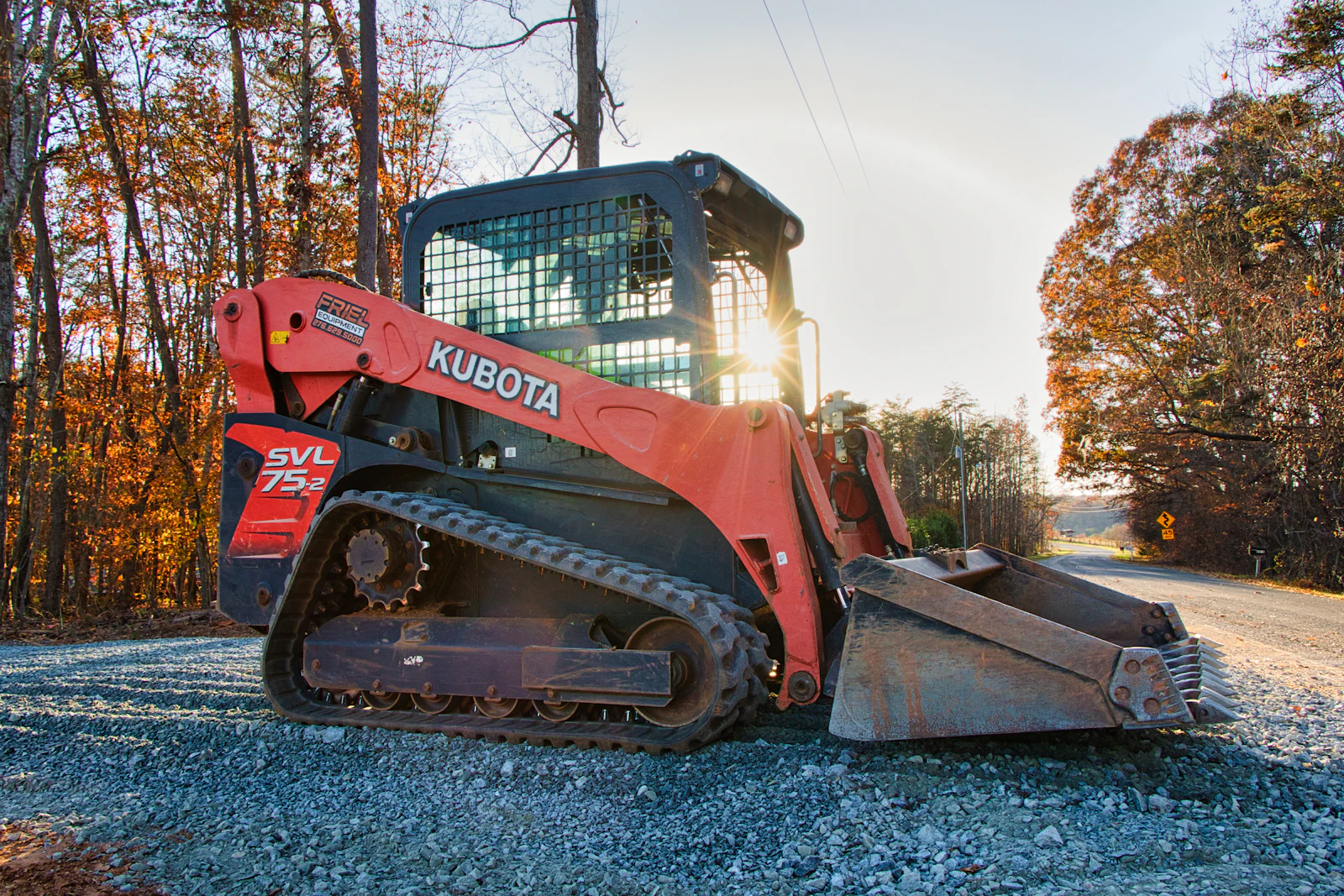
Skid Steer Loader Rental Rates in Columbus (Daily/Weekly) — 2026 Costs
Construction Costs Columbus
Price source: Costs shown are derived from our proprietary U.S. construction cost database (updated continuously from contractor/bid/pricing inputs and normalization rules).
Eva Steinmetzer-Shaw
Head of Marketing
Skid Steer Loader Rental Rates Columbus 2026
For Columbus, Ohio concrete driveway scopes (demo support, subgrade corrections, base stone handling, backfill, and site cleanup), 2026 planning budgets for skid steer loader equipment hire typically land in these working ranges: $220–$375/day, $880–$1,500/week, and $2,200–$3,800 per 4-week month for a mid-size wheeled skid steer with standard bucket; tracked compact track loader equivalents often price higher due to undercarriage and transport. Actual hire costs shift with rated operating capacity (ROC), cab/heat, high-flow hydraulics, attachment mix (breaker/hammer, forks, grading tools), and whether you’re billed on an 8-hour day/44-hour week/176-hour month structure (common in rate sheets). In Columbus you’ll commonly source from national fleets (United Rentals, Sunbelt Rentals, Herc) or local dealer-rental operations; the best outcome usually comes from matching machine class to driveway constraints (soft subgrade, limited access, street loading rules) and locking logistics (delivery windows, off-rent cutoffs, and return condition) in the PO.
| Vendor |
Daily Rate |
Weekly Rate |
Review Score |
Website |
| Columbus Equipment Rentals (Columbus Equipment Company) |
$575 |
$1 400 |
9 |
Visit |
| Ohio Cat Rentals (Columbus) |
$610 |
$1 600 |
8 |
Visit |
| BigRentz (Columbus supplier network) |
$393 |
$1 240 |
4 |
Visit |
| DOZR Marketplace (Columbus listings) |
$450 |
$1 325 |
4 |
Visit |
What Drives Skid Steer Loader Hire Pricing on Columbus Concrete Driveway Work?
Concrete driveway work tends to stress the parts of the hire ticket that get overlooked: hauling demo debris to a roll-off, placing dense graded aggregate, maintaining finished grade tolerances, and staying clean enough to avoid cleanup charges when you return. The cost drivers below are the ones that typically move skid steer loader hire rates in Columbus more than the headline day/week number.
- Machine size and ROC: A 700–1,200 lb ROC unit prices differently than a 1,500–1,800 lb ROC unit; step-ups often add $25–$90/day before attachments.
- Wheeled vs tracked: Tracked units can reduce rutting on wet clay subgrades (common around Central Ohio), but often add $60–$140/day plus higher wear exposure if you run on crushed concrete.
- Cab, heat/AC, and ride control: Enclosed cab packages commonly add $30–$75/day and can be worth it for long finishing days and shoulder-season rain.
- High-flow hydraulics: Needed for many breakers/planers; budget $40–$120/day uplift for high-flow class machines.
- Attachments and required accessories: Forks, grading buckets, tooth bars, breakers, and augers can add $10/day up to $300+/day depending on tool and duty cycle; some public rate sheets show forks at $40/day for large skid steer forks.
- Logistics and billing rules: Mobilization, delivery windows, and off-rent cutoffs can add 15%–40% to “all-in” cost on short driveway scopes.
Baseline Hire Budgets by Skid Steer Class (Columbus 2026 Planning)
Assumptions: machine-only pricing (no operator), standard bucket included, Columbus metro delivery, and typical contractor utilization (not continuous 8 hours at full load). Use these as estimating ranges, not guaranteed vendor quotes.
Compact / Tight Access (700–1,200 lb ROC)
- Hire range: $220–$300/day, $880–$1,150/week, $2,200–$3,000/4-week month.
- Where it fits on a concrete driveway: back yard access gates, narrow side-yard base placement, cleanup around forms, light loading to a trailer.
- Reference point (Ohio market): published dealer-rental examples show $220/day and $880/week for common wheeled skid steers, with tracked units priced higher.
Mid-Size Production (1,500–1,800 lb ROC)
- Hire range: $275–$375/day, $1,050–$1,500/week, $2,800–$3,800/4-week month.
- Where it fits: driveway demo support (loading broken concrete), base stone placement, pulling and spreading, general site logistics.
- Public rate-sheet signal: an agency pricing schedule shows a 1,500–2,000 lb class skid steer at $225/day, $660/week, $1,490/month (pickup), which can be lower than typical retail contractor pricing but is useful as a market anchor.
Tracked Compact Track Loader (CTL) Alternative
- Hire range: $300–$450/day, $1,200–$1,650/week, $3,200–$4,500/4-week month.
- Cost caution: CTLs can be the right call for wet subgrades, but you should budget higher exposure for undercarriage cleaning and wear if you run over crushed concrete and rebar tie ends.
- Reference point (Ohio market): published tracked rental examples show $300/day to $375/day and $1,200/week to $1,500/week depending on model class.
Hidden-Fee Breakdown (The Numbers That Change the PO Total)
If you’re coordinating skid steer loader equipment hire for a concrete driveway in Columbus, plan for these “line-item multipliers” even when the vendor advertises a clean daily/weekly rate.
- Delivery / pickup: budget $175–$325 each way for metro delivery, plus mileage when outside the vendor’s normal radius; some published schedules show mobilization at $290 for the first mile plus $4 per additional mile.
- Minimum transport charges: common minimums are $250–$350 even if the jobsite is close, because you’re buying a truck + driver window.
- Damage waiver (DW) / rental protection: commonly 10%–15% of rental charges (machine + some attachments). Confirm whether it covers tire/track punctures and vandalism.
- Environmental / shop / admin fees: often 2%–6% of rental, sometimes with a per-item cap.
- Fuel policy: most fleets deliver “full tank” and require “full return.” If you return short, budget make-up at $6–$9/gal plus a service/labor fee of $25–$60.
- Cleaning: rate sheets commonly reserve the right to charge cleaning at $75/hour beyond included thresholds (example language notes cleaning time allowances by term). This is one of the most frequent avoidable adders on driveway scopes due to wet clay and slurry.
- After-hours / tight delivery windows: budget $95–$175 for “call-out” style constraints (early drop, late pickup, constrained downtown access).
- Late return penalties: many rental agreements convert hours into fractions of a day (e.g., 1/8 day per extra hour) once you pass the grace period.
- Weekend/holiday billing exposure: if the vendor cannot receive returns on Sunday, you may pay an additional day (or be billed through Monday) unless your contract explicitly stops time on Saturday return.
- Deposit / credit hold: depending on account status, expect $500–$2,000 authorization or deposit requirements for small-account rentals.
Skid Steer Attachments Hire Costs for Driveway Demo and Base Prep
Attachment choice is where driveway work wins or loses money. The cheapest machine rate can become the most expensive ticket if you add a breaker, swap couplers onsite, or trigger cleaning because the wrong bucket packs wet clay into the quick-attach.
Common Columbus Concrete Driveway Attachment Adders (2026 Planning)
- Pallet forks: budget $25–$60/day, $75–$150/week; a public schedule shows large skid steer forks at $40/day, $90/week, $185/month.
- Hydraulic breaker/hammer (for slab edges, thickened approaches): budget $175–$300/day, plus grease and bit wear (often billed if abnormal). Confirm if you need high-flow or standard-flow.
- Tooth bucket or bolt-on tooth bar: $35–$60/day if not included; can reduce spin on compacted base but may scar finished subgrade if operators aren’t disciplined.
- Grading bucket / smooth edge bucket: $30–$70/day; worth it if you’re fine-trimming base stone to meet concrete thickness tolerance.
- Auger drive + bits (for light pole bases, gate posts, or sign footings adjacent to driveway): drive commonly $90–$180/day; bits often priced separately—one schedule shows a 6-inch skid steer auger bit at $11/day, $29/week, $73/month.
- Trailer (when pickup is allowed and you have towing capacity): published dealer-rental examples show $45 extra for an equipment trailer.
Columbus-Specific Cost Considerations (Concrete Driveway Reality)
- Rain + clay cleanup risk: Central Ohio subgrades can turn to heavy mud quickly. Build a cleaning allowance (see below) or enforce track/tire wash-down before loading out to avoid billed cleaning time at rates like $75/hr.
- Delivery radius and traffic time: many yards sit near the I-270 beltway; deliveries into dense neighborhoods or campus-adjacent zones can push you into a higher “haul zone” or narrower delivery windows. Budget $0.00–$6.00/mi after the first mileage band, depending on vendor structure.
- Street cleanliness and documentation: Columbus driveway jobs that load out broken concrete can leave fines/complaints if mud tracks onto the roadway. It’s often cheaper to budget a $150–$300 street-sweep allowance than to argue a cleaning backcharge later.
Example: Columbus Concrete Driveway Base Rebuild—How a “2-Day Rental” Becomes a 4-Day Charge
Scenario: You’re reworking a 2-car driveway base after demo. You want a mid-size wheeled skid steer on a Friday/Saturday schedule to move 12 tons of #57 stone and load out 8 cubic yards of broken concrete into a roll-off. The vendor’s yard accepts returns Monday morning only (no Sunday receiving), and off-rent must be called in by 3:00 p.m. for next-day pickup.
- Machine hire: budget $325/day x 4 billed days (Fri–Mon exposure) = $1,300 even though you only “worked” ~14 hours.
- Delivery/pickup: $250 each way = $500 (or, if billed like some schedules, $290 first mile + mileage).
- Damage waiver: 12% of rental line items ≈ $156.
- Environmental/admin: 4% ≈ $52.
- Fuel short return: 8 gal short at $7.50/gal + $35 service fee = $95.
- Cleaning: if you return muddy tires/undercarriage and the yard bills 2.0 hours at $75/hr = $150.
- All-in planning total (illustrative): about $2,253 before tax—roughly 70%+ above the “two-day” machine-only expectation.
Estimator takeaway: for Columbus driveway work, you typically save more money by controlling billing days + transport + return condition than by fighting for $20/day on the base hire rate.
Budget Worksheet (Estimator-Friendly Line Items—No Surprises)
- Skid steer loader equipment hire (mid-size wheeled): $1,050–$1,500/week allowance (or $275–$375/day if truly short-term).
- Attachment allowance (choose as needed): forks $90–$150/week; smooth grading bucket $40–$90/day; breaker $175–$300/day.
- Delivery + pickup: $350–$700 total (metro) OR mobilization schedule (e.g., $290 first mile + $4/mi).
- Fuel/defuel allowance: $50–$175 (covers short returns + service fee).
- Damage waiver/rental protection: 10%–15% of rental subtotal.
- Environmental/admin/shop fees: 2%–6% of rental subtotal.
- Cleaning allowance (driveway mud contingency): $150–$300 (2–4 hours at $75/hr, depending on term thresholds).
- Wear/damage contingency (tires/curbs/hidden debris): $250–$750 (especially if demo rubble is on grade).
- Weekend exposure contingency: 1 extra day of hire if return windows are constrained.
Rental Order Checklist (For the PO, Delivery, Off-Rent, and Return)
- PO scope clarity: specify “skid steer loader” class (ROC), wheeled vs tracked, cab/heat requirement, and whether high-flow is required for attachments.
- Billing structure: confirm whether the vendor bills on 8-hr day / 44-hr week / 176-hr month and how overtime converts to charges.
- Delivery window: set a hard on-site receiving window and confirm jobsite access (gate width, overhead lines, street parking restrictions).
- Delivery pricing: confirm flat haul vs mileage; document any “minimum haul” and any after-hours fees ($95–$175 planning range).
- Damage waiver / insurance: confirm DW percentage (10%–15%) and exclusions (tires, tracks, glass, vandalism).
- Pre-use documentation: photos/video of bucket edge, tires/tracks, coupler, cab glass, and hour meter at drop.
- Off-rent rules: confirm required notice time and cutoff (often mid-afternoon) and whether weekends stop time.
- Return condition: confirm fuel level requirements and cleaning expectations; note that some rate sheets explicitly list billed cleaning at $75/hr after thresholds.
- Return documentation: get a signed return ticket showing date/time, hour meter, fuel condition, and any noted damage.
Ownership vs Equipment Hire (Driveway-Focused Decision)
For concrete driveway contractors in Columbus who only need a skid steer episodically (demo support, base prep, storm cleanup), equipment hire often stays cost-effective because you’re avoiding storage, maintenance, tires/tracks, and insurance overhead. If your utilization is steady (multiple driveways per week) and you can keep the machine billable 40+ hours/week, ownership may pencil—however, the “all-in” rental ticket is still a useful benchmark to validate internal equipment charge rates and transport utilization.
How to Reduce Skid Steer Loader Equipment Hire Cost in Columbus (Without Changing Production)
Once the machine class is correct for the driveway scope, most savings come from managing time, transport, and return condition. The recommendations below are written for rental coordinators and project managers who want fewer backcharges and more predictable equipment hire cost outcomes.
- Schedule around off-rent cutoffs: If the vendor needs off-rent by mid-afternoon for next-day pickup, treat that as a “hard cost deadline.” Missing it can add 1 extra billed day, which can outweigh negotiating $25/day off the rate.
- Bundle delivery with other equipment moves: If you’re also receiving forks, breaker, or a second attachment, confirm whether attachments ride on the same haul or trigger a second mobilization. A second haul can add $175–$325 (or more) instantly.
- Control the cleaning variable: For Columbus clay and wet aggregate, plan a jobsite wash-down step and a “clean loading” practice before the machine goes on the trailer. Cleaning can be billed at rates like $75/hr once you exceed included thresholds in some policies.
- Right-size the attachment package: Don’t pay for high-flow if your breaker/attachment set doesn’t require it. High-flow uplifts can run $40–$120/day depending on fleet class.
Contract Terms to Confirm Before You Release the PO
These items are where most “rate disputes” originate on skid steer loader hire tickets—especially on concrete driveway work where exposure to damage and cleaning is high.
- Hour-meter vs calendar billing: many rate sheets reference 8-hour days and 44-hour weeks. Clarify whether exceeding those hours converts to overtime charges or additional day fractions.
- Tire/track responsibility: clarify whether punctures, sidewall cuts, or undercarriage wear are excluded from DW. Budget a contingency of $250–$750 for rubble-heavy driveway demos.
- Fuel make-up and service fees: confirm per-gallon rate ($6–$9/gal planning) and whether there’s a flat service fee ($25–$60 planning) on top.
- Return condition thresholds: confirm what “broom clean” means, and whether the vendor applies cleaning charges after a certain amount of time; one published policy example calls out billed cleaning at $75/hr.
- Delivery/mobilization structure: confirm flat-rate vs mileage; published schedules can show structures like $290 first mile + $4/additional mile, which matters if your driveway site is outside the normal haul radius.
Driveway-Specific Operating Constraints That Change Hire Cost
- Wet weather utilization drop: if rain stops base prep, you can end up paying calendar days while utilization goes to near-zero. Mitigation: shorter initial term with extension option, or hold-to-call off-rent language if available.
- Formwork and finished grade protection: plan for ground protection mats; if you don’t, you may lose time repairing lawns/edges, extending hire by 1 day.
- Downtown/denser neighborhood access: narrower streets can force smaller delivery equipment or tighter windows (increasing haul cost). Budget $95–$175 for constrained deliveries as a planning allowance.
- End-of-day refuel/recharge expectations: make refueling part of closeout so you don’t buy expensive make-up fuel + fees.
- Documentation requirement: photos at pick-up/return prevent “post-return” damage claims and shorten closeout.
Attachment Strategy for Concrete Driveway Efficiency (Cost-First)
When you’re renting a skid steer loader for a concrete driveway in Columbus, the attachment goal is to reduce touch time on base material and minimize rework—without stacking unnecessary daily attachment rent.
- If you’re loading broken concrete: keep the standard bucket but add forks only if you’re handling palletized materials. Forks can be a relatively low adder (examples show $40/day class pricing).
- If you’re trimming base: consider a smooth grading bucket add ($30–$70/day) rather than running a toothed bucket that leaves a rough subgrade and causes over-order on concrete thickness.
- If you’re breaking thickened edge/approach: breaker/hammer rent ($175–$300/day) can be justified if it prevents bringing in a second machine or extending demo labor by a full day.
2026 Columbus Hire Market Notes (Budgeting Guidance, Not Vendor-Specific Quotes)
For 2026 planning, expect skid steer loader hire costs in the Columbus area to remain sensitive to (1) fleet utilization during peak construction months, (2) haul availability, and (3) attachment availability (especially breakers and specialized grading tools). Published Ohio-market examples show day rates in the low-to-mid $200s for wheeled skid steers and $300s for tracked units, while public schedules show lower “pickup” rates in some categories (useful as anchors but not always representative of contractor retail).
Practical Closeout Steps to Avoid Backcharges
- Before pickup: photograph hour meter, fuel gauge, bucket edge, tires/tracks, and any existing dents.
- Clean to a defensible standard: remove packed mud from undercarriage and coupler area; cleaning can be billed at $75/hr once past included thresholds in some policies.
- Confirm off-rent time in writing: email/text confirmation helps if the ticket later shows an extra day.
- Get a signed return ticket: ensure it notes “received clean” and “no damage observed” where applicable.
Bottom Line for Columbus Concrete Driveway Skid Steer Hire
If you budget only the daily skid steer rate, you will under-carry the real equipment hire cost on a driveway scope. For Columbus in 2026, a reliable estimate includes: machine term, haul both ways, DW, admin/environmental, fuel policy risk, and a realistic cleaning allowance. The most consistent savings come from (a) controlling billed days via off-rent timing, (b) avoiding a second mobilization, and (c) returning the unit clean and fueled.