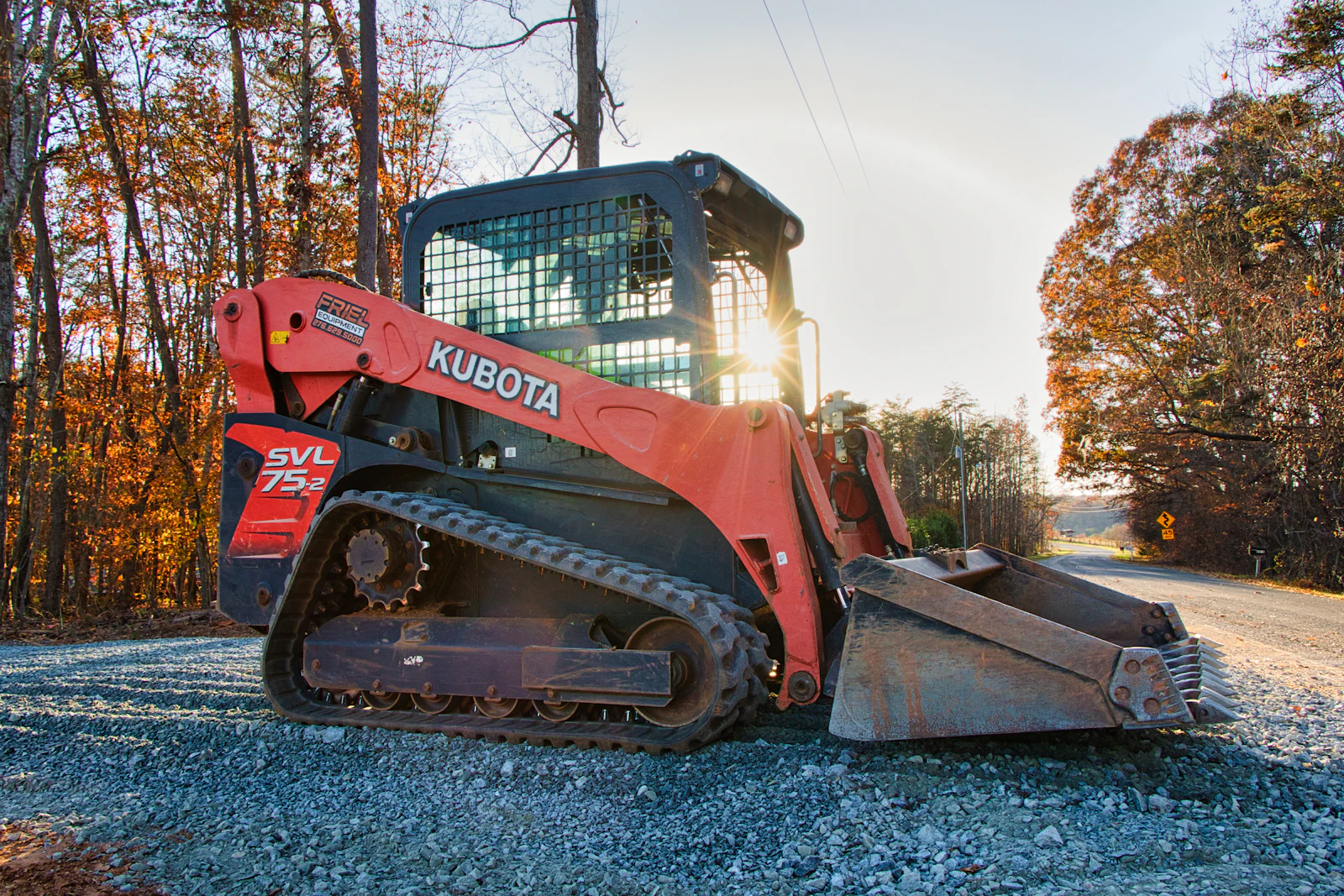
Skid Steer Loader Rental Rates Denver 2026
For Denver-area concrete driveway scopes in 2026 (demo, haul-off loading, base grading/placing, and site cleanup), plan skid steer loader equipment hire costs in these ranges (USD, dry hire only, before delivery, damage waiver, attachments, fuel, and cleaning): wheeled skid steer (approx. 1,500–2,000 lb ROC) at $275–$450/day, $1,050–$1,650/week, and $2,700–$4,200/month; and compact track loader / tracked skid steer at $350–$575/day, $1,300–$2,100/week, and $3,300–$5,400/month. Larger units (2,500–3,000 lb ROC or higher-flow configurations) commonly price above these bands. Denver inventory is typically sourced through national rental houses (e.g., United Rentals, Sunbelt, Herc) and strong local dealer-rental networks (e.g., Bobcat-focused branches), with pricing governed by machine class, hour-meter billing rules, delivery constraints, and concrete-specific cleanup/return-condition risk. Weekly/monthly “cheap” rates often assume a defined hour basis (commonly 8-hour day and 40–44-hour week conventions; monthly is frequently a 4-week/28-day construct).
| Vendor |
Daily Rate |
Weekly Rate |
Review Score |
Website |
| United Rentals |
$395 |
$1 185 |
8 |
Visit |
| Sunbelt Rentals |
$385 |
$1 155 |
9 |
Visit |
| Herc Rentals |
$375 |
$1 125 |
8 |
Visit |
| Wagner Cat Rentals (The Cat Rental Store) |
$405 |
$1 215 |
8 |
Visit |
| The Home Depot Rental |
$350 |
$1 050 |
8 |
Visit |
Planning assumptions for the ranges above (state in your estimate): (1) standard-flow hydraulics unless a high-flow attachment is required; (2) bucket included, specialty attachments extra; (3) 8-hour meter day; (4) pickup/return at branch (no trucking included); (5) no operator included; (6) no sales tax included. National guidance commonly lands in the $200–$500/day class for skid steers and recognizes meaningful add-on costs beyond the base rate.
How Machine Class And Undercarriage Change Your Hire Cost
Wheeled skid steer vs tracked (CTL): for concrete driveway work, wheeled machines are often cheaper on rate card but can create higher total hire cost if you need mats, extra cleanup, or traction support. In Denver, tracked machines are commonly selected when the driveway subgrade is soft after irrigation/rain, when there’s freeze-thaw breakup under the slab edges, or when you’re staging on uncompacted base. Dozr’s marketplace averages for compact track loader rental in Denver are consistent with the market premium tracks command.
Typical 2026 Denver planning adders by configuration (use as allowances, not promises):
- Enclosed cab / heat: add $35–$85/day (higher in winter demand).
- High-flow hydraulics (if required for cold planer, high-flow broom, etc.): add $75–$150/day.
- Non-marking/“turf” tires or specialized track types: add $20–$60/day (or a one-time swap fee in some yards).
- Up-sized ROC class (moving from ~1,800–2,000 lb ROC to ~2,700–3,000 lb ROC): often adds $75–$200/day depending on availability and seasonality.
Meter hours matter: many rental programs treat a “day” as 8 engine hours, a “week” as roughly 40 hours, and a “month” as roughly 176 hours (variations exist by lessor and contract). If your concrete driveway operation is running two shifts (or just idling while crews form, sawcut, and place), you can burn through the hour cap fast and trigger overtime.
Concrete Driveway Scope: Tasks And Attachment Adders That Drive Hire Cost
For a typical concrete driveway package, the skid steer is rarely “just a bucket.” Concrete-specific productivity—and cost—usually hinges on having the right attachment on the PO from day one to avoid unplanned downtime billed at a full daily rate.
Common attachments and 2026 Denver planning ranges (add to the base machine hire):
- Hydraulic breaker / hammer (driveway demo): $225–$375/day, $700–$1,150/week; budget an additional $40–$90/day for breaker tool wear items if your contract pushes consumables back to the renter.
- 4-in-1 bucket (grading edge control, carry, clamp): $50–$95/day.
- Pallet forks (bundled forms, rebar, base pallets): $25–$45/day.
- Soil conditioner / power rake (subgrade conditioning): $225–$350/day.
- Angle broom / sweeper (cleanup to meet HOA/ROW standards): $175–$300/day plus potential bristle wear charges.
- Auger (fence posts, pier holes adjacent to driveway): $125–$225/day plus $35–$65/day per bit size depending on inventory.
Concrete driveway note: If you’re removing an existing slab, you may need a coordinated package (skid steer + breaker + dump insert/roll-off logistics). If the driveway is in a tight Denver infill neighborhood, track width, turning radius, and delivery access can cost more than the attachment itself (see logistics sections below).
Hidden-Fee Breakdown For Skid Steer Equipment Hire In Denver
To keep your skid steer loader hire costs predictable, treat the base daily/weekly/monthly rate as only one line item. The “real” invoice is usually shaped by trucking, waiver/insurance, fuel, and return-condition charges—especially on concrete work where slurry, mud, and cement dust can trigger cleaning and filter service.
Common add-on costs (use as estimating allowances for Denver 2026):
- Delivery / pickup (within metro): $175–$325 each way for standard business-hour windows; many yards also apply a $250 minimum haul charge if you’re outside a core radius.
- Mileage outside core radius: often $5.50–$7.50 per loaded mile (frequently applied one-way from branch to site).
- After-hours / weekend delivery windows (if your pour schedule forces it): add $150–$250 per move, subject to dispatch availability.
- Damage waiver / loss damage waiver (LDW): commonly 10%–15% of the rental charges (machine + attachments). (This is not the same as providing your own insurance certificate.)
- Refundable deposit / authorization hold (when credit terms aren’t established): often $500–$2,000+ depending on machine class and attachment package.
- Refuel / recharge: diesel “full-to-full” is typical; refuel service frequently combines a convenience fee (often around $25–$40) plus a marked-up fuel rate (commonly $6.00–$8.00/gal on invoice, varying by lessor and timing).
- Cleaning: light wash-down $95–$150; concrete/mud-heavy return $200–$350+ (especially if cement fines pack into steps, radiator screens, or quick-attach points).
- Flat tire / track damage exposure: tire repair admin charges commonly start around $75–$175; track repairs can be substantially higher depending on damage mechanism and contract responsibility.
Why concrete driveway rentals get flagged for cleaning: cement dust and slurry can accelerate filter loading. If you’re operating near fresh sawcutting or demo, add an allowance for extra filter service (commonly billed as parts + labor) and plan dust control (mist, vac, or wet methods) to avoid avoidable downtime and cleanup fees.
Billing Rules That Move The Needle (Hours, Weekends, Off-Rent)
Most skid steer loader rental agreements for commercial accounts define the billing unit and hour basis. It’s common to see an “8-hour day” and “work week” basis; monthly billing is frequently tied to a 4-week construct and may not prorate cleanly mid-cycle.
Rules to confirm on the PO and at dispatch:
- Hour-meter overtime: if you exceed the included hours, budget $55–$95 per excess hour (or a pro-rated day rate) depending on contract language.
- Late return cutoff: common practice is billing another day if the unit misses a defined cutoff (often end-of-business). A practical allowance is 1/8 day per hour after the daily hour cap or after the return cutoff, but confirm the lessor’s policy in writing.
- Weekend billing: some branches support “Friday PM pickup / Monday AM return” at a 1-day charge, but others bill 2–3 days depending on utilization and season. Treat weekend as a risk item in the estimate for concrete driveway pours that run long.
- Off-rent notification: many lessors require an off-rent call/email with equipment ID before a dispatch cutoff; if you miss it, you can get billed an extra day even if the unit is parked. Budget an admin buffer of $0–$450 (one day) for schedule volatility if your project is permit/inspection driven.
Denver-Specific Logistics That Affect Delivered Hire Cost
Denver is a delivery-driven rental market for compact equipment: tight residential streets, alley-loaded garages, and limited laydown push most concrete driveway scopes toward delivered equipment (rather than customer pickup). Three local conditions often change the delivered skid steer hire cost:
- Access constraints in older neighborhoods: if a tilt-deck can’t safely stage, you may need a smaller machine class or a different delivery method, raising cost even when the daily rate looks lower.
- Elevation and heat: Denver’s elevation can reduce effective power margin; to keep cycle times up (and avoid “extra days” on hire), some contractors step up one frame size or choose tracks for traction. This is a cost avoidance move when your schedule is tighter than your rate card.
- Weather swing and freeze-thaw: concrete driveway subgrade work can turn from “finish grading” to “rework and drying” quickly. If you expect spring melt or afternoon storms, a longer weekly rate can be cheaper than stacking daily charges while you wait for moisture limits.
If your site is west into the foothills or you’re moving between Denver and mountain-adjacent suburbs, extend your delivery allowance using mileage-based trucking and include a contingency for I-70 corridor delays (late return charges can be more expensive than the incremental trucking planning).
Insurance, Damage Waiver, And Return-Condition Risk
For commercial concrete driveway work, lessors will usually ask for a certificate of insurance (COI) meeting their requirements and may still offer/require a waiver product. Waivers commonly price as a percentage of rental (often 10%–15%) and reduce exposure for accidental damage—but rarely cover negligence, theft with keys left in, or improper transport. Treat waiver selection as a line-item decision: it’s frequently cheaper than absorbing one damage event, but it should not substitute for jobsite controls (secure parking, key control, and documented condition photos at delivery and pickup).
Return-condition controls that reduce disputes (and cost): document hour meter and condition at drop, keep a daily log, and photograph quick-attach plates, hoses, and undercarriage before calling off-rent—especially after concrete demo where rebar can snag hydraulic lines.
Budget Worksheet For Skid Steer Loader Equipment Hire (Concrete Driveway)
Use the following estimating worksheet as bullet line items (no tables) to build a defensible “skid steer loader hire cost Denver” budget for a concrete driveway package. Adjust quantities to your planned duration and whether you’ll be billed daily vs weekly.
- Skid steer loader (wheeled, 1,500–2,000 lb ROC): allowance $275–$450/day × ____ days (or $1,050–$1,650/week × ____ weeks).
- OR compact track loader (tracked): allowance $350–$575/day × ____ days (or $1,300–$2,100/week × ____ weeks).
- Attachment: hydraulic breaker: $225–$375/day × ____ days (demo window only).
- Attachment: sweeper / angle broom: $175–$300/day × ____ days (final cleanup / dust control).
- Attachment: pallet forks: $25–$45/day × ____ days (forms/rebar/base pallets).
- Delivery + pickup: $175–$325 each way × 2 moves (add $5.50–$7.50/mi outside core radius).
- Damage waiver (if selected): 10%–15% of rental subtotal (machine + attachments).
- Fuel allowance: ____ gallons × $6.00–$8.00/gal (if you expect refuel billing rather than self-fuel) + $25–$40 convenience fee if returned not full.
- Cleaning allowance: $95–$350 (set higher if you’re demoing concrete and expect slurry/cement dust).
- Overtime/excess hours contingency: $55–$95/hr × ____ hours (protects you if the machine is idling during formwork or running extended shifts).
- Mats / surface protection (if required): allowance $25–$60/day or a one-time purchase/haul cost (use when crossing finished flatwork or pavers).
- Cold-weather allowance (seasonal): block heater / winter kit $10–$15/day (if offered/needed) and schedule float for freeze-thaw rework.
Rental Order Checklist For A Clean Off-Rent In Denver
Use this checklist to reduce schedule-driven overbilling (extra days) and return-condition back-charges—two of the most common causes of skid steer loader equipment hire cost overruns on concrete driveway jobs.
- PO details: machine class (ROC), wheels vs tracks, cab type, standard-flow vs high-flow, included bucket size, requested delivery date/time window, and estimated off-rent date.
- Billing basis confirmation: confirm 8-hour day definition, weekly hour caps, monthly hour caps, overtime rate method, and weekend billing rule in writing.
- Delivery requirements: site contact phone, gate codes, staging location, overhead clearance, street parking limitations, and whether a tilt-deck can safely unload.
- Condition documentation: photos/video at delivery (all sides, quick-attach, tires/tracks, hoses, cab), plus hour meter reading.
- Operational controls: key control, daily walkaround, grease points, track/tire inspection, and concrete debris removal at end of shift.
- Fuel/return standard: confirm “full-to-full” expectation; plan who fuels it and where (avoid refuel fees + marked-up gallons).
- Dust control plan: if operating near sawcutting or demo dust, assign responsibility for radiator screen cleaning to prevent overheating shutdowns that still burn rental time.
- Off-rent procedure: confirm cutoff time for same-day off-rent (email + equipment ID). If pickup is delayed by the lessor, confirm whether billing stops at off-rent notice or at physical pickup (this varies by contract).
- Return-condition cleanup: quick-attach cleaned, cab swept, debris removed from undercarriage, and any concrete splatter addressed before calling pickup (reduces $200–$350+ cleaning exposure).
Example: Five-Day Concrete Driveway Demo And Base Prep In Denver
Scenario: Remove and replace a 1,000 sq ft residential concrete driveway in central Denver with tight access (single-lane street, limited staging). Work plan: 2 days demo/loading, 2 days base rework and grading, 1 day cleanup and material handling.
Rental approach (cost-driven choices):
- Select a tracked skid steer/CTL to maintain productivity on wet subgrade and avoid getting stuck (which often costs more than the track premium through added days).
- Book a weekly rate rather than stacking dailies to protect against weather and inspection variability.
- Add a breaker only for the first 2 days, then swap to forks/bucket for grading and handling forms.
Cost build (planning numbers, Denver 2026):
- CTL weekly hire: $1,300–$2,100/week.
- Breaker (2 days): $225–$375/day × 2 = $450–$750.
- Delivery + pickup: $175–$325 each way × 2 = $350–$650 (add after-hours allowance of $150 if your street can only accept delivery outside peak times).
- Damage waiver: 10%–15% of the rental subtotal (often cheaper than absorbing one hose/quick-attach damage event).
- Cleaning allowance (concrete demo): $200–$350.
- Overtime contingency: assume 6 excess hours at $55–$95/hr = $330–$570 if the unit is left idling during formwork or used for extended haul loading.
- Fuel/refuel risk: if returned short, budget $25–$40 convenience + $6.00–$8.00/gal.
Operational constraint that changes the invoice: If the branch requires off-rent notice before a cutoff and you miss it by one day, you can unintentionally add another full day charge (up to $575 on the tracked class). Build the off-rent process into the superintendent’s closeout checklist, not just the estimator’s notes.
Ways Rental Coordinators Reduce Skid Steer Hire Cost Without Creating Risk
- Right-size the machine to the cycle time: if you’re loading trucks continuously during demo, moving up one class can remove a full rental day—often a net savings even if the daily rate is $75–$200/day higher.
- Split attachments by phase: breaker for demo days only; forks/broom for closeout only. Avoid paying $175–$375/day for attachments sitting unused on site.
- Lock delivery windows early: paying an extra $150–$250 for after-hours trucking can be cheaper than losing a day waiting on a missed dispatch and burning $275–$575 in hire.
- Control cleaning: allocate 30 minutes end-of-shift to knock concrete fines off the machine; it’s often cheaper than a $200–$350+ cleaning line on the invoice.
- Prevent downtime that still bills: keep spare pins, a grease gun, and a plan for concrete debris management so the machine doesn’t sit “on rent” while crews troubleshoot basic issues.
When A Compact Track Loader Or Mini Loader Is Cheaper Than A Skid Steer
For Denver concrete driveway projects, a compact track loader can be a lower total equipment hire cost choice if it prevents weather-related stuck events and reduces rework on soft subgrade (despite a higher base rate). Conversely, if access is extremely tight (rear-yard alley access, narrow gates), a smaller loader class can reduce delivery complexity and avoid higher trucking fees and failed delivery attempts (some yards charge a re-dispatch / failed pickup fee; budget an admin allowance of $85–$150 if access is uncertain). When in doubt, ask dispatch for the machine’s operating width with bucket and confirm access with a tape measure before the PO is released.