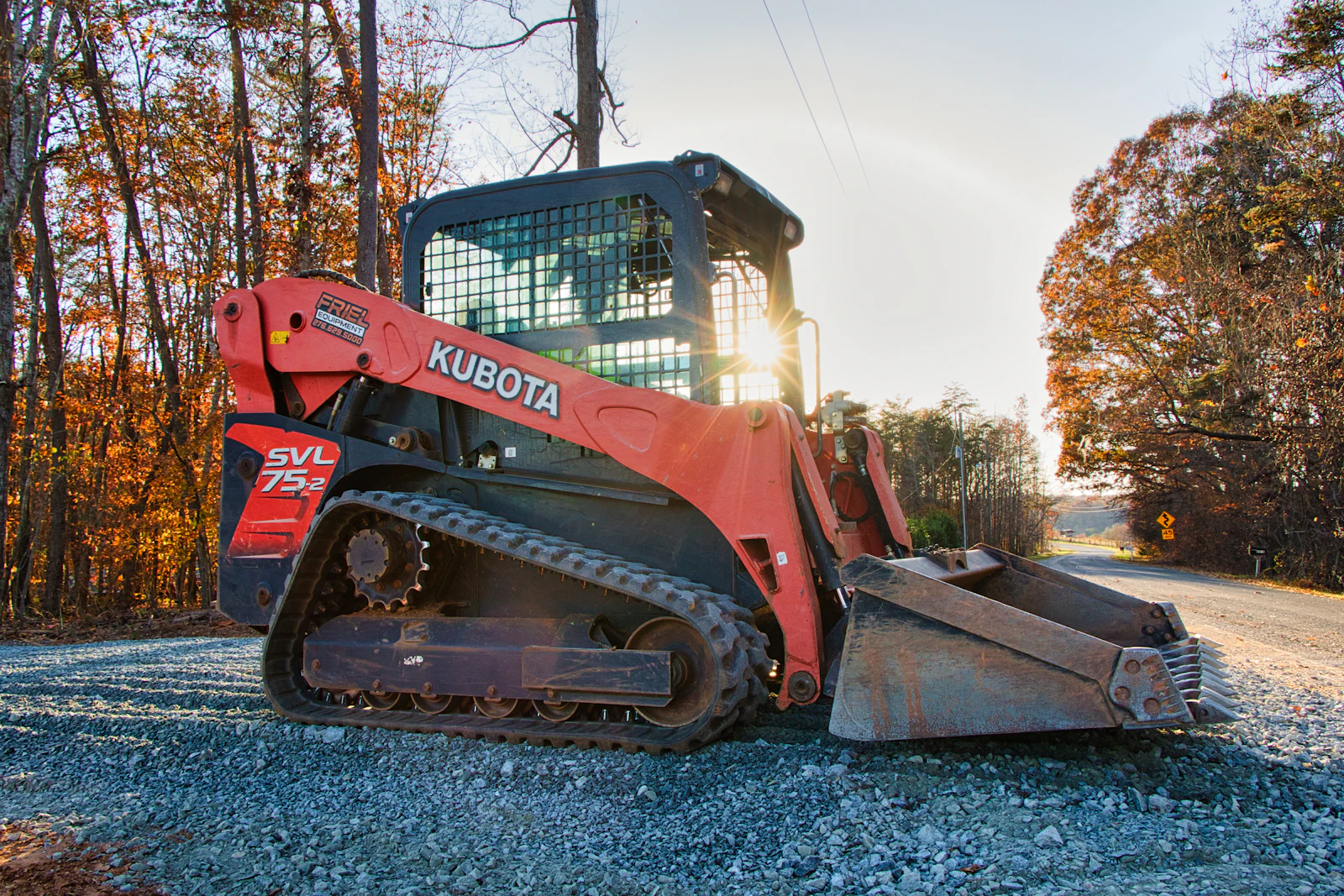
Denver 2026 planning ranges (skid steer loader equipment hire): budget $325–$550/day, $1,050–$1,700/week, and $2,500–$3,950/month for a job-ready skid steer loader with a general-purpose bucket, with tracked compact track loaders typically landing at the upper half of the range. These ranges assume a standard rental clock (often 8 machine-hours/day, 40 hours/week, 160 hours/4 weeks) and “normal” wear-and-tear use on compacted subgrade—no demolition hammering, no continuous rock work, and no severe undercarriage abrasion. In Denver, rental coordinators usually see pricing move most based on (1) track vs wheel, (2) rated operating capacity and hydraulic flow, (3) delivery logistics (tight urban sites vs. easy yard drops), and (4) attachment package (trencher/auger/sweeper). National fleets (e.g., United Rentals, Sunbelt, Herc) and strong local independents can all be competitive—your true cost is the all-in ticket after freight, waiver/insurance, fuel/cleaning, and overtime-hour exposure.
| Vendor |
Daily Rate |
Weekly Rate |
Review Score |
Website |
| United Rentals |
$375 |
$1 125 |
8 |
Visit |
| Sunbelt Rentals |
$395 |
$1 188 |
9 |
Visit |
| Herc Rentals |
$360 |
$1 080 |
8 |
Visit |
| Wagner Cat Rentals |
$405 |
$1 215 |
8 |
Visit |
| Bighorn Rentals |
$300 |
$900 |
10 |
Visit |
skid steer loader rental
For skid steer loader rental in Denver, it helps to budget by machine class rather than by a single “skid steer” number. The posted market examples below show how wide the spread can be once you specify tracks, capacity, and term:
- Wheeled skid steer (typical mid-size): often budgets around $375–$425/day, $1,200–$1,300/week, $2,500–$2,750/month for contractor-grade units (bucket included).
- Tracked compact track loader / “tracked skid steer”: commonly $425–$500/day, $1,250–$1,700/week, $3,000–$3,950/month depending on ROC and undercarriage.
- Mini track loader (tight-access): a Denver-specific posted example is $300/day, $900/week, $2,100/month—useful when a full-size machine triggers access constraints or matting requirements.
Estimator note (billing clock): many rental programs define the rate by included operating hours (e.g., 8 hours/day, 40 hours/week, 160 hours/4 weeks). If your foreman routinely runs 9–11 hours/day or adds weekend shifts, you should pre-carry overtime/extra-hour exposure in the estimate rather than “hoping it washes out.”
What Changes Skid Steer Loader Hire Costs in Denver?
When you’re building a Denver equipment hire budget, the base day/week/month rate is only the starting point. The following drivers are the ones that most often swing the all-in cost (and cause change orders if you don’t carry allowances):
- Tracks vs. tires: tracked units typically carry a premium because they work when Denver jobs are wet, snowy, soft, or unfinished; they also have higher undercarriage wear risk. Wheeled units can be cheaper but may require better access/grade and can increase rut-repair scope.
- Rated operating capacity (ROC) and lift geometry: a 2,000 lb ROC class is a different cost band than a 2,800–3,200 lb ROC class. If you’re loading tri-axle dumps, a vertical-lift tracked unit can reduce cycle time but may push you into a higher weekly/monthly bracket.
- Cab configuration and seasonal requirements: enclosed cab + heat (and sometimes A/C) is not optional for many winter schedules. Budget an additional $35–$90/day equivalent uplift versus open cab when availability gets tight.
- Hydraulic flow and attachment readiness: standard-flow vs high-flow determines whether you can run a broom/sweeper, cold planer, mulcher, or certain trenchers without derating productivity. If you “save” $50/day on the wrong machine but add labor hours, the equipment line item wasn’t really cheaper.
- Term structure: if the work is truly continuous, a monthly can land near 3× weekly (or similar) with 160-hour inclusion; if the work is stop/start (utilities, punch list), short-term weekly resets and delivery cycles can be cheaper than a month you don’t use.
Denver-Specific Cost Adders to Carry in 2026 Budgets
Denver/Front Range logistics and job conditions create a few recurring “local” adders that change skid steer loader equipment hire costs in practice:
- Urban delivery constraints: downtown, RiNo, and tight alley drops frequently require narrower delivery windows and on-site receiving. Carry $95–$175 each way for metro delivery/pickup as a baseline allowance, plus a $45–$85 re-delivery/“missed site” fee risk if the driver can’t access the drop. (Confirm your supplier’s policy at PO time.)
- Mountain or extended-radius work: if your “Denver” job is actually I-70 corridor, foothills, or far suburbs, carry a mileage adder such as $3.50–$6.00/mile beyond a stated radius (often 15–25 miles), or a flat extended-haul of $250–$450 each way depending on DOT constraints and driver time.
- Elevation/derate reality: at Denver’s ~5,280 ft elevation, diesel engines and hydraulics may feel “softer” under peak load. If the scope is near-capacity (loading heavy wet sand, dense base course, or big boulders), carry contingency for a larger ROC class (often +$75–$125/day) rather than burning schedule on an under-sized unit.
- Winter return conditions: freeze-thaw mud and snow pack into undercarriages. Budget a tracked-undercarriage cleanout allowance of $125–$275 per return event if your crew can’t wash/clean before off-rent (and confirm you have an approved washout area).
Hidden-Fee Breakdown for Skid Steer Equipment Hire
If you want the estimate to match the final invoice, treat the following as standard line items (or at least explicit allowances). These are the fees that most often show up after the fact for skid steer loader rental rates in Denver:
- Minimum rental charge: many counters have a 1-day minimum (or a 4-hour minimum on compact units). If your planned use is 2–3 hours, you still pay the minimum.
- Damage waiver (DW) / rental protection: commonly carried as 10%–15% of the rental rate (sometimes with minimums). If you’re providing your own insurance, confirm certificate requirements and whether a waiver can be declined.
- Fuel / re-fuel charge: diesel machines typically go out full; return full to avoid a refuel markup. Carry $6.00–$9.00/gal as a conservative “rental yard refuel” allowance (often higher than pump pricing once service is included).
- DEF and emissions considerations: Tier 4 units may require DEF; if your crew ignores low-DEF warnings and derates the machine, you can lose production and still pay the clock.
- Cleaning: standard clean $65–$150; heavy concrete/mud/asphalt residue can be $200–$450, especially if it requires chipping or specialty wash.
- Cutting edge / bucket wear policy: confirm whether “normal wear” is included. Some houses bill abnormal wear on cutting edges, tires, or track lugs.
- Late return / after-hours policy: if the contract says return by 4:00 p.m. and you roll in at 4:30, you may get billed an extra day. Carry a $0–$550 exposure depending on your day rate.
- Weekend billing: some programs treat Friday PM to Monday AM as a “weekend” package; others bill 2–3 days. A posted example of a weekend package for a tracked skid steer is $465 (vs $310/day), which illustrates why you must confirm weekend rules in writing.
- Overtime/extra-hour charges: if you exceed included hours, some suppliers charge by the hour. A posted example shows $100/hour beyond included seat time—carry this risk if you’re running extended shifts.
Attachments and Accessories That Commonly Drive the Ticket
In Denver, attachments are often the difference between a “cheap skid steer day rate” and a realistic all-in equipment hire cost. If the PM asks for a multi-tool skid steer package, budget attachments explicitly (and confirm hydraulic flow compatibility):
- Pallet forks: plan $75–$95/day, $200–$285/week, $500–$700/month depending on class.
- Post hole auger: plan $200–$250/day, $450–$500/week, $850–$1,000/month (bit sizes may be included/limited).
- Auger attachment (Denver posted example): $195/day, $495/week, $1,295/month for a standard-flow package; larger augers may be extra.
- Trencher attachment (Denver posted example): $150/day minimum, $465/week, $1,400/month for a standard-flow 48-inch-deep class trencher.
- Sweeper / broom: plan $250/day, $500/week, $1,050/month plus dust-control expectations (water kit or vac system) if working near occupied buildings.
- Grapple: plan $200/day, $500/week, $1,000/month (verify whether it’s root grapple vs demolition grapple).
- Low-flow brush mower: plan around $250/day, $650/week, $1,750/month (confirm required guarding and debris-control rules).
- Transport trailer (if not delivering): a posted Denver-area example for a 16k GVWR power-tilt deckover trailer is $125/day, $650/week, $1,625/month; verify that your supplier allows “trailer-only” rentals and confirm tiedown requirements.
Operational constraint: If your crew is self-hauling, confirm CDL/driver qualification, load securement, and that your truck is rated for the combined trailer + machine weight. A single roadside issue can erase any freight savings.
Example: 10-Day Denver Utility Trench Package (Real Constraints, Real Numbers)
Example: You have a 10-day utility trench scope in Denver (RiNo area), limited laydown, delivery only between 7:00–9:00 a.m., off-rent must be called in by 2:00 p.m. for next-day pickup, and the GC requires daily housekeeping (no spoil piles in the alley). You choose a tracked skid steer loader (better traction and less rut risk) plus a trencher attachment, and you add forks for pipe bundles.
- Tracked skid steer hire (10 days): budget as 2 weeks @ $1,450–$1,700/week rather than 10 daily tickets to avoid day-rate burn. (Planning range; confirm at quote.)
- Trencher attachment (2 weeks equivalent): carry $465–$650/week depending on model/chain depth.
- Forks (2 weeks): carry $200–$285/week.
- Delivery + pickup (urban): carry $140 each way = $280 (allowance), plus a $65 “missed site” risk if an alley is blocked.
- Damage waiver: carry 12% of time/attachment rental (allowance).
- Fuel: carry 25 gallons total at $7.50/gal = $187.50 (if your crew can’t refuel on site, assume rental-yard refuel pricing).
- Cleaning/undercarriage: carry $225 at return due to wet clay and alley gravel packing into tracks.
- Overtime hours exposure: if the crew runs 12 extra hours beyond the included clock, carry 12 × $100/hour = $1,200 risk in a worst-case model (or manage hours tightly).
The takeaway for Denver equipment managers: the weekly strategy, freight plan, and hour control usually matter more than negotiating $25/day off the base rate.
Budget Worksheet
- Skid steer loader equipment hire (tracked or wheeled): allowance $325–$550/day or $1,050–$1,700/week or $2,500–$3,950/month
- Attachments (select as needed): forks $75–$95/day; auger $195–$250/day; trencher $150–$255/day; sweeper $250/day
- Delivery/pickup: $95–$175 each way (metro) + extended radius $3.50–$6.00/mile beyond radius (if applicable)
- Damage waiver / rental protection: 10%–15% of rental (or insurance certificate admin time)
- Fuel/refuel: allowance $6.00–$9.00/gal (plus DEF as needed)
- Cleaning: standard $65–$150; heavy $200–$450; tracked undercarriage cleanout $125–$275
- Weekend/holiday billing exposure: carry $155–$465 package uplift depending on policy and machine class
- Overtime/extra operating hours: carry $100/hour exposure if shifts exceed included hours
- Ground protection (if required): mats/plywood allowance $12–$35 per sheet/mat per day (varies by type and quantity)
Rental Order Checklist
- Confirm machine class: wheeled vs tracked; ROC; enclosed cab; auxiliary hydraulics (standard vs high-flow)
- Confirm included items: bucket type (tooth/smooth), coupler style, backup alarm requirements, beacon, fire extinguisher (if required)
- Confirm billing clock in writing: 8 hr/day, 40 hr/week, 160 hr/4 weeks (or your supplier’s equivalent) and the extra-hour rate
- Delivery requirements: site contact, exact address, delivery window, drop location, surface condition, forklift/spotter needs
- Insurance/DW: COI submitted, waiver accepted/declined, deductible responsibilities understood
- Off-rent procedure: cutoff time (e.g., 2:00 p.m.), weekend rules, after-hours drop policy
- Return condition documentation: pre/post photos (tracks/tires, bucket edge, cab/glass), hour meter, fuel level, known damage noted on tickets
- Environmental controls: approved washout plan, dust-control expectations (especially for sweeping or indoor work)
Off-Rent Rules and Return-Condition Standards That Affect Total Cost
To control total construction equipment hire costs in Denver, manage the end-of-rental as tightly as the start:
- Off-rent isn’t retroactive: most suppliers stop the clock when you call off-rent and the unit is accessible for pickup. If the machine is behind a locked gate, buried in materials, or blocked by parked vehicles, the clock can keep running.
- Weekend exposure: if you “finish Friday” but can’t get pickup until Monday, understand whether you’re billed 1 day, 2 days, or a weekend package.
- Return cleanliness: track machines packed with clay or asphalt millings are the fastest path to a cleaning surcharge. Build wash/clean time into the plan and designate who signs the return ticket.
- Document condition: require field teams to take hour-meter and condition photos at delivery and at off-rent; it reduces invoice disputes and protects your job cost report.
How to Choose Daily vs Weekly vs Monthly for Skid Steer Loader Equipment Hire
Denver equipment managers typically save money by matching the rental term to how the crew will actually use the unit—especially when attachments and freight are involved.
- Choose daily when the scope is truly short (one load-out, one backfill, one broom pass) and you can guarantee return before cutoff. In practice, the daily model breaks if you get hit with a late-return day charge or a weekend billing rule.
- Choose weekly when you have a defined 5–10 working-day window or when the crew will be on/off the machine but still needs it accessible on site. Weekly often reduces the “one more day” invoice creep.
- Choose monthly when utilization is consistent and you’re confident you will burn enough hours to justify the month. If utilization is intermittent, consider two separate week rentals instead of a month plus idle time—especially if your supplier includes only a fixed hour bank per month.
Common 2026 Add-On Charges to Put on Every Denver Skid Steer Estimate
Use this as a practical “invoice reality” checklist for skid steer loader hire costs Denver. These are not universal, but they are common enough that omitting them creates budget variance:
- Environmental / admin fees: carry 3%–8% of rental as a catch-all for shop supplies, environmental, and admin fees if your supplier uses them.
- After-hours emergency swap: if you’re running critical path utility restoration, carry a $250–$600 contingency for a same/next-day swap delivery (availability dependent).
- Key/lockout replacement: carry $45–$120 if keys go missing (varies by fleet and key type).
- Flat tire / foam fill exposure (wheeled): carry $175–$450 per incident depending on tire size and whether foam fill is used.
- Track damage exposure (tracked): if the scope includes demolition rubble, rebar, or sharp riprap, carry a contingency of $750–$2,500 for track/undercarriage damage risk depending on severity and contract responsibility.
- Downtime policy: confirm whether breakdown time is credited and how quickly a replacement is dispatched in the Denver metro area.
Strategies to Reduce Total Skid Steer Loader Rental Cost (Without Cutting Capability)
- Bundle attachments at PO time: you’ll often spend more on a last-minute attachment run (extra freight + lost production) than the attachment’s weekly rate. If the PM “might need” forks, it’s usually cheaper to carry $200–$285/week and return unused than to scramble midweek.
- Control machine-hours: set expectations on included hours and track hour meter daily. If your supplier charges extra hours (e.g., $100/hour), one long weekend can become a four-figure overage.
- Plan delivery like a subcontract: confirm access, gate codes, and a named receiver. A single failed delivery attempt can add $45–$85 plus lost crew time.
- Match the machine to the ground: if the site is tight and finished surfaces are present, a mini track loader at roughly $300/day can reduce surface repair and matting costs compared with forcing a full-size unit into a constrained footprint.
Attachment Package Planning Notes for Denver Crews
Attachment availability can be the bottleneck in peak season. For 2026 planning, keep a simple rule: if the attachment is essential, reserve it like the machine and confirm compatibility (hydraulic flow, coupler, electrical, and guarding).
- Auger package planning (fencing/caissons): carry $195/day or $495/week for a standard-flow auger package, then confirm if larger bits are extra and whether teeth/wear are included.
- Trencher package planning (utilities/irrigation): carry $150/day minimum or $465/week for a standard-flow 48-inch-deep class trencher, plus allowance for chain wear if you’re trenching in cobble or caliche-like material.
- Sweeping/housekeeping: if you need a broom to meet GC cleanliness requirements, carry $250/day and confirm dust-control expectations (water kit, work hours, and disposal rules).
Rental Closeout Practices That Prevent Denver Invoice Disputes
- Take end-of-rent photos: hour meter, fuel level, all sides, cab/glass, bucket edge, tracks/tires. This is the fastest way to resolve “it wasn’t like that” discussions.
- Capture off-rent timestamp: email or portal confirmation, plus who authorized pickup. If pickup slips, you have documentation.
- Sign the return ticket carefully: note any pre-existing damage discovered at pickup and ensure it matches your delivery inspection notes.
- Confirm attachments returned: missing fork tines, auger bits, or coupler pins are common back-charges; assign a specific person to verify all components before the truck leaves.
Denver 2026 Market Notes for Skid Steer Loader Equipment Hire
Posted market examples in the Denver area show workable baselines for estimator budgets: mini track loader pricing around $300/day, tracked skid steer packages around the $395/day range, and higher-capacity tracked units commonly landing in the $425–$500/day band depending on ROC and term. Use these as anchors for planning, then tighten with written quotes once you know (1) the exact machine class, (2) delivery location, (3) attachments, and (4) expected operating hours.