Build your next estimate with CountBricks
Create an itemized estimate for your project, with materials, labor, and quantities you can review and edit.
Create my estimateStart a 7-day free trial. Sign up, then enter your project details.
Skid Steer Loader Rental Rates Detroit 2026
For Detroit-area concrete driveway scope in 2026, plan skid steer loader equipment hire budgets in three practical bands: wheeled skid steer (mid-frame, ~1,800–2,600 lb ROC) at roughly $280–$350/day, $965–$1,250/week, and $2,895–$3,300/month; larger wheeled units at roughly $290–$400/day, $1,100–$1,450/week, and $2,955–$3,900/month; and compact track loaders (CTLs) at roughly $425–$550/day, $1,395–$1,850/week, and $3,900–$4,900/month. These planning ranges assume a standard bucket, standard workday meter limits, and market-typical availability in Metro Detroit. In practice, procurement teams commonly source from national rental fleets (United Rentals, Sunbelt Rentals, Herc Rentals) and established local yards in Warren/Detroit-area corridors; pricing usually tightens with negotiated accounts, longer terms, and flexible delivery windows.
| Vendor |
Daily Rate |
Weekly Rate |
Review Score |
Website |
| United Rentals |
$425 |
$1 700 |
9 |
Visit |
| Sunbelt Rentals |
$410 |
$1 640 |
8 |
Visit |
| Herc Rentals |
$395 |
$1 580 |
8 |
Visit |
| The Home Depot Tool & Truck Rental |
$389 |
$1 170 |
9 |
Visit |
| EquipmentShare |
$405 |
$1 620 |
9 |
Visit |
What Concrete Driveway Work Changes In Skid Steer Equipment Hire Pricing
“Concrete driveway” is a cost-sensitive term for skid steer hire because it rarely stays “just loading.” Even when demolition is performed by saw + breaker crew or by an excavator, the skid steer is often expected to (1) strip spoils, (2) load heavy rubble, (3) backfill and fine grade, and (4) handle pallets/forms. That drives two immediate cost impacts for Detroit equipment hire:
- Hydraulic performance and coupler type matter. High-flow vs standard-flow and whether the yard supplies a compatible coupler can add time (and unplanned attachment swaps) if not aligned up front.
- Surface protection and traction selection matter. Wheels can be cheaper, but CTLs may be required after rain events or on clay subgrade common in Southeast Michigan, especially during spring/fall shoulder seasons.
For estimating, treat the base skid steer hire rate as only ~60–75% of the “all-in” equipment hire cost on driveway projects once you include delivery/pickup, damage waiver, consumables, cleaning, and attachment adders.
Detroit Planning Assumptions For 2026 Skid Steer Loader Hire
To keep your equipment hire estimate aligned with how most Detroit-area rental contracts bill, these assumptions are commonly used when you build a PO:
- Metered time: budget on an 8-hour day, 40-hour week, and 160-hour month. Overage commonly bills at an overtime rate (see allowances below).
- Base configuration: 0.6–0.7 yd general-purpose bucket (smooth edge) is often included; a tooth bucket may be an adder or a substitution depending on yard.
- Fuel: diesel is usually “return full” or “refuel service” (your cost exposure is often higher if the yard refuels).
- Wear and cleanliness: concrete slurry, mud-packed undercarriage (CTL), and caked-on material typically trigger cleaning charges if returned non-compliant.
Core Rate Bands You Should Carry (Wheeled Vs Tracked)
Using published Metro Detroit rate sheets as a sanity check, a mid-frame wheeled skid steer commonly sits around the high-$200s per day with weekly near $1,000 and monthly near $2,900, while a CTL can land in the low-$400s per day with weekly near $1,400 and monthly near $3,900. For 2026 budgeting, many equipment managers carry these procurement-ready planning ranges:
- Wheeled skid steer (S185/S570 class): $280–$350/day (minimum day may apply), $965–$1,250/week, $2,895–$3,300/month.
- Wheeled skid steer (S250/S560 class): $290–$400/day, $1,100–$1,450/week, $2,955–$3,900/month.
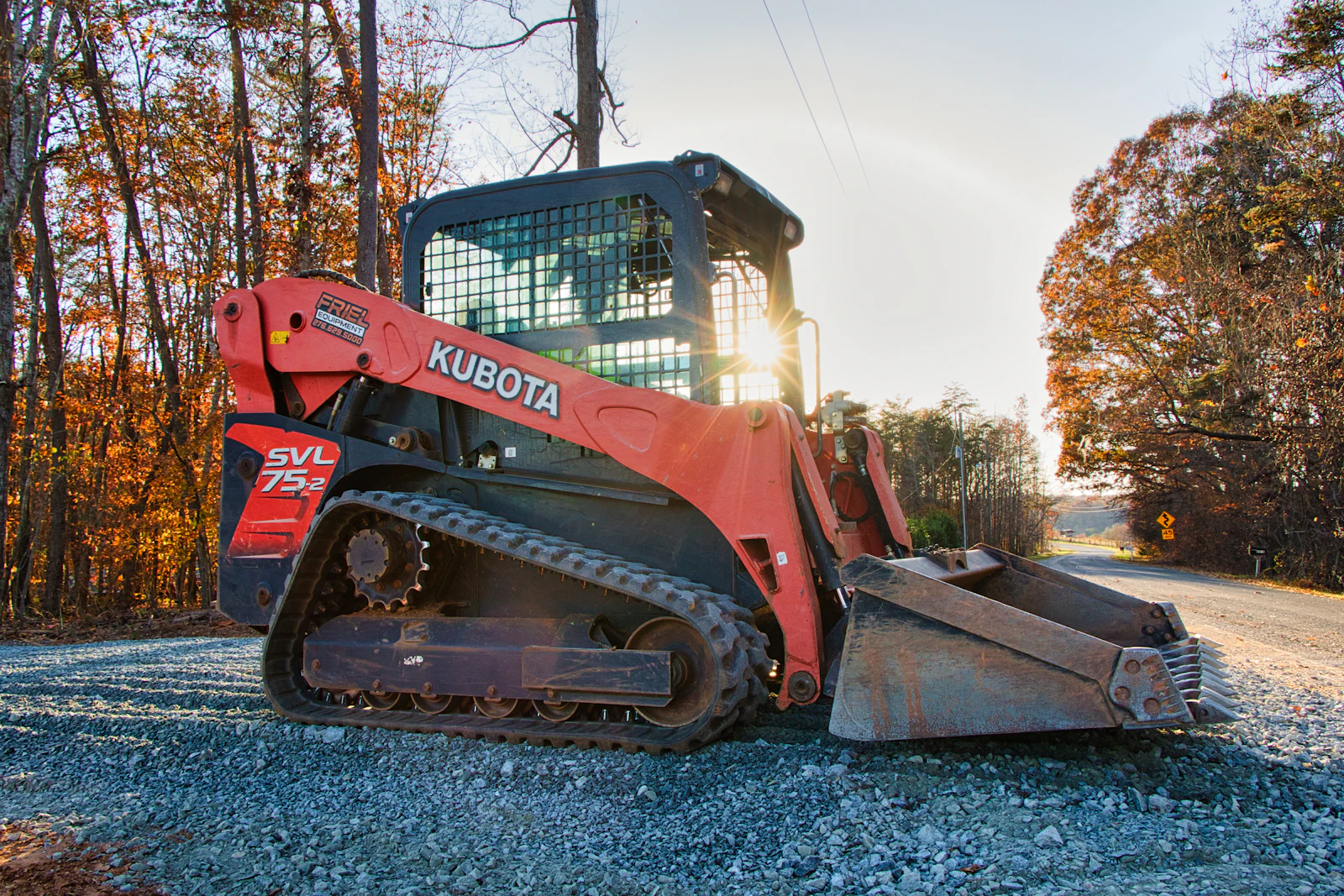
- Compact track loader (T590 class and similar): $425–$550/day, $1,395–$1,850/week, $3,900–$4,900/month.
Detroit-specific note: if the driveway is in a tight urban lot with street staging, a wheeled unit can reduce undercarriage cleanup and simplify transport, but CTLs often win on schedule reliability after thunderstorms (less rutting) and on mixed gravel/subgrade conditions.
Attachments And Adders Common On Concrete Driveway Packages
On driveway scopes, attachment costs can rival the skid steer base hire if you carry multiple tools. For 2026 Detroit planning, budget the following common adders (non-binding ranges; validate with your rental coordinator’s quote):
- Hydraulic breaker/hammer: +$150–$250/day, +$450–$750/week (plus chisel wear if applicable). If your demolition plan is “skid steer does the breaking,” this is a major cost driver.
- Tooth bucket (swap or add): +$25–$60/day if treated as an attachment line (some yards swap at no charge; clarify).
- Grapple bucket: +$90–$160/day for handling broken slabs and irregular debris safely.
- Pallet forks: +$30–$75/day to unload pavers, mesh, forms, and bagged materials.
- Power broom / sweeper: +$110–$190/day when the municipality or GC requires daily street/sidewalk cleanup.
- Plate compactor attachment (or separate compactor): if you are using the skid steer for base prep, many crews rent a dedicated compactor instead; if you keep it skid-steer-mounted, plan +$120–$220/day equivalent exposure.
If you only need the skid steer for loading and grading (and you are not breaking concrete with it), a wheeled unit with a bucket + forks is typically the most cost-controlled equipment hire package in Detroit.
Hidden-Fee Breakdown (The Stuff That Blows Up The PO)
These are the line items that most frequently shift skid steer loader equipment hire cost between the estimate and the invoice. Use them as allowances unless your quote explicitly fixes them:
- Delivery / pickup: commonly $125–$250 each way inside a typical Metro Detroit radius; mileage-based structures often show up beyond the “local” zone at about $4–$7 per loaded mile.
- Minimum rental charge: even if you only need the machine for a short loadout, some yards enforce a $150–$250 minimum on powered equipment.
- Damage waiver / rental protection: often 10%–15% of time-and-material rental (machine + attachments). This is not the same as full insurance; clarify deductibles and exclusions.
- Environmental / administrative fees: sometimes 4%–10% of rental lines (varies by contract).
- Fuel and refuel service: if returned not full, budget a refuel service charge (often $25–$50) plus fuel priced above retail equivalent (commonly modeled at $6–$9/gal effective).
- Cleaning: for concrete jobs, carry $150–$400 risk for pressure wash / undercarriage cleanout (CTLs trend higher because of packed tracks).
- Wear items / cutting edges: tooth loss or excessive bucket edge wear can be billable; carry a contingency of $75–$250 on high-abrasion, debris-heavy driveway work.
- After-hours / weekend handling: if your delivery or pickup requires special dispatch, budget $95–$175 for off-hours mobilization or a 10%–25% weekend/holiday surcharge depending on the contract terms.
- Late return / extra day billing: some contracts effectively bill an extra day if the machine misses the yard’s cutoff (commonly around 2:00 p.m. off-rent notification). Treat cutoff and off-rent procedure as a schedule-critical constraint.
- Meter overtime: carry $25–$45 per excess hour as a planning exposure if you anticipate double-shifting for driveway demo/loadout.
Detroit-specific operational constraint: deliveries across I-75/I-94 corridors can be impacted by peak congestion; if your site has a strict morning pour or inspection window, ask the yard for a confirmed delivery appointment and clarify whether “wait time” is billable after 30 minutes on-site.
Example: Detroit Concrete Driveway Removal And Base Prep (Realistic Equipment Hire Numbers)
Scenario assumptions: Replace a 12 ft x 40 ft driveway panel (about 480 sq ft). Concrete is 5 in thick with mesh. Demo is performed by a dedicated breaker crew, but the skid steer is responsible for rubble handling, loading, and grading.
- Equipment selection: Wheeled skid steer (mid-frame) at $280/day (published Metro Detroit rate sheet anchor).
- Term: 3-day window (Fri–Sun), but note many yards still bill weekend days depending on contract and open hours.
- Attachments: pallet forks at +$50/day (planning), tooth bucket swap at +$35/day (planning).
- Delivery/pickup: $200 each way (planning) due to tight curb access and appointment scheduling.
- Damage waiver: 12% of rental lines (planning).
- Cleaning allowance: $250 (planning) because concrete dust and wet spoils commonly return with caked-on residue.
Estimator takeaway: even before disposal and trucking, the “equipment hire only” exposure can land around the mid-$1,800s to low-$2,400s depending on weekend billing, attachment days, and whether you can off-rent by the yard’s cutoff on the final day. The biggest controllables are (1) aligning delivery with when the demo crew is actually ready to load, and (2) ensuring forks/bucket/teeth are on the same ticket so you are not paying a second mobilization.
City-Specific Considerations For Detroit Skid Steer Equipment Hire
- Freeze-thaw and hard subgrade: in colder months, tooth buckets and higher breakout force become more valuable; if you expect frozen spoils, the “cheaper” unit can become a slower unit (overtime risk).
- Dust control expectations: driveway demo creates fine dust; if your site is near occupied properties, you may need wetting and cleanup routines that increase sweeper/cleanup attachment demand and cleaning fees.
- Right-of-way and street staging: if you must stage on-street, clarify whether your delivery can be curbside only and whether the driver will place equipment beyond curb (some yards limit placement for liability).
How To Keep Your Skid Steer Hire Cost Predictable
To keep equipment hire cost stable on a driveway scope, manage the contract mechanics as aggressively as the field plan:
- Confirm “day” definitions and off-rent procedure (who calls it in, what time, and whether voicemail/email counts).
- Pre-approve substitution rules: if the yard substitutes a larger unit, confirm whether you pay the substituted class rate.
- Document condition at delivery and return: photos of cutting edge, forks, tires/tracks, and hour meter protect you from disputed wear and damage claims.
- Match machine to access limits: a wider CTL may trigger extra handling if your driveway gate clearance is tight; a second mobilization is usually more expensive than renting the correct size from day one.
Concrete Driveway Scope: Picking The Right Skid Steer Class For Cost And Risk
For concrete driveway work in Detroit, skid steer selection is rarely about “can it lift.” It is about cycle time, ground disturbance, and return-condition risk (cleaning and damage). Use these rules of thumb when you’re translating a field request into an equipment hire PO:
- Choose wheeled skid steers when you have firm access, short duration, and you want the lowest delivery complexity. They typically have lower undercarriage cleanup risk and can be more forgiving for tight driveway access.
- Choose CTLs when you expect rain, soft base, or you must keep rutting to a minimum (common when you’re rebuilding subgrade and you can’t afford rework). CTLs usually cost more per day but can reduce schedule slips that create extra days on rent.
Operational Constraints That Commonly Add Days (And Cost)
Most “unexpected” skid steer equipment hire cost in driveway projects is really schedule logic showing up on an invoice. In Detroit, watch these operational constraints:
- Delivery cutoffs: if the yard’s last dispatch is around 3:00–4:30 p.m., a same-day recovery can fail and you pay an extra day. Build your plan so the machine can be staged for pickup before the cutoff.
- Weekend billing: if the yard is closed Sunday, a Friday delivery with Monday pickup can bill as 3–4 rental days depending on the contract. If you only need Saturday work, consider Saturday pickup if available.
- Off-rent notice rules: contracts often require off-rent notification by early afternoon (commonly near 2:00 p.m.) to stop billing that day. Miss it and you effectively buy another day.
- Battery/charging (if you spec electric compact equipment): while most skid steers are diesel, some fleets carry electric alternatives; if you choose electric, confirm whether you have 240V access and whether an extra battery is required (often a separate line item).
- Indoor/garage adjacent work: if the skid steer will enter enclosed areas, you may need low-emission equipment or ventilation and dust containment, which can add attachments (brooms, vacs) and cleaning costs.
Budget Worksheet (Skid Steer Loader Equipment Hire Only)
Use this as a practical estimator’s worksheet for a Detroit concrete driveway package (edit quantities to match your term):
- Base skid steer hire: $280–$400/day (wheeled) or $425–$550/day (CTL), times planned billable days.
- Attachments allowance: forks $30–$75/day; grapple $90–$160/day; sweeper $110–$190/day; breaker $150–$250/day (only if the skid steer is doing demolition).
- Delivery + pickup: $250–$500 total typical (or $4–$7/mile beyond local radius).
- Damage waiver / protection: 10%–15% of rental lines.
- Environmental/administrative fees: 4%–10% of rental lines (if applicable).
- Fuel exposure: refuel service $25–$50 plus effective $6–$9/gal if returned short.
- Cleaning exposure: $150–$400 (higher probability on wet weather returns or CTLs).
- Overtime meter exposure: $25–$45 per excess hour (if you anticipate extended days).
- Return damage contingency: $75–$250 for cutting edge/teeth wear or minor hose/guard damage risk on rubble handling.
Rental Order Checklist (What Your Rental Coordinator Should Lock Down)
- PO scope language: specify “skid steer loader equipment hire for concrete driveway loadout and grading” and list included attachments by name and coupler type.
- Machine class: wheeled vs CTL, ROC range, and whether high-flow is required for any attachment.
- Billing definitions: confirm day/week/month meter limits (8/40/160) and the overtime $/hour rate.
- Damage waiver: confirm % and whether it applies to attachments; request exclusions list (glass, tires/tracks, misuse).
- Delivery requirements: address, contact, on-site receiving window, and whether driver needs a call-ahead 30–60 minutes prior.
- Site constraints: curb-only vs place-on-site, driveway load limits, and whether steel plates/mats are required to protect existing surfaces.
- Off-rent process: who authorizes off-rent, cutoff time (often ~2:00 p.m.), and acceptable notice method (phone/email/portal).
- Return condition: fuel level requirement, cleaning expectations, and photo documentation at pickup/return (meter and condition).
- Incident procedure: contact path for breakdowns and whether a replacement unit triggers re-delivery fees.
Market Notes For 2026: What To Expect When You Request A Skid Steer In Detroit
Metro Detroit demand can spike around weather windows (spring grading season and post-storm cleanup), which affects both availability and the probability of substitutions. National fleet providers advertise broad skid steer and compact track loader selections and attachment options, which can help when you need a specific coupler or a rapid replacement. From a cost-control perspective, the best lever is usually term length: if your driveway work is at risk of running long, negotiating a weekly rate up front is often cheaper than stacking daily rates due to schedule creep.
When Monthly Equipment Hire Beats Weekly (And When It Does Not)
Monthly skid steer hire rates can look attractive, but only if you can use the hours and keep the machine productive:
- Monthly wins when you have a backlog of driveway or flatwork loadout across multiple sites and can keep the unit turning without idle days.
- Weekly wins when your scope is inspection-driven (e.g., waiting on base approval) and the machine might sit. Idle time is the most expensive “work” your rented skid steer can do.
Closeout: How To Reduce Disputes And Back-Charges
To reduce end-of-rental disputes (and protect your equipment hire budget), standardize closeout documentation:
- Delivery photos: take time-stamped photos of tires/tracks, bucket edge, forks, and meter reading at drop.
- Return photos: repeat photos at pickup/return; include any pre-existing dents or guard damage.
- Clean before pickup: a 30-minute pressure wash can avoid a $150–$400 cleaning line item.
- Fuel discipline: top off locally before pickup to avoid premium refuel pricing and service charges.
If you want, share your expected driveway square footage, whether demolition is by breaker on the skid steer or separate equipment, and whether you need CTL vs wheels; then I can tighten the Detroit equipment hire allowance bands to a more job-specific “not-to-exceed” PO structure.