Build your next estimate with CountBricks
Create an itemized estimate for your project, with materials, labor, and quantities you can review and edit.
Create my estimateStart a 7-day free trial. Sign up, then enter your project details.
Skid Steer Loader Rental Rates Fresno 2026
For skid steer loader equipment hire in Fresno in 2026, planning budgets typically land in the $325–$525/day, $1,500–$2,100/week, and $2,500–$4,900/28-day month range for wheeled skid steers (with wider spreads when you step into compact track loaders, high-flow hydraulics, or enclosed cabs). Assume these are base machine rates excluding attachments, delivery/pickup, damage waiver, fuel, cleaning, and any meter-hour overages. As a local market datapoint, A1 Equipment Rentals in Fresno advertises a Bobcat S450 at $335/day, $1,500/week, $2,500/month, and a Bobcat T590 track loader at $425/day, $1,650/week, $3,550/month (availability and terms apply).
| Vendor |
Daily Rate |
Weekly Rate |
Review Score |
Website |
| A1 Equipment Rentals (Fresno) |
$375 |
$1 450 |
10 |
Visit |
| Quinn Rental Services (The Cat Rental Store) — Fresno |
$400 |
$1 225 |
8 |
Visit |
| DOZR Marketplace (Fresno supplier network) |
$295 |
$965 |
4 |
Visit |
What Drives Skid Steer Loader Equipment Hire Costs in Fresno?
When you are hiring a skid steer loader specifically for digging footings in Fresno, the true cost is less about the posted day rate and more about matching machine configuration to soil, access, and production targets. The biggest cost drivers rental coordinators see on footing scopes include:
- Wheeled vs. track: Compact track loaders (CTLs) are usually a higher hire class, but can reduce rut repair, towing events, and “cleanup days” on irrigated lots or after a Fresno-area storm.
- Operating capacity and lift path: A lighter unit (roughly 1,400–1,900 lb ROC class) can be cheaper to hire, but if you are moving spoils into taller bins or over forms, a vertical-lift machine can shorten cycle time (or prevent a mid-job upsize).
- Hydraulics package: High-flow is a cost adder, but it is often required for trenchers, planers, or certain auger drives. Budget +$75–$150/day (or +$250–$450/week) when high-flow is mandatory.
- Cab (open vs. enclosed): In Fresno summer heat and dust, enclosed cab/AC can be a productivity and safety item, but it commonly adds +$40–$90/day.
- Emissions tier / jobsite rules: Some GC sites (schools, municipal, hospital) may require newer Tier 4 Final equipment; newer fleet can mean a higher base rate or fewer discounts.
- Included bucket and coupler style: Confirm what “standard bucket” means (width, tooth vs. smooth edge, quick-attach type). If the standard bucket is not suited to footing trenches, you can lose half a day swapping last-minute.
For reference only (not a vendor quote), United Rentals notes that online quotes show daily, weekly, and monthly (28 days) rates, which aligns with common rental billing cycles you should use for month comparisons.
Digging Footings: How the Scope Changes the Hire Plan
Skid steers can dig footing trenches or pier holes, but cost risk increases when you treat a skid steer like a mini excavator. If your footing work includes tight trench tolerances, deep cuts, or continuous grade control, plan for:
- More finish passes: Expect additional machine hours for trench cleanup, especially in Fresno-area hardpan/clay where sidewalls can slough or break out.
- Spoils management time: If spoils must be stockpiled behind a setback line, loaded into small dump trailers, or kept off adjacent landscaping, your “dig time” may be only 50–70% of total run time.
- Utility exposure: Footing lines frequently cross service laterals. If you need to slow down for potholing/handwork, consider extending the hire term to avoid overtime-day billing.
Practical takeaway: for footing scopes, the lowest equipment hire cost is often a week rate even if you think you only need 2–3 days. The delta between a 3-day charge and a week rate can be smaller than one surprise delay day (inspection miss, re-stake, concrete form change).
Fresno Market Baseline: Example Published Rates You Can Anchor To
Use published local rates as anchors, then build your own all-in estimate with adders. A1 Equipment Rentals (Fresno) advertises the following machine-only rates at the time of writing: Bobcat S450 skid steer loader $335/day, $1,500/week, $2,500/month; Bobcat T590 compact track loader $425/day, $1,650/week, $3,550/month.
Those published figures are useful for budgeting, but do not assume they include delivery, attachment swaps, fuel, cleaning, or damage waiver. Also confirm whether the “month” is a 28-day billing period (common) rather than a calendar month.
Attachment And Accessory Hire Adders (Budget Allowances)
Footing excavation almost always needs at least one attachment beyond a smooth-edge bucket. If you do not lock these in at PO time, you risk (a) paying premium spot rates, or (b) losing a day waiting for the right setup. Typical Fresno-area skid steer attachment rental pricing allowances for 2026 planning:
- Tooth bucket upgrade: +$25–$45/day (or +$90–$160/week). Often the single best productivity adder for footing trenches in compacted soils.
- 4-in-1 bucket: +$60–$110/day. Useful when you must cut, carry, and back-drag for footing pad prep without a second machine.
- Hydraulic auger drive: +$95–$175/day; auger bits commonly +$20–$45/day per bit (e.g., 12 in., 18 in., 24 in.).
- Trencher attachment (chain): +$160–$275/day. Confirm high-flow requirements before you assume compatibility.
- Pallet forks: +$35–$60/day for unloading rebar bundles, forms, or block.
- Grapple bucket: +$90–$140/day for demo/brush clearance before footing layout.
- Grading laser receiver / mast kit (if available): +$45–$95/day (often overlooked; can prevent rework in footing elevations).
- Equipment trailer (if you self-haul a small unit): +$85–$150/day, plus tie-downs (budget $25 for replacement straps if yours are non-compliant).
Note: if you are hiring through a national account (e.g., United Rentals or Sunbelt) versus a local yard, the attachment catalog is often broader, but delivery and minimum terms can differ. Treat attachments as separate line items in your equipment hire estimate rather than “included.”
Hidden-Fee Breakdown (What Commonly Hits the Invoice)
This is where most “day rate vs. true day cost” gaps show up. Build these allowances into your Fresno skid steer loader hire budget:
- Delivery and pickup: Common allowance $150–$225 each way within an in-city radius; beyond that, budget $3.50–$5.50/mile. If you need a tight window (e.g., before 7:00 a.m. on a school site), add an after-hours/time-window surcharge of $75–$150.
- Minimum rental term / mobilization minimums: Some yards effectively price a “one-day minimum” even if you off-rent early; budget a $0–$95 minimum-charge risk if you are attempting a 4-hour task.
- Damage waiver / rental protection plan: Commonly 10%–15% of the base rental (machine + attachments). If you provide your own insurance, confirm the COI wording and deductibles.
- Environmental / admin fees: Budget 3%–6% of the rental subtotal if your vendor applies shop/environmental recovery fees.
- Fuel (diesel) make-up: Most skid steers are delivered full and expected back full. If vendor-fueled, budget $6.50–$8.50/gal for make-up diesel plus a service fee; if DEF applies, budget $4.00–$6.00/gal.
- Cleaning: Fresno dust and clay can trigger cleaning charges. A Central California rate sheet example notes an excessive cleaning fee of $75.00 per hour; many yards also have minimums (commonly $75–$150) if the machine returns caked.
- Concrete/construction debris removal: If you return with concrete splatter or rebar tie-wire wrapped in axles/undercarriage, budget a remediation minimum of $250 (or more if it becomes shop labor).
- Wear items and damage: Track damage, tire cuts, bent steps, broken light guards, and bucket edge/teeth loss are frequent. Budget a contingency of $150–$600 for a short footing job if the site is rocky or demolition debris is present.
- Late return / extra day triggers: Many yards bill another day if you miss the cutoff (often early morning) for next-day availability. Budget +$150–$525 risk (one extra day rate) if your return logistics are uncertain.
Billing Rules That Change the True Daily Hire Cost
Before you compare quotes, make sure each vendor is quoting the same billing logic:
- Day/week/month hour definitions: A Central California heavy equipment rate sheet example shows rates based on an 8-hour day, 44-hour week, and 176-hour month. Even when vendors do not publish these definitions, the same concept often governs overage billing.
- Meter-hour overages: If your crew runs long days, budget $8–$15 per excess hour (or the equivalent prorated day rate) once you exceed the included hours.
- Weekend and holiday billing: If you take delivery Friday and off-rent Monday, clarify whether Saturday/Sunday are billed as full days, half days, or “free days” on a weekly rate. For budgeting, assume at least 1 additional day of billing exposure if the machine sits on site over a weekend and your contract does not explicitly exclude it.
- Off-rent notification: Many rental contracts require a call/email by a cutoff (often 2:00–3:00 p.m.) to stop billing the next day. If you miss it, you may pay an extra day even if the skid steer is idle.
- Attachment swaps and downtime: If you swap from bucket to auger midweek, budget $45–$95 for a service dispatch or yard handling time if not self-performed.
Fresno-Specific Cost Drivers You Should Plan Around
Local operating conditions in Fresno change real-world hire costs in ways estimators sometimes miss:
- Heat impacts (summer scheduling): Fresno heat often pushes crews toward early starts. If your site requires delivery before business hours, budget the $75–$150 time-window surcharge noted above and confirm gate access and standby rules.
- Dust control and housekeeping: Valley dust and dry decomposed granite can lead to cleaning charges at off-rent. Proactively budget for dust control: e.g., a small water trailer/tank rental allowance of $75–$120/day (or arrange on-site water) to reduce cleanup and compliance risk.
- Outlying delivery radius norms: If your footing job is outside core Fresno (e.g., toward Madera, Selma, Sanger, or rural parcels), assume mileage billing beyond an included radius and add $3.50–$5.50/mile each way unless your vendor contract states otherwise.
Example: 5-Day Skid Steer Hire for Footing Trenches (All-In Budget)
Example scenario (budgeting illustration, not a vendor quote): a small commercial TI footing scope needs a wheeled skid steer with a tooth bucket for 5 working days, delivered to a constrained site with a single access gate and a strict return cutoff.
- Base machine: Use a weekly hire anchor of $1,500/week for a Bobcat S450 class unit (example published rate in Fresno).
- Tooth bucket upgrade allowance: $35/day x 5 = $175.
- Delivery + pickup: $175 each way = $350 (in-city allowance).
- Damage waiver: 12% of rental subtotal (machine + attachment): 12% x $1,675 = $201.
- Environmental/admin: 5% of rental subtotal: 5% x $1,675 = $84.
- Fuel make-up: assume 15 gal at $7.50/gal = $113 if returned below full.
- Cleaning contingency: 1 hour x $75/hr = $75 (dusty return).
Illustrative all-in equipment hire budget: approximately $2,498 before sales tax, jobsite-specific compliance costs, and any meter-hour overages. If the job slips one day past the cutoff, add a full extra day exposure of roughly +$335–+$525 depending on your contracted day rate class.
Budget Worksheet (Estimator-Friendly Line Items)
Use these as bullet line items in your estimate for skid steer loader equipment hire costs in Fresno (digging footings):
- Skid steer loader hire (wheeled, 1,400–1,900 lb ROC class): $325–$525/day or $1,500–$2,100/week.
- Compact track loader alternative (if soils/access justify): $425–$725/day or $1,650–$2,450/week. (Local published anchor for a T590 class: $425/day, $1,650/week, $3,550/month.)
- Attachment: tooth bucket: $25–$45/day.
- Attachment: auger drive: $95–$175/day; bits: $20–$45/day.
- Delivery and pickup: $300–$450 total (in-city) plus mileage beyond radius $3.50–$5.50/mile.
- Damage waiver / rental protection: 10%–15% of machine + attachment rental.
- Environmental/admin: 3%–6% of rental subtotal.
- Fuel/DEF make-up: diesel $6.50–$8.50/gal; DEF $4.00–$6.00/gal (if applicable).
- Cleaning contingency: $75–$225 (assume $75/hr with a 1–3 hour exposure).
- Meter-hour overage contingency: $8–$15/hr beyond included hours.
- Ground protection (if working near finished paving/curb): mats allowance $12–$20 each/day (quantity depends on access path).
- Weekend/holiday billing contingency: +0.5 to +2.0 days depending on delivery/return plan and contract language.
Rental Order Checklist (PO, Delivery, Off-Rent, Return)
- Confirm machine class (ROC, wheeled vs. track), required hydraulics (standard vs. high-flow), and whether an enclosed cab is required for operator productivity.
- List every attachment as a separate PO line (bucket type, teeth, auger drive + specific bit diameters, forks).
- Specify billing definitions: 8-hr day, 44-hr week, 28-day month, and meter-hour overage rates (get it in writing).
- Set delivery window and site constraints: gate code, delivery contact, forklift-only access areas, and where the driver can safely unload.
- Clarify delivery cutoff rules: what time you must call in to stop billing (off-rent) and what time the truck must be loaded to avoid another day.
- Document condition at delivery with photos/video: bucket edge, quick-attach pins, tires/tracks, hour meter, and any existing dents.
- Plan return-condition steps: remove tape/wrap, knock off heavy mud, sweep cab, and refuel to full to avoid make-up fuel charges.
- Return paperwork: require a signed off-rent ticket, time stamp, and driver acknowledgment of attachments returned (prevents “missing bucket/forks” back-charges).
How To Compare Fresno Skid Steer Hire Quotes Without Getting Burned
For professional equipment managers, the cleanest way to compare skid steer loader equipment hire costs is to normalize quotes into a single “all-in per working day” number. Do this by forcing each quote into the same assumptions:
- Billing cycle: treat monthly as a 28-day rate when comparing to week/day.
- Included hours: confirm if the rate assumes an 8-hour day and what the meter-hour overage rate is (do not wait for the invoice).
- Delivery math: always include both directions (delivery + pickup) and any tight-window surcharges.
- Risk adders: apply damage waiver (or your insurance admin cost) consistently across all quotes.
If you have a national account (e.g., United Rentals/Sunbelt) and a local yard quote (e.g., Fresno-based yard), you may see different structures: one may look cheaper on day rate but higher on delivery; another may discount weekly but require a longer minimum term for attachments. Normalize first, then decide.
When Weekly vs. Monthly Hire Is Actually Cheaper (Even for Short Footing Jobs)
Many footing scopes are scheduled as “3 days” and then turn into 5–7 days due to inspections, rebar changes, or over-excavation corrections. Because monthly is commonly priced as a 28-day rate, you can often hit a breakeven point earlier than expected.
- If your wheeled skid steer is $1,500/week and $2,500/month (published Fresno example), the breakeven is roughly 1.7 weeks (about 12 working days if you bill weekdays only, or sooner if weekends bill).
- If your compact track loader is $1,650/week and $3,550/month (published Fresno example), the breakeven is roughly 2.15 weeks.
Actionable tactic: if your footing schedule is uncertain, request a rate structure that allows conversion (e.g., “apply paid days toward the week rate”) or negotiate a not-to-exceed cap once you cross the weekly threshold.
Compact Track Loader vs. Wheeled Skid Steer: Cost vs. Cleanup Trade
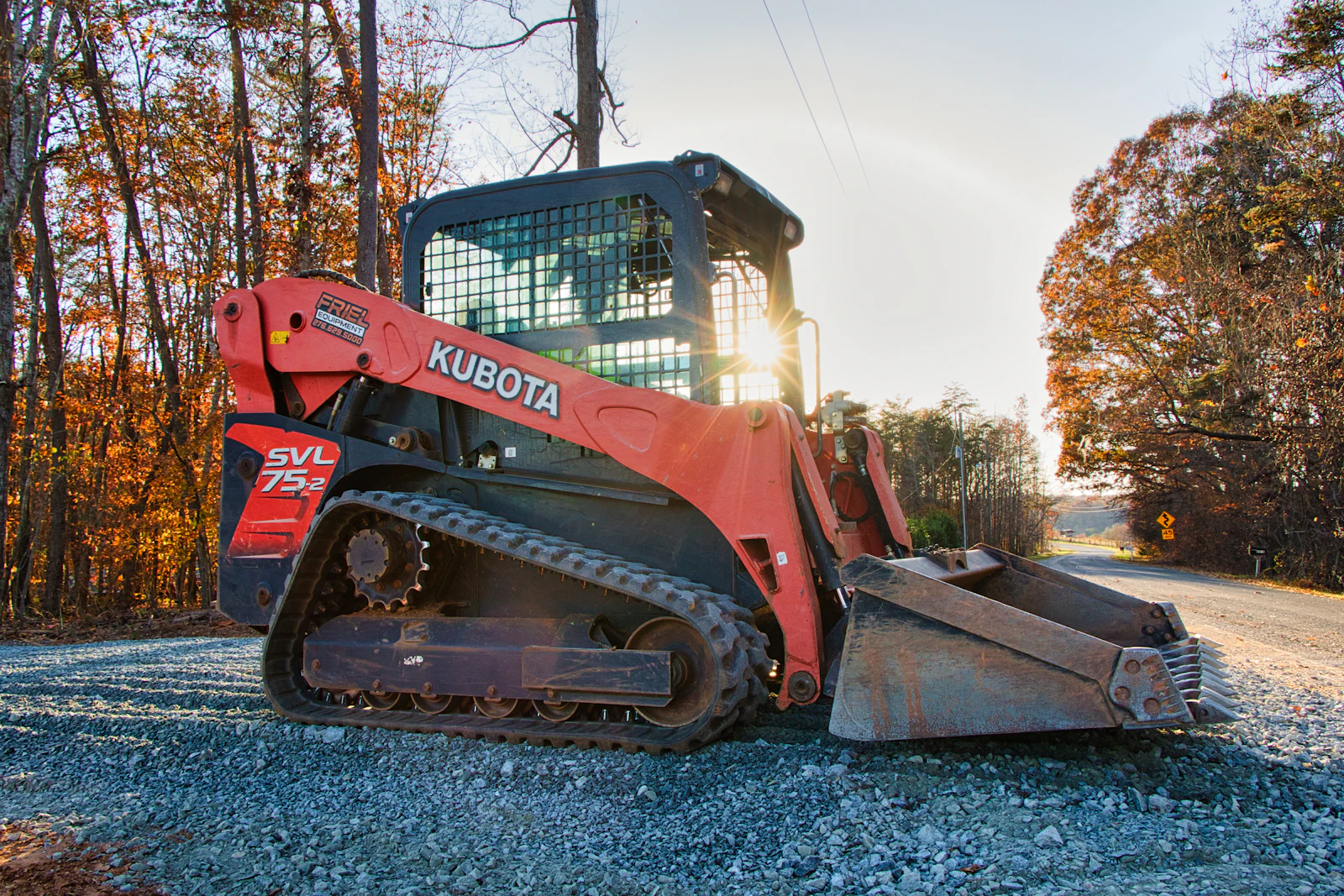
In Fresno, the decision is often driven by soil moisture and finish-surface sensitivity. A compact track loader typically costs more to hire, but can reduce indirect costs:
- Less rut repair: If you are digging footings adjacent to a finished curb/sidewalk, avoiding rutting can prevent an extra mobilization day for base repair (often $300–$900 in labor/materials even before you talk equipment).
- Fewer towing events: Getting a wheeled skid stuck can cost $250–$750 in tow/assist time plus lost production.
- Return-condition risk: Tracks can return with packed clay; budget a higher cleaning contingency for CTLs (often +$150–$350 vs. a dry wheeled return), especially after irrigation or rain.
Use the published Fresno track loader anchor ($425/day, $1,650/week, $3,550/month) to sanity-check whether your CTL premium is justified by reduced indirects.
Using Public Rate Books as a Sanity Check (Not a Market Quote)
For certain public works change-order discussions, California’s published equipment rental rate references can help validate order-of-magnitude numbers. In the Caltrans equipment rental rates book (cost of equipment ownership reference), the skid steer category under “Tractors, Rubber Tire, Industrial, Farm & Skid Steer” shows hourly rates such as $36.46/hr for <50 HP “with loader or dozer,” and $48.51/hr for >50 HP “with loader or dozer” (specific code/configuration dependent).
To translate that into a planning lens: $36.46/hr x 8 hours = $291.68/day and $48.51/hr x 8 hours = $388.08/day as a reference figure before rental-company overheads, delivery, attachments, and market conditions. That is one reason Fresno market day rates in the $325–$525/day band are directionally plausible for common skid steer classes.
Closeout Practices That Prevent Back-Charges on Footing Jobs
Footing work is hard on buckets, cutting edges, and undercarriage. The fastest way to keep equipment hire costs controlled is to close out cleanly:
- Off-rent early in the day: Align your final footing pass and spoils loadout so the machine can be staged for pickup before the vendor’s cutoff. Missing the cutoff can trigger a full extra day charge (budget +$325–$725 depending on class).
- Photo-document return condition: Take clear photos of the bucket edge/teeth, quick-attach, tires/tracks, and hour meter at pickup time. This reduces disputes over “new damage” and helps recover damage waiver value if a claim is needed.
- Refuel to full on-site: It is almost always cheaper to refuel yourself than pay make-up fuel at $6.50–$8.50/gal plus service fees.
- Knock down heavy spoil before pickup: A quick pressure wash (or at minimum a shovel/scrape on track frames) can save a cleaning hit. A Central California example rate sheet cites $75/hr for excessive cleaning, which adds up fast if the yard has to detail the machine for the next renter.
If you want, share your expected footing quantity (linear feet and depth), spoil handling plan (stockpile vs. export), and whether the site is paved/finished. With that, you can set a tighter equipment hire budget and choose between skid steer vs. CTL vs. mini excavator for lowest all-in cost.