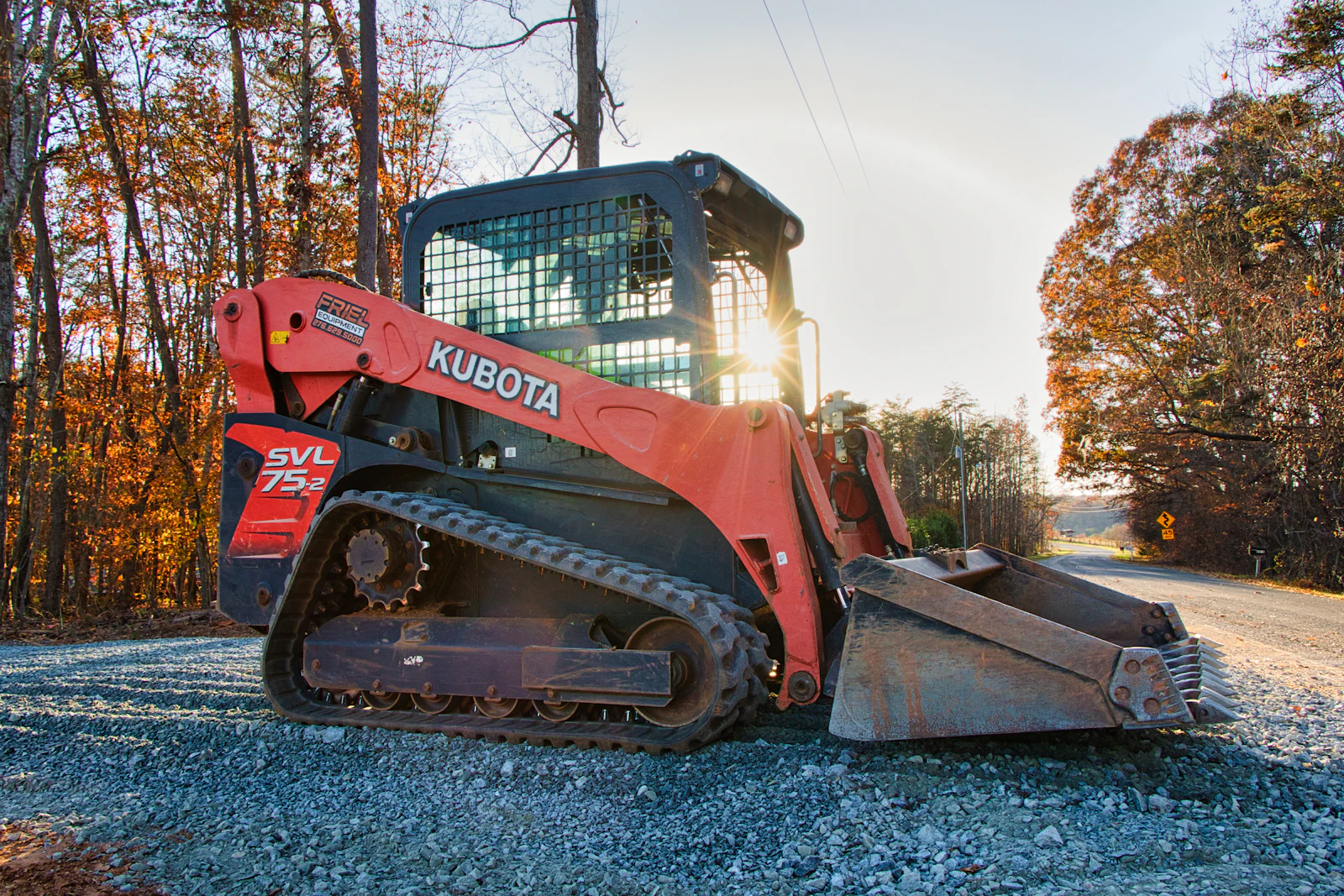
For 2026 planning in Houston, skid steer loader equipment hire typically budgets in the $325–$575/day, $850–$1,550/week, and $2,600–$4,400 per 28-day (4-week) period range for wheeled skid steers and small-to-mid compact track loaders, with higher-capacity/high-flow units and specialty configurations running higher. These are straight-time “one shift” planning ranges based on common 8-hour day / 40-hour week / 160-hour 4-week utilization limits that many hire providers use for billing and overtime. In Houston specifically, frequent wet subgrades and clay soils often push demand toward compact track loaders (CTLs), which can affect availability and pricing during peak civil and concrete seasons. National and regional rental houses operating across Greater Houston (plus local compact-equipment fleets) typically publish daily/weekly/4-week rate structures, and some publish example local pricing that helps anchor budgets.
| Vendor |
Daily Rate |
Weekly Rate |
Review Score |
Website |
| Aztec Rental Center |
$310 |
$1 015 |
10 |
Visit |
| Bobcat of Houston |
$250 |
$750 |
9 |
Visit |
| Mainland Tool and Supply |
$275 |
$825 |
9 |
Visit |
| Quality Rentals Delivered |
$350 |
$1 150 |
10 |
Visit |
| Westland Equipment & Supplies (WeSeq Rentals) |
$275 |
$825 |
10 |
Visit |
Skid Steer Loader Rental
Use the sections below as a cost-focused estimator’s guide for skid steer loader rental Houston and skid steer loader hire cost Houston TX decisions: rate ranges by class, attachment adders, delivery rules, overtime triggers, and the hidden fees that move the final invoice.
Houston 2026 Skid Steer Loader Hire Rate Ranges (Day / Week / 4-Week)
The biggest driver of base hire cost is machine class (rated operating capacity, hydraulic flow, and tires vs. tracks). The ranges below are practical 2026 budgeting bands built from published rate sheets and Houston market examples (verify against your account pricing, negotiated discounts, and availability).
- Small-frame wheeled skid steer (approx. 1,300–1,800 lb ROC): budget $325–$425/day, $825–$1,050/week, $2,600–$3,200/4-week (often best for interior demo support, light grading, tight access).
- Mid-frame wheeled skid steer (approx. 1,800–2,400 lb ROC): budget $375–$525/day, $950–$1,300/week, $3,000–$3,900/4-week.
- Large-frame wheeled skid steer (approx. 2,400–3,000 lb ROC): budget $450–$575/day, $1,150–$1,550/week, $3,600–$4,400/4-week.
- Compact track loader (CTL) alternative (traction-forward choice in Houston): budget $400–$650/day, $1,150–$1,650/week, $3,300–$4,800/4-week depending on size and whether high-flow is required.
Anchors you can use to sanity-check budgets: published contractor rate sheets show wheeled skid steers in the low-to-mid $300s/day up through the high $400s/day depending on size/class, and common skid steer attachments (e.g., grapple bucket, brush cutter, breaker/hammer) add meaningful daily cost. A Houston fleet example shows a CTL-class unit priced at $350/day and $1,150/week with a standard bucket included (monthly by approval), which is consistent with the lower end of CTL pricing when availability is good.
Assumptions That Must Be Stated on Every Skid Steer Hire Quote
To avoid change orders and invoice disputes, publish your assumptions directly in the estimate/PO notes:
- Billing period definition: many major providers quote daily, weekly, and “monthly” as a 28-day (4-week) rate (not a calendar month).
- Shift/usage limits: “basic” rates commonly include 8 hours/day, 40 hours/week, 160 hours/4 weeks.
- Overtime (metered) usage: a common structure is OT billed at 1/8 of the daily rate per extra hour, 1/40 of the weekly rate per extra hour, and 1/160 of the 4-week rate per extra hour.
Estimator tip: if your superintendent expects long pushes (e.g., 10 hours/day for 6 days), price OT proactively. Example: at a $480/day hire rate, OT can budget around $60/hour (=$480 ÷ 8) once you exceed 8 meter hours/day.
What Drives Skid Steer Loader Hire Costs in Houston?
Houston is a large, logistics-heavy market; the equipment hire cost you actually pay is rarely just the base day/week/4-week number. These are the drivers that move total cost for skid steer loader rental with attachments Houston packages:
- Tires vs. tracks (jobsite ground conditions): after heavy rains, saturated clay subgrades and muddy laydown areas increase the probability you’ll need tracks, which typically rent higher and may carry higher damage/wear exposure if operators spin tracks in aggregate.
- High-flow hydraulics requirement: if you’re running a mulcher, some brooms, or certain planers, high-flow often shifts you into a more expensive unit class; budget a $75–$150/day premium versus standard-flow when high-flow is mandatory (confirm availability—high-flow fleets are finite).
- Cab configuration: open ROPS is usually cheaper; enclosed cab can add $40–$90/day but may reduce downtime in Houston summer heat and heavy rain events.
- Access and delivery complexity: downtown Houston traffic windows, refinery/port badging, and restricted delivery cutoffs can push you toward after-hours mobilization (see delivery notes below).
Attachment Adders That Commonly Double the Line-Item Cost
Most rental houses include a standard dirt bucket, but everything else is typically an adder. Use these 2026 Houston budgeting allowances (and note that specialty attachments may have minimum rental terms):
- Pallet forks: $40–$85/day, $160–$260/week.
- Grapple bucket: $95–$160/day, $280–$550/week (published sheets show $113/day and $282/week as one example).
- Brush cutter / mower: $200–$360/day, $520–$1,000/week (published sheets show $235/day and $588/week as one example).
- Hydraulic breaker (hammer): $275–$450/day, $750–$1,250/week (published sheets show $320/day and $799/week as one example).
- Auger drive: $120–$220/day plus bit(s) at $25–$60/day each (common adders when you need multiple diameters on the same job).
- Trencher attachment: $160–$280/day depending on chain width and soil conditions (clay can increase wear and cleaning time).
- Sweeper broom (dust control / cleanup): $175–$325/day; indoor work may require HEPA vac and dust shrouds as separate line items.
Houston-specific note: interior warehouse TI work often requires dust-control (negative air / HEPA vac) and “clean return” expectations. If you use a skid steer indoors on slab, plan for $100–$250 in cleaning allowance if the unit comes back with concrete slurry, drywall dust, or adhesive residue.
Hidden-Fee Breakdown (Delivery, Fuel, Damage Waiver, Cleaning, Overtime)
When rental coordinators ask why an invoice is 20–40% above the base rate, it usually traces back to the add-ons below. Put them in your estimate as explicit allowances for equipment hire costs control:
- Delivery / pickup: commonly $125–$250 each way inside a local radius (often 10–20 miles), then mileage at $4–$8/mile beyond that. Houston toll roads and security check-ins can extend driver time; some providers treat delays beyond 30–60 minutes as billable wait time.
- Minimum transport charge: budget $200–$350 if you require specific time windows (e.g., 7:00–9:00 a.m. only) or have site access constraints.
- Damage waiver / rental protection: often 10%–15% of the rental charge (not including fuel), or a daily minimum (e.g., $15–$35/day) depending on provider/program.
- Environmental / admin fees: budget 3%–7% of rental or a flat $5–$20 per line, depending on contract structure.
- Fuel / refuel surcharge: most skid steers go out full; return expectations vary. If you return short, refuel can be billed at a retail-plus rate; budget $6–$10/gal effective refuel charge for diesel (market-dependent) plus a service fee.
- Battery / regen expectations (Tier 4 diesel): excessive idling and short runs can trigger regen issues; some contracts treat service calls as billable if caused by misuse—budget a potential $150–$350 field service trip if you’re on a tight schedule.
- Cleaning: light wash-down may be included; “excessive” cleaning is often billed. Budget $75 (basic) to $300 (heavy concrete/mud).
- Wear charges (cutting edges, teeth, tracks): some published rental sheets explicitly state wear charges per inch on certain wear components (examples on published sheets include figures like $100–$250 per inch).
- Overtime hours: if you exceed included meter hours, OT commonly follows the fractional-rate formulas described earlier.
Example: 17 Working Days of Skid Steer Loader Hire for a Houston Concrete Contractor
Scenario: sidewalk/demo spoil handling and base prep on a constrained infill site near the Loop, with a 7:00 a.m. start requirement, no laydown space, and weekend security restrictions (no Saturday returns). You need a mid-frame unit plus forks and a breaker, and you expect some OT during pours.
- Machine hire: plan 3 weeks at $1,150–$1,350/week = $3,450–$4,050.
- Pallet forks: $50–$75/day for 10 days = $500–$750.
- Hydraulic breaker: $275–$450/day for 4 days = $1,100–$1,800.
- Delivery + pickup: $175–$250 each way = $350–$500 (add $75–$150 if you require a hard arrival window).
- Damage waiver: budget 12% of rental = roughly $500–$900 (depends on what the provider applies it to).
- Overtime (meter hours): assume 12 extra hours across the rental. If daily equivalent is $480, OT can budget ~$60/hour = $720.
- Cleaning + wear: allowance $150–$350 for mud/concrete residue and bucket edge wear documentation.
Budget outcome: a realistic total for this 17-day Houston skid steer loader rental package is often $7,000–$10,700 all-in, depending on attachment days, OT, and logistics allowances. The point is not the exact number—it’s that attachments + OT + transport routinely exceed the “base weekly rate” if you don’t manage them actively.
Budget Worksheet (No Tables)
- Base skid steer loader hire (select class): $________ (allow $850–$1,550/week).
- 4-week conversion option (if schedule risk): add alternate at $________ (allow $2,600–$4,800/4-week depending on wheels vs. tracks).
- Attachments:
- Pallet forks allowance: $50/day × ____ days
- Grapple allowance: $125/day × ____ days
- Breaker allowance: $350/day × ____ days
- Auger + bits allowance: $175/day + $40/day per bit × ____ days
- Delivery and pickup: $200 × 2 = $400 (increase for restricted windows).
- Damage waiver / rental protection: 12% of rental = $________.
- Environmental/admin fees: allow 5% = $________.
- Fuel/refuel risk: allow $150–$350.
- Cleaning: allow $150–$300 (indoor slab work and mud are common drivers).
- Overtime (meter hours): allow 10–20 hours at approximately $45–$75/hour depending on base rate.
- Contingency for damage/wear disputes: allow $250–$750 (tires, cutting edges, hoses, missing pins).
Rental Order Checklist (PO, Delivery, Return, Off-Rent)
- PO and billing: confirmed account terms, tax status, job number/cost code, and who can approve extensions.
- Machine specs: ROC class, tires vs. tracks, standard-flow vs. high-flow, cab requirements, coupler type, bucket width.
- Attachments: list each attachment by name + required hoses/couplers; confirm whether attachments have their own minimum term.
- Delivery plan: site contact + phone, gate instructions, delivery window, equipment staging point, and whether driver needs badging/escort (common on industrial Houston sites).
- Condition documentation: take delivery photos of bucket edge/teeth, tires/tracks, forks tines, glass, hour meter reading, and any pre-existing leaks.
- Operational rules: confirm included meter hours and overtime billing method (meter-based).
- Off-rent and return: confirm cutoff time for off-rent call (often same-day afternoon), whether weekends count, and who is authorized to release the machine.
- Return condition: refuel expectation, cleaning expectation, and required documents (signed delivery/return tickets, photo set, and meter hours at pickup).
How to Control Skid Steer Loader Equipment Hire Costs in Houston (Billing Rules, Off-Rent, and Weekend Traps)
The fastest way to reduce skid steer loader equipment hire costs is to manage billable time, not just the rate. Houston traffic, weather, and restricted site access can add “dead rent” days unless you plan off-rent timing and pickup windows.
Off-Rent Rules and Weekend Billing: Where Houston Jobs Commonly Bleed Cost
- Partial day = full day: many contracts treat any possession under 24 hours as a full rental day; similarly, a “rental week” may be defined by time elapsed or meter hours—read the terms and align your schedule.
- Weekend holds: if your site doesn’t allow weekend pickups, coordinate Monday pickup and negotiate weekend charges up front. If you take Friday delivery “just in case,” you can accidentally buy 2–3 days of idle rental.
- Off-rent cutoff times: set an internal rule: off-rent requests must be submitted before 2:00–3:00 p.m. local time (typical in practice) to avoid another day billed. Put the cutoff in your superintendent’s look-ahead.
- Standby during storms: Houston rain bands and tropical weather can stop earthwork; most rental policies do not allow weather credits. (Build weather float into schedule rather than hoping for rent relief.)
Overtime Cost Control Using Shift Math (A Field-Friendly Method)
Because overtime is commonly calculated as a fraction of the base rate after included hours, you can forecast OT with simple arithmetic and avoid surprises:
- Daily rentals: OT per hour ≈ Daily Rate ÷ 8.
- Weekly rentals: OT per hour ≈ Weekly Rate ÷ 40.
- 4-week rentals: OT per hour ≈ 4-Week Rate ÷ 160.
Example (numbers you can reuse): if you’re paying $1,240/week and you run 52 hours, you have 12 OT hours. OT rate ≈ $1,240 ÷ 40 = $31/hour. OT cost = 12 × $31 = $372 (plus tax/fees depending on contract).
Delivery and Access Logistics in Houston That Change Total Hire Cost
Houston isn’t a “show up any time” market for many sites. These constraints are common cost multipliers:
- Traffic-window delivery: if your GC only allows deliveries 7:00–9:00 a.m. or 1:00–3:00 p.m., budget a “time-certain” delivery surcharge of $75–$150 or a higher flat mobilization in lieu of mileage.
- Port/refinery badging and escorts: if the driver needs to wait for escort or badging, add a wait-time allowance after 30–60 minutes. If the provider can’t access, you may still pay the trip charge.
- Downtown / Med Center site constraints: limited staging may require a smaller unit (higher $/capacity) or a shorter delivery truck. Budget an extra $50–$125 if specialty transport is required.
Damage, Wear, and Cleaning: Put Numbers to the Risk
Most disputes in skid steer loader hire are condition-related. You can reduce exposure by budgeting realistic allowances and documenting condition on/off rent.
- Tire damage: budget $150–$350 for a service call + tire/repair if the unit comes back with sidewall cuts (common on demo sites with rebar tie-offs and scrap).
- Tracks and undercarriage: if you select CTL for wet Houston soils, set an internal rule against spinning tracks on aggregate; track/roller damage can escalate quickly. Budget a contingency of $500–$1,500 on high-risk sites.
- Wear charges: some published sheets state wear charges per inch (examples include $100, $175, or $250 per inch on certain wear items). Use this as a reminder to photo bucket edges and attachment wear surfaces at both delivery and pickup.
- Cleaning: for Houston mud jobs, write a return standard: “pressure washed, cab/vitals blown out, debris removed.” If not feasible, budget $150–$300 and treat it as unavoidable.
- Lost/missing items: common backcharges include missing attachment pins/keepers ($15–$40), lost keys ($25–$75), and damaged quick-coupler hoses ($75–$250).
When a CTL (Tracks) Is Actually Cheaper Than a Wheeled Skid Steer in Houston
Even if tracks cost more per day, CTLs can reduce total job cost when you consider productivity and recovery costs:
- Soft subgrade / rain impacts: if a wheeled unit bogs down and you lose 1 day/week to recovery, the “cheaper” rate becomes more expensive than a CTL that stays productive.
- Slab protection and rework: tracks can reduce surface damage in certain conditions, avoiding cleanup and rework cost on finished areas.
- Marketplace vs fleet pricing variability: marketplace averages for CTL rental in Houston can be materially higher (and may skew toward larger units), while local fleet examples can be lower when supply is good—validate the actual class you’re pricing.
Procurement Notes: How to Write the PO to Match How the Invoice Will Be Built
- State the billing basis: “Rate includes 8/40/160 hours; meter-based OT applies.”
- State the period basis: “Monthly is 28-day (4-week) rental period.”
- List included accessories: bucket size, coupler type, any hydraulic hoses, and whether a spare set of forks or a second bucket is included or separately billed.
- Define delivery and pickup: “Time-certain delivery required” (if needed) and who signs tickets.
- Insurance and waiver: confirm whether you’re using your COI or paying damage waiver (often 10%–15% of rent). If waiver is not authorized, state “No waiver without written approval.”
Houston 2026 Market Practice Reminders (Operational Constraints)
- Delivery cutoffs: same-day dispatch is often possible, but late-day orders can push delivery to the next day; build a 1-day float when your schedule is weather-sensitive.
- Heat and uptime: in peak heat, enforce daily checks and radiator clean-out (especially on dusty demo sites) to avoid billable service trips and downtime.
- Indoor dust-control: if you’re using the unit in enclosed spaces, align with EHS on dust suppression; budget separate equipment if required (do not assume it’s “included” in the skid steer rental).
Bottom line for rental coordinators: the best Houston skid steer loader rental strategy is usually (1) select the right class (wheels vs tracks), (2) lock attachment days tightly, (3) schedule delivery/pickup around site access and off-rent cutoffs, and (4) document condition to avoid wear/cleaning backcharges. If you manage those levers, you can keep total equipment hire costs close to the planned day/week/4-week rates rather than letting fees and OT erode the budget.