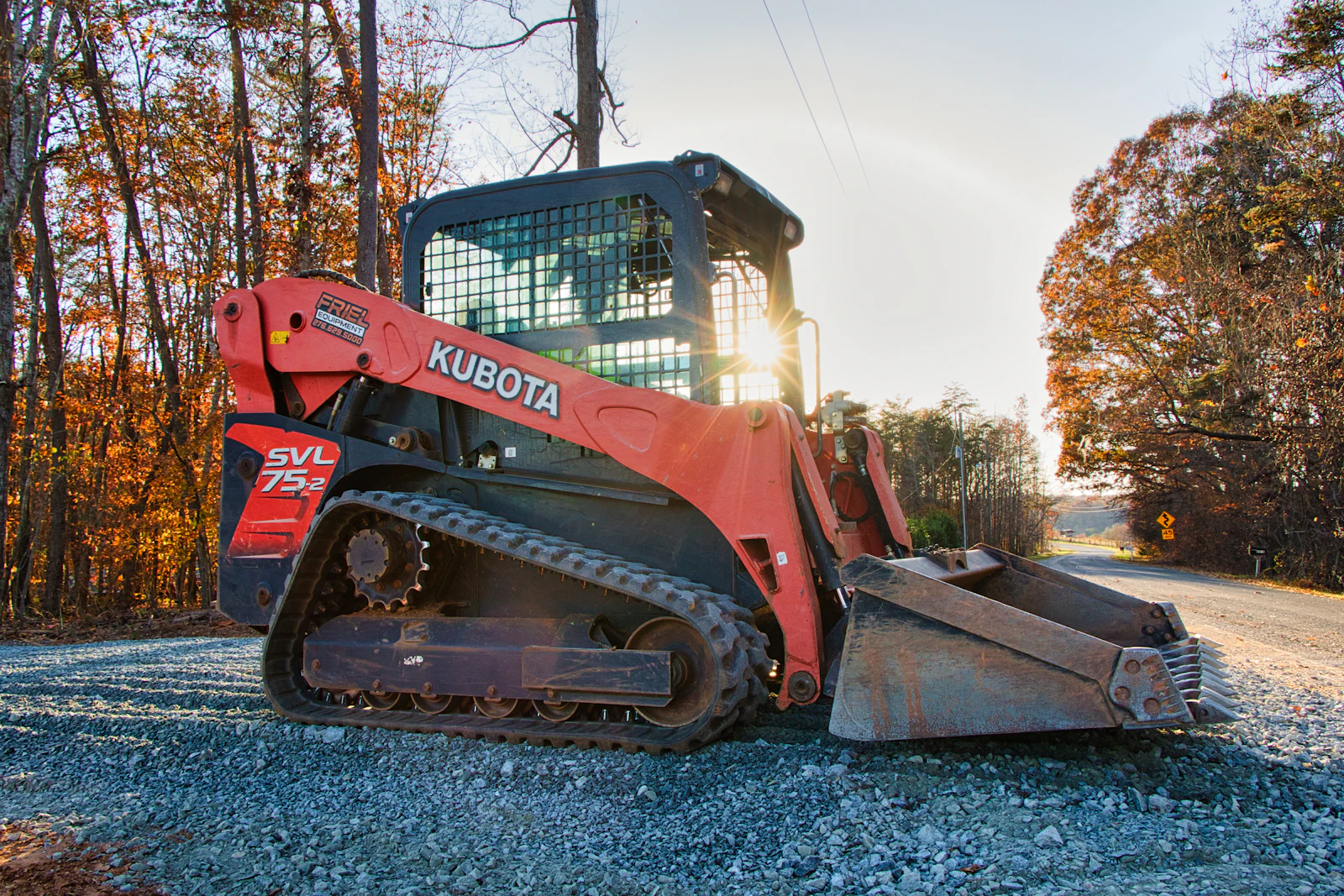
Skid Steer Loader Rental Rates in Jacksonville (Daily/Weekly) — 2026 Costs
Jacksonville Construction Cost Hub
Price source: Costs shown are derived from our proprietary U.S. construction cost database (updated continuously from contractor/bid/pricing inputs and normalization rules).
Eva Steinmetzer-Shaw
Head of Marketing
For Jacksonville, Florida projects planning skid steer loader equipment hire in 2026, budget typical base rental ranges (machine only, before delivery, waiver, fuel, and attachments) of $225–$375/day, $850–$1,450/week, and $2,100–$3,600/4-weeks for mid-size wheeled or compact track units; premium configurations (enclosed cab, higher ROC, or high-flow for cutters/planers) often plan at $300–$550/day, $1,100–$1,900/week, and $2,900–$4,900/4-weeks. These are planning ranges compiled from published rate sheets and common national fleet structures, then normalized for 2026 estimating (Jacksonville branch availability, delivery distance, and seasonality will move totals). Jacksonville buyers typically source from national fleets (United Rentals, Sunbelt Rentals, Herc Rentals) and local equipment dealers depending on attachment needs and lead time.
| Vendor |
Daily Rate |
Weekly Rate |
Review Score |
Website |
| United Rentals |
$425 |
$1 225 |
10 |
Visit |
| Sunbelt Rentals |
$415 |
$1 190 |
9 |
Visit |
| Herc Rentals |
$420 |
$1 205 |
9 |
Visit |
| Ring Power (Cat Rental Store) |
$440 |
$1 260 |
7 |
Visit |
Skid Steer Loader Rental
2026 Jacksonville planning rates (USD) for skid steer loader rental generally map to size class and configuration more than brand. Use these bands when you need a defensible budget number before formal quotes:
- Wheeled skid steer (ROC ~1,000–1,600 lb): $225–$325/day; $850–$1,250/week; $2,100–$3,000/4-weeks.
- Compact track loader (ROC ~1,400–2,200 lb): $300–$475/day; $1,050–$1,650/week; $2,700–$4,200/4-weeks.
- High-flow (cab) CTL / skid steer (for brush cutter, cold planer, forestry head): $350–$550/day; $1,250–$1,900/week; $3,200–$4,900/4-weeks.
Reality check vs. published rate sheets: A Sunbelt rate sheet example shows a 2,100–2,800 lb track skid steer class at $356.25/day, $831.25/week, and $2,142.25/4-weeks (pickup rates), plus delivery billed separately. Another published contract schedule shows a high-flow cab skid steer class at $280/day, $735/week, and $1,510/month on a public pricing page (again, delivery/mobilization separate). Treat those as benchmarks; your Jacksonville branch quote may land higher or lower based on fleet age, utilization, and included accessories.
What Drives Skid Steer Loader Equipment Hire Costs in Jacksonville?
Skid steer loader equipment hire costs are rarely “just the day rate.” For Jacksonville rental coordination, the cost drivers below typically explain the variance between a low initial quote and the final paid invoice:
- Machine type (wheels vs. tracks): Tracks cost more but reduce rutting in soft sand and wet clay (common across Jacksonville coastal/river-adjacent sites).
- Rated operating capacity (ROC) and lift path: Moving from a ~1,000–1,400 lb ROC class into ~2,000+ lb classes increases the base rate and usually increases transport class as well.
- Cab and HVAC: Enclosed cab models typically carry a premium but can be operationally necessary for long shifts, dust control, or rain operations.
- High-flow hydraulics: High-flow is the big step-change when you need a brush cutter, cold planer, forestry mulcher, or high-demand broom. The public schedule example above shows high-flow cab pricing separated as its own class.
- Metered hour structure (the hidden limiter): Many fleets price the “day” assuming an 8-hour usage cap and then bill overage (details in Post Body 2).
- Attachments and quick-coupler compatibility: One attachment can add 25%–80% to the machine-only rental spend on short terms (daily rentals).
- Delivery distance and access constraints: Jacksonville’s geographic sprawl means “in-town” deliveries can still be 20–35 miles each way depending on branch location, jobsite (Westside vs. Beaches vs. Northside), and traffic windows.
Typical Add-Ons That Move the Hire Price
Use these adders to build an “apples-to-apples” skid steer loader rental budget in Jacksonville. The numbers below are practical estimating ranges, anchored by published rate sheets where available.
Delivery / Pickup (Mobilization)
- Each-way delivery fee (flat + mileage): plan $120–$300 each way plus $3.00–$6.00 per loaded mile after minimums. A Sunbelt rate sheet example shows $120 each way + $3.25 per loaded mile.
- Alternate structure (first mile + per-mile): some public schedules show a “first mile” charge like $290 plus $4 per additional mile.
- Site access surcharge: plan $75–$200 if escorting is required, delivery is outside standard windows, or offloading requires special coordination.
Common Attachments (Budget Adders)
Attachment pricing varies widely by brand and wear, but published sheets provide useful anchors:
- Pallet forks (large skid class): plan $35–$60/day, $90–$140/week, $185–$310/4-weeks. Example published numbers include $47.50/day and $285.00/4-weeks.
- Sweeper / broom: plan $85–$140/day, $180–$350/week, $500–$900/4-weeks. Example published numbers include $90.25/day and $536.75/4-weeks.
- Brush cutter (4 in. cut class): plan $130–$200/day, $300–$500/week, $800–$1,250/4-weeks. Example published numbers include $142.50/day and $831.25/4-weeks.
- Auger drive head: plan $85–$140/day, $200–$350/week, $500–$900/4-weeks. Example published numbers include $95.00/day and $513.00/4-weeks.
- Auger bits: plan $10–$35/day per bit depending on diameter and tooth type; one public schedule shows a small bit class at $11/day, $29/week, $73/month.
- 4-in-1 bucket: plan $45–$95/day if not included with the base machine (confirm bucket type in the PO).
- Grapple bucket: plan $75–$160/day depending on width and duty class.
Hidden-Fee Breakdown
Use this section as a pre-PO “fee trap” checklist for skid steer loader equipment hire costs. These items are where Jacksonville rental invoices usually drift from the original estimate:
- Damage waiver (DW) / rental protection: commonly 10%–15% of the rental charges (machine + attachments). If you decline DW, confirm your insurance certificate requirements and deductibles.
- Fuel / diesel charge: plan for “return full” or be billed “fuel + service.” A mid-size unit can carry ~16.5 gallons fuel capacity in some classes. A practical budgeting allowance is $6–$10/gal billed (fuel plus handling), not pump price.
- Cleaning / de-mud fee: plan $75–$250 for heavy clay, concrete slurry, or excessive vegetation in the belly pan/undercarriage. Track units on wet sites are the most common trigger.
- Undercarriage wear (track machines): some contracts hold customers responsible for abnormal wear or damage; photograph track condition at delivery and return.
- After-hours / weekend dispatch: plan $150–$350 if you need Saturday delivery, late pickup, or storm-response mobilization.
- Late return penalty: often billed in fractions of a day (for example, 1/8-day or 1/4-day increments). Confirm your branch’s cutoff (commonly early afternoon) for same-day off-rent.
- Meter overage: plan $12–$30 per hour above included hours, depending on class and term.
- Tire or track damage: solid tire skid steers reduce puncture risk but can cost more to rent; pneumatic tires can trigger replacement billing if torn on demo debris.
Jacksonville-Specific Logistics That Change Your Rental Total
- Coastal sand and wet season impacts: If you are working near the Intracoastal or low-lying lots after heavy rain, a compact track loader often prevents downtime from rutting—but you should budget extra cleaning time/fees and plan stricter undercarriage washout controls.
- Heat/humidity operating practices: Summer heat in Jacksonville increases idle time for operator breaks and can push more “meter hours” without proportional production. For metered rentals, manage shift planning so you do not burn billable hours moving between small work zones.
- Delivery radius reality: Jacksonville’s footprint means a “local” delivery can cross 20–35 miles, which makes mileage-based mobilization a real line item (especially if you rotate attachments mid-week).
Example: 3-Week Jacksonville Site Package With Real Constraints
Scenario: You need a high-flow compact track loader for 15 working days (3 weeks) to clear and grade a commercial pad on the Westside. The site has limited laydown, so you want delivery Monday AM and pickup Friday PM, and you need a brush cutter for the first 5 days plus forks for material handling throughout.
- High-flow CTL base rent: plan $1,350/week x 3 = $4,050 (planning midpoint for 2026 premium class).
- Brush cutter attachment: assume $160/day x 5 = $800 (published sheets show the same class can land around $142.50/day, so $160/day is a conservative 2026 planning number).
- Pallet forks: assume $55/day x 15 = $825 (benchmarked against $47.50/day).
- Delivery + pickup: assume $180 each way plus $4.00/mile for a 22-mile run = ($180 + $88) x 2 = $536.
- Damage waiver: assume 12% applied to rental subtotal (base + attachments) of $5,675 = $681.
- Cleaning allowance: $150 (wet clay and vegetation buildup risk).
Estimated total (before tax): $4,050 + $800 + $825 + $536 + $681 + $150 = $7,042. The key operational constraint here is that a Friday PM pickup may miss branch cutoff; if the machine stays on-rent through Monday, you can unintentionally add another $250–$475 day-equivalent depending on contract rules. Manage off-rent timing aggressively.
Budget Worksheet
- Skid steer / compact track loader base rent allowance: $225–$550/day depending on configuration.
- Delivery (mobilization) allowance: $300–$900 round trip (depends on mileage structure and site access). Benchmarks include $120 each way + $3.25/loaded mile on published sheets.
- Attachment allowance (choose what applies):
- Pallet forks: $35–$60/day (benchmark: $47.50/day).
- Brush cutter: $130–$200/day (benchmark: $142.50/day).
- Sweeper/broom: $85–$140/day (benchmark: $90.25/day).
- Auger drive: $85–$140/day (benchmark: $95.00/day).
- Auger bits: $10–$35/day per bit (benchmark: $11/day for a small bit class).
- Damage waiver / protection: 10%–15% of rental charges (confirm if attachments are included).
- Fuel / refuel handling: $60–$180 per event (example: 10–18 gallons at $6–$10/gal billed).
- Cleaning / return condition: $75–$250.
- Meter overage allowance: $12–$30/hr above included hours.
- Contingency for schedule slip / weekend billing: 0.5–2.0 extra days in the budget, depending on off-rent rules.
Rental Order Checklist
- PO scope: machine class (wheels vs tracks), ROC class, cab/open, high-flow requirement, quick-attach type, bucket type (teeth vs smooth vs 4-in-1).
- Term and billing: daily/weekly/4-week rates, included meter hours, meter overage rate, and weekend/holiday billing rules.
- Delivery requirements: address, contact, delivery window, gate codes, forklift/crane needs (if any), and a clear offload/staging area.
- Pickup/off-rent controls: cutoff time to stop billing, required off-rent notification method (phone/email/app), and who has authority to request pickup.
- Insurance/DW: confirm whether you’re taking damage waiver (and percent) or providing certificate of insurance; clarify deductible exposure.
- Fuel/return condition: “return full” expectation, acceptable mud/debris levels, and required documentation (delivery photos, return photos, meter readings).
- Attachments: list each attachment on the PO with serial-tracked delivery verification; confirm spare teeth/bits if you’re augering in abrasive sand.
- Operator/safety: confirm trained operator availability, site PPE requirements, and spotter needs in tight urban areas.
How Rental Contracts Bill Time and Meter Hours
For skid steer loader equipment hire costs, “time” has two layers: calendar time (days/weeks) and machine utilization (meter hours). Many fleets treat skid steers as metered equipment and define included usage such as 4 hours for a half-day, 8 hours for a day, 40 hours for a week, and 168 hours for a month; usage above those thresholds is billed as additional charges.
- Estimator tip: If your Jacksonville schedule is production-heavy (demo cleanup, hauling, long push distances), ask for the meter overage rate up front and add a line-item allowance (for example, 10–25 overtime hours/week at $12–$30/hr).
- Operations tip: Separate “tool time” from “transport time.” If the skid steer is being used to shuttle material across a large footprint, meter hours climb quickly with modest production.
Delivery Windows, Off-Rent Rules, and Weekend Billing
Jacksonville jobs frequently lose money on skid steer rental not because the rate was wrong, but because billing rules weren’t operationalized on site.
- Delivery cutoff: if the machine arrives late afternoon, many branches still bill a full day. Plan for AM deliveries on day 1.
- Off-rent cutoff: if you call pickup after cutoff (often early afternoon), you may be billed an additional day even if the machine is idle overnight.
- Weekend reality: if you off-rent Friday after cutoff, pickup may not occur until Monday—effectively adding 2–3 calendar days of exposure. If you cannot avoid it, negotiate “standby” or “off-rent pending pickup” terms in writing.
- Storm response: for hurricane season planning, confirm whether emergency dispatch is billed at premium rates (commonly $150–$350 additional dispatch charge) and whether minimum term rules apply.
Damage, Wear, and Return-Condition Controls That Protect Your Budget
Skid steer rentals are compact but expensive to repair. The fastest way to stabilize hire costs is to reduce disputable condition issues at return.
- Delivery documentation (10-minute rule): take photos of all four sides, bucket cutting edge/teeth, forks tines (if included), tracks/tires, and the hour meter on arrival.
- Track care (CTL): plan daily undercarriage cleanout on wet Jacksonville sites to reduce packed clay/sand—this lowers derailment risk and helps avoid cleaning fees ($75–$250 typical allowance).
- Refuel/return full: because some units have tanks around 16.5 gallons in certain classes, a “return empty” can become a high-fee refuel event.
- Attachment verification: on return, photograph attachment serial/asset tags and condition; most disputes are about missing hoses/couplers/teeth rather than the core machine.
Indoor Work and Dust-Control Requirements (Often Overlooked)
If your skid steer loader rental is for indoor slab work (warehouse TI, retail buildout, or manufacturing maintenance), Jacksonville estimates should include extra controls:
- Non-marking track/tire requirement: plan $50–$150/day premium if a specialty configuration is needed.
- Dust suppression: if brooming or grinding support is needed, the sweeper/broom attachment itself can run around $90/day on published sheets, and you may need additional filtration/cleanup labor beyond rental.
- Floor protection and cleanup: add a $150–$300 cleaning allowance for indoor use where return must be “contract clean.”
Ownership Vs. Equipment Hire for Skid Steers (Cost Perspective)
For Jacksonville fleet managers deciding between purchase and ongoing equipment hire, skid steers usually break on utilization and attachment strategy:
- Hire wins when you have variable attachment needs (forks one week, brush cutter the next), seasonal peaks, or projects spread across multiple sites where you’d otherwise carry transport overhead year-round.
- Ownership wins when you keep a skid steer working consistently and can control maintenance, tire/track wear, and operator discipline. The “soft” cost you’re avoiding is the recurring package of delivery, DW, refuel handling, and cleaning fees that can add 20%–45% to short-term rentals.
Rental Market Notes for 2026 Planning in Jacksonville
For 2026, plan rental procurement with lead time if you need a specific configuration (high-flow + cab + track + specialty attachment). National fleets actively market skid steers and compact track loaders across a wide range of configurations, including online rate structures on some channels, but availability can tighten during peak construction and storm-recovery periods.
- Lead time: plan 2–5 business days for common classes; 1–2 weeks if you need a specialty head (planer/forestry) plus a high-flow host machine.
- Rate sensitivity: daily rentals are the most volatile; weekly/4-week terms typically produce the best effective rate if you can keep utilization steady.
- Quote discipline: require quotes to show base machine, each attachment line, delivery structure, DW percent, included hours, and overage rate—otherwise you cannot compare bids.
Regulatory and Site Compliance Note
Confirm operator qualification requirements, site traffic plans, and any project-specific owner requirements for enclosed cabs, backup alarms, and spotters. For Jacksonville municipal or owner-controlled sites, also confirm whether idling restrictions or noise windows apply, because those constraints can increase the number of billed days required to complete the same production scope.