

Create an itemized estimate for your project, with materials, labor, and quantities you can review and edit.
Create my estimateStart a 7-day free trial. Sign up, then enter your project details.
For Las Vegas concrete driveway scopes, 2026 skid steer loader equipment hire costs typically plan in three layers: (1) the base machine rate (wheeled skid steer vs. compact track loader), (2) attachment and configuration adders (hydraulic breaker/high-flow, tooth bucket, forks, tracks/tires selection), and (3) “jobsite reality” costs such as delivery windows, overtime meter hours, refuel/cleaning, and damage waiver or insurance compliance. As a planning range for Las Vegas (including North Las Vegas and Henderson yard coverage), many rental coordinators budget roughly $300–$475/day for wheeled skid steers and $470–$540/day for compact track loaders, with weekly pricing commonly landing around $900–$1,600/week and 4-week pricing around $2,050–$3,600/4-weeks depending on class and availability. In practice, national providers (e.g., United Rentals, Sunstate Equipment, Sunbelt Rentals, and Herc Rentals) and regional independents all quote differently by spec and season; use the ranges below as 2026 budgeting guidance unless you have a negotiated rate sheet.
| Vendor | Daily Rate | Weekly Rate | Review Score | Website |
|---|---|---|---|---|
| United Rentals | $420 | $1 206 | 9 | Visit |
| Sunbelt Rentals | $280 | $735 | 9 | Visit |
| H&E Equipment Services | $435 | $1 250 | 9 | Visit |
| Dragon Equipment Rentals | $300 | $1 175 | 9 | Visit |
Assumptions used for the 2026 planning ranges below: one-shift use (commonly 8 machine-hours/day, 40/week, 160 per 4-week), standard bucket, normal wear-and-tear, and no operator included. Many rental agreements define overage billing when you exceed one-shift use (for example, hourly overage can be calculated as 1/8 of the daily charge, 1/40 of the weekly charge, or 1/160 of the 4-week charge).
Wheeled skid steer (common driveway support machine): Budget $300–$475/day, $900–$1,150/week, and $2,050–$2,650 per 4-weeks for typical 1,300–2,700 lb class units when availability is normal. As a nearby-market reference for Las Vegas-area sourcing, DOZR pricing in Henderson, NV shows examples such as $295/day, $898/week, $2,053/4-weeks (1,300 lb class) and $468/day, $1,145/week, $2,648/4-weeks (higher class), with an “average daily” shown around $413 and “average monthly” around $2,438.
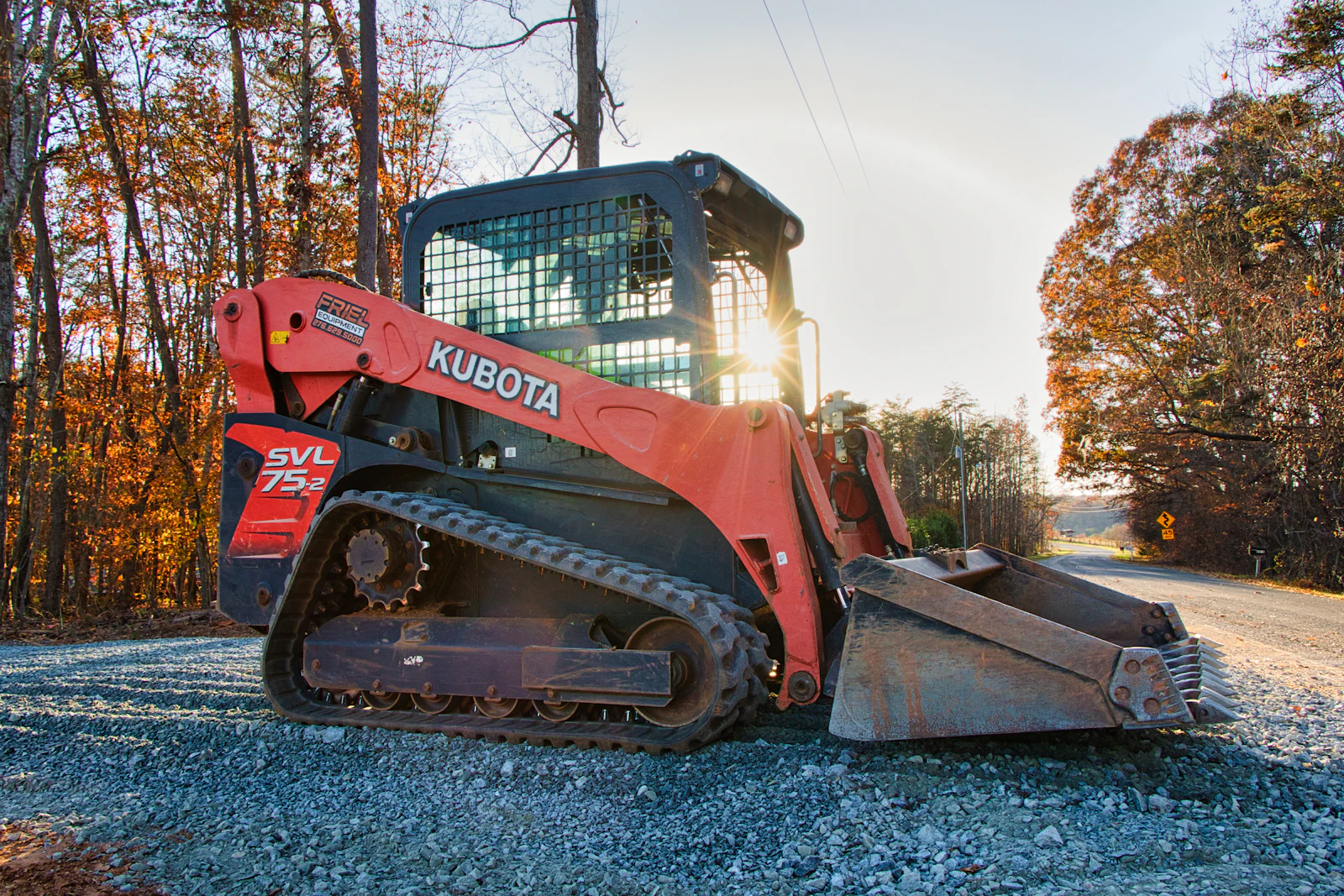
Compact track loader (CTL) / tracked skid steer (common for demolition/debris handling and subgrade work): Budget $470–$550/day, $1,340–$1,600/week, and $3,100–$3,600 per 4-weeks for mid-class CTLs in the Las Vegas metro, with heavier/higher-flow units pushing higher. On DOZR’s North Las Vegas CTL page, published examples include $470/day and $1,347/week with $3,147/4-weeks for one tracked class, plus higher-class examples like $540/day, $1,532/week, and $3,574/4-weeks; the same page also reports an average daily price in the ~$498–$539/day range depending on where you read the page summary vs. the FAQ block (a useful reminder that class mix and availability change quickly).
Short-term “minimum” style pricing (useful for residential driveway windows): Some regional independents publish 4-hour minimums (e.g., $280 for 4 hours and $350 for a 24-hour day) and week/month price points like $1,400/week and $3,500/month, often with an 8-work-hour allowance inside the 24-hour day. Treat these as a reference point only and confirm your Las Vegas branch and spec (cab, ROC, high-flow) before budgeting.
1) Wheels vs. tracks (surface and haul-path risk): For concrete driveway demolition support (loading broken concrete, moving base, loading bins), wheeled skid steers can be cost-effective on hard surfaces, but traction and tire damage risk increase if you’re working over loose base, wet slurry from sawcutting, or uneven subgrade. CTLs generally cost more per day but can reduce stuck time and improve breakout/traction on disturbed grade.
2) Operating capacity class and lift geometry: Moving 12–20 inch chunks of driveway slab into a 10–15 yard roll-off often pushes you into a mid-size ROC class for productivity. Bigger class typically means higher day rate, higher transport weight (which can increase hauling cost), and higher damage waiver base.
3) Cab configuration (open vs. enclosed): Las Vegas dust and heat are real cost drivers. A sealed cab with A/C can improve operator uptime, but it usually rents at a premium and may carry higher cleaning expectations (filters, cab interior).
4) Hydraulics (standard-flow vs. high-flow): A hydraulic breaker for driveway slab removal often requires high-flow (or at minimum the correct couplers/pressure) depending on breaker size. High-flow machines typically rent higher and, if mis-specified, can cause mid-rental swap-outs (double transport charges, lost time, and re-mobilization).
Las Vegas-specific cost reality (2–3 items that routinely change totals): (a) Delivery/pick-up windows around the Resort Corridor and major arterial congestion can force early delivery (pre-7:00 a.m.) or late pick-up, which can trigger after-hours dispatch premiums; (b) dust-control expectations (especially when breaking concrete) can require water application and cleanup labor that becomes a “cleaning fee risk” at return if slurry hardens on the chassis; (c) summer heat drives higher idle time for cooling and can amplify overage-hours exposure if production slows mid-day.
On driveway scopes, the base skid steer hire cost is rarely the whole story. Plan attachment and configuration adders explicitly, because they also influence delivery weight and damage waiver totals.
Concrete driveway note: If you are pairing a skid steer with a saw + skid steer breaker, confirm who owns slurry control and washdown. Dried slurry and concrete splatter are the #1 cause of avoidable return-condition charges on this scope.
Most rental coordinators in Las Vegas plan skid steer rentals as “one shift included” even if the contract language varies by provider. A common structure is: 8 hours/day, 40 hours/week, 160 hours/4-weeks included; hours above that are billed as an hourly fraction of the base rate (e.g., 1/8 of the daily rate per hour for daily rentals).
Practical estimator guidance for driveway work: If your crew will run the breaker + bucket handling in two shifts (or long summer days to beat HOA/noise cutoffs), the overage can be material. Example planning math: a $470/day CTL at 1/8 per hour implies ~$58.75 per excess hour; 6 excess hours becomes ~$352.50 in overage on a “one-day” rental before waivers, fees, or tax.
Delivery is often the swing factor between “cheap day rate” and “expensive total.” For skid steers, you’ll typically see either (a) a flat delivery + flat pick-up inside a radius, or (b) a base charge plus per-mile. As one published independent-yard example, delivery is shown as $100 + $4 per mile from the store and includes both delivery and pick-up (your Las Vegas yard may structure it differently, but the math illustrates why radius matters).
Las Vegas access items that change cost in real POs:
When you’re forecasting skid steer loader equipment hire costs in Las Vegas for a concrete driveway scope, these are the recurring “non-rate” charges to look for on quotes and final invoices:
Example: 2-day concrete driveway breakout support (Las Vegas planning numbers)
Scope: break and load ~30 linear feet of 4-inch slab into a 12-yard bin; tight residential access; 8-hour workday; machine staged on plywood to protect adjacent pavers.
Cost build (illustrative): CTL $480/day x 2 = $960 (mid-class tracked rate reference); breaker attachment $264/day x 2 = $528 (published example hammer adder); delivery/pick-up allowance $275 total (local radius assumption; confirm your yard); damage waiver 12% of base rental ($960 + $528) = $178.56; cleaning allowance $150 (slurry risk); fuel/refuel allowance $60; plus tax and any environmental/transport surcharges. If you exceed shift hours by 4 hours total, add roughly (1/8 of $480) x 4 = $240 in overage. The point: the “$480/day” headline can become $1,800+ all-in very quickly if you don’t manage hours, slurry, and transport.
Use this quick worksheet format when you’re building a 2026 Las Vegas equipment hire cost estimate for skid steer loader support on a concrete driveway package. Adjust line items to your vendor’s terminology and your contract terms (especially surcharges).
Use this to reduce invoice drift on skid steer loader equipment hire for a Las Vegas concrete driveway package.
Match the rental term to calendar constraints, not just machine-hours. If your driveway work is restricted to weekday daytime windows, a weekly rate can outperform stacked day rates even when you only run 2–3 days. Use your local references: for wheeled skid steers, Henderson-area published examples show $295/day but $898/week; if you’re going beyond 2–3 days of access-limited production, weekly can be the safer budget.
Protect the rental from slurry and hardened concrete. A cleaning line can show up when equipment is returned with excessive concrete residue. Set a field rule: rinse at the end of each day while slurry is still green, and keep a $150–$250 cleaning allowance in the estimate if you can’t guarantee washdown access.
Control overage hours with a production plan. If you’re paying $470/day and you run 12 hours, you may pay 4 excess hours at roughly $58.75/hour (daily ÷ 8) in addition to the day rate, depending on contract. Coordinate truck/bin swaps so the machine is not idling while billed hours accumulate.
Model delivery as a mini-logistics job. If you are outside a typical metro radius, a base + mileage structure can dominate the invoice. The published example of $100 + $4/mile (including delivery and pickup) shows how a 25-mile one-way distance can become $200 total base + $200 mileage = $400 transport before surcharges—sometimes more than a full day rate on a smaller skid steer.
In 2026, expect the rental counter to require either (a) proof of coverage that meets their requirements or (b) purchase of a damage waiver / rental protection plan. For budgeting, many guides still cite 10%–15% of the rental rate as a typical waiver range (actual terms vary by provider and exclusions).
Operationally, the easiest way to keep waiver and damage disputes off your closeout is documentation: pre-rental photos, delivery condition notes, and return photos with meter-hours and fuel level. This is especially important on driveway demolition where rebar, jagged concrete, and tight maneuvering can create undercarriage and tire/track damage exposure.
Las Vegas rental availability can tighten during peak civil/site seasons and during major event periods when transport capacity is constrained. If you’re doing a concrete driveway package in a dense neighborhood, treat delivery scheduling as a first-class constraint (not an afterthought): lock your delivery appointment, confirm driver call-ahead, and schedule pickup to avoid an extra billed day caused by missed cutoffs. Then run the machine inside the one-shift hour model (8/40/160) unless you intentionally budget overage.
