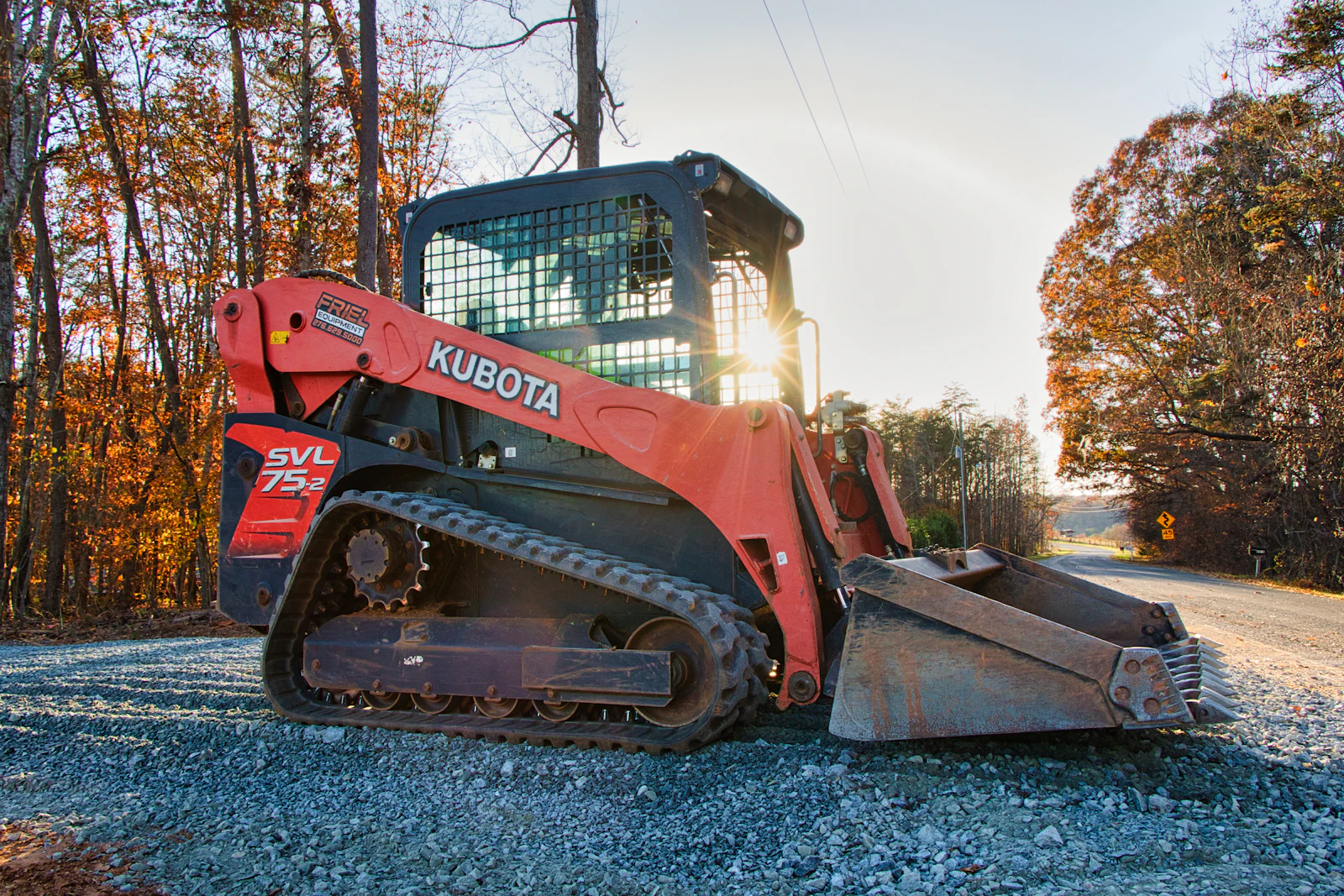
Skid Steer Loader Rental Rates Los Angeles 2026
For Los Angeles concrete driveway scopes (demo support, haul-off loading, base prep, and final site clean), plan 2026 skid steer loader equipment hire pricing in these workable ranges: $350–$575/day, $1,200–$1,850/week, and $2,800–$4,900 per 4-week billing period for a jobsite-class wheeled skid steer or compact track loader, assuming standard bucket and standard shift utilization. LA pricing is frequently quote-driven (fleet availability and delivery windows matter as much as machine size), but the same national providers you already buy from (e.g., United Rentals, Sunbelt, Herc) and regional yards typically land within these planning bands when you include normal market add-ons like delivery, damage waiver, and environmental recovery fees.
| Vendor |
Daily Rate |
Weekly Rate |
Review Score |
Website |
| United Rentals |
$375 |
$1 450 |
8 |
Visit |
| Sunbelt Rentals |
$365 |
$1 400 |
8 |
Visit |
| Herc Rentals |
$350 |
$1 350 |
7 |
Visit |
| The Home Depot Rental |
$310 |
$1 240 |
8 |
Visit |
| The Cat Rental Store (Los Angeles area dealer network) |
$395 |
$1 520 |
8 |
Visit |
What Drives Skid Steer Equipment Hire Cost In Los Angeles For A Concrete Driveway?
Concrete driveway work in Los Angeles tends to push rental cost up for three reasons: (1) time compression (tight pour schedules and short on-site windows), (2) surface protection expectations (finished hardscape, pavers, and curb-adjacent access), and (3) delivery constraints (traffic, limited staging, and strict receiving cutoffs). Those conditions often change the “cheap daily” number into a higher effective cost per production hour once you account for delivery/pickup, standby, and the run-time limits that many rental schedules assume.
2026 Planning Rate Bands By Machine Class (Wheeled Vs. Compact Track Loader)
Wheeled skid steer (common for driveway subgrade work on firm, dry sites): plan $375–$525/day, $1,200–$1,650/week, and $2,500–$3,800/4-week depending on rated operating capacity and cab configuration. Published benchmark schedules in other markets regularly show mid-$300/day to low-$400/day for larger wheeled skid steers, which is a useful reality check when negotiating LA quotes.
Compact track loader (CTL) / tracked skid steer (common for soft subgrade, slopes, or when you need higher traction): plan $425–$650/day, $1,450–$2,050/week, and $3,000–$5,100/4-week. A current Los Angeles marketplace snapshot shows CTL pricing examples such as $349/day, $1,184/week, $2,867/4-weeks on a smaller class and $500/day, $1,750/week, $4,750/4-weeks on a larger class (availability-driven).
Mini skid steer / small footprint units (when access is constrained by gates/side yards): you may see published local SoCal yard rates around $400/day, $1,200/week, $2,700/4-weeks for a small “skidsteer” class unit (often used for tight residential access). This can be cheaper to mobilize and faster to place, but it can be slower loading export or moving base rock—so it’s not always the least-cost option for concrete driveway production.
Attachments And Options That Commonly Add Real Cost (Driveway Work)
Driveway packages rarely stay “machine only.” The attachment mix is where equipment hire costs move quickly—especially if you need high-flow hydraulics or additional wear components.
- Pallet forks: plan $40–$90/day when you need to offload base material pallets, forms, or barriers.
- Hydraulic breaker / hammer: plan $250–$350/day for driveway demo support (plus bits).
- Pickup broom / sweeper: plan $120–$275/day if the GC expects daily street/sidewalk cleanup or you’re working under strict dust-control expectations.
- Auger power unit (less common for driveway, but used for gate posts/footings): plan $95–$250/day plus bit charges; bits are often billed separately.
- Bucket upgrades (tooth vs smooth; width change): some yards price buckets as separate line items on smaller classes (e.g., $25/day for a 36-inch bucket has been published by a local SoCal yard), while many jobsite-class packages include one standard bucket and charge only for “specialty” buckets.
Hidden-Fee Breakdown (What Rental Coordinators Actually Get Billed)
For Los Angeles equipment hire cost control, assume the following adders unless your MSA/quote explicitly waives them:
- Delivery and pickup: common planning allowances are $175–$350 each way inside a “local” radius, then $4–$7 per loaded mile beyond that. Some published government schedules show structures like a higher first-mile charge (e.g., $290 for the first mile) with $4 per additional mile for earthmoving equipment delivery—useful as a benchmark for what “mobilization” can look like.
- Waiting time / redelivery: if the driver can’t offload due to no receiver, blocked access, or an undersized gate, budget $95–$150/hour for standby and a $125–$250 redelivery dispatch. (This is one of the most common LA cost overruns due to traffic + tight staging.)
- Damage waiver / rental protection plan: plan 12%–18% of time-and-attachment charges unless your insurance certificate is accepted in lieu. (Confirm whether the waiver excludes tires/tracks/undercarriage.)
- Environmental / admin recovery fees: plan $6–$15/day or 3%–8% as a percentage add-on, depending on the vendor’s billing model.
- Fuel (diesel): most rentals go out full and must come back full; if not, plan a convenience fuel charge commonly equivalent to $7–$10 per gallon (or higher than pump price) plus a service fee.
- Cleaning and concrete residue: budget $75/hour for excessive cleaning with concrete splatter, caked mud, or dried slurry; some published rental terms also define cleaning thresholds (e.g., extra charges once cleaning time exceeds set hour limits by rental duration).
- Undercarriage/tire wear: track damage can create a high, unexpected charge; for planning, carry a contingency of $1,800–$3,500 for a significant track event on a CTL, or $250–$600 per damaged tire on a wheeled skid steer (actuals vary by brand and tire spec).
Utilization Rules That Change The “Real” Day Rate
Many rate cards assume a standard utilization window, and LA driveway schedules can violate those assumptions (late starts due to demolition, inspections, concrete deliveries, etc.). One published policy example: a 24-hour day with an 8-hour run-time limit, a 7-day week with a 40-hour limit, and a 4-week period with a 160-hour limit. Over-usage can be billed at 1/4 of the day rate per hour, and running over 4 hours past the limit may be billed as an additional day. Treat this as a cost driver any time the skid steer is also doing cleanup, moving forms, or staging rebar beyond the “earthwork” shift.
Concrete Driveway Scope Notes That Affect Skid Steer Hire Pricing
For a concrete driveway, the skid steer is usually rented for one (or more) of these phases: export loading (demo spoils), grading and proof-roll support, spreading and trimming base aggregate, and end-of-day cleanup. Here’s what changes the hire cost in practice:
- Machine selection vs. export volume: if you’re loading 10-yard end dumps, a higher ROC machine can reduce truck cycles—but it can also increase hire rates and delivery complexity. Balance production vs. mobilization cost.
- Surface protection requirement: if the route crosses finished pavers, budget for track mats or plywood protection plus the labor time to place/remove; that extra time may push you into overage hours or an extra rental day.
- Dust-control expectations: sweeping attachments, water source coordination, and stricter cleanup often justify adding a pickup broom for the full week (not just the pour day), which typically costs more than the incremental time on a bucket.
- Access constraints (LA-specific): hillsides, narrow driveways, and curbside staging frequently force smaller machines or a CTL for traction—then you spend more on delivery windows and standby time if the receiving area is tight.
Where LA Buyers Commonly Source Skid Steer Rentals (Without Overbuying)
Los Angeles buyers typically split skid steer equipment hire between national yards (better depth of fleet, smoother account billing, broader attachment inventory) and regional yards (faster dispatch and sometimes simpler delivery arrangements). If you’re comparing offers, normalize the quote into: time charges + attachment charges + delivery/pickup + waivers/fees + expected fuel/cleaning. LA quotes that look “low” on the day rate often recover margin in delivery, minimum days, or higher waiver percentages.
Practical negotiating tip: ask for the vendor’s off-rent cut-off time (commonly mid-afternoon) and whether weekends are billed as calendar days or “working days.” A Friday delivery with a Monday pickup can accidentally bill 3–4 days if off-rent rules are missed.
Example: Los Angeles Concrete Driveway Prep With A CTL (Real Numbers, Real Constraints)
Scenario: You need a CTL to (1) load demo spoils into a 10-yard truck, (2) spread 12 tons of base, and (3) broom-clean the street at end of day. The site is in a dense LA neighborhood with no on-site laydown, and deliveries must hit a 7:00–9:00 AM window to avoid gridlock and parking conflicts.
- Machine hire: CTL planned at $500/day for 3 days = $1,500.
- Delivery + pickup: allowance $250 each way = $500 (increase if a second trip is needed due to blocked access).
- Pickup broom: allowance $175/day for 3 days = $525.
- Damage waiver: assume 15% applied to time + attachments (here, 15% of $2,025 = $304).
- Environmental/admin fees: allowance $12/day for 3 days = $36.
- Fuel/return condition: assume 8 gallons/day average burn; if returned short, allow $9/gal convenience charge. A half-tank short (12 gallons) could add $108.
- Standby risk (LA receiving): if you miss the delivery slot and the truck waits 2 hours at $125/hour, add $250.
Planning total: $1,500 + $500 + $525 + $304 + $36 = $2,865 before fuel shortfall/standby. In LA, the operational constraints (delivery slot discipline and return condition) can swing this by $250–$500+ without changing the base day rate.
Budget Worksheet (Skid Steer Equipment Hire Allowances For LA Driveways)
- Skid steer / CTL base rent: ___ days @ $___/day (carry $350–$575/day wheeled; $425–$650/day tracked)
- Weekly conversion check: compare ___ days vs 1 week @ $1,200–$2,050/week (often cheaper at day 4–5)
- 4-week / monthly check: if phased work, price as $2,800–$5,100/4-weeks and confirm off-rent rules
- Attachments allowance:
- Forks: $40–$90/day
- Breaker/hammer: $250–$350/day
- Pickup broom: $120–$275/day
- Auger (if needed): $95–$250/day + bits
- Delivery + pickup: $175–$350 each way (plus $4–$7/mile outside local radius); include a $125–$250 redelivery allowance
- Damage waiver: 12%–18% of time + attachments (unless waived by insurance)
- Environmental/admin: $6–$15/day or 3%–8% (confirm billing model)
- Fuel: full-to-full; add $75–$150 contingency for convenience fuel charges
- Cleaning: allow $75/hour with a 1–2 hour contingency when working in wet soil or around concrete slurry/residue.
- Overage hours: if your crew uses the skid steer beyond a standard shift, carry overage at 1/4 day rate per hour, and note that > 4 hours over can trigger another day.
- Return condition documentation: allocate 15–30 minutes foreman time for walk-around photos/video, hour meter capture, and attachment serial verification (prevents post-return disputes)
Rental Order Checklist (What LA Rental Coordinators Should Lock Before Dispatch)
- PO accuracy: machine class (ROC/HP), cab/ROPS, bucket type/width, requested attachments, and whether high-flow is required
- Delivery constraints: LA receiving contact, gate width, driveway slope/grade note, curb restrictions, and the acceptable delivery window (e.g., 7:00–9:00 AM)
- Off-rent rules: vendor cut-off time for same-day off-rent; weekend/holiday billing rule; after-hours dispatch surcharges (often $125–$200)
- Insurance: COI on file, waiver acceptance/decline documented, deductible alignment confirmed
- Fuel policy: full-to-full confirmed; DEF requirements if applicable; refuel charge basis clarified (per-gallon and service fee)
- Condition reporting: pre-delivery photos on receipt; note existing tire cuts/track chunking; verify hour meter reading
- Return requirements: cleaning expectations, attachment count verified, and “ready for pickup” staging plan that avoids driver standby charges
Cost Control Notes Specific To Los Angeles (Avoidable Overruns)
- Traffic-driven standby: schedule deliveries early and confirm the receiver is on-site; a single missed handoff can create $95–$150/hour standby plus redelivery.
- Hillside access: if you have a steep approach (common in Hollywood Hills/Silver Lake-style topography), specify CTL upfront; switching from wheeled to tracked same-day is a common availability + cost problem.
- Dust-control and cleanup expectation: if you anticipate daily street cleanup, pricing the broom for the full term is typically cheaper than trying to “add it later” mid-rental (dispatch + attachment availability often becomes the constraint).
Pricing Benchmarks Used For 2026 Planning
Los Angeles CTL sample rates and averages were benchmarked from a current LA marketplace listing showing both average daily/monthly pricing and class examples.
Mini skid steer / small-class published SoCal yard pricing was referenced from a regional equipment page listing day/week/4-week values for a small skidsteer class and bucket add-ons.
Run-time limit structures and over-usage billing were referenced from a published rental FAQ that outlines 8-hour/40-hour/160-hour utilization assumptions and a 1/4 day-rate per hour overage model.
Cleaning fee benchmarks and an hourly cleaning rate were referenced from a published rental rate/spec sheet indicating $75/hour for excessive cleaning.
Additional machine and attachment daily/weekly/monthly benchmarks were referenced from published rate schedules (used as negotiation and sanity-check anchors; LA quotes vary by availability and dispatch).