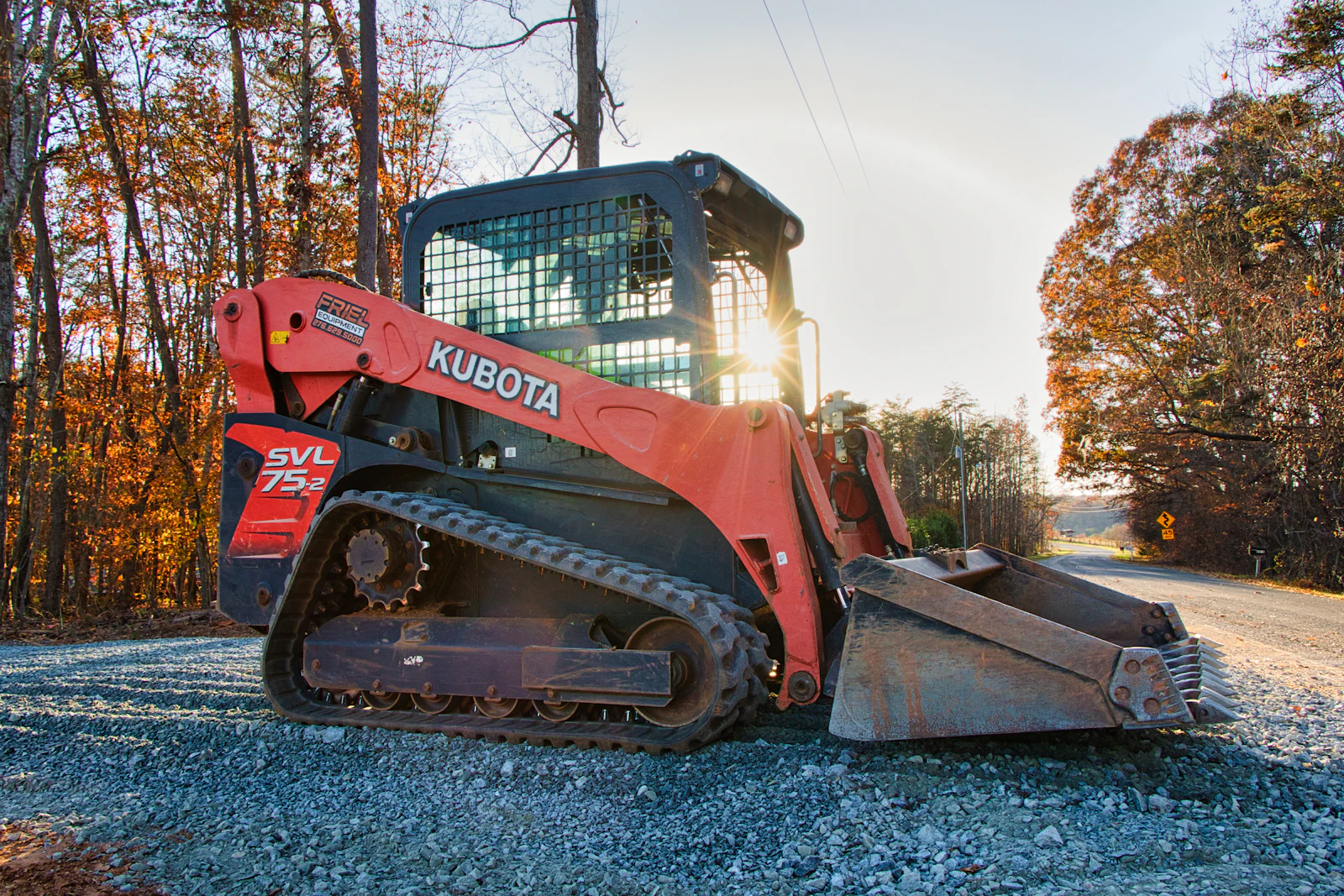
Skid Steer Loader Rental Rates in Los Angeles (Daily/Weekly) — 2026 Costs
Construction Cost Hub – Los Angeles
Price source: Costs shown are derived from our proprietary U.S. construction cost database (updated continuously from contractor/bid/pricing inputs and normalization rules).
Eva Steinmetzer-Shaw
Head of Marketing
Skid Steer Loader Rental
For Los Angeles job sites planning 2026 work, a realistic budget range for skid steer loader equipment hire is typically $250–$525 per day, $950–$1,950 per week, and $2,800–$5,200 per 4-week period (often billed as a 28-day “month”), assuming one-shift utilization and a standard bucket. Published examples show how far rates can swing by class and supplier: some posted weekly rates land around $1,100–$1,500/week for common mid-frame units and compact track loaders, while some published day rates are in the $260–$370/day range depending on capacity and track vs. tire. In LA, the “real” hire cost is usually driven less by the base rate and more by delivery logistics, meter-hours, attachments (forks/auger/breaker), cleaning, and off-rent timing. Most national providers (e.g., United Rentals, Sunbelt, Herc) and strong regional yards can cover the market, but the cost outcome is primarily determined by spec discipline and site constraints—not logo.
| Vendor |
Daily Rate |
Weekly Rate |
Review Score |
Website |
| Calgrove Equipment Rentals |
$410 |
$1 035 |
9 |
Visit |
| LGP Equipment Rentals |
$410 |
$1 035 |
9 |
Visit |
| Sunstate Equipment |
$410 |
$1 079 |
8 |
Visit |
| High Reach Equipment Services |
$335 |
$1 075 |
9 |
Visit |
| Perris Equipment |
$135 |
$475 |
7 |
Visit |
Skid Steer Loader Hire Cost Ranges In Los Angeles For 2026 Planning
The ranges below are meant for estimator-level budgeting for skid steer loader hire in Los Angeles and nearby basin cities (one shift, typical commercial GC controls, and a standard bucket unless noted). Actual quoted rates will depend on branch availability, seasonality, and contract terms.
- Small-frame wheeled skid steer (approx. 1,000–1,600 lb ROC): budget $250–$375/day, $900–$1,350/week, $2,800–$3,900/4-week.
- Mid-frame wheeled skid steer (approx. 1,800–2,400 lb ROC): budget $300–$450/day, $1,050–$1,650/week, $3,200–$4,600/4-week. Published specials and rate sheets commonly show mid-frame day rates in the high-$200s/low-$300s and weekly rates near $1.1k as a reference point.
- Compact track loader (CTL) equivalent class: budget $360–$525/day, $1,300–$1,950/week, $3,800–$5,200/4-week. CTLs typically price higher because they are more expensive to own/maintain and more sensitive to undercarriage wear.
- Mini / stand-on / mini track loader (tight access): budget $220–$350/day, $850–$1,400/week, $2,200–$3,500/4-week. A published “mini track loader” day rate at $220/day provides a lower anchor for this class.
Assumptions to state in your estimate: 8-hour shift included, 40 hours/week, 160 hours/4-weeks (many rental agreements are structured this way). If you run a second shift, overtime is commonly billed using a formula tied to the base rate (for example, an hourly overtime rate equivalent to 1/8 of the daily, 1/40 of the weekly, or 1/160 of the 4-week charge).
What Drives Skid Steer Loader Hire Cost In Los Angeles?
Base rates are only the starting point. For Los Angeles equipment hire coordination, these are the cost drivers that change invoices the most:
- Track vs. tire and surface sensitivity: If you must use a CTL for soft subgrade, slope stability, or traction, plan for higher base rates and stricter return-condition review (undercarriage wear, track cuts, embedded debris).
- Machine size and hydraulic package: High-flow hydraulic machines (for planers, heavy brush cutters, bigger breakers) usually rent at a premium. A common planning adder is +$50–$125/day vs. standard-flow in the same frame size.
- Utilization model (meter-hours): “Day” may mean “24 hours” but with only 8 working hours included; additional hours can trigger overtime charges.
- Downtown access and logistics: Tight delivery windows, street-use permits, limited laydown, and mandatory escort/flagging can add cost faster than the machine rate. In LA, it’s common for sites to request delivery before 7:00 AM to avoid traffic; after-hours delivery frequently adds a premium.
- Emissions and compliance spec: Many owners/CMs will require Tier 4 Final or equivalent fleet. If your scope forces newer fleet, you may see higher rates but fewer breakdown events.
- Jobsite conditions that create cleaning/maintenance exposure: Wet clay, decomposed granite, concrete slurry, or demolition fines increase cleanup time and can trigger cleaning charges (or at least delay off-rent pickup).
Hidden-Fee Breakdown For Skid Steer Loader Equipment Hire
To keep skid steer loader rental rates in Los Angeles comparable across bids, normalize the “hidden fees” and state them as allowances. The items below are where budget drift happens.
- Delivery & pickup: Common structures include a flat mobilization plus mileage. One published example is $100 + $4/mile (including delivery and pickup), which is a useful benchmark for estimating when you’re inside or outside the supplier’s normal delivery radius. For LA planning, also carry a conservative range of $150–$350 each way when dispatch is constrained by traffic or when a larger rollback/tilt-bed is required.
- Minimum rental charges: Some yards quote 4-hour minimums (useful for short scopes) and then step to daily/weekly. One posted structure shows $280/4 hours and $350/1 day as an example.
- Weekend/holiday billing: Clarify whether a Friday delivery and Monday pickup is billed as 1 day, 2 days, or 3 days. If your CM restricts weekend work, you can overpay without ever turning a wheel.
- Off-rent cutoff time: Many suppliers require off-rent notice by a daily cutoff (often mid-afternoon) to stop billing next day. If you miss cutoff by even an hour, you can inadvertently buy an extra day.
- Damage waiver (DW) vs. insurance: DW commonly prices as a percentage of the rental rate (often 10%–15%). If your GL/auto doesn’t address physical damage to rented equipment, DW can be the cleaner path for budget certainty.
- Environmental/administrative fees: Many rental agreements include a service or environmental recovery fee, commonly 5%–10% of rental charges (varies by supplier/contract).
- Fuel/DEF and refueling: Expect the unit to go out full and return full. If you return short, common refuel charges show up as a “fuel service” line item plus a per-gallon rate; budget $6–$9/gal equivalent for diesel service fueling in dense LA submarkets (plus a $25–$75 service component), unless your vendor contract fixes it.
- Cleaning: If returned with concrete splatter, caked mud, or excessive debris in the engine bay, budget a cleaning charge of $150–$350. Dust-control requirements on some sites (HEPA vacs, vac-attachments, wet methods) can reduce risk of cleaning fees but may add accessory costs.
- Late return / overtime shift use: When you run beyond one shift, many contracts bill overtime based on the base rate math (e.g., 1/8 daily per hour on a daily rental).
Attachment And Accessory Adders That Move The Total Hire Cost
Los Angeles skid steer loader hire costs are frequently attachment-driven. The machine rate might look competitive until you add the production tool that actually does the work. Budget these as separate line items so PMs can value-engineer later without changing the whole equipment package.
- Pallet forks: sometimes included, sometimes $25–$60/day or $90–$180/week. Some posted packages include bucket or forks in the base rate, but don’t assume that’s universal.
- General purpose bucket: often included; specialty buckets (4-in-1, low-profile, high-capacity, concrete bucket) can add $35–$95/day.
- Auger drive: budget $125–$250/day; auger bits commonly add $35–$75/day per bit (size-dependent). Carry extra for rock teeth or hardpan conditions.
- Hydraulic breaker/hammer: budget $175–$325/day plus a chisel wear allowance. If you’re breaking inside an occupied facility, include additional dust-control accessories and cleanup time.
- Trencher attachment: budget $175–$300/day. Utility locates, trench plates, and traffic control can exceed the equipment cost on LA street-front work.
- Grapple bucket / root grapple: budget $90–$175/day. These are common for demo sorting and landscape debris handling.
- Street sweeper / pickup broom: budget $175–$325/day. This can reduce cleaning fees and keep the GC’s SWPPP/dust plan intact, but it is often billed like a “second machine.”
- Towable trailer (if you self-haul): budget $75–$150/day depending on capacity; confirm towing requirements (many suppliers require at least a 3/4-ton truck for certain trailer/load combinations).
Budget Worksheet
Use this as a practical, table-free worksheet for a skid steer loader equipment hire budget in Los Angeles. Adjust quantities and add site-specific constraints (access, security, work hours).
- Base skid steer loader hire (mid-frame wheeled): allow $350/day x ___ days (or $1,300/week x ___ weeks).
- Upgrade to compact track loader (if required by soils/slope): add +$90/day (or +$350/week).
- Delivery & pickup allowance: allow $450 lump sum (typical urban dispatch) OR $100 + $4/mile benchmark if you want a mileage-driven allowance.
- After-hours / limited window delivery: allow $200 per event (early AM or late PM coordination).
- Damage waiver: allow 12% of rental charges (if you don’t provide physical damage coverage).
- Environmental/service fees: allow 7% of rental charges (contract-dependent).
- Fuel/DEF/refuel risk: allow $150/week for diesel & DEF consumption plus $75 contingency for vendor refuel service if returned short.
- Cleaning contingency: allow $250 (concrete/mud/dust exposure).
- Attachment package allowance: forks $45/day, auger drive $185/day, (2) bits at $55/day each, breaker $250/day (only include what the scope truly needs).
- Security/theft deterrence: allow $8/day if GPS/telematics adders or immobilizer requirements apply (common on higher-theft corridors).
Rental Order Checklist For Skid Steer Loader Hire
- PO details: correct job name, cost code, onsite contact name/number, and authorized rental start date/time.
- Delivery instructions: confirm delivery window (e.g., 6:00–7:00 AM), gate code, truck access route, and unload area (rollback vs. tilt-bed constraints).
- Site readiness: confirm you have space for offload, ground bearing is suitable, and there is a clear route to workface (avoid forcing a second mobilization).
- Machine spec confirmation: tire vs. track, ROC class, cab type (open vs. enclosed), hydraulic flow (standard vs. high-flow), and quick-coupler type.
- Attachments on the same truck: verify forks/bucket/auger/breaker are physically delivered with the loader; missing attachments frequently cause paid standby time.
- Utilization expectations: document planned shift (8 hours standard), and request the overtime rule in writing (how additional hours are billed).
- Off-rent procedure: record the off-rent cutoff time and required notice method (email/portal/phone), and document who is authorized to off-rent.
- Return condition documentation: take date-stamped photos of tires/tracks, bucket cutting edge, forks, couplers, and hour meter at both delivery and pickup.
- Recharge/refuel expectations: confirm “full out / full in” requirements and whether vendor fuel service is allowed/charged.
Example: 7-Day Downtown Los Angeles Skid Steer Loader Hire With Real Constraints
Scenario: You’re supporting a TI project near Downtown Los Angeles with a constrained loading dock, 7:00 AM–3:30 PM work hours, no weekend operations, and a requirement to keep haul routes clean (dust and track-out control). You need a mid-frame skid steer loader for material moves and light demo cleanup, plus forks and a pickup broom.
Budget build (planning numbers):
- Weekly skid steer loader rental: $1,400/week (benchmark example of a posted weekly rate).
- Forks: assume included OR carry $125/week if not included (avoid “free” assumptions unless confirmed).
- Pickup broom: $275/day x 3 days used = $825 (you only need it for the dust/track-out push at demo start and final cleanup).
- Delivery/pickup: $100 + $4/mile benchmark, assume 20 miles round-trip equivalent billing basis = $180 total for delivery and pickup (your supplier’s actual dispatch model may differ).
- Limited delivery window premium: allow $200 (DTLA early delivery coordination and driver wait-time risk).
- Damage waiver: 12% of rental charges (apply to $1,400 + $825 = $2,225) = $267.
- Environmental/service fee: 7% of rental charges (same base) = $156.
- Cleaning contingency: $250 (fine dust and demolition debris exposure).
Planner’s takeaway: even with an apparently “reasonable” $1,400/week machine rate, the package lands closer to $3,478 planned all-in for the week once you include broom time, logistics, and common percentage adders. That’s why LA skid steer loader equipment hire estimating should always start from the full package, not just the base rental rate.
Operational Rules That Commonly Change Your Hire Invoice
These rules are where rental coordinators can either protect margin or accidentally purchase extra time:
- Shift definition and meter-hours: Confirm whether the contract is “24 hours with 8 working hours included” and how the machine meter is used for overtime. Some published rental structures explicitly define the day as 24 hours with 8 work hours included.
- Overtime math: If you exceed one shift, many agreements bill at a fraction of the base rate per additional hour (e.g., 1/8 of daily per hour on a daily rental).
- Off-rent timing: Put the cutoff time in the superintendent’s plan for the last day. Missing the cutoff is one of the most common avoidable extra-day charges.
- Weekend billing: If the project is dark on weekends, negotiate weekend treatment up front. If the vendor bills Saturday/Sunday as full days simply because the unit is on rent, your effective weekly cost climbs fast.
- Standby because of access: If the truck cannot unload due to blocked access, you can incur re-delivery charges (often $150–$300) plus lost production time. Treat site access control as a cost-control measure.
- Return condition standards: Photograph tires/tracks and attachment wear. Carry allowances for wear items: tire damage charges can be material (budget $250–$450 for a severe cut), and undercarriage/track damage can be $600–$1,200+ depending on scope and supplier policy.
Insurance, Damage Waiver, And Risk Controls
From a cost perspective, decide early whether you are pushing risk to your insurance program or buying rental-company damage waiver. Typical cost planning approaches:
- Damage waiver: budget 10%–15% of rental charges when you need predictable exposure (especially for CTLs and attachment-heavy scopes).
- Deposit/credit hold: depending on account structure, plan a $0–$500 deposit (cash account) or a credit card hold that can reach $1,000–$3,000 on short-term rentals.
- Theft risk controls: In LA, theft exposure is real; budget $8–$15/day for add-on telematics/GPS where required, plus practical site measures (fencing, lighting, and “keys controlled by foreman” policy).
- Operator qualification: If you need vendor-led familiarization or documented training, plan $75–$150 as an administrative/training allowance (varies; not every vendor offers it as a formal paid line item).
When A 4-Week Hire Beats Weekly (And When It Doesn’t)
For skid steer loader hire costs in Los Angeles, the 4-week rate usually wins when the machine is genuinely needed every week and you have stable site access. The 4-week rate can become a liability when:
- Permitting/inspections can stop work for 3–7 days unexpectedly (you end up paying for idle time).
- Only a specific phase needs the loader (e.g., demo cleanup and initial rough grade), and the rest of the project shifts to handwork or smaller equipment.
- The attachments are the cost driver (you can sometimes keep the base machine longer but only rent the specialty attachment for 1–3 days).
A practical estimator rule is to compare (a) 2 weeks of weekly rates vs. (b) a prorated 4-week with early off-rent treatment (if allowed). If early off-rent is not credited, avoid booking 4-week rates “just in case.”
Los Angeles-Specific Considerations That Affect Equipment Hire Cost
- Traffic and delivery windows: LA basin congestion makes narrow windows expensive. If your site requires delivery inside a 60-minute slot, carry a wait-time/after-hours allowance (commonly $150–$300).
- Dust-control expectations: Many LA projects require aggressive dust management. If you’re working in dry decomposed granite or demo fines, your skid steer package may need a broom attachment ($175–$325/day) or additional cleanup labor—often cheaper than paying repeated cleaning charges and schedule delays.
- Heat and duty cycle: In hotter submarkets (e.g., San Fernando Valley summer work), plan for slightly reduced production during peak heat and avoid “second shift” assumptions unless you’ve priced overtime meter-hours explicitly.
If you want, share (1) skid steer class/ROC, (2) track vs. tire, (3) expected meter-hours per day, (4) attachments list, and (5) site ZIP code and delivery window, and I can tighten the 2026 equipment hire budget range to a narrower, bid-ready estimate.