

Create an itemized estimate for your project, with materials, labor, and quantities you can review and edit.
Create my estimateStart a 7-day free trial. Sign up, then enter your project details.
2026 planning ranges for skid steer loader equipment hire in Louisville, KY (digging footings support, loading spoil, backfill, stone placement): expect $325–$575/day, $900–$1,450/week, and $1,950–$3,250/month for a wheeled skid steer (typ. 1,500–2,700 lb ROC class). For a compact track loader (tracked skid steer) that is more common on wet/clay sites, budget $375–$700/day, $1,100–$1,925/week, and $2,450–$5,900/month depending on flow package, cab, and attachment needs. Assumptions: standard bucket included, rates are time-based (8-hour day / ~40–44-hour week / ~160–176-hour month), and exclude delivery, fuel, damage waiver, taxes, and cleaning.
| Vendor | Daily Rate | Weekly Rate | Review Score | Website |
|---|---|---|---|---|
| United Rentals | $425 | $1 225 | 9 | Visit |
| Sunbelt Rentals | $410 | $1 180 | 8 | Visit |
| Herc Rentals | $420 | $1 200 | 9 | Visit |
| Boyd CAT (The Cat Rental Store) | $405 | $1 150 | 9 | Visit |
| The Home Depot Tool Rental | $360 | $1 000 | 7 | Visit |
For Louisville-area footing packages, rental coordinators typically price the skid steer as a support machine (spoil management, stone staging, backfill, site shaping) rather than the primary excavation tool, then add attachments only where they reduce handwork or rehandling. National providers (for example, United Rentals and Sunbelt) generally have the depth of fleet for “need it tomorrow” replacements, while Louisville/Jefferson County independents can be competitive on weekly and monthly equipment hire when you control delivery windows and return condition. Marketplace quotes can be a useful benchmark; for Louisville, published marketplace averages for wheeled skid steer hire have been shown around the low-$300s/day with weekly and monthly equivalents that track close to the 3:1:1 month/week/day pattern, subject to availability and class.
On footing jobs in Louisville, the skid steer almost always earns its keep through cycle time: keeping the trench line clear, maintaining a clean working platform for form crews, moving #57 stone, and managing spoils so trucks can get in and out without rework. From an equipment hire cost standpoint, the machine choice that most affects your total is not “brand,” it is undercarriage and hydraulic spec. After rainfall (common in the Ohio River Valley), tracked units can avoid stoppages and rut remediation that wipe out any apparent daily savings on a wheeled skid steer.
Plan your hire around how your vendor bills time. Many rental schedules are explicitly based on 8-hour days, 44-hour weeks, and 176-hour months (or similar). If your footing operation runs long shifts (or you are trying to “catch up” after an inspection delay), meter-hour overages can become the hidden driver of cost even when you hold the machine for the same number of calendar days.
Wheeled skid steer: Most cost-effective for paved access, stable subgrade, and tight residential infill where you want fast travel speed and minimal track maintenance. In Louisville, this frequently fits work in the Highlands, Germantown, and similar neighborhoods where you may have short pushes, alley access, and frequent on/off moves.
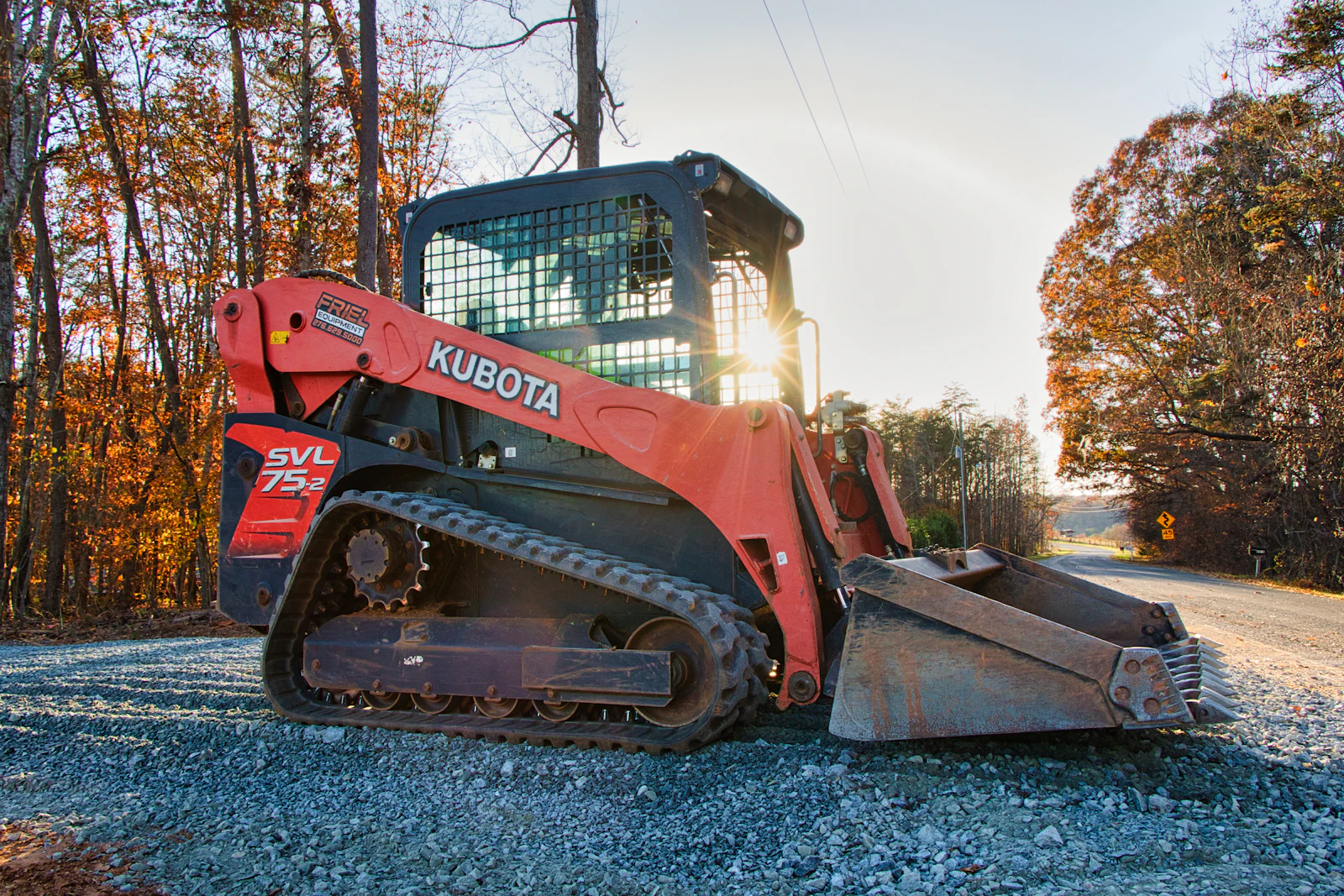
Compact track loader (CTL): Higher hire rate but often lower total job cost in Louisville clay and wet conditions, especially when you are staging spoils on unprepared ground or working around new foundation drains. Track units also reduce “site repair” labor (ruts) that otherwise shows up in your budget as unplanned stone and grading passes.
Cost deltas you should carry in your 2026 estimate:
Louisville-specific note: If your job is across the river in Southern Indiana (or your supplier yard routes you over tolled bridges), confirm whether bridge tolls are passed through on delivery tickets. That can be a small line item (often $10–$30) but it shows up repeatedly if you swap attachments mid-week.
For “digging footings,” skid steers are rarely the best primary digging tool compared to a compact excavator; however, attachments can still reduce handwork, speed up material handling, and keep your excavation crew productive. Budget attachments as separate equipment hire line items, and confirm whether the vendor requires a compatible coupler style (standard quick-attach vs. proprietary).
Typical 2026 attachment adders you will see on Louisville quotes:
If you are considering specialty tools (brush cutter, planer, stump grinder) because the site has demolition and clearing before footing layout, expect to step into higher hydraulic flow, with a corresponding jump in equipment hire rate. A published high-flow CTL schedule example shows a CTL at $650/day, $1,925/week, and $5,750/month, with separate daily adders for items like a $145/day 4-in-1 bucket and $80/day forks on that schedule; treat those as upper-band references when planning a Louisville budget.
On footing jobs, “calendar days” and “billable days” are not the same. Your total equipment hire spend is often controlled by dispatch cutoffs and off-rent rules more than the sticker day rate.
Operational constraint that matters in Louisville: downtown and medical district jobs can force narrow delivery windows (traffic, staging permits, spotter requirements). A missed window can create a “return trip” charge or reschedule fee, so bake in schedule realism rather than trying to win the bid on day rate alone.
Use this section as a pre-award checklist to prevent avoidable equipment hire overages on skid steers assigned to digging footings support.
Use these line items as a field-ready allowance set for a Louisville skid steer loader equipment hire package supporting digging footings (adjust quantities to your schedule).
Use this checklist to reduce total equipment hire cost exposure (and end-of-rental disputes) on Louisville footing scopes.
Example scenario (operationally realistic): A 9-business-day footing phase in Jeffersontown with frequent rain delays, tight staging, and a Monday concrete pour. The skid steer is primarily for spoil management, bringing stone, and final subgrade cleanup.
Result: even with a competitive weekly hire, the “real cost” is driven by delivery timing, waiver election, fuel discipline, cleaning, and hour management. This is why footing-phase coordinators in Louisville often prioritize dispatch control and return condition over shaving $25/day off the base machine rate.
Skid steer agreements frequently put specific exposures on the renter: tires, undercarriage wear, and “abuse” damage. For tracked units supporting digging footings, your biggest avoidable charges are typically (1) track/undercarriage damage from running on sharp rubble and (2) cleaning from mud and concrete splash.
Published rental schedules commonly note cleaning charges such as $75/hour for excessive cleaning and emphasize renter responsibility for tire damage and excessive undercarriage wear; treat those as standard risk categories to control on Louisville footing jobs.
This article focuses on skid steer loader equipment hire costs, but it is worth stating the estimator reality: if your scope is true “footing excavation” (depth control, trench geometry, working near existing utilities), a compact excavator is often the lower-risk production choice. In that case, the skid steer is still valuable as a support machine, but you may downsize it to a cheaper class (or shorten the hire) if the excavator can handle the bulk digging and the skid steer only handles spoils and backfill. The cost lever is duration: turning a 3-week skid steer hire into a 6-day hire typically saves more than negotiating a small day-rate discount.
For 2026 planning in Louisville, expect seasonal pricing pressure in spring and early summer when sitework and foundation starts peak. Keep your equipment hire plan resilient by (1) allowing a substitution clause (ROC and hydraulic flow minimums rather than a specific model), (2) pre-booking delivery windows for downtown and hospital corridor projects, and (3) defining off-rent procedures clearly so weather delays do not inflate billable days. If you are bidding lump sum, your cleanest risk control is to carry explicit allowances for delivery/pickup, waiver, cleaning, and meter-hour overages rather than hiding them inside a single blended day rate.
Continue with estimating workflows, reviewed plan quantities, or cost guides organized by topic.
