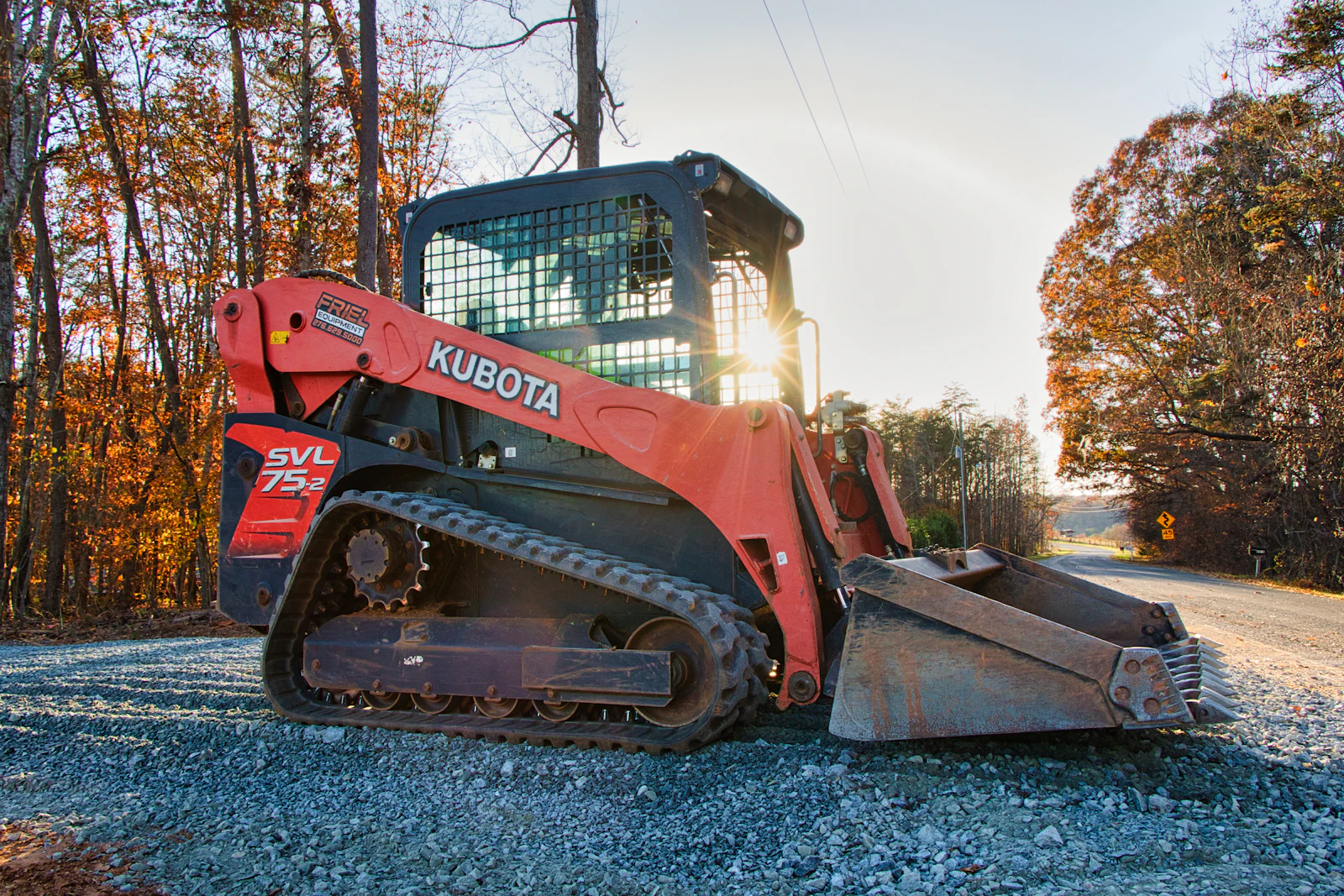
Skid Steer Loader Rental
2026 planning ranges (Louisville, KY): budget $225–$500/day, $850–$1,650/week, and $2,400–$4,600/28-days for a standard wheeled skid steer loader with bucket, with compact track loader (CTL) and high-flow units typically landing at the top end. These are estimating ranges for contractor-grade equipment hire, assuming (1) an 8-hour billed day, (2) a 40-hour billed week or equivalent weekly cap, (3) a 28-day “monthly” rate (common in national rental programs), and (4) normal wear-and-tear included but attachments, freight, damage waiver, fuel, and cleaning billed separately. In Louisville you’ll typically source from national fleets (United Rentals, Sunbelt Rentals, Herc Rentals) plus local dealer-rental operations; note that Ahern Rentals has joined United Rentals, which can affect branch availability and negotiated rate structures for equipment hire programs.
| Vendor |
Daily Rate |
Weekly Rate |
Review Score |
Website |
| United Rentals |
$375 |
$1 450 |
9 |
Visit |
| Sunbelt Rentals |
$360 |
$1 400 |
9 |
Visit |
| Herc Rentals |
$350 |
$1 350 |
8 |
Visit |
| The Cat Rental Store |
$395 |
$1 550 |
8 |
Visit |
| The Home Depot Tool & Truck Rental |
$325 |
$1 300 |
8 |
Visit |
2026 Planning Rental Rates And What They Include In Louisville
Skid steer loader hire cost is best estimated by matching machine class (rated operating capacity, cab configuration, flow) to the actual production constraint (ground conditions, access, indoor controls, and attachment duty). Published rate sheets and program pricing from larger rental networks show how wide the spread can be by class. For example, a published Sunbelt price list shows daily/weekly/monthly reference rates by skid steer weight class and CTL class (e.g., 1,500–2,000 lb class and larger classes) and also lists common attachment day/week/month adders. (g
For Louisville estimating, it’s useful to bracket your budget with at least two references: (1) a local-market “typical” range and (2) published program/guide rates that indicate how attachments and CTL classes price out. A Louisville-specific 2026 planning statement commonly cited in estimating content places skid steer rental in the rough band of $200–$500/day, $800–$1,200/week, and $2,500–$3,500/month depending on model and attachments; treat that as a planning midpoint rather than a guaranteed quote.
Meanwhile, separate published rate examples show that a “skid steer” line-item can be materially lower or higher depending on whether it’s a wheeled unit, a CTL, enclosed cab, and/or high-flow. A 2024 rental rate PDF from an independent rental operation lists Skid Steer at $175/day, $612.50/week, and $1,837.50/month (plus hourly/minimum structures), while listing a tracked Kubota SVL75 at $250/day, $875/week, and $2,625/month. Those are not Louisville-specific, but they’re useful for “sanity-check” deltas between wheeled vs tracked classes when you’re building a 2026 equipment hire budget.
What’s typically included in the base hire rate: the machine, standard bucket (often), and normal maintenance. What’s commonly excluded and should be carried as separate allowances: delivery/pick-up, fuel/diesel, environmental cleanup/cleaning, damage waiver or rental protection plan, and any attachment (forks, broom, auger drive/bit, trencher, breaker, brush cutter, grading box, etc.). National renters also emphasize that you’ll see daily/weekly/monthly structures (often with a 28-day “monthly” definition) when shopping through their online marketplaces, but branch terms still govern billing caps, off-rent timing, and freight.
What Drives Skid Steer Equipment Hire Costs In Louisville?
1) Wheels vs tracks (and Louisville soil/mud realities). Louisville and Jefferson County sites frequently encounter clayey subgrades, wet shoulder conditions, and churned mud during shoulder-season storms. If you’re paying a crew to wait, CTL premium pricing can be justified by lower stuck-time and less rut repair. Plan CTL or “track skid steer” pricing when you have: (a) saturated lots, (b) slope work on disturbed soils, or (c) tight production windows where a tow-out is unacceptable.
2) High-flow hydraulic demand. The rental price jumps when the job requires high-flow for attachments like cold planers, forestry cutters, or certain broom/brush systems. Even if the base daily looks acceptable, the attachment cost plus a high-flow machine class can double your “all-in” day cost compared to a standard-flow bucket-only skid steer.
3) Enclosed cab and job conditions. If you’re working around traffic control, winter conditions, or dusty milling/concrete demo, a cabbed unit (often with heat/AC) reduces operator fatigue and can meet site rules. That said, cabbed units often carry higher rental classes in published lists. (g
4) Delivery complexity in Louisville metro. Jobsite access (downtown/riverfront congestion, limited staging, alleys, and restricted delivery windows) can force smaller delivery vehicles, timed dispatch, or after-hours placement—each of which pushes freight cost and the risk of redelivery charges.
Hidden-Fee Breakdown For Skid Steer Loader Hire
For accurate skid steer loader equipment hire costs in Louisville, build an “all-in” model that carries the items below as separate line-items (or negotiated inclusions). The goal is to avoid the classic estimating miss where the “day rate” is correct but the invoice is 25–60% higher due to freight, waiver, fuel, and return-condition charges.
- Delivery / pick-up: Common structures include flat fees inside a radius (often 10–20 miles) or a base plus mileage. One published pricing sheet shows a freight structure of $120 each way + $3.25 per loaded mile. If your Louisville site is 18 loaded miles from the yard, that’s about $178.50 each way before any wait time or redelivery.
- Minimum billing and time caps: Many programs use an 8-hour day definition; some rate cards show 4-hour minimums and hourly pricing. One published example shows a 4-hour minimum with an hourly line plus a daily cap structure.
- Weekend/holiday exposure: If you take delivery Friday and don’t off-rent until Monday, you may be billed over the closed days depending on the contract. Carry a 1-day weekend standby allowance of $175–$450 unless you have written “off-rent” terms.
- Damage waiver / rental protection: Typical damage waiver adders in the market often run 10%–15% of time-and-attachment charges. Budget a waiver line even if you plan to provide your own coverage, because some renters require one or the other.
- Fuel: If returned short, many renters bill “yard fuel” at a premium. For 2026 planning, carry $6.00–$8.50/gal billed fuel (diesel) as a conservative exposure (even if local pump prices differ on the day).
- Cleaning / de-mudding: Louisville’s wet subgrades can turn into undercarriage mud and packed wheels. Carry a $95–$250 cleaning fee (higher for CTLs) if you cannot guarantee a wash-down before return.
- Late return / extra day triggers: Missing the branch cut-off can trigger an additional billed day. Carry a $175–$500 “missed cut-off” exposure when the schedule is volatile.
- Service calls: If the machine is down due to jobsite-caused issues (debris in sprockets, flats, contaminated fuel), service mobilization can be billed. Carry $150–$350 per trip plus parts.
Attachment And Add-On Pricing That Moves The Total
Attachments are where skid steer loader hire cost estimates commonly fail. Even when the base machine is a weekly rental, attachments may be billed daily, billed weekly with different caps, or billed as “specialty” with higher waiver percentages. Use published attachment pricing as a baseline and then adjust for Louisville availability and high-flow requirements.
Published attachment day/week/month examples include (rates vary by program and class): pallet forks listed around $47.50/day in one published sheet and $51/day in another; a sweeper/broom around $90.25/day or $107/day; a brush cutter around $142.50/day or $149/day; and an auger attachment around $95/day or $94/day.
For 2026 Louisville planning, realistic “street” adders you can carry in budgets (before negotiation) are:
- Pallet forks: $45–$95/day, $140–$310/week.
- 4-in-1 bucket: $65–$135/day, $180–$450/week (higher for larger coupler widths). (g
- Hydraulic auger drive: $95–$175/day, $225–$525/week (plus bits). Published examples show an auger line at $125/day and $437.50/week.
- Auger bits: $15–$45/day per bit; one published example lists “bits only” at $20 (4-hour minimum) / $40/day.
- Hydraulic breaker: $195–$350/day, $680–$1,050/week. A published example shows $195/day and $682.50/week.
- Brush mower (60 in.): $170–$260/day, $595–$950/week; published examples show $170/day and $595/week for a 60-inch brush mower.
- High-flow brush mower (72 in.): $225–$325/day, $785–$1,250/week; a published example shows $225/day and $787.50/week.
Operational note: don’t assume the attachment will “just fit.” Confirm coupler type, hose routing, case drain requirements, and hydraulic flow. A $0 mismatch in the estimate can become a $250–$600 lost half-day in the field if the crew stands down while swapping couplers or sourcing adapters.
Example: 10-Day Utility Trench Backfill In Louisville With Tight Delivery Windows
Scenario. You have a 10-business-day (two-week) underground repair and backfill package near central Louisville with a narrow delivery window (7:00–9:00 a.m.), limited laydown, and a requirement to keep streets broom-clean at end of shift. You need a skid steer loader with bucket plus forks for pallet handling, and you may add an auger for two days of sign-post holes.
Assumptions (2026 planning):
- Machine: mid-class wheeled skid steer at $1,100/week (2 weeks = $2,200 time charge).
- Delivery/pick-up: $190 each way (2 moves = $380) based on a base-plus-mileage model comparable to published examples.
- Damage waiver: 12% of machine + attachments (carry as $264 on $2,200).
- Forks: $70/day for 10 days = $700 (or negotiate a weekly cap if available).
- Auger drive + bit: $150/day drive + $30/day bit for 2 days = $360.
- End-of-rent cleaning exposure due to mud: $150.
- Fuel/top-off exposure: 18 gallons at $7.50/gal billed = $135 (only if returned short).
- Late cut-off risk: carry $300 contingency (if pick-up misses the window and triggers another day).
Estimated “all-in” hire cost: $2,200 (time) + $380 (freight) + $264 (waiver) + $700 (forks) + $360 (auger) + $150 (cleaning) + $135 (fuel exposure) + $300 (schedule contingency) = $4,489 planning total. Your biggest levers to reduce cost are (1) negotiate forks to a weekly rate cap, (2) eliminate return fuel exposure with documented top-off, and (3) schedule off-rent before the cut-off to avoid the extra day.
Budget Worksheet
Use this as a quick estimating artifact for skid steer loader equipment hire cost in Louisville (adjust to your contract terms and site controls):
- Skid steer loader (wheeled) weekly hire: allowance $900–$1,650/week (select class and cab/high-flow as required).
- Compact track loader premium (if needed): add $150–$350/week over wheeled equivalent for mud/floatation risk.
- Delivery + pick-up: allowance $300–$650 total inside metro; add $4–$8/loaded mile outside typical radius (or carry a base-plus-mileage structure similar to published examples).
- Damage waiver / rental protection: allowance 10%–15% of time + attachments.
- Fuel/top-off: allowance $75–$250 (or plan “return full”).
- Cleaning/undercarriage wash-down: allowance $95–$250 (higher for CTL and wet clay).
- Attachments (select):
- Forks: $45–$95/day
- Auger drive: $95–$175/day; bits: $15–$45/day
- Sweeper/broom: $90–$200/day (useful for Louisville street cleanliness requirements)
- Breaker: $195–$350/day
- Brush cutter: $170–$325/day (high-flow class at top end)
- Redelivery / missed window contingency: allowance $150–$400.
- After-hours or timed delivery: allowance $100–$250 if the site cannot receive during normal dispatch windows.
Rental Order Checklist
- PO and rate confirmation: confirm day/week/28-day definitions; confirm whether weekends are billed and whether a weekly cap applies.
- Delivery requirements: address, contact, delivery window, truck access notes (alley/curb lane), and any on-site escort requirement.
- Freight basis: confirm flat vs mileage; confirm redelivery fee; confirm wait-time billing if the driver is held more than 30 minutes.
- Attachments: list each attachment, required hydraulic flow, coupler type, and any bits/teeth included vs billed.
- Damage waiver / insurance: confirm waiver %; provide certificate if using contractor coverage; document existing damage at delivery with time-stamped photos.
- Fuel policy: confirm “return full” expectations; document fuel level at drop.
- Off-rent rules: confirm cut-off time (many branches operate with afternoon cut-offs); require written confirmation of off-rent date/time.
- Return condition documentation: clean machine, remove debris from undercarriage, photograph tires/tracks, bucket cutting edge, and hour meter at pick-up.
How To Reduce Skid Steer Hire Cost Without Losing Uptime
- Use the right term: if you need it more than 3–4 days, request the weekly hire (many fleets price weekly as the economic default).
- Schedule off-rent before the cut-off: a single missed cut-off can cost +$175–$500 in an extra day.
- Bundle attachments smartly: forks and a broom often have predictable use; negotiate a weekly cap instead of open-ended daily billing.
- Control mud: on Louisville wet sites, plan a 30-minute wash-down at the end of each shift to avoid a $95–$250 cleaning fee and reduce wear risk.
- Avoid dead-haul freight: if your crew can legally and safely haul, compare “grab and go” vs delivery; but only do this with properly rated trailer/tie-downs and documented chain-of-custody.
When Monthly Equipment Hire Beats Owning For Short-Term Fleets
For most contractors, ownership pencils out only when utilization is consistently high and the organization can absorb maintenance scheduling, transport, and replacement risk. For project-based demand in Louisville—especially for intermittent grading, backfill, and material handling—skid steer equipment hire is often the lower-risk option because your cost is tied to schedule, not to idle months.
As a rule of thumb for 2026 estimating, if your anticipated need is < 8–10 weeks/year for a specific skid steer class (standard-flow wheeled), renting is frequently more economical once you include: (1) transport, (2) maintenance labor, (3) tires/tracks, (4) downtime, and (5) replacement cycle. If you need a high-flow unit or CTL only on select projects, renting protects you from carrying an expensive specialty asset that sits.
Contract Terms That Commonly Change The Final Invoice
Two quotes with the same “weekly rate” can produce very different final costs. Before you release a PO, confirm these billing items in writing:
- Off-rent timing: what time must you call off-rent to stop billing (and does “called off” stop billing, or only “picked up”)? Carry a 1-day standby exposure if you can’t guarantee pick-up.
- Hour meter limits: some agreements bill excess hours above an 8-hour day or 40-hour week. Carry an overage allowance such as $35–$85/hour if you anticipate double-shifts.
- Wear items: clarify responsibility for tires, cutting edges, and track damage. A single tire can become a several-hundred-dollar exposure; carry a $250–$900 damage contingency for rough demo environments.
- Attachment wear: trencher teeth, auger bits, and planer drums can be billed if returned excessively worn. Carry $75–$300 exposure depending on attachment severity.
- Cleaning standard: “broom clean” vs “pressure washed” expectations matter. If the machine is used in Louisville clay and returned packed, your cleaning fee risk is real (carry $95–$250, and more for CTL undercarriage work).
Compliance And Jobsite Controls That Add Real Cost
Compliance isn’t a line-item on a rental quote, but it changes real equipment hire cost through delays and special requirements:
- Operator qualification and site rules: ensure you have trained operators and that site-specific orientation is scheduled; a half-day delay can easily exceed $200–$500 in idle equipment time.
- Indoor dust-control: if you’re using a skid steer indoors (warehouse slab repair, interior demo), you may be required to add dust suppression, HEPA vac support, or cleanup. Carry $150–$400/day for supplemental dust-control measures if required by GC/site EHS.
- Traffic control and street cleanliness: Louisville urban work frequently requires end-of-day cleanup. If you need a broom attachment, budget it as an explicit add-on rather than hoping “we’ll just use the bucket.” Published attachment examples show broom adders in the ~$90–$107/day range in some programs; 2026 field pricing can be higher depending on class and availability.
Louisville-Specific Dispatch And Site-Condition Notes
- Delivery radius norms: many suppliers treat the Louisville metro (Jefferson County and near suburbs) as “local,” but farther runs toward Bullitt County, Oldham County, or across the river can convert to base-plus-mileage. Use a freight model like base each way + loaded-mile when estimating out-of-core sites; published examples show structures such as $120 each way + $3.25/loaded mile.
- Heat and storm impacts: summer heat can increase hydraulic temp issues on continuous high-flow attachment use; plan for short cool-down windows so you don’t incur billable downtime on a clocked day.
- Freeze-thaw and hardpan seasons: when winter conditions stiffen subgrade, plan on tooth bucket selection and potentially higher wear allowances; otherwise you risk productivity loss and longer on-rent duration.
Quick Reference Callouts For 2026 Skid Steer Hire Estimating (Louisville)
- Base hire planning bands: $225–$500/day, $850–$1,650/week, $2,400–$4,600/28-days (class-dependent).
- Freight planning: $300–$650 total in typical metro scenarios; add mileage beyond radius. A published example structure is $120 each way + $3.25/loaded mile.
- Damage waiver: carry 10%–15% unless you have negotiated waivers or provided coverage terms.
- Common attachment day adders: forks $45–$95, broom $90–$200, auger drive $95–$175 (+ bit $15–$45), breaker $195–$350, brush cutter $170–$325.
- Cleaning exposure: $95–$250 (higher for CTL undercarriage mud).
- Missed cut-off exposure: $175–$500 (one unintended extra day).
If you want, share your expected duration (calendar vs workdays), attachment list, and whether the site is muddy/soft or paved. I can turn the above into a tight “not-to-exceed” rental estimate with contingency logic (still without vendor tables).