

For Miami concrete driveway scopes in 2026, plan skid steer loader equipment hire budgets in three tiers: a wheeled skid steer (typically 45–75 hp) at roughly $250–$550 per day, $900–$1,850 per week, and $2,400–$4,400 per 4-week period; a compact track loader (CTL) at roughly $350–$750 per day, $1,400–$2,600 per week, and $3,500–$6,800 per 4-week period; and large-frame/high-flow packages at $650–$1,050 per day when you add production attachments. These are planning ranges, not guaranteed branch quotes—Miami availability, delivery logistics, and attachment demand swing the total. As real local reference points, one Miami-area listing shows $179 (4-hour), $281 (daily), and $936 (weekly) for a small skid steer; another shows $350 (1 day), $1,400 (week), and $3,500 (month) for a tracked loader, with delivery priced separately. National rental houses (e.g., United Rentals, Sunbelt Rentals, Herc Rentals) generally rate equipment on an 8-hour shift basis, which becomes critical when driveway demo runs long and meter hours exceed the included usage.
| Vendor | Daily Rate | Weekly Rate | Review Score | Website |
|---|---|---|---|---|
| United Rentals | $198 | $595 | 8 | Visit |
| Sunbelt Rentals | $230 | $668 | 9 | Visit |
| Herc Rentals | $198 | $562 | 9 | Visit |
| The Home Depot Rental | $390 | $1 313 | 9 | Visit |
| Alltool Rental Co. | $281 | $936 | 6 | Visit |
When you’re building a concrete driveway estimate, treat the published day/week/4-week rate as only the base of the skid steer loader hire cost. Your all-in rental spend is usually driven by (1) machine class and tires vs tracks, (2) hydraulic flow requirements for breaker/planer/sweeper attachments, (3) delivery/pickup constraints in Miami neighborhoods, and (4) how strictly the supplier enforces shift-hour limits.
Shift-hour assumption to price correctly: many major rental terms describe the daily/weekly/4-week rate as “one-shift” usage based on 8 hours/day, 40 hours/week, and 160 hours per 4-week period. If your driveway crew runs 10–12 hour demo days (common when you’re trying to keep ready-mix placement on schedule), you should budget overtime hours or a higher effective rate rather than hoping it gets waived.
Concrete driveway work tends to push skid steer utilization into short, intense bursts: slab breakup and load-out, subgrade trimming, base placement, and cleanup. That pattern matters because rental houses price by “rental period” but many also track metered hours. A driveway that looks like a two-day job on the schedule can price like a week if it straddles a weekend pickup window, or if you exceed included hours and trigger overtime billing.
For driveway demo and prep, most rental coordinators end up choosing between two cost profiles:
Attachment adders (budgetary): on concrete driveway scopes, the attachment line items can exceed the machine line item if you’re doing any demolition or finish cleanup. Typical hire adders you should carry in Miami bids include:
To control skid steer loader equipment hire cost in Miami, you need to budget the “invoice movers” up front. These aren’t surprises to rental houses; they become surprises when the estimator only carries the base day/week/4-week rate.
Delivery and pickup: if you cannot self-haul, delivery becomes a major driver—especially in Miami traffic and when the jobsite has tight access or scheduled receiving windows. One local published example prices delivery at $100 plus $4 per mile from the store and notes it includes both delivery and pickup; other suppliers may quote flat mobilization plus mileage. For budgeting, a common Miami allowance is $150–$350 round-trip inside a typical metro radius, then $4–$7/mile beyond that. If your site has restricted hours (e.g., condo/HOA receiving), carry an after-hours or “scheduled delivery” allowance of $75–$175 and confirm cutoff times (many branches require same-day off-rent or will pick up next business day).
Minimum rental charges: some local stores publish short-term minimums such as a 4-hour rate ($179 on one listing; $280 on another). This matters if you’re trying to “just grab a skid steer for a quick load-out” but the supplier bills the minimum anyway. If you know you only need 3 hours of machine time, you still need to price the 4-hour minimum plus logistics.
Overtime/excess hours: many rental terms base rates on one shift and then charge additional hours as a fraction of the daily/weekly/4-week rate. For example, one major renter publishes overtime as 1/8 of the daily rate per extra hour on a daily rental, 1/40 of the weekly rate per extra hour on a weekly rental, and 1/160 of the 4-week rate per extra hour on a 4-week rental. Separately, one local listing states each 24-hour period includes 8 work hours on the machine—so meter management is not optional when you’re demoing concrete and loading trucks late in the day.
Fuel and refuel options: treat fuel as an explicit allowance. Larger rental houses often provide multiple fuel billing approaches (for example, prepay or pay-on-return options and a return-full option). If you return equipment under-fueled, carry a refuel service line such as $50–$125 convenience charge plus a per-gallon rate that may be above retail. For driveway work, the most controllable strategy is to document starting fuel level with photos and return to at least that level.
Damage waiver / rental protection: budget 10%–15% of base rental as a planning allowance for a damage waiver or rental protection plan when your own property coverage is not being used, but confirm exactly what it covers. On driveway demo, common exposure points are hydraulic hoses, tires/tracks, and attachment damage. If you’re renting from a supplier that requires proof of insurance for commercial use, budget the administrative time to produce a COI and endorsements quickly so the machine is not held at will-call.
Cleaning and concrete residue: driveway demo creates slurry, fines, and rebar fragments that can trigger cleaning charges. Carry a cleaning allowance of $150–$400 if the machine returns with concrete splatter or caked mud in the undercarriage; for CTLs, undercarriage clean-out is a frequent charge risk after wet weeks. If you’re using the skid steer to load wet debris, also carry a $75–$150 allowance for “jobsite wash-down controls” (tarps, berms, or vacuum cleanup) to avoid washing fines into storm drains.
Weekend/holiday billing rules: driveway schedules frequently straddle weekends. If you take delivery Friday and the branch cannot pick up until Monday, you may effectively pay for weekend days depending on the supplier’s billing practices and your off-rent timing. As a planning control, set your pour schedule so you can off-rent the skid steer the same day you finish base placement and final cleanup, and confirm the branch’s off-rent cutoffs in writing.
Scenario: 1 residential driveway replacement managed by a small civil crew near Coral Gables with tight access (single-car width at the garage), storm forecast on Day 2, and HOA rules requiring street cleanup before 5:00 PM daily. You need the skid steer primarily for slab debris handling and base distribution.
Estimator takeaway: even with only two calendar days on site, the all-in skid steer equipment hire cost can land in the $1,700–$3,200 range once you combine base rent, attachments, mobilization, waiver, and cleanup allowances. That range tightens significantly when you lock delivery windows, pre-stage a washout/cleanup plan, and off-rent the breaker immediately after demo.
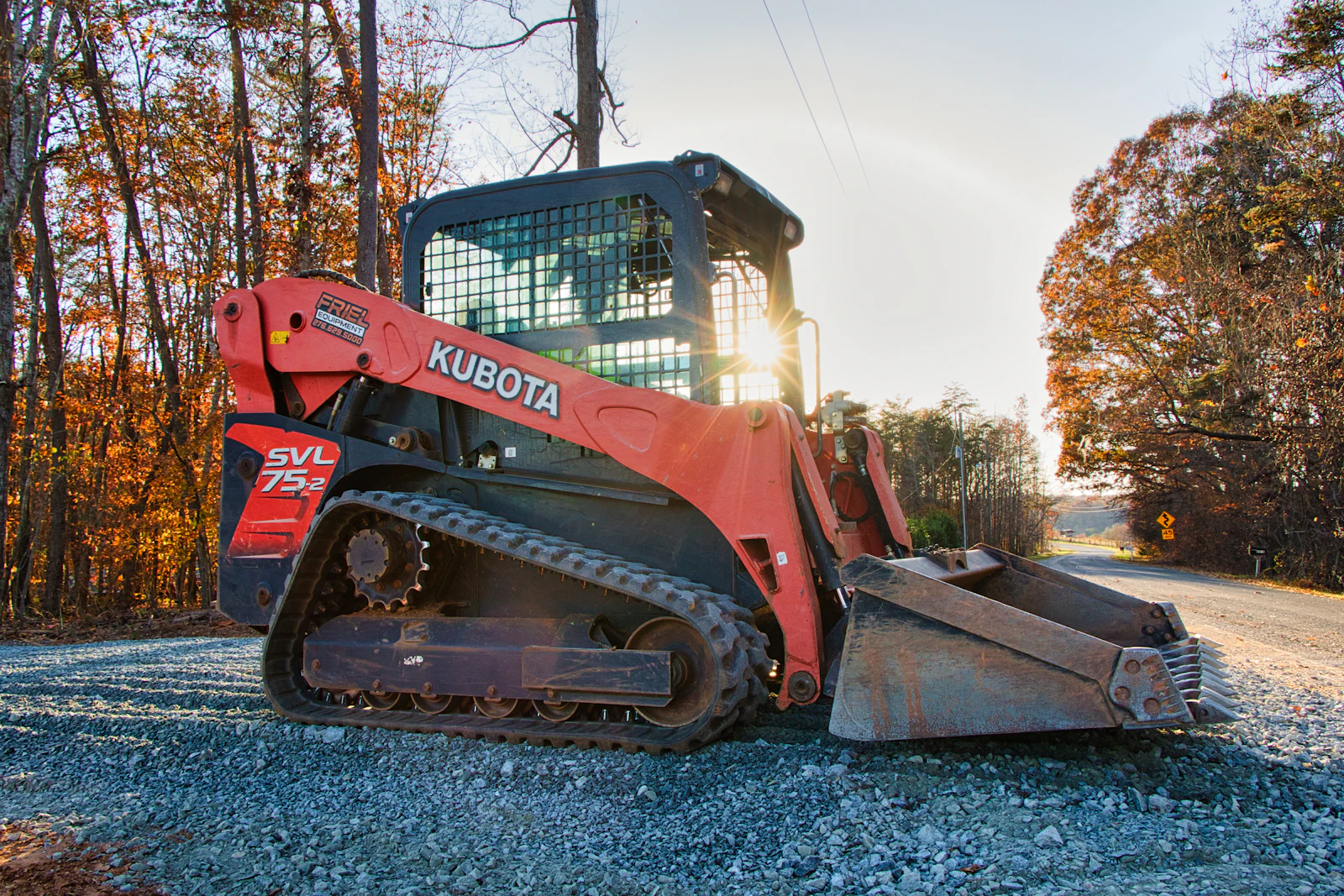
Concrete driveway work is attachment-driven. To keep equipment hire costs predictable, build your rental request around the actual production tools rather than assuming the branch will ‘throw something in.’ In Miami, attachment availability can tighten during storm cleanup and peak construction months, which can push you from day-rate thinking into week-rate commitments.
One-shift hours and overtime math: align superintendent expectations to the rental contract. Major rental terms commonly define base rates around 8 hours/day, 40 hours/week, and 160 hours per 4-week period. If your project is scheduled for extended days, either (1) budget overtime hours using the supplier’s published overtime fractions, or (2) ask for a negotiated multi-shift rate up front so overtime doesn’t hit unexpectedly at closeout.
Off-rent and pickup timing: your rental period typically ends when the equipment is returned and accepted, or when the supplier picks it up and confirms off-rent (policies vary). To avoid paying idle weekend days, schedule pickup for the same day you complete cleanup, and stage the skid steer where a tilt-bed can access it without waiting for gate access or spotters.
Fuel billing selections: for national suppliers that provide multiple fuel options, decide at order time whether you will return full or pay on return. A clear fuel decision prevents arguments about starting level and avoids convenience charges when the crew is rushing to demobilize after a concrete pour window.
Insurance requirements and risk allocation: some suppliers’ terms for commercial customers specify minimum liability requirements (commonly $1,000,000 per occurrence) and may require property coverage on the rented equipment unless you elect a protection plan. From a cost-control standpoint, the “cheapest” rental rate can become expensive if it delays mobilization due to COI issues or if your internal risk team requires endorsements that take days to process.
Payment terms and late fees (accounts): if the rental is billed to a house account, understand late payment provisions and internal approval timing. Some rental terms describe late payment fees such as 2% per month after a stated aging threshold, so slow closeout documentation can create avoidable cost.
If your Miami driveway crew is renting frequently, it’s reasonable to sanity-check ownership economics—but the comparison only works if you price the same things that show up on rental invoices: delivery, attachments, damage exposure, and downtime. As a rough planning frame, a mid-size skid steer/CTL can easily represent $55,000–$95,000 in capital depending on configuration, plus trailer/transport, maintenance, tires/tracks, and hurricane-season storage considerations. If your rental pattern exceeds 10–14 billable days per month for most of the year and you can keep it utilized across crews, ownership may pencil. If your usage is spiky (common in driveway replacement), equipment hire usually stays the safer cost-control approach because you’re buying availability only when the schedule needs it.
Do ‘monthly’ rental rates mean 30 days? Often no. Many rental structures define a month as a 4-week (28-day) period. Treat ‘4-week’ language as the pricing basis during quote review and align it to your schedule.
Can I budget a half-day and expect to pay half a day? Not reliably. Some suppliers publish a 4-hour minimum charge, which can be cost-effective for quick moves but still requires transport, documentation, and return-condition controls.
What is the cleanest way to avoid ‘surprise’ charges? Put three controls in place: (1) photo document meter hours/fuel/damage at delivery and pickup, (2) confirm off-rent cutoff times in writing, and (3) itemize every attachment and option on the PO so nothing gets added after the fact.
