Build your next estimate with CountBricks
Create an itemized estimate for your project, with materials, labor, and quantities you can review and edit.
Create my estimateStart a 7-day free trial. Sign up, then enter your project details.
Skid Steer Loader Hire Costs Milwaukee 2026
For Milwaukee-area concrete driveway work in 2026, skid steer loader equipment hire budgets typically land in these planning bands (machine only, before delivery, waiver, fuel/cleaning, and attachments): $200–$380/day, $600–$995/week, and $1,800–$2,700 per 28-day month for common wheeled units and mid-size compact track loaders; premium configurations (high-flow hydraulics, specialty tires/tracks, or high-demand seasons) can push higher when availability tightens. Local fleet options commonly include national providers (United Rentals, Sunbelt Rentals, Herc Rentals) and Milwaukee-area branches such as Milwaukee Tractor & Equipment and Area Rental & Sales; posted rates vary by model capacity, attachment package, and delivery distance.
| Vendor |
Daily Rate |
Weekly Rate |
Review Score |
Website |
| Area Rental & Sales |
$380 |
$995 |
9 |
Visit |
| Milwaukee Tractor & Equipment |
$275 |
$825 |
8 |
Visit |
| United Rentals |
$395 |
$1 185 |
8 |
Visit |
| Sunbelt Rentals |
$385 |
$1 155 |
7 |
Visit |
| Herc Rentals |
$375 |
$1 125 |
8 |
Visit |
What You Are Really Renting For A Concrete Driveway Scope
Concrete driveway scopes tend to fall into three rental “packages,” and each package changes your total hire cost more than the base day rate:
- Demo + load-out: skid steer plus a concrete breaker/hammer and (often) a concrete claw or grapple to handle broken slab without excessive handwork.
- Subgrade correction + base placement: skid steer plus a grading attachment (power box rake / Harley rake) to hit elevations and improve compaction readiness.
- Material handling: skid steer plus forks for palletized pavers/curb, bulk bag handling, and moving forms/rebar bundles.
On Milwaukee residential and light-commercial driveways, the operational constraints that most often add cost are: tight alley access/turnarounds (delivery vehicle size), winter/freeze-thaw schedule pressure (higher demand before hard freeze), and strict jobsite cleanliness requirements when working near finished siding/garages (additional cleaning time/fees). Build your estimate around “all-in” job costs, not just the posted day rate.
Base Rental Rate Ranges You Can Use For 2026 Milwaukee Budgeting
Use the ranges below as 2026 planning allowances for Milwaukee dispatch, assuming a standard 8-hour shift day and that the supplier bills a 28-day “month” (common in rental contracts). Some suppliers also publish half-day / 4-hour options, which can be cost-effective when you truly have a short on-site window.
- Wheeled skid steer (about 60 HP / ~1,600 lb ROC): plan $200/day, $600/week, $1,800/28-days for basic bucket work and material handling when ground conditions allow tires.
- Wheeled skid steer (about 67 HP / ~2,000 lb ROC): plan $250/day, $750/week, $2,250/28-days as a common “sweet spot” for driveway base work and light demo support.
- Wheeled skid steer (about 74 HP / ~2,800 lb ROC): plan $275/day, $825/week, $2,475/28-days when you need extra breakout force, larger bucket, or higher lift.
- Wheeled skid steer (about 90 HP / ~3,400 lb ROC): plan $300/day, $900/week, $2,700/28-days for heavier driveway demo support and faster cycle times (especially with larger trucks and stockpiles).
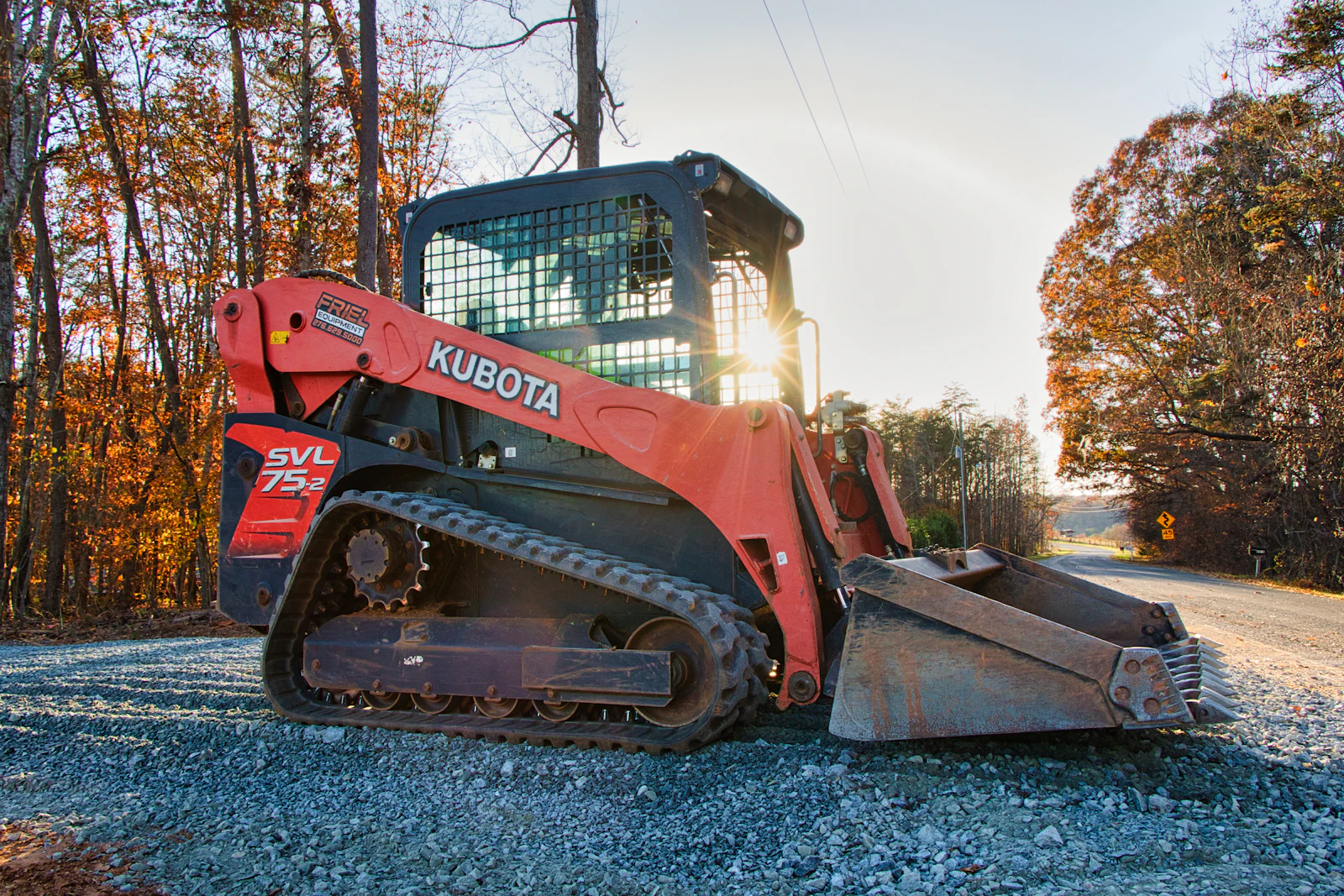
- Compact track loader (about 74 HP / ~2,700–3,700 lb ROC): plan $275–$300/day, $825–$900/week, $2,475–$2,700/28-days when you need better flotation on soft subgrade or want less rutting during wet periods.
- Compact track loader (about 90 HP / ~4,500 lb ROC): plan $325/day, $975/week, $2,925/28-days for higher production and heavier attachments (note: availability can be the limiting factor).
- Short-window rental option (4-hour/half-day): some Milwaukee-area yards publish $380 for 4 hours and $380/day on certain ~2,000 lb ROC units—useful when you can schedule trucks, labor, and disposal with a tight on-site plan.
Assumption to state on bids: “Rates based on single-shift usage; excess meter hours billed per contract.” This matters on driveway pours where you may choose to run early/late to keep trucks moving.
Attachments That Typically Make Or Break Concrete Driveway Productivity
For concrete driveway scopes, the attachment line items can exceed the delta between a small and a mid-size loader. If you need to fracture slab, separate embedded mesh, or handle broken chunks safely, budget attachments explicitly (and confirm coupler type, auxiliary flow, and tool weight compatibility).
- Hydraulic breaker / concrete breaker: budget $200/day, $600/week, $1,800/28-days as a common posted add-on in the Milwaukee market.
- Concrete claw: budget $125/day, $375/week, $1,025/28-days to handle slab chunks and reduce hand sorting.
- Skeleton / rock bucket: budget $125/day, $375/week, $1,025/28-days when you need to screen and keep base material while removing debris.
- Power box rake: budget $200/day, $600/week, $1,800/28-days to shape subgrade/base quickly and reduce hand-raking labor.
- Pallet forks: budget $50/day, $150/week, $450/28-days for moving forms, rebar bundles, bagged cement, or paver pallets.
- Extra bucket: budget $50/day, $150/week, $450/28-days when you need a clean bucket for base after using the primary bucket in demo/debris.
Cross-check alternate published attachment schedules when negotiating multi-week packages. For example, some regional rate sheets show forks at $40/day, grapple at $175/day, and a Harley rake at $350/day, which can be useful as “should-cost” benchmarks when comparing quotes.
Hidden-Fee Breakdown
Most “rate shock” events on skid steer hire come from charges that are legitimate but not carried in the estimator’s first-pass budget. In Milwaukee, these are the most common items to carry as allowances (adjust to your supplier’s contract language):
- Delivery / pick-up (mobilization): carry $150–$300 each way within a typical 15–25 mile radius; outside that radius, carry mileage at $5–$8 per loaded mile or a higher flat mobilization. (Downtown/limited-access deliveries may add waiting time.)
- Minimum haul or trip charge: carry a minimum of $125 even if the unit is swapped with another delivery.
- Fuel surcharge on transportation: carry 5%–12% of transportation depending on published diesel indices and supplier program.
- Damage waiver (optional but common): carry 10%–15% of the base rental rate (machine + attachments) unless your contract requires proof of coverage in lieu.
- Cleaning fee (return condition): carry $125–$250 if the unit returns with concrete slurry, mud packed into undercarriage/axles, or excessive debris in the cab.
- Track/tire abuse charge: carry $250–$600 exposure for track cuts from rebar/mesh or tire sidewall damage from broken slab edges (often assessed after inspection).
- After-hours service or swap: carry $95–$175 if you request emergency dispatch outside normal yard hours.
- Late return / extra day: carry $75–$150 per hour for operator “standby” impacts if your yard charges waiting time on recovery, and assume that missing the off-rent cutoff can trigger an additional day on the invoice (confirm cutoff time, often mid-afternoon).
Delivery Windows, Off-Rent Rules, And Milwaukee-Specific Cost Drivers
Milwaukee jobs frequently turn on logistics details that do not show up in the rental rate:
- Delivery access: alleys and narrow drive approaches can force smaller rollback/tow vehicles or require curb/parking coordination. If you anticipate a tight window, specify a delivery appointment and carry $50–$125 for “jobsite not ready / redelivery” exposure.
- Weather sequencing: in shoulder seasons, rain and freeze-thaw can force you onto tracks (higher base rate) and can increase cleaning and undercarriage inspection time on return.
- Concrete dust control: if you are pairing the loader with cutting/grinding subcontractors, plan for additional daily cleaning and filter checks; some fleets will bill cleaning when concrete dust is embedded in cab vents and radiators.
Also confirm whether your supplier requires a phone call or email to put equipment “off rent.” Many contracts treat the off-rent timestamp as the point that matters—not when the truck physically arrives—so document it in your closeout notes.
Metered Use Limits, Shift Definitions, And Why It Matters
Skid steers are commonly billed on a single-shift basis. A standard reference used in the industry is 8 hours/day, 40 hours/week, and 160 hours per 4-week period, with overages subject to additional charges. When your driveway scope includes long truck queues (live loading) or time-critical base shaping ahead of a concrete crew, you may exceed the “included” hours even if you only keep the unit for a short calendar duration.
Example: Two-Day Concrete Driveway Removal And Base Prep (Milwaukee Area)
Example: 1,000 sq ft driveway replacement with slab demo (4"), load-out to trucks, and 6" base correction. Constraints: tight residential street parking, one-way alley for access, and an off-rent cutoff that requires you to call by 3:00 pm to avoid a third day charge (confirm with your supplier).
- Skid steer (74–90 HP class): carry $275–$300/day x 2 days = $550–$600.
- Concrete breaker attachment: $200/day x 2 = $400.
- Concrete claw: $125/day x 2 = $250.
- Delivery + pick-up: allowance $225 each way = $450.
- Damage waiver: assume 12% of rental charges (machine + attachments) = roughly $144–$156 on the above.
- Cleaning exposure: allowance $175 (concrete dust + slurry).
Planning total (equipment hire only, excluding trucks/disposing concrete): approximately $1,969–$2,031 for a two-day package under these assumptions. The main swing factors are delivery constraints (redelivery/wait time) and whether you return the breaker clean and greased per supplier requirements.
Budget Worksheet
Use this as a quick estimator’s set of line items (edit the allowances to match your negotiated account terms):
- Skid steer loader rental (2–5 days) @ $200–$380/day (select wheeled vs track based on subgrade and access).
- Concrete breaker attachment @ $200/day (or weekly if >3 days).
- Concrete claw or grapple @ $125/day.
- Forks @ $50/day (forms/rebar/pallets).
- Power box rake @ $200/day (base shaping allowance).
- Mobilization (delivery + pick-up) allowance: $300–$600 (distance/access dependent).
- Fuel/transport surcharge allowance: 5%–12% of transport.
- Damage waiver allowance: 10%–15% of rental subtotal.
- Cleaning allowance: $125–$250.
- Redelivery / wait-time contingency: $50–$125.
- Track/tire damage contingency (demo work): $250–$600.
Rental Order Checklist
- PO number and cost code (separate codes for machine vs attachments if you track internally).
- Delivery address, site contact, and a 2-hour delivery window; note any alley approach, gate width, and overhead clearance.
- Confirm machine type (wheeled vs CTL), rated operating capacity, and whether an enclosed cab is required for dust/cold weather.
- List attachments explicitly (breaker, claw, forks, bucket type) and verify coupler style + auxiliary hydraulics requirements.
- Confirm included shift hours and meter overage billing (e.g., 8-hour day standard).
- Confirm off-rent process (who calls it off rent, how it is timestamped, and any cutoff time).
- Document delivery condition with photos (bucket cutting edge, tires/tracks, cab glass, quick coupler, hoses).
- Return condition plan: refuel expectations, grease points (especially breaker), and washout/cleaning requirements.
How Driveway Scope And Sequence Change The Equipment Hire Duration
For concrete driveway packages, rental duration is usually driven by sequencing more than production rate. If trucks are not staged, disposal is delayed, or base material delivery is missed, the skid steer sits on rent while the meter hours may stay low—but you still pay calendar time. A few practical planning rules for Milwaukee scheduling:
- Demo day vs. base day split: If you can’t guarantee continuous trucking during demo, consider splitting the rental into a short breaker-focused window (often a 4-hour/1-day charge) and a separate base-prep window later in the week.
- Weather float: Carry at least 1 additional day of float in spring/fall for rain-softened subgrade that forces track use and slower cleanup.
- Inspection closeout time: Plan 30–60 minutes at the end of the last shift for cleaning, greasing (breaker), and photo documentation so you can confidently dispute damage claims.
Milwaukee Considerations That Impact Skid Steer Hire Costs
Local conditions are not just operational—they change cost:
- Freeze-thaw and saturated subgrade: If you’re working near Lake Michigan influence zones or in early spring thaw, a compact track loader may reduce rutting and restoration costs, but it may also increase your daily rate versus tires (carry the CTL range of $275–$325/day for common sizes).
- Downtown access and parking restrictions: A “normal” delivery can turn into a timed appointment with limited staging. Carry $75–$150 for delivery wait-time exposure if you have to coordinate loading zones or a flagger.
- Dust-control expectations near finished structures: If the job is adjacent to occupied space (garage/shop), plan for a cabbed unit and higher cleanup standards. A cleaning allowance of $125–$250 is cheaper than a disputed return inspection.
Controlling Hire Cost Without Under-Specifying The Machine
- Specify the task, not just “skid steer”: If you need a breaker, ask for a machine approved for that breaker class and confirm auxiliary flow. Avoid a last-minute upsize that can add $25–$75/day plus a second mobilization.
- Negotiate weekly conversion: If you may run into weather delays, ask your supplier to apply day charges toward a weekly cap (common practice, but confirm in writing).
- Right-size attachments: A claw at $125/day can reduce labor and loading time enough to eliminate a whole extra day of machine time—often the best ROI on driveway demo.
- Control transport costs: When possible, coordinate delivery/pickup with other rentals on the same site to avoid duplicate $150–$300 mobilizations.
Insurance, Damage Waiver, And Documentation Practices That Protect Your Budget
For rental coordinators, the goal is to avoid unplanned charges after the unit returns:
- Damage waiver vs. certificate of insurance: If you carry your own coverage, confirm whether the supplier still requires an administrative waiver percentage. If you take the waiver, carry 10%–15% of the rental subtotal as a standard budget line.
- Meter hour discipline: Use the single-shift benchmark (8 hours/day, 40 hours/week, 160 hours/4 weeks) to plan staffing so you don’t pay both overtime labor and rental overage.
- Return-condition photo set: Take 10–15 photos minimum (all four sides, tires/tracks, bucket edge, coupler, cab interior, hour meter) and store them with the off-rent email/call log.
More Allowances To Consider For A Concrete Driveway Package
- Grease/consumables for breaker use: carry $15–$30/day for grease and tool-point inspection time.
- Hydraulic hose damage exposure: carry $150–$350 if working around sharp concrete/rebar; document hose condition at delivery.
- Weekend billing policy: some yards offer a “special weekend rate,” but terms differ—carry a conservative assumption of 1.5–2.0 day billing if you keep it from Friday PM to Monday AM unless your agreement states otherwise.
- Standby/idle time: if your crew is waiting for trucks or disposal, you’re effectively paying calendar rent. Treat each lost half-day as $100–$200 of avoidable cost on common Milwaukee day rates.
2026 Planning Notes For Milwaukee Equipment Hire Requests
When you issue a 2026 skid steer loader hire request for a concrete driveway in Milwaukee, include these notes to reduce re-quotes and change orders:
- State whether you prefer wheeled or compact track and why (surface protection, subgrade softness, restoration limits).
- List required attachments with day/week/month needs (e.g., breaker $200/day, claw $125/day, forks $50/day, box rake $200/day).
- Ask supplier to confirm transport charges and any fuel surcharge mechanism tied to diesel pricing.
- Confirm off-rent cutoff and process (who must call; how it is timestamped) to avoid an inadvertent extra day.
- Carry contingencies explicitly: $300–$600 mobilization, $125–$250 cleaning, $250–$600 track/tire exposure, and 10%–15% waiver/insurance line.
If you want the tightest budget, the most effective lever is usually not squeezing the base day rate—it is eliminating dead time (truck staging, disposal readiness, and verified off-rent) and selecting the correct attachment package on day one.