

For New York City concrete driveway scopes in 2026, plan skid steer loader equipment hire budgets in three layers: the base machine rate, the access/transport layer (delivery, street constraints, time windows), and the “production package” (attachments, high-flow, tires, waivers, and cleaning). As a practical 2026 planning range for a wheeled skid steer in NYC, most rental coordinators should carry $275–$475 per day, $1,050–$1,700 per week, and $3,100–$4,800 per 4-week period depending on rated operating capacity, cab vs ROPS, and whether high-flow hydraulics is required for driveway demolition attachments. Published NYC-metro pricing examples include a $300/day and $1,200/week wheeled skid steer listing (with an 8-hour runtime inclusion), while New York statewide contract pricing shows smaller-to-larger skid steer categories commonly falling between the low-$200s/day and low-$400s/day (before NYC access costs and add-ons).
| Vendor | Daily Rate | Weekly Rate | Review Score | Website |
|---|---|---|---|---|
| United Rentals | $302 | $971 | 9 | Visit |
| Sunbelt Rentals | $225 | $660 | 8 | Visit |
| Herc Rentals | $320 | $741 | 9 | Visit |
| Taylor Rental Center (NYC Metro) | $300 | $1 200 | 8 | Visit |
Concrete driveway scopes tend to push skid steer hire costs up because the work is attachment-driven and wear-driven. A basic bucket-and-forks setup for moving spoils and base stone is often the lowest total-cost configuration. However, when the scope includes demolition (breaking and loading), expect adders for a hydraulic breaker, a grapple bucket, a 4-in-1 bucket, or a grading blade. Also expect stronger enforcement of return condition (concrete buildup, slurry, and rebar fragments), which can convert a “cheap day rate” into a higher effective cost once cleaning and damage exposure are accounted for.
NYC-specific cost pressure points are usually logistics rather than the skid steer itself: short delivery windows, limited curb space, and off-rent rules that continue billing until the machine is physically picked up. In Manhattan and parts of Brooklyn/Queens, plan extra coordination time and potential after-hours delivery premiums if your site can’t accept a rollback during standard windows.
Most professional equipment rental agreements price the machine by calendar time (24-hour day, 7-day week, and a “4-week” billing period), but they cap metered utilization as well. For example, industry-standard terms commonly treat the base rate as one shift: 8 hours/day, 40 hours/week, and 160 hours per 4 weeks. If you exceed those thresholds, overtime is typically billed using a fraction of the base rate (for instance, 1/8 of the daily rate per extra hour).
A NYC-metro posted rate example for a wheeled skid steer explicitly states 8 hours of running time included per 24-hour rental period and that the customer is responsible for fuel—two details that materially change the real equipment hire cost on high-production driveway scopes.
When you’re scoping a concrete driveway package, the most useful way to budget is by rated operating capacity and configuration, because that drives both the base rental and whether you can safely run the attachment you need.
NYC estimator note: those published price points are useful anchors, but NYC driveway deployments typically require higher allowances for delivery constraints, tighter scheduling, and add-ons. For 2026 bids, many contractors carry a 10%–25% NYC uplift above a “clean” base rate if the site is inside the five boroughs, has curb-lane constraints, or requires specific delivery windows.
Concrete driveway projects usually become attachment-led. If you do not budget attachments explicitly, your “skid steer hire” line will be understated.
For driveway removal specifically, the breaker choice (and whether you need high-flow) is often the biggest single adder. If you can sequence the work to keep the breaker on rent for only 1–2 days (and switch back to bucket/forks for base and stone handling), you can materially reduce the blended weekly cost.
In NYC, delivery and pick-up can equal (or exceed) one day of base rent if you’re not careful about timing. Two published pricing structures illustrate how this typically shows up:
NYC operational constraints that change total hire cost: (1) delivery cutoffs (commonly 1–3 PM to schedule next-day pickup), (2) limited curb frontage requiring a hard appointment window, and (3) “off-rent” that stops only when the machine is collected, not when you finish using it. Build the access plan first, then place the rental order.
Use this section as a pre-award checklist to prevent avoidable “post-ticket” charges on skid steer loader equipment hire in New York.
Scenario: Queens driveway demo and base prep over 3 working days, with one day dedicated to breaking/removal and two days for loading spoils, spreading base stone, and backfill grading. Site constraints: delivery must occur between 7:00–9:00 AM, pickup must be scheduled with a firm appointment window, and the contractor can only stage the skid steer on-site (no overnight street staging).
Planning cost build (illustrative): Day-rate skid steer budgeted at $350/day x 3 days = $1,050. Breaker (500 lb class) budgeted for $200/day x 1 day = $200. Forks budgeted for $50/day x 3 days = $150. Delivery/pickup allowance carried at $250 each way = $500 (or mileage-based equivalent depending on supplier). Add a contingency line of $150 for cleaning risk given concrete work and tight return timing. The practical takeaway: even when the base machine is “only” a few hundred dollars per day, the real equipment hire cost is driven by attachments and logistics.
Use these line items (no tables) as a bid-time worksheet for skid steer loader equipment hire costs in New York concrete driveway work:
Rental coordinators can avoid most disputes and back-charges by locking these items down on the PO and at delivery.
For NYC driveway work, the rental decision is rarely just “what is the daily rate?” The financially correct question is “what is my maximum exposure if the skid steer or attachment is damaged or stolen, and what surcharges apply to my billing structure?” Published rental program terms commonly identify charge categories that show up on final invoices, including environmental/emissions surcharges, preventative maintenance charges, and transportation surcharges tied to deliveries and pickups.
Actionable budgeting approach for 2026: carry a waiver/coverage allowance of 10%–18% of the base rent unless your corporate policy mandates a different structure, and carry a “surcharges and compliance” allowance of 3%–8% for vendors that apply EES/PM or similar charge families. If you are using delivery services, explicitly carry the transportation surcharge logic shown in published terms (example: fixed 9% with a $9 minimum, plus a variable component).
NYC schedules often push driveway work across weekends due to DOT windows, concrete placement timing, or neighbor/noise constraints. That creates two pricing risks:
Also confirm whether “monthly” means a 4-week billing period or a calendar month. Many national rental agreements and rate structures reference a 4-week/160-hour baseline rather than a true calendar month, which affects how you compare vendor quotes.
In New York, driveway packages frequently require tight staging: the skid steer can’t always sit on the street overnight, and the job may not have laydown space for a rollback plus attachments. These constraints typically increase the number of moves (and therefore the transportation cost exposure) more than they increase the base machine rate.
When you evaluate quotes, separate the cost drivers you can control from those you can’t:
Published structures show two common ways transportation is priced—flat per item within a radius (example: $250 each way within 30 miles) or a combination of load/unload plus per-mile (example: $125 load/unload plus $2.50/mile). Use the structure that matches your supplier, then build a conservative allowance for borough logistics.
To control total skid steer loader equipment hire cost, treat attachments as short-duration production tools:
Concrete driveway work has a predictable failure mode: the machine comes back with hardened concrete on the bucket, forks, steps, and undercarriage. If your supplier applies cleaning charges for excessive concrete/paint/dirt, that can erase the benefit of negotiating the base day rate. Published terms explicitly put cleaning responsibility on the customer when equipment is returned with excessive concrete buildup.
Practical controls: (1) require end-of-shift scrape-down while material is still green, (2) take return photos of the bucket cutting edge and quick-attach plate, and (3) record meter hours at off-rent call-in and at pickup. This is especially important in NYC because billing disputes often hinge on whether the machine was actually ready for pickup within the agreed window.
NYC-metro posted pricing provides a good “street check” for 2026: one example shows $300/day and $1,200/week for a wheeled skid steer in the NYC metro area, with fuel responsibility on the customer and an explicit runtime inclusion. Another published 2026 price list elsewhere shows a mid-size skid steer at $440 full day, $1,760/week, and $4,070/month, along with a $75 cleaning deposit and a delivery/pick-up rate listed at $75/hr—useful as an upper-bound planning comparator when NYC availability tightens.
For competitive NYC driveway bids in 2026, the “win” is usually achieved by managing the cost layers you control: minimizing moves, compressing attachment days, and avoiding overtime/overutilization charges that trigger fractional hourly billing beyond included shift hours.
Do I need a cab unit for a driveway job? Not always. Cab units can increase the base rate, but in NYC they often reduce downtime in winter weather and improve operator comfort when running a breaker. Budget both options and choose based on schedule risk.
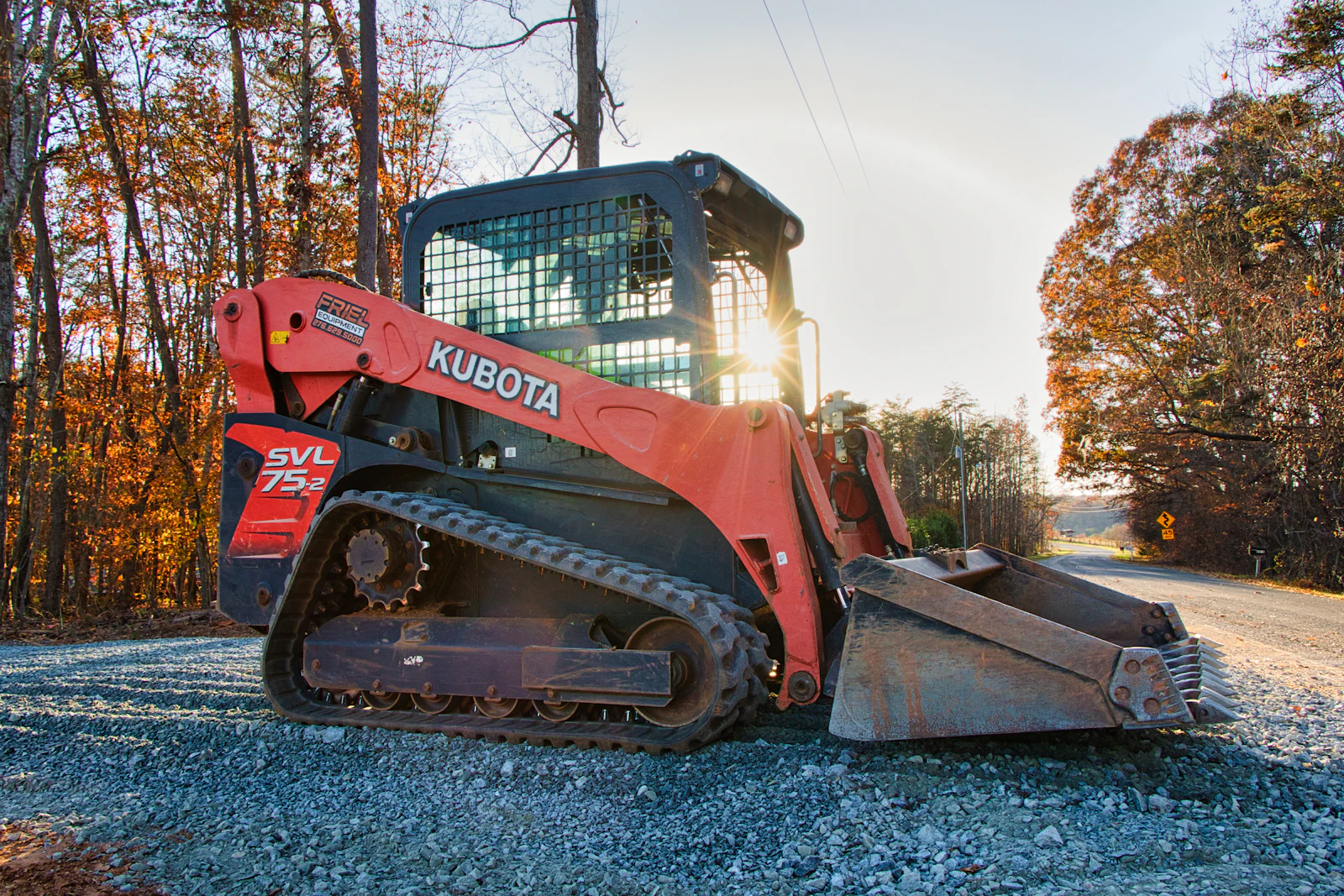
Should I rent a compact track loader instead of a wheeled skid steer? If the subgrade is soft or you’re working in shoulder seasons with saturated soils, a track loader can reduce rutting and rework. However, it is typically higher base rent than a wheeled skid steer, and delivery/weight constraints may be more complex. If you can stabilize access with mats and keep the work dry, wheeled skid steer hire is often the lower total equipment hire cost for driveway scopes.
What is the fastest way to blow the budget? Two things: (1) calling off-rent but missing the pickup window (billing continues), and (2) returning the unit with concrete buildup that triggers cleaning and damage assessment. Align off-rent timing with your supplier’s cutoff and enforce return-condition discipline.
