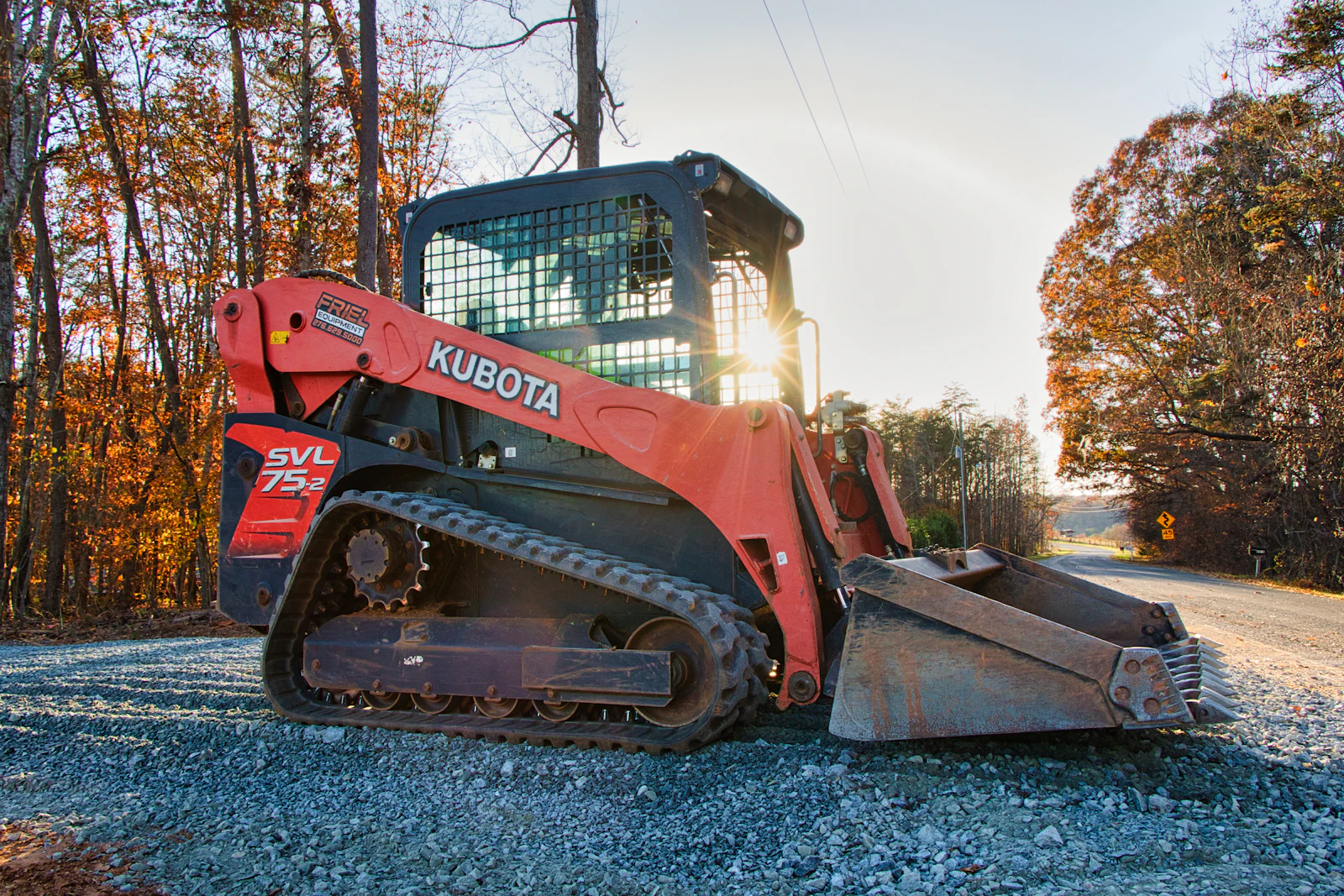
Skid Steer Loader Hire Costs Omaha 2026
For Omaha-area footing excavation, skid steer loader equipment hire typically budgets in the $190–$310/day, $700–$1,050/week, and $1,600–$2,600 per 28-day “month” range for a wheeled skid steer with standard bucket, with compact track loaders (CTLs) commonly running higher due to undercarriage costs and demand. Local published rate cards in the Omaha market show wheel skid steers as low as $185/day and up to about $280/day, with weekly and 28-day rates stepping down materially versus daily. In practice, rental coordinators sourcing from Bobcat dealers plus national fleets (United Rentals, Sunbelt, Herc) will see final pricing swing most on shift-hours, delivery routing, attachments (trencher/auger), and “time out to time returned” rules that can bill weekends if you miss cutoff windows.
| Vendor |
Daily Rate |
Weekly Rate |
Review Score |
Website |
| Bobcat of Omaha |
$260 |
$845 |
10 |
Visit |
| Rental City Tool & Equipment |
$325 |
$975 |
9 |
Visit |
| United Rentals (Omaha, NE) |
$335 |
$1 050 |
10 |
Visit |
| Sunbelt Rentals (Omaha, NE) |
$330 |
$1 040 |
8 |
Visit |
| NMC The Cat Rental Store (Omaha, NE) |
$310 |
$995 |
8 |
Visit |
Omaha benchmark rates (published local card, excluding tax/fees/delivery): Bobcat of Omaha lists (with bucket) skid steers ranging from $185/day, $650/week, $1,450/28-days (S70) up to $280/day, $900/week, $2,300/28-days (S770). For footing packages where traction and flotation matter in spring mud, their compact track loaders run roughly $270/day, $930/week, $2,500/28-days (T450) up to $410/day, $1,410/week, $3,860/28-days (T86/T870).
2026 planning assumption used in this guide: take published Omaha rates as the “base,” then carry a +5% to +15% seasonal/availability factor for peak grading season, short-notice dispatch, and higher-horsepower machines. (This is a budgeting range, not a promise of vendor pricing.)
How Footing Excavation Scope Changes Skid Steer Hire Cost
“Digging footings” is rarely just machine time. In Omaha, the code-driven frost line depth is commonly treated as 42 inches minimum to bottom of footing, which pushes deeper cuts, more spoils handling, and longer run-time than shallow slabs-on-grade. (g If you are excavating trench/strip footings, you can run a skid steer as the primary spoils handler and backfill machine, but production hinges on access, turning radius, and whether you can stockpile onsite or must load out continuously. A rental estimate should explicitly capture: (1) trench length and spoil volume, (2) soil moisture (spring clay vs. dry), (3) undercarriage choice (wheels vs. tracks), and (4) whether attachments (trencher/auger) substitute for mini-excavator time.
Typical footing-excavation hire pattern in Omaha metro: many crews run the skid steer on a weekly rate through excavation + forming days, then off-rent before concrete placement to avoid paying for idle days. That strategy only works if your “off-rent” call, pickup scheduling, and yard-return cutoff times prevent weekend billing. Bobcat’s posted terms emphasize a one-day minimum and that rental charges are calculated from time out to time returned (not “days used”).
Model Class Selection For Digging Footings (What You Pay For)
For equipment hire cost control, treat “skid steer” as a class with multiple price tiers:
- Small frame (e.g., S70 / S450 class): lower daily rate, easier transport, but slower spoils handling and more cycles. Published Omaha examples include $185/day and $200/day tiers.
- Mid-size (e.g., S650/S66/S76 class): often the best cost-per-yard moved for footings; published example $260/day, $845/week, $2,200/28-days.
- Large frame (e.g., S740/S770 class): higher rate but better breakout force and cycle time; published $275–$280/day range.
Wheels vs. tracks: In Omaha’s spring conditions (thaw + rain), CTLs reduce “stuck time” and rut remediation, but undercarriage wear is priced in. When you budget a CTL for footing excavation, compare the CTL weekly rate (often $930–$1,410/week on the published local card) versus the cost of rework and stone stabilization if a wheeled machine tears up access.
Attachments And Add-Ons That Drive Rental Spend
Footing work frequently needs more than a standard bucket. Omaha-area published attachment rates provide a solid “adder library” for estimators:
- Trencher (4 ft deep, 6 in wide): $155/day, $600/week, $1,650/28-days—useful for narrow strip footings, utility runs into the footing trench, or drain tile segments.
- Auger power head with bit: $120/day, $350/week, $1,050/28-days—common for pier footings, deck piers, sign bases, and sonotube-style packages.
- Auger bits (6, 9, 12, 18 in): $30/day, $90/week, $270/28-days; larger 24–36 in bits: $40/day, $100/week, $300/28-days.
- Auger extensions (2 ft or 4 ft): $20/day, $50/week, $150/28-days—often required once you account for frost depth targets and grade transitions.
- Pallet forks: $40/day, $160/week, $400/28-days—material handling for forms, rebar bundles, and palletized block.
- Trailer option (if self-haul is allowed): a “skid loader trailer” is published at $160/day, $640/week, $1,920/28-days.
Estimator note: An attachment may look “cheap” relative to the machine, but it can force extra delivery legs or separate pickup scheduling if it’s sourced from another yard. Add a contingency line for split deliveries when the machine and attachment are not co-located (common in tight inventory weeks).
Shift Hours, Metering, And Overtime: Where Costs Jump Quietly
Most major rental contracts treat the posted daily/weekly/4-week price as a one-shift allowance. One common standard is 8 hours/day, 40 hours/week, 160 hours per 4 weeks. If you run longer (pour-day prep, weather recovery, or two crews), overtime is often billed as a fraction of the base rate. For example, Herc describes excess-shift use as payable at 1/8 of the daily charge, 1/40 of the weekly charge, or 1/160 of the 4-week charge (plus taxes).
Why this matters for digging footings in Omaha: frost-depth excavation plus spoils staging can create long days right before inspection or concrete. If you budget only “7 days = weekly rate,” but the crew actually runs 55–65 hours to recover rainouts, your invoice can include overtime hours even without extending calendar days. Capture expected meter hours as a separate estimating variable, not an assumption.
Omaha-Specific Logistics That Move The Invoice
Equipment hire cost in Omaha is heavily influenced by dispatch realities and jurisdiction boundaries:
- Metro geography: deliveries to outlying west Omaha/Elkhorn or south metro (Papillion/La Vista) often look “local,” but routing plus traffic windows can push a “standard” delivery into a higher bracket if the truck can’t double up stops. Budget a realistic delivery radius and a “missed window” allowance.
- Cross-river jobs: if the site is in Council Bluffs, Iowa, you may face different tax treatment and delivery routing constraints than Omaha proper; flag the job’s exact address early (do not assume “Omaha metro = same invoice”).
- Soil + season: Omaha clay plus spring moisture increases the probability you’ll need a CTL instead of wheels, or you’ll pay for stone/cleanup and longer meter hours. Plan for weather-driven productivity loss rather than assuming steady cycle times.
Hidden-Fee Breakdown
These items are where skid steer loader equipment hire costs commonly drift above the “rate card”:
- Delivery / pickup: plan $175–$325 each way within a typical metro radius, plus possible $4–$8 per loaded mile outside the standard zone. If a driver is detained at site, many fleets bill waiting time (budget $95–$140/hour after an initial grace period).
- Transportation surcharge (some national contracts): Herc documents a transportation surcharge framework that includes a fixed component currently 9% (minimum $9) and can vary with diesel indices; their example shows 16% total in one scenario. (Not every vendor uses the same structure—treat this as a contract-check item.)
- Damage waiver / rental protection: one published Omaha term indicates that if you do not provide liability insurance, a 15% Rental Protection Plan fee may be applied to total equipment rental charges.
- Cleaning fees: published terms warn that cleaning fees apply for excessive concrete/asphalt contamination. For budgeting, carry $150–$600 depending on material and how quickly it’s addressed.
- Fuel / refuel: published terms state you’ll be charged per gallon if returned not full. Budget $4–$7/gal equivalent and confirm whether the vendor delivers “full” and expects “full on return.”
- Preventative maintenance adders (select categories): Herc describes a PM charge of $1–$6 per hour on certain equipment categories, billed and later trued-up to actual hours. (This is not universal across vendors, but it is a real contract mechanism you should screen for.)
- Late return / missed off-rent: budget 1 extra day if pickup is requested after cutoff or the machine is blocked in by rebar, spoil piles, or form trucks. Because some contracts bill “time out to time returned,” even a “one-day slip” can become a weekend charge.
Tax Treatment To Include In Omaha Budgets
In Omaha, rental invoices commonly include sales tax (unless your exemption applies). Nebraska’s state sales and use tax rate is 5.5%. Local tax drives the combined rate higher; published Nebraska Department of Revenue local rate tables show Omaha at 7.0% in at least one widely used rate sheet. Always confirm the jobsite jurisdiction (and whether delivery is taxable) with your accounting policy and the vendor’s invoice structure.
Budget Worksheet (Skid Steer Hire For Digging Footings)
- Skid steer base hire: 1 week at $700–$1,050 (or published model rate if specified) plus contingency of 2 extra days at $190–$310/day.
- Attachment adder (choose as needed): trencher $600/week; auger head $350/week; auger bit $90/week; extension $50/week.
- Delivery + pickup: $350–$650 total (metro) plus potential mileage outside standard radius.
- Rental protection / damage waiver: 10%–17% of rental charges (use 15% where contract requires).
- Overtime allowance: 8 included hours/day; budget overtime if planned hours exceed 40/week.
- Fuel / refuel: allowance $80–$250 depending on run time and whether returned full.
- Cleaning allowance: $150–$600 (mud, clay packing, concrete splatter).
- Track-out / dust control (if applicable): $100–$400 for mats/sweeping consumables when working near finished pavements or sensitive facilities.
- Sales tax: apply jurisdiction rate (often around 7% in Omaha) to taxable lines.
Rental Order Checklist (What Prevents Cost Creep)
- PO details: job name, site address (exact jurisdiction), requested rate (daily/weekly/28-day), and “one-shift” hour allowance (8/40/160).
- Delivery requirements: contact name/number, gate code, delivery window, and “truck access confirmed” (turning radius + overhead clearance).
- Insurance / protection: COI for full equipment value if required, or confirm the rental protection plan percentage (e.g., 15%) and exclusions.
- Attachments and coupler type: confirm bucket size, tooth configuration, and whether the attachment needs separate transport.
- Off-rent procedure: document off-rent call time and pickup cutoff; confirm whether weekends/holidays bill if not returned.
- Return condition documentation: photos of hours/meter, fuel level, and condition at pickup; note existing dents/cracks at delivery to prevent back-charges.
If you want this page tuned to a specific footing scope (linear feet of trench, spoil export, or pier count), provide the planned depth/width and whether the site is in Omaha city limits or a surrounding municipality.
Worked Cost Example With Real Jobsite Constraints (Omaha Footings)
Example: A small commercial addition in west Omaha needs trench/strip footings to frost depth. The crew rents a mid-size wheel skid steer (published class example: S650/S66/S76 at $260/day, $845/week, $2,200/28-days) with pallet forks and an auger package for a few pier points. Constraints: (1) excavation must reach the locally referenced 42-inch frost line, (2) the site has limited staging so spoils must be stockpiled tight, (3) work runs long to hit an inspection window, and (4) pickup must occur before the vendor’s cutoff to avoid weekend “time out” billing. (g
- Machine hire: 1 week at $845 plus 2 extra days at $260/day = $1,365 equipment rent.
- Attachment hire: pallet forks $160/week; auger power head with bit $350/week; 12-inch bit $90/week; 2' or 4' extension $50/week (needed to comfortably reach depth with grade).
- Protection plan (if required by your contract position): carry 15% of equipment rental charges as a planning allowance where you cannot furnish the required insurance.
- Delivery + pickup: budget $225 each way for metro routing (adjust if outside normal radius or if you need a dedicated time window).
- Overtime risk: if you exceed a one-shift assumption (8 hours/day, 40/week), some contracts bill overage. Carry an overtime allowance equal to 10%–25% of weekly rent when schedule risk is high.
- Fuel and refuel: plan $120 fuel allowance (and avoid refuel service by returning full; vendors may charge per gallon if not full).
- Cleaning allowance: plan $250 if clay packs the frame/tires and you do not pressure-wash before return (cleaning charges can apply for excessive dirt/concrete).
Resulting budget take-away: even when the “headline” rate looks like $845/week, a footing-excavation package with attachments, logistics, and risk allowances commonly lands in a $2,400–$3,400 all-in planning band before tax, depending on delivery, overtime, and protection plan position. Apply Omaha-area sales tax where applicable (often shown around 7.0% in local rate tables) and confirm taxability of delivery lines with your vendor and accounting rules.
Contract Terms To Confirm Before You Dispatch
Most cost overruns on skid steer loader equipment hire come from terms that were present in the agreement but not carried into the estimate:
- Time basis: confirm whether billing is “calendar day,” “24-hour day,” or “time out to time returned.” Published Omaha terms state rental charges are calculated from time out to time returned and that there are no hourly rates with a one-day minimum.
- Shift-hour allowance: document included hours and overtime method (some vendors use the 1/8, 1/40, 1/160 approach for overage calculations).
- Transportation adders: some fleets apply a transportation surcharge (Herc documents a fixed component currently 9% (minimum $9) plus a variable component tied to diesel indices). Even if your chosen vendor doesn’t, you should treat “delivery pricing model” as a bid-day checklist item.
- Insurance / protection: verify COI requirements and any stated protection plan percentage (e.g., 15% on total equipment rental charge in one published Omaha term set).
- Return condition: confirm responsibility for tire repair, cleaning, and damage; document pre-existing issues at delivery with photos to prevent back-charges.
Operational Controls Rental Coordinators Use In Omaha
- Schedule around cutoff windows: for footing jobs, try to dispatch Monday morning and pick up Thursday/Friday early to avoid being billed through the weekend when “time out” governs charges.
- Plan for frost-depth productivity: 42-inch footing depth increases spoils volume and cycle count; build meter-hour contingencies and do not assume “one shift” if inspection timing is tight. (g
- Choose wheels vs. tracks by access condition: if access is soft, CTL premium can be cheaper than rut repair + lost time. Use published CTL rates as a reference point and add a seasonal factor for peak demand.
- Reduce attachment deadtime: order pallet forks only if you truly need them for form bundles; return attachments early when possible (many vendors will off-rent accessories separately if they are physically returned).
- Document fuel and meter at pickup: because refuel is commonly charged per gallon and overtime can be meter-based, a pickup photo set (meter, fuel, condition) is a low-effort cost control.
Procurement Notes For 2026 Budgeting
If you are building a 2026 equipment hire budget for repeated footing packages in Omaha, consider a two-tier estimating model:
- Base case: mid-size wheel skid steer on weekly rent + standard bucket + one delivery and one pickup, assuming one-shift use.
- Footing-risk case: add CTL option pricing, attachment adders (auger/trencher), and an explicit line for overtime + cleaning + weather recovery days.
This approach keeps your estimate aligned with how rental invoices are actually built—rate card plus contract mechanisms—so you can explain variances cleanly at closeout.