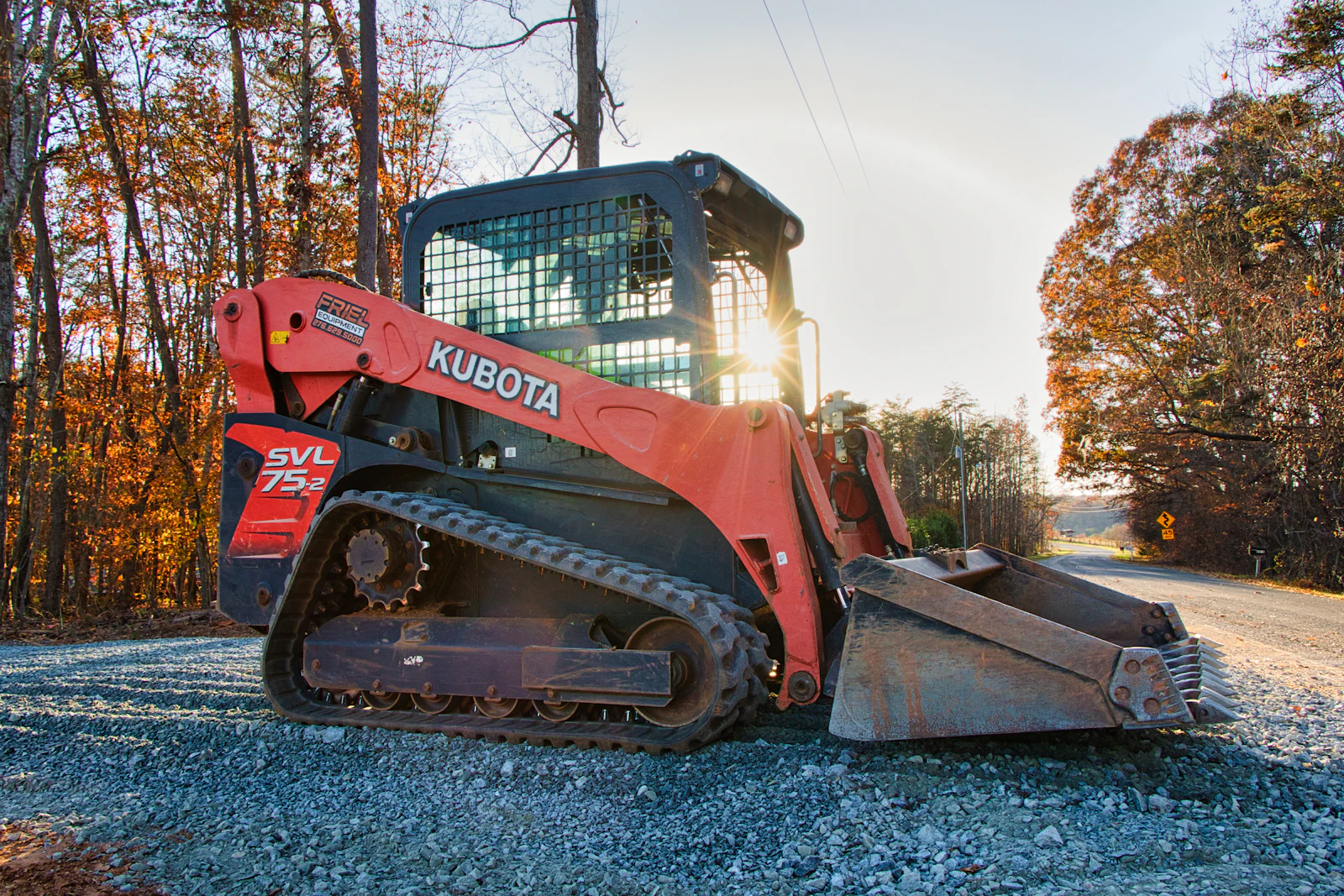
Skid Steer Loader Equipment Hire Costs Philadelphia 2026
For Philadelphia concrete driveway scopes in 2026, plan skid steer loader equipment hire in these working ranges (pre-tax, before delivery/fuel/waiver): $250–$525/day, $950–$1,950/week, and $2,900–$4,900 per 28-day month depending on wheeled vs compact track loader (CTL), ROC class, and whether you need a breaker, 4-in-1 bucket, or specialty bucket for concrete handling. These ranges align with published “typical” skid steer rental ranges ($200–$500/day and $800–$1,800/week) and Philadelphia-specific market summaries, with CTLs generally pricing higher than wheeled units. In the Philadelphia metro, national rental houses (e.g., United Rentals, Sunbelt, and Herc) and regional dealers (including Hoffman Equipment’s PA/South Jersey footprint) can all support driveway demo, stone base placement, and site cleanup—what changes your total cost most is transport logistics, metered-hour limits, and attachment adders rather than the base machine alone.
| Vendor |
Daily Rate |
Weekly Rate |
Review Score |
Website |
| United Rentals |
$560 |
$1 680 |
9 |
Visit |
| Sunbelt Rentals |
$545 |
$1 635 |
9 |
Visit |
| Herc Rentals |
$525 |
$1 575 |
8 |
Visit |
| Stephenson Equipment (Prospect Park / Philadelphia Metro) |
$500 |
$1 500 |
10 |
Visit |
| Best Line Equipment / Bobcat of Philadelphia (Warminster) |
$485 |
$1 455 |
9 |
Visit |
Philadelphia Concrete Driveway Work: Picking The Right Skid Steer Class (Cost-First)
Concrete driveway work typically uses a skid steer loader for (1) demo support (loading broken concrete into a dumpster), (2) subgrade correction, (3) aggregate placement and grading, and (4) cleanup. Your equipment hire cost hinges on machine size and surface sensitivity:
- Small-frame wheeled skid steer (tight access, lighter footprint): often the best cost-control choice for rowhome driveways and narrow gates where maneuverability beats raw breakout force. Budget $250–$380/day and $950–$1,250/week for planning.
- Medium-frame wheeled skid steer (most common for driveway base prep): budget $300–$450/day and $1,100–$1,550/week when you need faster cycle times and more stable grading.
- Compact track loader (CTL) (traction + float on soft subgrade): budget $340–$525/day and $1,250–$1,950/week; published regional pricing also shows CTL weekly pricing at $1,000–$2,500 and monthly at $3,000–$4,900 depending on platform size.
Philadelphia-specific consideration #1 (street logistics): tighter streets and parking controls can push you toward vendor delivery instead of contractor pickup, and waiting/standby time can become a real line item if the driver cannot stage close to the work frontage.
Philadelphia-specific consideration #2 (surface protection): if you must cross finished pavers, fresh sidewalks, or decorative concrete, plan on ground protection (mats/plywood) and a “no steel on finished surface” site rule—this often drives CTL vs wheeled selection and cleaning/track inspection expectations at return.
Philadelphia-specific consideration #3 (summer heat + dust controls): during hot weeks, expect stricter dust and cleanup expectations on occupied residential blocks; if the GC requires wet methods, you may add a water tank rental and allocate extra wash-down time to prevent silica dust drift onto adjacent properties.
2026 Planning Ranges For Skid Steer Hire (With Hour Assumptions)
Most professional rental agreements price around a “single shift” utilization model. A common framework is 8 hours/day, 40 hours/week, and 160 hours per 4 weeks (28-day month); overages or extra shifts can trigger additional charges. When you build a Philadelphia skid steer loader equipment hire budget for concrete driveway production, state your assumptions in the estimate and PO notes:
- Wheeled skid steer (small/medium frame): $250–$450/day; $950–$1,550/week; $2,900–$4,400/28-days.
- CTL (medium/large platform): $340–$525/day; $1,250–$1,950/week; $3,200–$4,900/28-days (with published CTL monthly examples up to $4,900 for large platform).
- Mini track loader / “stand-on” for ultra-tight access (48 in class): commonly prices near small skid steer day rates but may be restricted by availability; confirm lift capacity and whether concrete bucket options are offered.
Cost control note: if your driveway scope is a 1–3 day burst, the daily rate is rarely the whole story—delivery/pickup, damage waiver, and attachment rates usually exceed the “discount” difference between two similar machine models.
Hidden-Fee Breakdown (What Actually Moves The Invoice)
Below are the adders that most often change real-world skid steer loader hire cost in Philadelphia for concrete driveway work. Use these as 2026 planning allowances unless your vendor quote states otherwise:
- Delivery/pickup (each way): typically $150–$275 each way inside an inner-zone radius; for out-of-zone moves, budget $6–$9 per loaded mile (and confirm whether there is a minimum). If the driver needs a smaller truck due to alley access, expect a premium.
- After-hours / Saturday delivery window: budget a dispatch premium of $75–$175 when you request a fixed delivery appointment outside normal routing.
- Wait time / jobsite standby: if the truck cannot offload due to blocked frontage, locked gate, or no spotter, budget $95–$150 per hour after a short grace period (often 15–30 minutes).
- Damage waiver / rental protection: commonly 10%–15% of the base rental (machine + attachments). Clarify whether it covers theft, glass, tires/tracks, and vandalism.
- Refundable deposit / credit hold: budget $500–$2,000 depending on account status and machine class.
- Environmental / shop / admin fees: budget $10–$25 per contract or per period, plus local taxes where applicable.
- Fuel/DEF at return: plan to return “full” or budget refuel at $6–$8/gal diesel equivalent plus a service charge; DEF (if charged separately) often budgets at $4–$6/gal.
- Cleaning (concrete dust/mud): budget $85–$250; for hardened concrete slurry on tracks/undercarriage, plan a higher cleaning allowance of $150–$350.
- Metered-hour overages: if you exceed the included 8/40/160 hour caps, budget an overage model such as 10% of the daily rate per excess hour on hour-metered machines (varies by contract).
- Weekend billing rules: confirm whether a “weekly” rate is 5 business days or 7 calendar days; if you take delivery Friday and off-rent Monday, you can inadvertently pay for idle days if off-rent cutoffs aren’t followed.
Attachment Hire Costs For Concrete Driveway Scopes (Adders To The Base Machine)
Concrete driveway scopes often need at least one attachment beyond a standard bucket. Budget these skid steer attachment hire costs as planning ranges in Philadelphia:
- Pallet forks: $15–$35/day; $60–$110/week; published examples show forks & frame at $90/week or $250/month.
- Grapple bucket (demo cleanup productivity): $75–$160/day; $250–$450/week; published example shows $400/week and $500/month.
- 4-in-1 bucket (grab/grade/back-drag): $45–$95/day; $175–$350/week.
- Concrete breaker / hydraulic hammer: $175–$325/day; $650–$1,150/week (also confirm whether a point/chisel is included or billed as wear).
- Tooth bucket vs smooth-edge bucket: commonly included as “bucket of choice,” but specialty buckets may add $10–$35/day depending on the fleet policy.
- Trailer (if contractor pickup is allowed): $85–$160/day; $250–$450/week, plus tie-downs and compliance requirements. Note: combined tow weights can exceed 8,700–10,300 lb depending on machine class, which can disqualify light-duty pickups and create last-minute delivery costs.
Example: 2-Day South Philly Concrete Driveway Demo With Tight Access
Scenario: 18 ft x 20 ft driveway slab removal and haul-off staging on a dense residential block. Gate opening is 52 in, and the GC requires the street to be clear by 3:30 pm daily. Production plan uses a small CTL (better traction on disturbed base) plus a breaker attachment.
- CTL hire (2 days): $410/day x 2 = $820 (planning rate).
- Breaker attachment (2 days): $240/day x 2 = $480.
- Delivery + pickup: $225 each way = $450.
- Damage waiver (12%): 0.12 x ($820 + $480) = $156.
- Cleaning allowance (concrete dust): $150.
- Fuel/DEF allowance: $85.
- Philadelphia sales tax planning (where applicable): use 8% to sanity-check the “out-the-door” number.
Resulting planning subtotal (before any haul-off containers or stone): about $2,291 plus tax on taxable lines (your vendor will define what’s taxable). The key operational constraint here is the 3:30 pm daily clear-out: if you miss pickup on Day 2 and keep the unit overnight, the “extra day” can cost $410–$525 plus another day of waiver and potential weekend billing impact.
Budget Worksheet (Skid Steer Equipment Hire Allowances)
Use this as a quick estimator worksheet for Philadelphia skid steer loader equipment hire costs tied to concrete driveway scopes (no vendor-specific pricing assumed):
- Skid steer / CTL base rental: ____ days at $____/day (or ____ weeks at $____/week)
- Attachment 1 (breaker OR grapple OR 4-in-1): ____ days at $____/day
- Attachment 2 (forks / specialty bucket): ____ days at $____/day
- Delivery charge (each way): $____ delivery + $____ pickup
- Appointment window premium (if required): $____
- Wait time contingency (1–2 hours): $95–$300
- Damage waiver (10%–15%): $____
- Fuel/DEF allowance: $75–$150
- Cleaning allowance (concrete dust/mud): $85–$350
- Ground protection (mats/plywood rental or purchase): $100–$400 allowance
- Tax allowance (Philadelphia combined sales tax planning where applicable): 8% on taxable lines
- Metered-hour overage contingency: $100–$350 (if production is uncertain)
Rental Order Checklist (What Rental Coordinators Should Lock Down)
- PO includes: machine class (wheeled vs CTL), ROC class, bucket type, auxiliary hydraulics requirement, and any “no steel track” rules.
- Delivery address notes: street access restrictions, low-clearance routes, required spotter, and preferred offload side.
- Delivery window: confirm cutoffs (e.g., “deliver before 7:00 am”); state standby authorization limit (e.g., “driver wait time not to exceed 30 minutes without approval”).
- Billing basis: confirm included hours (8/40/160) and overage rules; confirm whether weekend days bill automatically if off-rent isn’t called in time.
- Damage waiver: confirm % and exclusions (tires/tracks, glass, theft, vandalism) and whether you’re providing a COI in lieu of waiver.
- Return condition: require pre-return photos (tracks/tires, bucket cutting edge, cab, hour meter, fuel level) to defend against cleaning/damage back-charges.
- Off-rent process: confirm how to request pickup and what timestamp triggers an additional day (email vs portal vs phone).
How To Keep Skid Steer Hire Costs Predictable In Philadelphia (Scheduling And Off-Rent Rules)
For concrete driveway work, the fastest way to lose control of skid steer loader equipment hire cost is to let the unit sit idle while other trades catch up. In Philadelphia, tight delivery routing and dense neighborhoods amplify this risk. Apply these cost controls:
- Align delivery with “ready-to-work” conditions: don’t start rental time until dumpster/roll-off placement, sawcutting, and utility mark-outs are complete. Every idle day can cost $250–$525 plus waiver and taxes.
- Use the 28-day month strategically: many major platforms bill monthly on a 4-week (28-day) cycle rather than calendar months, and some systems automatically optimize to the cheapest day/week/4-week rate as the rental progresses—confirm whether your vendor does this so your forecast matches invoicing behavior.
- Define off-rent timing in writing: require the PM/foreman to send an “off-rent release” message with date/time, photos, and accessible pickup instructions. If pickup is blocked by parked cars or fencing, you can incur $95–$150/hr standby and an extra day’s rent.
- Right-size the machine to the disposal plan: if you are loading into 10-yard vs 20-yard containers, verify dump height and reach; otherwise, you may need to re-handle material, extending rental duration and pushing you into hour overages.
Metered Hours, Extra Shifts, And Overage Charges
Concrete driveway scopes can spike machine hours because demo and cleanup occur in short bursts. Where rentals are hour-metered, your base hire typically assumes a single shift utilization model (commonly 8 hours/day, 40 hours/week, 160 hours per 4 weeks). If your plan includes double shifting (e.g., early morning load-out plus evening cleanup), build an explicit overage allowance. Even when the machine is “on rent,” rental agreements often treat usage beyond the cap as an extra shift or excess hours, which can materially increase cost without changing the calendar days.
Estimator tip: for driveway replacements where the skid steer is also spreading stone base and backfilling edges, assume 6–9 machine hours/day on active days—not 2–3 hours—so your hour cap risk is modeled honestly.
Concrete Driveway-Specific Adders You Should Not Miss
- Bucket wear / cutting edges: if you’re scraping compacted base or handling broken slab with rebar, confirm whether wear items are included or billed; set a contingency of $50–$150.
- Flat tire risk on wheeled skid steers: demolition debris can drive tire replacement charges; if you choose wheeled units for a slab demo, consider whether a CTL premium is cheaper than a tire back-charge.
- Dust-control requirements: if the GC/owner requires wet suppression, budget a water source plan; if you rent a small water tank trailer, add $45–$95/day plus delivery.
- Street occupancy impacts: if you need the rental truck to block a lane briefly, coordinate arrival with permitted work windows to avoid reschedules (a reschedule can functionally add $75–$175 in premium routing plus standby risk).
- Photo documentation: require “arrival condition” photos within 30 minutes of delivery and again at pickup; this is one of the cheapest ways to reduce post-rental disputes.
Taxes And Compliance Notes (Philadelphia)
When you build an equipment hire budget for Philadelphia, remember that the combined Philadelphia sales tax rate is commonly cited as 8% (state + local), and it can apply to taxable rental charges depending on how the transaction is structured. Always confirm taxability with your vendor and accounting team rather than assuming “rental is always taxed” or “rental is never taxed.”
What To Ask For When You Request A Quote (To Avoid Change Orders)
To keep skid steer loader equipment hire costs clean for a concrete driveway scope, ask for a quote that explicitly states:
- Base rate type: day / week / 28-day month and the included hour limits (8/40/160).
- Delivery and pickup price (each way), delivery window rules, and standby charges.
- Damage waiver % and exclusions; confirm whether theft/vandalism are covered and what documentation is required for a claim.
- Fuel policy (full-to-full vs charge at return) and cleaning criteria (what triggers $85 vs $350 cleaning).
- Attachments: exact attachment model, hydraulic coupler compatibility, and whether wear tools are included.
- Off-rent process: required notice, cutoff time, and whether weekend days are billed if pickup occurs after cutoff.
Cost-Saving Moves That Still Fit Professional Specs
- Bundle attachments only when needed: for driveway base prep, forks may be unnecessary; for demo cleanup, forks can be cheaper than a grapple if debris is already broken and you’re just handling pallets/blocking.
- Choose wheeled units on clean, hard surfaces: if access is paved and debris is controlled, wheeled skid steers can be the lower-cost option; published comparisons commonly show wheeled units renting less than tracked by about $50–$100/day in many markets.
- Timebox the breaker: rent the hydraulic hammer for 1 day (peak demo) and keep the base machine for 2–3 days (cleanup and base placement). This frequently saves $200–$400 versus keeping the attachment throughout.
- Plan pickup for the same day you finish: avoid “one more night” rentals that create an extra day plus waiver and tax, especially when weekend billing is in play.
Quick 2026 Sanity-Check Totals (Use As A Forecast Range)
If you need a fast internal forecast for a Philadelphia concrete driveway replacement, these “all-in” planning ranges help validate quotes:
- 1-day rental with delivery (machine + bucket only): typically $525–$1,050 after delivery/pickup, waiver, fuel allowance, and basic fees.
- 2–3 day rental with one attachment (breaker or grapple): typically $1,600–$3,200 depending on attachment days, delivery complexity, and cleaning.
- 1-week rental for base + grading + cleanup: typically $2,100–$4,400 all-in when you include delivery both ways, waiver, and one moderate attachment add.
These are intentionally planning-level numbers: they are not a substitute for a written quote with stated hour limits, off-rent rules, and attachment specifics. Use them to catch missing line items before your PO is issued.