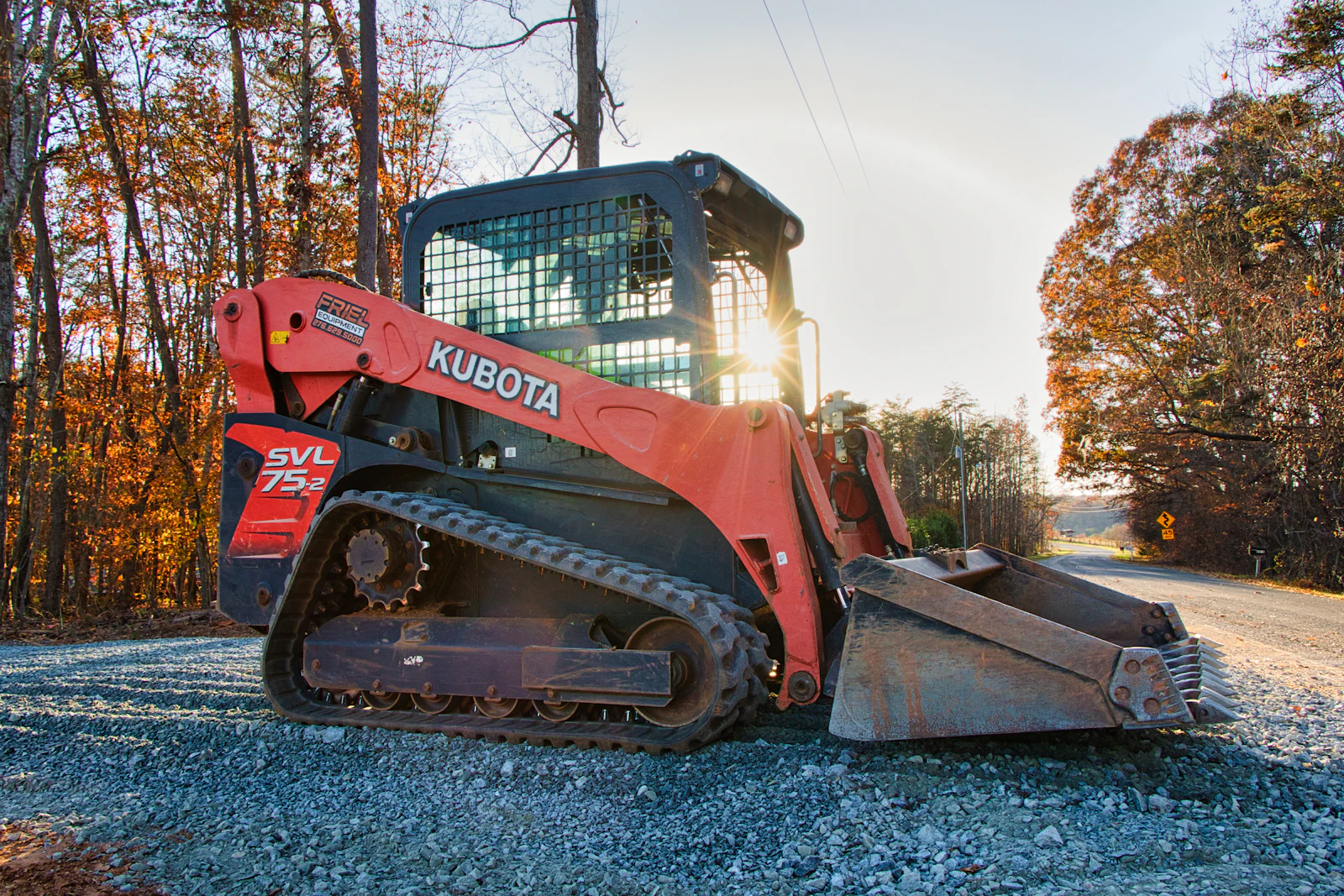
Skid Steer Loader Rental Rates Raleigh 2026
For Raleigh concrete driveway work in 2026, plan skid steer loader equipment hire costs (machine only) in these ranges: $275–$475/day, $950–$1,650/week, and $2,700–$4,200/4-weeks for a wheeled skid steer; and $375–$575/day, $1,200–$1,950/week, and $3,300–$5,100/4-weeks for a compact track loader (CTL) when you need flotation on wet subgrade. These are planning ranges assuming an 8-hour shift day and standard buckets; actual branch pricing will move with availability, seasonality, credit status, and whether you’re booking online vs. counter. In the Triangle market, managers commonly source units through national houses (United Rentals, Sunbelt, Herc) plus regional dealers and Bobcat/Cat rental stores; the cost outcome is usually driven more by delivery, waivers, attachments, and off-rent rules than by the base day rate alone.
| Vendor |
Daily Rate |
Weekly Rate |
Review Score |
Website |
| Sunbelt Rentals |
$225 |
$660 |
9 |
Visit |
| United Rentals |
$420 |
$1 206 |
8 |
Visit |
| Herc Rentals |
$410 |
$1 195 |
8 |
Visit |
| Gregory Poole Rentals (Cat Rental Store) |
$405 |
$1 175 |
8 |
Visit |
| Triad Equipment / True Value Rentals (Wake Forest – Raleigh Metro Delivery) |
$380 |
$1 140 |
9 |
Visit |
How Concrete Driveway Work Changes Skid Steer Hire Cost in Raleigh
Concrete driveway scopes tend to push skid steer hire costs up because the job is rarely “machine only.” Even if you’re not using the skid steer for concrete demo, you’re typically using it to (1) move breakout and spoils, (2) place and fine-grade base stone, (3) load out pallets/forms/rebar, and (4) keep the site clean enough for inspection and placement crews. Each of those steps can introduce an attachment adder, extra mobilizations, or a longer rental term (which is good if you can convert day-rates to week-rates, but expensive if you get trapped into an extra day by weekend billing or a missed off-rent cutoff).
Raleigh-specific cost drivers for driveway work (that show up on invoices): clay subgrade that turns to mud after rain (often pushing you to a CTL), tight subdivision access and HOA/municipal work-hour limits that compress production into fewer billable hours, and cleanup expectations (street sweeper/broom attachments or cleaning charges) when you’re tracking fines onto asphalt or into storm drains.
Choose Wheel Vs. Track and Size Class to Control Hire Spend
For concrete driveway packages, the “right” hire class is usually dictated by access and subgrade moisture, not just rated operating capacity (ROC). A practical way to estimate is to bracket Raleigh pricing using published 2026 rate cards and a local Triangle listing, then apply local delivery/fee allowances.
Local Triangle benchmark (tracked unit): a Bobcat T64 compact track loader listed for Raleigh-Durham area rent shows $400/day, $1,200/week, and $3,600/month.
Published 2026 rate-card benchmarks (other U.S. markets, useful for 2026 planning ranges): a 2026 rental brochure example shows skid loaders at $350/day (S5**/S6**) up to $525/day (S740/S770), and track loaders at $425/day (T450) up to $625/day (T870/T86), with weekly/4-week pricing scaling accordingly.
Why this matters in Raleigh driveway work: if your schedule is weather-sensitive (common in late winter/early spring rain cycles), paying an extra $100–$175/day to go from tires to tracks can be cheaper than eating (a) a second mobilization, (b) a cleaning fee, and (c) an extra rental day because the wheeled unit couldn’t stay productive on saturated subgrade.
Typical 2026 Raleigh hire selections (planning)
- Wheeled skid steer (mid-frame, 1,800–2,400 lb ROC equivalent): best when you’re staying on compacted stone, existing asphalt, or dry subgrade and you need lower delivery cost and easier transport.
- Compact track loader (CTL, vertical lift, enclosed cab preferred): best when you expect mud, need stability while loading trucks, or want better finish control when spreading base material before final compaction.
- Enclosed cab / HVAC premium: commonly worth budgeting on summer pours because Raleigh heat/humidity drives fatigue and slows cycle time; in practice, the “cab premium” is often embedded in the model class you’re reserving.
Attachment Hire Pricing That Commonly Hits Driveway Budgets
Concrete driveway work frequently requires at least one add-on beyond a general-purpose bucket. Attachment pricing varies by supplier, but published rate sheets help coordinators set allowances and avoid surprises.
Common attachment adders (examples from a published 2026 rate sheet): forks shown at $80/day, $240/week, and $720/4-weeks; breaker shown at $250/day, $750/week, and $2,250/4-weeks; auger system shown at $120/day and $360/week; and auger bits at $50/day (under 18") or $80/day (18" and over).
Alternative published 2026 attachment benchmarks: pallet forks shown at $59/day, $155/week, and $397/4-weeks; breaker shown at $285/day and $775/week; and a planer shown at $450/day and $1,195/week (high-flow applications).
Public-sector contract pricing signals you may see reflected in delivery line items: an equipment lease/rental schedule example includes pallet forks at $40/day, $90/week, and $185/month, and shows a delivery/mobilization line item structure with a base delivery charge plus per-mile adders on certain items.
For driveway crews, forks (to handle palletized forms/mesh), a smooth-edge bucket (for final base grading), and a broom (for cleanup and demob) are the most common “small” adders. Hydraulic breakers or planers show up when you’re self-performing demo of an existing driveway or curb returns—if you add them late, you can end up paying (1) a second delivery and (2) an extra day because the attachment arrives after the first shift.
Hidden-Fee Breakdown
Most “skid steer rental cost Raleigh” misses the invoice drivers below. For accurate equipment hire cost forecasting on concrete driveway projects, carry explicit allowances for these categories (and confirm your branch rules before release):
- Delivery / pickup: budget $125–$250 each way inside a typical metro radius, and $3–$6 per loaded mile (or a mileage adder) outside the base radius. If you have a constrained delivery window (e.g., must arrive after 9:00 AM and before 2:00 PM due to site access), budget a $75–$150 time-window surcharge or a reschedule fee if the truck is turned away.
- Minimum rental terms: some branches will enforce a 1-day minimum (common), while others effectively enforce a 2-day minimum when the delivery lands late Friday and weekend billing applies. Always ask how “week” is defined (often 5 billable days) and whether Saturday counts as a full day when the machine remains on rent.
- Damage waiver / rental protection: plan 10%–18% of the base rental (machine + attachments). Many market guides cite 10%–15% as a typical range, but it varies by account and equipment class.
- Fuel / diesel refuel: budget $6.00–$8.50 per gallon if returned short of “full,” or carry a $35–$85 refuel service minimum depending on branch practice. For driveway jobs, the most common miss is returning with 1/4 tank because the unit idled during grade checks.
- Cleaning fees (concrete mud/fines): budget $95–$350 if the unit returns with caked clay, concrete splatter, slurry, or clogged radiators. In Raleigh subdivisions with street parking and storm-drain sensitivity, cleanup requirements are typically stricter than open commercial pads, increasing cleaning exposure.
- Wear/damage backcharges: budget $250–$450 per tire for sidewall cuts on wheeled units, and $900–$1,800 per rubber track if a CTL track is torn or de-tracked and damaged (rates vary widely; confirm your supplier’s policy and inspection process).
- Environmental/energy and admin fees: plan $3–$12/day as a blended allowance for common shop/environmental recovery fees, plus potential $2–$10/day telematics/admin adders depending on vendor.
Shift Hours, Overtime, and Weekend Billing Rules
For concrete driveway schedules, the biggest avoidable cost is paying “weekly” money for “daily” utilization. Many suppliers base day/week/4-week rates on one shift of use: one example policy states that the basic daily, weekly and 4-week rates include up to 8 hours/day, 40 hours/week, and 160 hours/4-weeks.
When you exceed one-shift use, overtime is often billed using a fraction of the base rate. One published example uses 1/8 of the daily charge per extra hour on daily rentals and 1/40 of the weekly charge per extra hour on weekly rentals.
Practical estimator takeaway (driveway work): if you schedule a CTL at $400/day and run 10 hours to catch weather, those 2 extra hours can price like an additional $100 (2 × $400 ÷ 8), before tax/waiver. The same logic applies to weekend “make-up” shifts—confirm whether Saturday hours are included as part of the weekly cap or billed separately.
Also validate your supplier’s off-rent cutoff (commonly a morning cutoff like 9:00–10:00 AM). Missing the cutoff by even 30 minutes can trigger a full extra day of hire on short-term driveway work.
Budget Worksheet
Use the following bullet worksheet as a no-table estimating artifact for Raleigh skid steer loader equipment hire cost planning on concrete driveway scopes (adjust for your company’s negotiated rates):
- Skid steer (wheeled) base hire: $275–$475/day allowance or $950–$1,650/week allowance.
- Compact track loader (CTL) base hire (if clay/mud risk): $375–$575/day allowance or $1,200–$1,950/week allowance.
- Delivery + pickup: $250–$500 round trip (metro) plus $3–$6/mile outside included radius.
- Damage waiver / rental protection: 10%–18% of (machine + attachments).
- Fuel/refuel exposure: $50–$150 allowance (or enforce “full-to-full” with photos).
- Cleaning exposure: $95–$350 allowance (increase if wet clay and street travel expected).
- Attachment: pallet forks: $59–$80/day or $155–$240/week benchmark.
- Attachment: breaker (only if self-performing demo): $250–$285/day or $750–$775/week benchmark.
- Attachment: broom/cleanup (if required by GC/municipality/HOA): $200/day benchmark on published sheet, or carry $150–$250/day planning allowance.
- Ground protection (if needed to protect existing asphalt/curb): $150–$400 allowance (mats rental/handling varies; confirm supplier or specialty provider).
- Contingency for weather + schedule slippage: add 0.5–1.0 extra day of base hire for spring rainy periods if you can’t secure “on rent / off rent” flexibility.
Example: Raleigh Concrete Driveway Prep Using a Tracked Skid Steer
Scenario: Replace a residential concrete driveway inside Raleigh city limits. Access is a single-lane street with school traffic, and the site is red-clay subgrade with rain in the 48-hour forecast. You decide to hire a CTL (tracked) to keep base placement on schedule and reduce rutting risk.
- Machine: CTL hire at $400/day (local Triangle benchmark) for 2 billable days = $800.
- Delivery/pickup: allowance $180 each way = $360 (metro windowed delivery).
- Forks: 2 days at $80/day = $160 (handling pallets/forms).
- Damage waiver: assume 12% of rental line items ($800 + $160) = $115.
- Fuel/refuel: allowance $75 (to avoid $6.00–$8.50/gal refuel pricing if returned short).
- Cleaning: allowance $150 because the CTL will cross wet clay.
Planned equipment hire cost (before tax): $800 + $360 + $160 + $115 + $75 + $150 = $1,660. The key operational constraint here is timing: if the machine delivers after 2:00 PM on Day 1 due to traffic and you still get billed a full day, you can lose 15%–30% of the productivity you assumed while still paying the day rate. Protect the budget by requiring a delivery ETA, documenting arrival time, and clarifying whether partial-day credit applies.
Delivery, Off-Rent, and Return-Condition Controls for Rental Coordinators
On Raleigh concrete driveway projects, coordinators can usually save more by tightening logistics than by negotiating $25/day off base rate. Focus on these controls (each directly tied to equipment hire cost):
- Delivery cutoffs: require a written delivery window and confirm the branch’s “day starts” rule (delivery time vs. calendar day). If your site can only receive between 9:00 AM and 1:00 PM, call that out on the PO—otherwise a missed window can generate a $75–$150 reschedule charge plus a lost production shift.
- Off-rent (call-off) procedure: confirm cutoff time and required method (phone + email + app). Missing the cutoff commonly triggers an extra 1 full day of hire.
- Return condition documentation: take 10–15 timestamped photos on pickup (all four sides, cab interior, coupler, bucket edge, tracks/tires, hour meter, fuel level). This is the cheapest mitigation against tire/track and cleaning backcharges.
- Fuel expectations: align “full-to-full” and specify whether you’re using customer-fueled vs. supplier fuel service. If supplier-fueled, request the posted fuel rate in advance (budget $6.00–$8.50/gal planning).
- Radiator and undercarriage cleanup: for clay-heavy sites, blow out radiators daily. A single overheating event can lead to downtime and a cleaning or service fee on return (carry $95–$350 cleaning exposure in the estimate).
Rental Order Checklist
Use this checklist (no tables) to reduce Raleigh skid steer loader equipment hire cost leakage on driveway scopes:
- PO setup: include project name, site address, requested delivery date/time window, and a clear “do not deliver outside window without approval” note.
- Rate confirmation: confirm whether rates are daily, weekly (often 5 consecutive days), or 4-week; confirm hour limits (commonly 8/40/160) and overtime method.
- Equipment spec: wheeled vs. CTL; ROC class; bucket type (smooth vs. toothed); enclosed cab requirement; required coupler style.
- Attachments: list each attachment separately (forks, breaker, broom, planer) to avoid counter substitutions that change pricing; confirm high-flow requirement before dispatch if using planer/broom.
- Insurance and waiver decision: provide COI if required; decide damage waiver vs. internal insurance handling; confirm waiver % (budget 10%–18%).
- Delivery/pickup: confirm round-trip freight estimate; clarify jobsite contact name/number; clarify access constraints (gate width, street parking, school traffic periods).
- Safety/ops requirements: confirm operator qualification expectations; confirm PPE and site rules; document any indoor dust-control requirements if the machine will be used in a garage or enclosed area (filters, sweeping vs. dry brooming).
- Off-rent plan: set a calendar reminder for off-rent call by the cutoff time; include a contingency plan for rain delays so you don’t keep the unit on rent unnecessarily over a weekend.
- Return condition: fuel to agreed level; remove debris from tracks/tires; pressure wash if muddy (where allowed); photograph final condition at pickup.
Cost-Reduction Tactics That Preserve Production
- Convert to weekly intentionally: if you’re at 3+ days, compare the week rate. A published local benchmark shows $400/day and $1,200/week, implying the 3rd day is effectively “free” if you truly use it.
- Bundle attachments early: avoid mid-rental attachment swaps that add freight. If you need forks for staging and a broom for demob, book both at initial release and return one early if off-rent rules allow partial returns.
- Use weekend rate structures strategically: some suppliers publish weekend caps (often higher than 1 day but lower than 2). A published 2026 rate sheet shows a weekend price (12-hour max) separate from day and week pricing.
- Right-size the CTL: moving from a mid-size to a large-frame CTL can add $75–$150/day, but if it reduces trucking cycles by 1–2 loads per day (larger bucket, faster cycle), it can still lower total equipment hire cost per cubic yard moved.
- Prevent cleaning backcharges: allocate 15 minutes/day for cleanup (undercarriage, radiator screen). This is typically cheaper than a $150–$350 cleaning fee and prevents overheating downtime.
Ownership Vs. Equipment Hire for Repeating Driveway Packages
If you are self-performing multiple driveway replacements per month across Wake County, compare annual hire spend (including freight, waivers, and cleaning) versus owning a mid-frame skid steer/CTL. Hire stays attractive when (1) utilization is spiky, (2) you frequently need different attachments/high-flow configurations, or (3) you can pass equipment cost through as a reimbursable. Ownership can win when you consistently exceed 12–16 billable days/month on the same class of machine and you have in-house maintenance capacity. Even then, many contractors still hire specialty attachments (planers, forestry cutters) rather than carrying them on the balance sheet.
2026 Market Notes for Raleigh Equipment Hire
In Raleigh, equipment availability and price are most volatile around spring rain-driven rescheduling, summer peak construction season, and post-storm demand spikes. For concrete driveway work specifically, schedule certainty often matters more than the lowest rate: paying an extra $50/day for a guaranteed delivery window can be cheaper than losing a placement crew and paying a standby day on concrete, pump, and finishing labor.
Compliance and Site Requirements to Avoid Backcharges
- Surface protection: if you must cross existing asphalt or decorative concrete, plan mats or plywood; rutting and edge damage are commonly charged back as restoration labor, not just equipment damage.
- Indoor/garage use: if the unit is used inside a garage during formwork, confirm ventilation rules and dust expectations; clogged filters and concrete dust contamination can trigger service fees.
- Utility locate coordination: if you’re using the skid steer for excavation near marked utilities, document locate status; repair exposure is far higher than any rental savings.
- Operator practice and coupler checks: improper coupler engagement is a common cause of bucket loss/damage and can create immediate backcharges plus downtime—include a pre-shift attachment lock verification in your daily plan.