

For Sacramento concrete driveway work in 2026, budgeting skid steer loader equipment hire is most reliable when you start with a published local counter rate for a mid-size wheeled skid steer (60–68 in class) and then build adders for delivery, attachments, and shift overages. As a current Sacramento-area reference point, a 60–68 in skid steer (example: Bobcat S550 class) is advertised at $366/day, $1,226/week, and $2,580 per “monthly” term (noted as a 4-week rental period), with a 4-hour minimum option at $269. If your concrete driveway scope will be on wet subgrade, soft landscaping edges, or you’re managing rut risk, planning numbers often move toward compact track loader pricing (commonly higher daily and 4-week rates), especially once you include a hydraulic breaker package and transport. National fleets (United Rentals, Sunbelt Rentals, Herc Rentals) and regional yards typically compete on availability, credit terms, and delivery control rather than strictly on the base day rate, so your “true hire cost” is usually decided by logistics, attachments, and off-rent timing.
| Vendor | Daily Rate | Weekly Rate | Review Score | Website |
|---|---|---|---|---|
| United Rentals | $325 | $1 150 | 8 | Visit |
| Sunbelt Rentals | $315 | $1 110 | 8 | Visit |
| Herc Rentals | $305 | $1 080 | 7 | Visit |
| The Home Depot Tool Rental | $290 | $1 000 | 8 | Visit |
| Ahern Rentals | $310 | $1 090 | 7 | Visit |
The planning ranges below are aimed at equipment managers and estimators who need defensible equipment hire budgets for driveway demolition, base rework, and export loading in Sacramento. Assumptions: (1) one-shift utilization (commonly 8 hours/day, 40 hours/week, 160 hours per 4-week term), (2) standard bucket included, (3) operator/fuel not included unless your agreement says otherwise. Herc explicitly documents the one-shift framework and how additional hours are priced (fractional rates tied to the daily/weekly/4-week charge).
Important billing note: “Monthly” is frequently defined as a 4-week billing period in rental systems; a Sacramento listing states that “Monthly Rates are for a 4-week rental period.” Always normalize your estimate to 28-day terms (not calendar months) unless your MSA overrides it.
A skid steer loader is typically the right equipment hire choice for a Sacramento concrete driveway package when your critical path is (a) loading broken slab into a truck/roll-off, (b) cutting and pulling base rock, (c) importing and grading aggregate base, and (d) final site cleanup and access restoration. Where costs get missed is when the driveway scope quietly shifts into “demolition + processing,” which can require a breaker (or a dedicated excavator hammer) and adds wear/cleaning exposure. If you can stage trucks efficiently, the skid steer often produces the best $/cubic-yard moved on tight residential driveways compared with larger wheel loaders that incur higher delivery and minimum charges.
Sacramento-specific operational constraints that influence real hire cost on driveway projects include: narrow residential curb cuts (requiring smaller trailers or careful delivery timing), hot summer afternoons (higher cooling load; schedule heavy breaker time in the morning), and dust control expectations (neighbors + visibility + indoor garage transitions). These aren’t “soft” issues—each can extend your rental term by 1–2 billable days if you miss delivery windows or need to stop work for cleanup and compliance.
For concrete driveway work, attachments are where hire costs swing dramatically. If your scope includes slab breakup, budgeting a breaker plus tooth bucket (or a dedicated concrete bucket) is usually the difference between a 1–2 day job and a 3–5 day job—so the attachment cost must be evaluated against schedule risk and trucking efficiency.
Estimator note: If you rent forks/breaker/trencher “attachment-only,” confirm whether your yard requires a compatible hydraulic flow class and coupler type. For example, one Sacramento breaker listing calls out hydraulic flow needs (5–18 GPM) and machine series requirements. A mismatch can create a same-day swap (and a paid extra day) if you discover it after delivery.
Concrete driveway work tends to generate the exact conditions that trigger rental adders: concrete dust/slurry, high auxiliary hydraulic hours (breaker), and frequent on/off trailer moves. A clean hire estimate should carry explicit allowances for the following cost drivers.
To keep equipment hire costs predictable, manage utilization like you would labor: define shift hours, track meter readings, and plan demob timing. Herc documents that basic daily/weekly/4-week rates typically cover one shift (8 hours/day, 40 hours/week, 160 hours/4 weeks), and that excess use is payable at fractional “hourly” rates (1/8 of daily, 1/40 of weekly, 1/160 of 4-week).
Practical overtime pricing example: if your daily rate is $366/day and your agreement follows the 1/8 rule, each overage hour can price at about $45.75/hour (366 ÷ 8), plus taxes and any damage waiver percentage. (Confirm the hourly method in your specific contract before relying on this.)
Weekend billing and off-rent timing: for driveway work, the most common unplanned cost is paying an extra day because the pickup is scheduled after the yard’s cutoff or because the site is not accessible when the driver arrives. Confirm (1) the branch cutoff time for next-day off-rent, (2) whether Saturday/Sunday are billable days on your rate structure, and (3) whether weekend pickups are available (often limited, sometimes premium-priced).
Scenario: 1,000 sq ft driveway removal and base rebuild with tight neighborhood controls. Work constraints: (a) no heavy deliveries after 3:30 pm due to school traffic, (b) dust control required when cutting/breaking slab, (c) trucks can only stage one at a time, (d) you must off-rent by 2:00 pm on Day 3 to avoid a 4th day billing.
Equipment hire budget (planning example):
Planning subtotal (equipment hire only): about $2,517 before tax and any transportation surcharge. If you miss the Day 3 off-rent cutoff and slip into a 4th day, add another $366/day plus the damage waiver percentage (and possibly another mobilization if the yard cannot pick up until the next business day).
Use this field-ready equipment hire worksheet format to build a clean PO and to avoid “unscoped” invoice adders (no tables; line items only):
Use this to keep your skid steer loader equipment hire aligned with driveway production and to reduce invoice disputes:
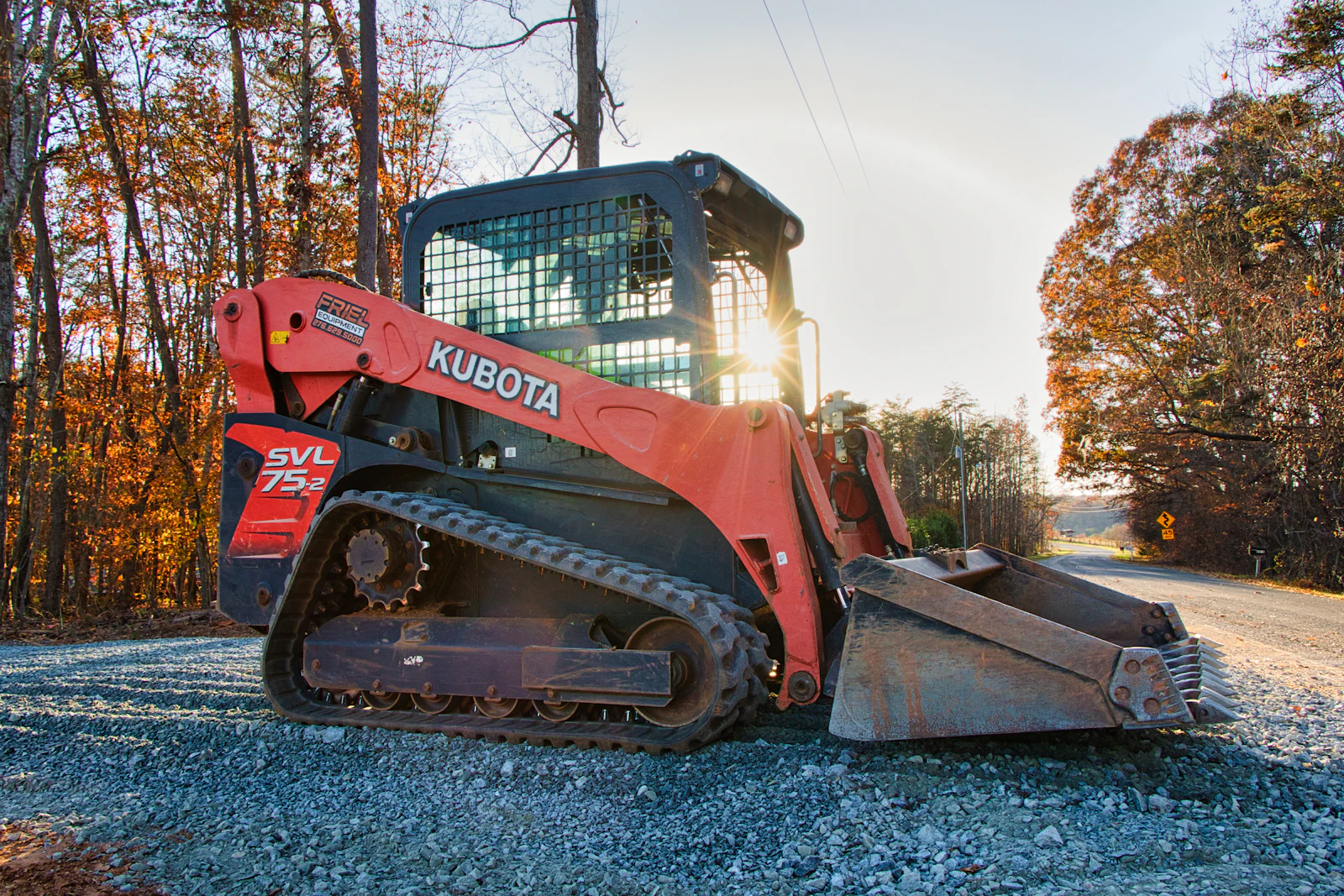
Two Sacramento driveways with the same square footage can land at very different equipment hire costs. The biggest drivers are usually (1) access and transport complexity, (2) dust/slurry management (which directly impacts cleaning time and return condition), and (3) subgrade moisture and traction (wheels vs tracks). If your site is in a tight residential pocket where a lowboy or tilt-deck is required, your transport can easily equal 0.5–1.0 additional rental days in cost. A Sacramento-region published schedule shows local moves at $75 delivery/$75 pickup for smaller truck deliveries and $125/$125 when a lowboy is required—so even “local” transport is a real cost line item.
Delivery radius norms: Sacramento yards often define “local” by travel time and truck type rather than a strict mileage number; if your driveway is in outlying areas (foothill edge, rural parcels, or jobsite access requiring special dispatch), plan for a non-local rate like $125/hour and remember lowboy moves may carry a 2-hour minimum.
Heat and production planning: Sacramento summer heat can reduce breaker efficiency (more cooldown/idle). If you’re estimating a 2-day breaker window, build in 1–2 hours/day of idle time as part of the “refuel/top-off” and overage-hour risk allowance, especially if your rental agreement enforces strict 8-hour shift caps. Herc’s published shift-rate framework (8/40/160) is a useful baseline when normalizing this risk across vendors.
Driveway work is notorious for off-rent slippage because the last 10% of the work (final cleanup, export haul, base touch-ups, forms staging) often runs into the afternoon. If pickup misses the cutoff, you may incur a full extra day plus damage waiver percentage. Using a $366/day reference, a single day slip can add $366 + (10% waiver on that day) + taxes, and potentially additional transport charges if the pickup becomes a separate dispatch.
Control measures rental coordinators actually use:
Concrete driveway work creates two invoice risks: cleaning labor and damage claims. Concrete slurry, caked clay, and paint/marking transfer can trigger cleaning charges. One published rate sheet example states an excessive cleaning fee of $75/hour (with thresholds that depend on whether the rental is daily/weekly/monthly).
Best practice: require a documented return condition: 10–15 photos plus a quick written condition note (date/time, meter hours, visible damage). For any driveway breaker work, photograph the auxiliary lines and quick-connects; leaks discovered at return can lead to downtime charges or repair backcharges depending on terms.
Most professional equipment managers either (a) provide a certificate of insurance that satisfies the rental contract, or (b) authorize the vendor’s rental protection plan / damage waiver and carry it as a percentage of rental charges. A common contract structure is a damage protection charge equal to 10% of the rental price.
Separate from the fee, confirm what the plan actually caps. For example, United Rentals’ RPP describes the customer responsibility being limited to the lesser of 10% of replacement value, 10% of repair cost, or $500 (plus state/local taxes), subject to conditions. Sunbelt’s RPP terms describe limiting the amount collected for certain damage scenarios to 10% of repair charges up to $500 per piece of equipment (and other limits), again subject to conditions and exclusions. Use these caps to decide whether you need “full” coverage via your own inland marine policy or whether the waiver is sufficient for a short driveway scope.
For driveway contractors in Sacramento, equipment hire often wins when (1) utilization is irregular, (2) you need to swap between wheeled and tracked units based on season (winter mud vs summer hardscape), or (3) attachment demand spikes (breaker weeks) and you don’t want the maintenance exposure. Public agency rate books can be helpful for internal benchmarking—Caltrans publishes an equipment rental rate book described as “cost of equipment ownership” and notes that calculated rates can be lower than rental yard rates because rental yards add overhead/profit and may price a premium for short-term rentals. For commercial estimating, treat agency ownership-cost rates as a reference only, not a substitute for quoted rental yard pricing.
If you want, share your planned driveway square footage, demo thickness (e.g., 4 in vs 6 in), and whether export is roll-off or end dump, and I can translate that into a tighter skid steer loader hire duration (days on rent) and attachment window so your PO lines match the actual critical path.
