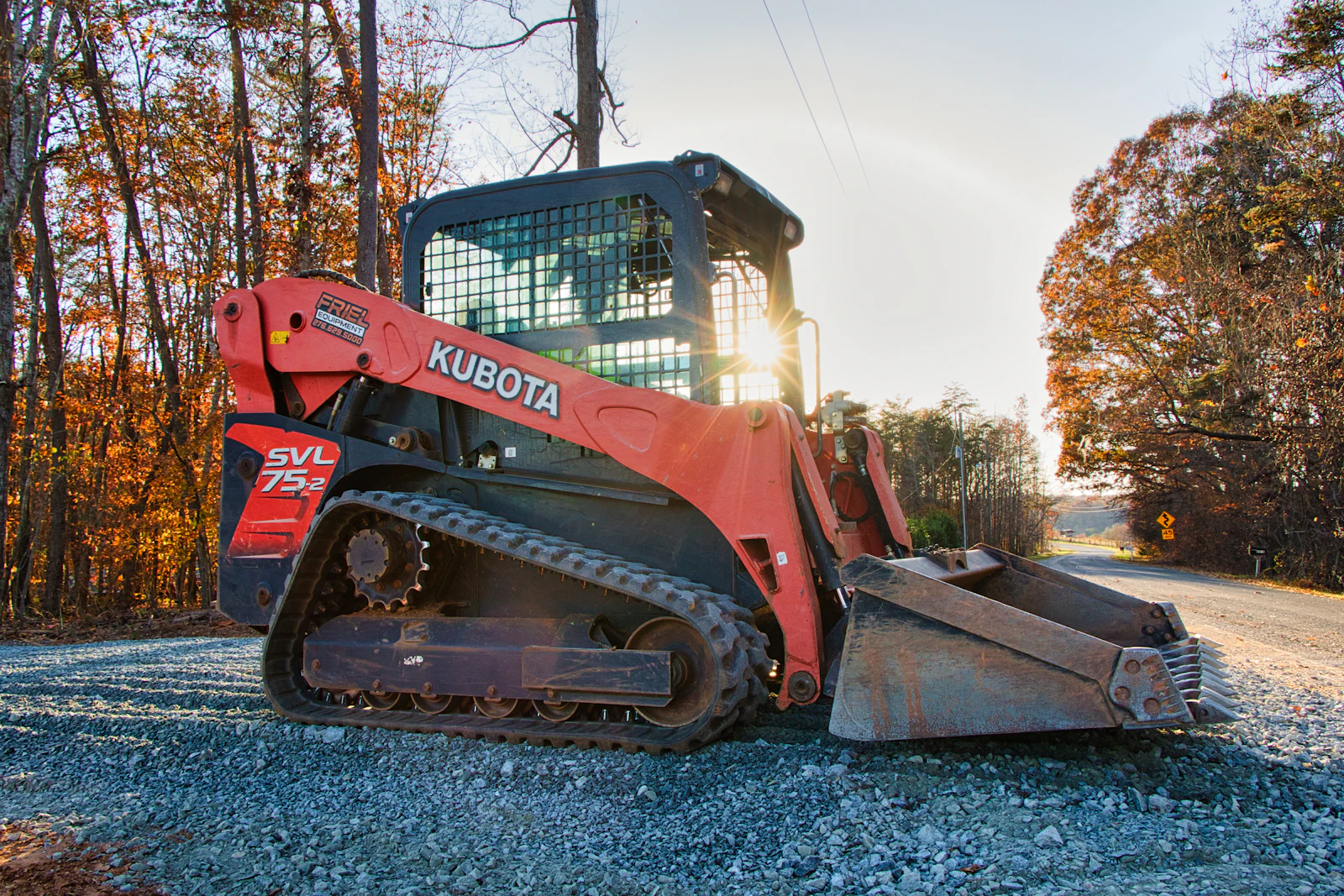
Skid Steer Loader Rental Rates San Diego 2026
For San Diego skid steer loader equipment hire supporting concrete driveway demolition, base export/import, and finish grading, 2026 planning budgets typically land in these ranges (machine only, before delivery/fees): $250–$450/day for a wheeled skid steer (roughly 1,500–2,000 lb ROC), $950–$1,700/week, and $2,200–$3,800 per 4-week period. For compact track loaders (CTLs) that reduce rutting and improve traction on decomposed granite or damp subgrade, plan $350–$550/day, $1,200–$2,100/week, and $3,000–$5,200 per 4 weeks. These ranges assume a standard 8-hour shift billing model and normal wear/tear; your real total is driven by delivery logistics, attachment mix (breaker, forks, bucket type), and return condition. As a reality-check, one San Diego-area rental yard publicly lists a small Bobcat S70 skid steer at $300/day, $1,070/week, and $2,315/month (published rate example, subject to change). Major networks serving the county (and commonly quoted by contractors) include United Rentals, Sunbelt Rentals, Herc Rentals, Cat Rental Store / Hawthorne Cat, and local independent yards; negotiated account pricing can move totals materially versus published “web” rates.
| Vendor |
Daily Rate |
Weekly Rate |
Review Score |
Website |
| United Rentals |
$400 |
$1 300 |
8 |
Visit |
| Sunbelt Rentals |
$400 |
$1 200 |
7 |
Visit |
| Sunstate Equipment |
$410 |
$1 079 |
9 |
Visit |
| Lakeside Equipment Sales & Rental |
$300 |
$1 070 |
9 |
Visit |
What Changes Skid Steer Equipment Hire Cost on a Concrete Driveway Job?
Concrete driveway scopes tend to push skid steer hire costs up compared to general earthmoving because the work is hard on tires/undercarriage, the job often requires a hydraulic breaker or planer, and debris handling can trigger cleaning and damage exposure. From a rental-coordinator perspective, the largest cost swings usually come from: (1) carrier class (mini vs 1,800 lb ROC vs 2,900 lb ROC), (2) wheeled vs tracked (CTL premium), (3) hydraulics (standard-flow vs high-flow), (4) attachment pairing and coupler compatibility, and (5) the transport and off-rent rules for San Diego delivery windows (urban access, driveway slope, and tight staging are common constraints west of I-805).
Machine Class (And Why “Small” Can Be More Expensive in the Field)
For a typical residential-to-light commercial driveway replacement, many foremen prefer a mid-size wheeled skid steer (around 1,700–2,000 lb ROC) for loading broken concrete into dump trailers, cutting grade, and handling base rock—provided access is adequate and you can avoid surface damage. Mini skid steers (or very small frame machines) can be attractive for narrow access but can drive longer cycle times, meaning you may need extra rental days (or exceed run-time limits) to hit production targets.
When planning equipment hire costs, align the class to your production plan:
- Mini / small skid steer (tight access): published example in the San Diego market shows $180 (3-hour), $240 (4-hour), $300/day, $1,070/week, $2,315/month.
- Mid-size wheeled skid steer (common driveway carrier): plan $300–$450/day depending on ROC, cab, and hydraulics.
- Compact track loader (CTL) for traction and reduced rutting: plan +$75–$150/day premium over a comparable wheeled unit, especially when you need to work after coastal morning moisture or when the subgrade is unstable.
Run-Time Limits, Overage, And Second-Shift Exposure
Most national rental terms effectively price the machine for a single shift. Herc’s published terms, for example, describe standard entitlement as 8 hours/day, 40 hours/week, and 160 hours per 4 weeks, with overage charged by a fraction of the base rate (e.g., 1/8 of the daily charge per extra hour on daily rentals). Even if your supplier’s exact formula differs, you should budget for overage if your driveway demo runs long, you add hauling/stockpiling tasks, or you lose time to sawcutting and utility locates.
Practical budgeting allowances that commonly show up on San Diego driveway packages:
- Overage hours: budget $35–$85 per hour depending on daily rate and the vendor’s fraction-of-rate policy.
- Weekend exposure: plan a 10%–25% weekend/after-hours premium when requesting Saturday delivery or late pickup windows (policy varies by branch and account).
- “Keep it one more day” risk: carry an extra 0.5–1.0 day contingency if you’re sequencing demo, formwork, and subgrade proof-roll tightly.
Skid Steer Attachments: The Real Cost Center on Concrete Driveway Work
For concrete driveway removal, the skid steer itself is rarely the whole story. Attachments often add 30%–90% to the rental ticket, and they also drive additional charges (wear parts, pins, cleaning, hydraulic couplers). Two widely used attachment classes for driveway scopes are:
- Hydraulic breaker (hammer): One San Diego-area yard publishes a breaker attachment at $235/day, $705/week, and $1,645/month. Another North County provider advertises a breaker attachment at $200/day (pickup only).
- Pallet forks: Published attachment pricing varies by supplier and region; one 2026 brochure example (not San Diego-specific) lists pallet forks at $59/day, $155/week, $397/4-week. Use this as a planning adder when you need to unload pavers, base, or form material on-site.
Common driveway-related attachment adders to carry in a 2026 estimate (allowances, not guaranteed quotes):
- Tooth bucket upgrade: +$25–$60/day when the standard smooth bucket can’t bite caliche/hardpan or you need better breakout for subgrade shaping.
- 4-in-1 bucket: +$90–$175/day when you need grab, backdrag, and finish control.
- Hydraulic auger drive: +$120–$220/day (bits often priced separately) for pier drilling or fence resets tied to driveway expansion joints.
- Planer / cold planer: +$350–$650/day if you’re feathering transitions at the garage slab or sawcutting isn’t feasible across the full depth.
Hidden-Fee Breakdown
To keep skid steer loader hire cost forecasts credible, build the “non-machine” lines into the estimate up front. These are the fees that most often surprise PMs when the driveway scope is aggressive or the site is constrained.
- Delivery / pickup: In San Diego County, budget $125–$275 each way for a skid steer/CTL in normal conditions; if your branch uses mileage beyond a base radius, carry $6–$10 per mile after the first 10–20 miles. Tight access (alley, steep approach, busy arterial) can trigger a smaller truck requirement and bump cost.
- Minimum delivery charge: carry a $150 minimum when you’re outside standard routes or requesting timed windows.
- Environmental / recovery fees: allow 5%–12% of the rental subtotal (commonly applied to machine + attachments; policy varies). Note that at least one San Diego yard explicitly notes environmental fees may be added.
- Damage waiver (DW): allow 10%–15% of the rental charges unless you are providing a certificate of insurance and have DW waived/modified by contract. (Confirm whether tires/tracks and attachment tools are excluded.)
- Fuel / recharge: skid steers usually go out full and are expected back full. Allow $6–$8 per gallon for vendor refuel pricing plus a $25–$50 service fee if returned low. One published rate sheet example (not San Diego-specific) notes units are sent out full and “make-up fuel” is charged on return.
- Cleaning: driveway demo can leave concrete slurry, rebar wire, mud, and adhesive residue. A published rate sheet example lists an excessive cleaning fee of $75 per hour. Carry a realistic allowance of $150–$450 (i.e., 2–6 hours) if you’re working in wet base, cutting asphalt transitions, or stockpiling spoils against the machine.
- After-hours / waiting time: if you miss the return cutoff, budget a $95–$175 after-hours lockbox/drop fee or an additional day, depending on contract terms.
- Late return / off-rent rules: if off-rent must be called in by (typical) 2:00–4:00 PM to stop billing next day, missing the cutoff can add 1 extra day even if you park the unit overnight.
San Diego-Specific Cost Drivers (Driveways)
San Diego’s operating realities can swing equipment hire costs in ways that estimators outside the region often miss:
- Urban delivery friction: Downtown, North Park, and coastal neighborhoods often require tight delivery windows and spotter coordination. If the truck can’t stage, you risk a return-trip fee or a second mobilization (carry +$125–$250 contingency on “must-hit” timed deliveries).
- Dust control expectations: Grinding, breaking, and loading broken concrete can trigger stricter dust-control practices. If you’re pairing with a water tank or using wet methods, expect more slurry cleanup and higher cleaning exposure (carry +$150–$300 cleaning contingency versus dry soil work).
- Grade and traction: Sloped driveways in hill areas can favor CTLs for stability. The CTL premium may still pencil out if it avoids tire spin, surface damage, or stalled production (especially when your export trucks must be loaded quickly to maintain haul cycles).
Example: 2-Day Concrete Driveway Demo With Breaker (San Diego)
Scenario: remove a 900 sq ft concrete driveway at 5 in average thickness, export broken concrete into a dump trailer, and rough-grade base in a single mobilization. Access is a 9 ft gate with a moderate slope; delivery must arrive between 7:00–9:00 AM due to school traffic restrictions on the street.
Planning hire package (allowance-level budget, 2026):
- Skid steer (mid-size wheeled): $375/day × 2 = $750
- Breaker attachment: use a published San Diego-area example class at $235/day × 2 = $470
- Delivery + pickup: $225 each way = $450 (timed window risk included)
- Damage waiver: 12% of rental charges (machine + breaker) = ~$146
- Environmental fee: 7% of rental charges = ~$85
- Fuel top-off: allow $60 (roughly 8–10 gallons equivalent at vendor pricing)
- Concrete slurry / dust cleanup: allow $225 (e.g., 3 hours at $75/hr benchmark)
- Run-time overage: allow $80 for 2 extra hours if you exceed an 8-hour shift and the contract applies a fraction-of-day hourly charge.
Total planning range: approximately $2,100–$2,500 all-in for the equipment hire portion (skid steer + breaker + typical fees), before taxes and before any additional attachments (forks, 4-in-1, planer) or second mobilization. This is the kind of number that holds up in a precon review because it explicitly carries delivery, waiver, cleanup, and overage exposure rather than treating “$375/day” as the whole story.
Budget Worksheet (Estimator-Ready, No Tables)
- Skid steer loader hire (wheeled): $300–$450/day; allow ___ days
- CTL upgrade (if required): +$75–$150/day; allow ___ days
- Breaker attachment hire: $200–$235/day; allow ___ days
- Forks attachment hire: +$40–$80/day (allowance)
- Bucket upgrade (tooth or 4-in-1): +$25–$175/day (allowance)
- Delivery (in): $125–$275 (allowance)
- Pickup (out): $125–$275 (allowance)
- Timed window / re-delivery contingency: $125–$250
- Damage waiver: 10%–15% of rental charges
- Environmental / recovery fees: 5%–12% of rental subtotal
- Fuel top-off: $40–$120 (allowance)
- Cleaning allowance: $150–$450 (2–6 hours) at $75/hr benchmark
- Run-time overage allowance: $50–$200 depending on schedule risk
- Damage exposure contingency (tires/tracks/attachment tools): $250–$1,500 depending on surface and debris (project risk allowance)
Rental Order Checklist (PO, Delivery, Off-Rent, Return)
Use this checklist to prevent the most common avoidable charges on skid steer loader equipment hire in San Diego—especially for concrete driveway work where attachments and cleanup can create disputes at off-rent.
- PO scope clarity: list the exact carrier class (ROC range), wheeled vs CTL, cab type (open vs enclosed), and whether high-flow hydraulics are required for breaker/planer.
- Attachment compatibility: confirm coupler type, hydraulic couplers, and whether the breaker includes the correct tool and retainer hardware. If you need a specific bit size, document it on the PO.
- Delivery requirements: provide jobsite contact, phone, and a delivery map; call out gate width (e.g., minimum 9 ft), slope, and where the truck can stage.
- Delivery window and cutoff: confirm the branch cutoff time for next-day delivery and for same-day off-rent calls (often 2:00–4:00 PM).
- Condition documentation: take dated photos of tires/tracks, bucket cutting edge, auxiliary hydraulics, cab glass, and hour meter at delivery and at pickup/return.
- Fuel policy: confirm “full-out/full-in” expectation and the refuel billing rate; plan who is responsible for fueling on-site.
- Grease and daily checks: assign responsibility for greasing, checking fluids, and daily walk-arounds; note that neglect can create wear/repair back-charges.
- Dust-control plan: document whether you are wet-cutting/sawcutting, using water suppression, or using vac/dust collection; this affects return cleanliness expectations.
- Off-rent process: confirm who is authorized to off-rent; require a return authorization or off-rent confirmation number before releasing the unit.
- Pickup readiness: stage attachments, remove debris wrapped around axles/tracks, and ensure the machine is accessible at the promised time to avoid “attempted pickup” or waiting charges.
How to Decide Between Wheeled Skid Steer and CTL (Cost-First)
For concrete driveway scopes, the decision is usually cost vs risk:
- Choose wheeled when you’re primarily loading broken concrete, operating on hard surfaces, and you can protect finished surfaces (plywood/track mats). Wheeled units often deliver the lowest base day rate and can be easier to clean.
- Choose CTL when you have soft subgrade, slope traction concerns, or you need to work early in the morning when coastal moisture makes the base slick. The higher day rate can be offset by fewer stuck events, less rut repair, and better grade control.
Budget note: if a CTL saves even 0.5 day of schedule on a two-day package, it can net out cheaper after delivery, waiver, and off-rent friction.
Billing Cycles And “4-Week” Math That Impacts Your Month Price
Many rental programs price “monthly” as a 4-week (28-day) period, not a calendar month. That matters when you have a driveway program running across month-end with staggered pours. If your schedule slips, your 29th–31st day can start a new cycle (or add pro-rated days), depending on contract. In 2026 planning, protect yourself by:
- Calling the period “4-week” on internal budgets and POs to avoid calendar-month confusion.
- Carrying a 2–3 day schedule contingency on long-lead driveway programs (utilities, inspections, homeowner access constraints).
Common Dispute Items (And What They Typically Cost)
These are the back-charges most frequently argued on concrete driveway equipment hire, with realistic 2026 allowance ranges so you can pre-approve contingencies:
- Excess cleaning: $75/hour benchmark exists on at least one published rate sheet; plan $150–$450 typical exposure.
- Broken or missing attachment pins/hoses: $65–$250 depending on hardware and labor.
- Breaker tool wear: $90–$300 if the tool is returned excessively worn or damaged (varies by tool and policy).
- Tire damage: $250–$900 per tire if you run over rebar, wire, or demo debris; risk increases when you stockpile broken concrete with protruding steel.
- Track damage / undercarriage wear (CTL): $500–$2,500 depending on severity and whether the vendor treats it as abnormal wear.
- Glass damage (enclosed cab): $350–$1,200 depending on panel and availability.
- Transport re-attempt: $125–$250 if the driver cannot access the drop location or the unit is blocked at pickup.
Operational Controls That Reduce Total Equipment Hire Cost
On driveway work, cost control is mostly operational discipline—especially around attachments and off-rent timing:
- Right-size the breaker: pairing an oversized breaker to a small carrier can slow production and extend days. Validate hydraulic requirements before dispatch.
- Stage export logistics: schedule dump trailers so the skid steer is always loading, not waiting. One lost hour per day can turn into billable overage under single-shift terms.
- Protect tires/tracks: enforce a “no rebar forest” rule in the stockpile area; cut rebar or keep it segregated to reduce punctures.
- Document condition: photos at delivery and pickup are your best defense against “pre-existing” damage disputes.
- Off-rent early: if your vendor cutoff is mid-afternoon, build a reminder into the foreman’s daily closeout so billing stops when production stops.
Sanity-Check: Published Rate Examples You Can Reference Internally
For internal estimating benchmarks (not promises of your account rate), the following published examples help you sanity-check whether a quote is in-family:
- Small skid steer (San Diego-area listing): $300/day, $1,070/week, $2,315/month for a Bobcat S70; also shows $180 (3-hour) and $240 (4-hour) options.
- Breaker attachment (San Diego-area listing): $235/day, $705/week, $1,645/month.
- Run-time entitlement concept (national program example): 8 hours/day, 40 hours/week, 160 hours/4 weeks, with overage charged as a fraction of base rate (example policy).
If your San Diego quote is far above these references, it may still be justified (larger ROC, high-flow, enclosed cab, or premium delivery requirements). The key is to force the quote to declare what is included: delivery radius, damage waiver, environmental/recovery fees, refuel, and cleaning thresholds.
When to Hire Longer-Term vs Re-Rent Weekly
For a contractor running multiple driveway replacements, long-term equipment hire can be cheaper than repeated weeklies—but only if you control idle days. A practical rule: if the skid steer will be active 12–15 days out of a 4-week period and you can store it securely, a 4-week rate usually outperforms stacking weeklies once you include repeated delivery/pickup. If you cannot secure the unit (theft risk) or you’ll have 5+ idle days waiting for inspections and pours, weekly rentals often reduce waste despite higher per-day math.
Summary for Rental Coordinators
For 2026 budgeting in San Diego, treat skid steer loader hire for concrete driveway work as a packaged cost: machine + delivery + waiver/fees + attachment(s) + cleanup + overage risk. If you build those lines explicitly, your estimate will track the invoice closely, your PM can pre-approve realistic contingencies (cleaning, fuel, tire/track exposure), and your off-rent process will stop billing on time rather than “when someone remembers.”