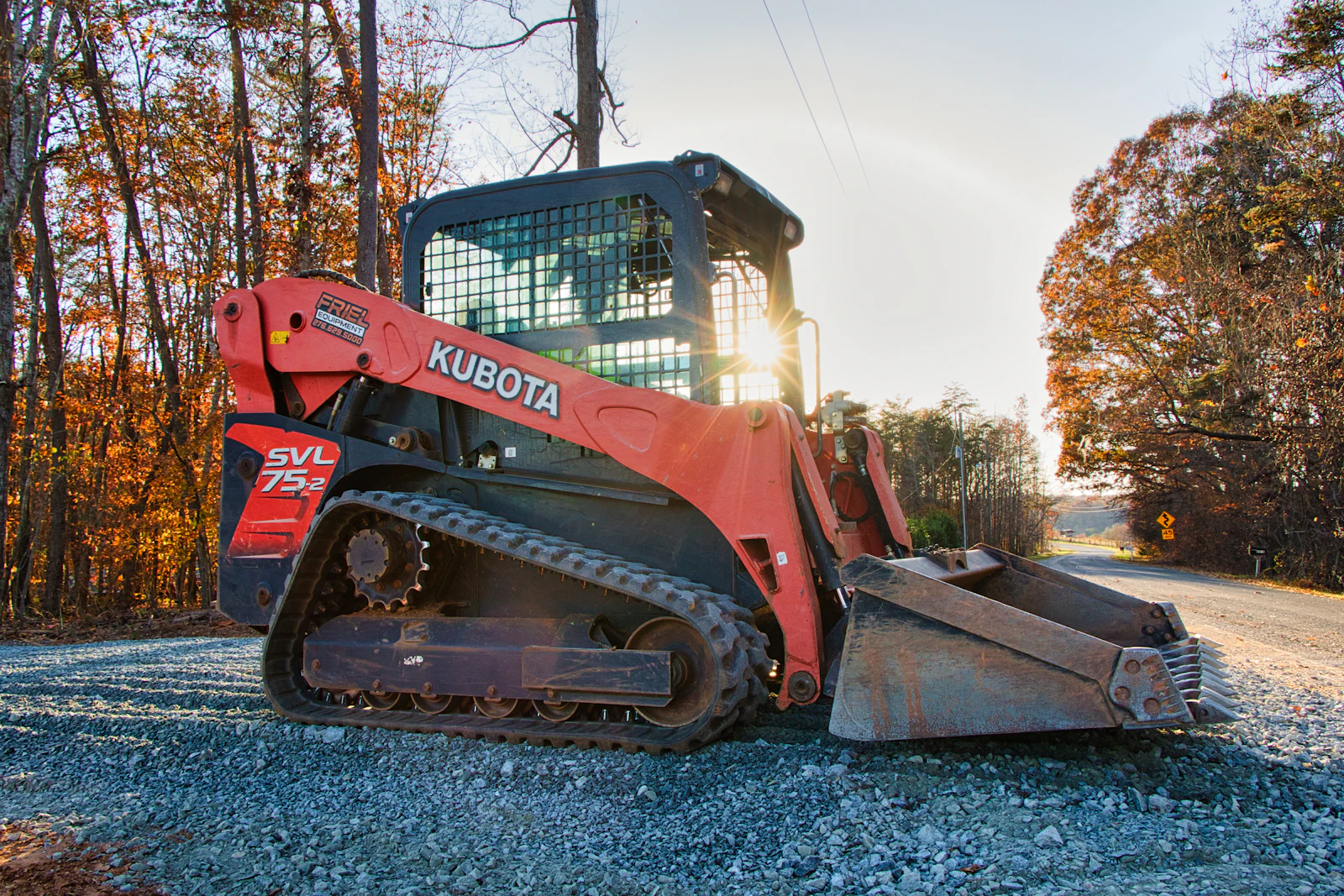
Skid Steer Loader Rental Rates San Francisco 2026
For San Francisco skid steer loader equipment hire supporting a concrete driveway scope (demo support, base import/export, grading, backfill, and material staging), a practical 2026 planning range (machine-only, no operator) is typically $325–$650/day, $1,050–$2,050/week, and $2,750–$5,750 per 28-day/4-week period depending on rated operating capacity (ROC), wheeled vs. tracked undercarriage, and whether you need high-flow hydraulics for attachments. In the San Francisco market, national rental fleets (e.g., United Rentals, Sunbelt, Herc) and well-equipped regional yards can usually cover both standard-flow wheeled units for tight residential access and higher-spec machines needed for breaker/broom work; your actual hire cost will swing most on access constraints, delivery windows, and attachment selection rather than base rate alone.
| Vendor |
Daily Rate |
Weekly Rate |
Review Score |
Website |
| United Rentals |
$317 |
$895 |
7 |
Visit |
| Sunbelt Rentals |
$299 |
$789 |
10 |
Visit |
| Herc Rentals |
$450 |
$1 100 |
9 |
Visit |
| Cresco Equipment Rentals (Cat Rentals) |
$435 |
$945 |
9 |
Visit |
Rate Assumptions Used for 2026 Concrete Driveway Estimating
When you compare skid steer rental rates across vendors, confirm the hour-basis behind the “day / week / month” numbers. Many commercial rate sheets are structured around an 8-hour day, a 40–44-hour week, and a 160–176-hour month (or a 28-day billing period). That hour-basis matters on concrete driveway replacements where you may run extended hours to hit pour windows and inspection cutoffs, or you may have low run-time but long possession time due to staging constraints.
What You Should Budget by Skid Steer Class (Wheeled vs. Tracked)
For San Francisco concrete driveway work, you’re typically choosing between (1) a wheeled skid steer loader to minimize surface disruption on existing flatwork and maneuver through narrow side yards, or (2) a compact track loader when you need traction on steep grades, wet subgrade, or demolition spoils. Use these 2026 budgeting bands for equipment hire (exclusive of tax, delivery, damage waiver, and fuel):
- Small / mid-frame wheeled skid steer (approx. 1,500–2,400 lb ROC): budget $325–$475/day, $1,050–$1,450/week, $2,750–$3,750 per 4 weeks.
- Large-frame wheeled skid steer (approx. 2,900–3,400 lb ROC): budget $375–$575/day, $1,250–$1,850/week, $3,250–$4,650 per 4 weeks.
- Compact track loader (CTL) for slope/traction (approx. 1,500–3,800 lb ROC): budget $450–$750/day, $1,450–$2,250/week, $3,600–$5,750 per 4 weeks (high-flow and heavier units trend to the top of the range).
As external anchors for your internal estimate, published rate sheets in the market show examples like $300/day, $900/week, $2,250/4-week for a mid-frame skid steer class and $370/day, $1,110/week, $3,330/4-week for a smaller track loader class (rates vary by region, fleet age, and spec). For a higher-spec high-flow class skid steer with cab/AC, published daily/weekly/monthly pricing can also run substantially higher.
San Francisco Concrete Driveway Constraints That Change the Hire Cost
San Francisco driveway scopes create real cost deltas versus suburban earthwork because the logistics (not the machine) often dominate the invoice:
- Tight access and staging: If you need a smaller frame to fit a 36–48 inch gate or to work in a garage/under a carport, you may pay more per productive yard moved because the rental class is less efficient. Conversely, forcing a large-frame unit can trigger extra costs for protection mats and spotters.
- Steep grades and traction: Neighborhood topography can push you from wheeled to tracked. Track machines typically carry higher base hire and higher “wear and tear” risk if used on abrasive demo rubble.
- Delivery window limitations: Downtown or dense residential zones frequently require AM-only delivery windows and strict return appointments. Missed appointments commonly convert into additional possession days even if the machine is idle.
For skid steer loader rental for concrete driveway replacement in San Francisco, you’ll often save money by paying slightly more for the right attachment package (to reduce labor and re-handling) rather than extending the base machine hire by 1–2 extra days.
Attachment Adders You’ll See on Driveway Scopes (Bucket, Forks, Breaker, Broom)
Attachments are where concrete driveway jobs can quietly double the “rental” line if you don’t pre-plan. Below are planning adders you can use for 2026 budgets; always confirm hydraulic flow and coupler compatibility.
- 4-in-1 bucket: plan $125–$195/day, $400–$650/week, $800–$1,200/4-week. (Published examples include $145/day, $440/week, $900/month on a commercial rate sheet.)
- Pallet forks (to stage rebar, forms, bagged mix, pavers): plan $60–$120/day, $200–$350/week, $450–$900/4-week. (Published examples include $80/day, $250/week, $650/month.)
- Hydraulic breaker/hammer (for slab demo): plan $225–$375/day, $750–$1,150/week, $2,000–$3,000/4-week depending on hammer size and whether bits are included.
- Angle broom / sweeper (cleanup for inspection/pour prep): plan $175–$300/day, $600–$900/week, $1,500–$2,600/4-week.
Hidden-Fee Breakdown
To keep your skid steer equipment hire cost accurate for San Francisco concrete driveway work, treat these as “expected” rather than “surprise” items:
- Delivery / pickup: budget $175–$325 each way inside a typical metro radius; add $6–$12/mile outside the base radius. If a truck is forced to wait for curb clearance or a spotter, budget $120–$185/hour for standby time.
- Damage waiver / rental protection: commonly 10%–15% of the base rental (machine + attachments). Confirm whether tires/tracks/glass are excluded.
- Cleaning: budget $95–$175 for a “normal wash,” but if the unit comes back with concrete slurry, mud-packed undercarriage, or hardened spoils, plan $75/hour shop cleaning as a realistic line item.
- Fuel and refueling: typical refuel charges land around $5–$9/gal equivalent on many invoices. If you return the unit below the agreed level (often “full”), you’ll pay make-up fuel plus a service fee.
- Wear items: track damage and excessive undercarriage wear are common chargebacks on CTLs used over broken slab and rebar debris. Carry a contingency of $250–$900 on demolition-heavy driveway scopes where the operator is not your employee.
- Late return / extra day conversion: if you miss the cutoff, an after-hours pickup can add $150–$250, and missing the off-rent window often triggers another full daily charge (even with low hours).
Operational Rules to Confirm Before You Release a PO
These are the “rules of the road” that change the final hire cost more than most coordinators expect, especially in San Francisco:
- Off-rent notice: confirm whether off-rent must be called by 12:00 PM or 3:00 PM local time to avoid an additional day.
- Weekend billing: confirm if a Friday PM drop automatically bills through Monday AM (or if a weekend rate exists).
- Hour overages: confirm hourly overage rate (often $35–$75/hour equivalent) once you exceed the daily or weekly hour cap.
- Return condition documentation: require time-stamped photos of bucket edges, tires/tracks, coupler face, and cab glass at delivery and pickup to avoid post-return disputes.
Budget Worksheet (Concrete Driveway Skid Steer Hire)
Use this as a field-ready estimating artifact for a San Francisco driveway replacement where the skid steer is supporting demo and subgrade prep.
- Skid steer loader (wheeled, standard-flow): allow 3 days at $375–$525/day.
- Attachment – 4-in-1 bucket: allow 3 days at $140–$190/day.
- Attachment – breaker/hammer: allow 1–2 days at $250–$350/day (plus spare bit allowance $40–$90 if billed separately).
- Attachment – forks: allow 2 days at $70–$110/day (often avoidable if you can hand-stage materials).
- Delivery + pickup: allow $450–$650 total (two-way), plus standby contingency $125.
- Damage waiver / rental protection: allow 12% of (machine + attachments).
- Cleaning contingency: allow $150 (or 2 hours at $75/hour if you expect slurry/mud).
- Refuel / recharge: allow $75–$180 depending on run hours and whether you can refuel on-site.
- Surface protection (mats/plywood for crossing existing flatwork): allow $120–$280 (quantity depends on access path and turn radius).
- Risk allowance (tires/tracks & bucket edge wear on demo debris): allow $300–$800 for high-demo scopes.
Example: 20' x 30' San Francisco Driveway Replacement With Tight Access
Scenario: A 600 sq ft driveway demo and replacement in San Francisco with a narrow staging area and a delivery window restricted to 7:00–9:00 AM. You need the skid steer for demo support (loading debris), base grading, and final cleanup. A workable 2026 equipment-hire allowance (rounded) looks like:
- Wheeled skid steer: 3 days at $450/day = $1,350
- Breaker: 2 days at $300/day = $600
- 4-in-1 bucket: 3 days at $165/day = $495
- Delivery + pickup: $275 each way = $550
- Damage waiver: 12% of $2,445 = $293
- Cleaning/refuel combined contingency: $225
Budgetary total (equipment hire + common rental fees only): approximately $3,500 before tax. The two biggest preventable overruns on this exact scope are (1) missing the off-rent cutoff and paying an extra daily charge, and (2) returning the unit with concrete fines/slurry that triggers shop cleaning time.
San Francisco Notes to Reduce Total Hire Cost (Without Downgrading the Machine)
- Prefer one well-planned delivery: If your street access is constrained, coordinate a single delivery/pickup with a clear curb zone rather than paying a second mobilization (often another $175–$325).
- Protect surfaces proactively: Budgeting $150–$250 for protection can be cheaper than a claims dispute over cracked pavers, scraped curbs, or track marks.
- Right-size the attachment package: Adding a broom for $200–$300/day can be cheaper than extending the skid steer hire by a day to meet cleanup requirements before inspection or pour.
Rental Order Checklist (For Skid Steer Loader Equipment Hire in San Francisco)
Use this checklist to keep the PO clean and avoid re-billing, especially on San Francisco driveway work where delivery timing and return condition are the main cost risks.
- PO details: machine class (ROC or model class), wheeled vs. tracked, enclosed cab vs. open ROPS, standard-flow vs. high-flow, bucket type, and required coupler style.
- Billing basis: confirm 8-hour day cap, weekly cap, and whether “month” means 28 days or 30 days; confirm hour-meter overage charges.
- Insurance & damage waiver: provide COI if required; decide whether to accept the rental protection plan (often 10%–15% of rental) or use your own coverage.
- Delivery plan: delivery date/time window, onsite contact, gate width, street grade, and whether a tilt-deck can safely unload. Carry a standby allowance of $120–$185/hour if curb space cannot be guaranteed.
- Site constraints: indoor/garage work requires ventilation controls; dense neighborhoods often require dust suppression—confirm whether fines/slurry cleanup standards apply.
- Return requirements: confirm off-rent cutoff (often 12:00 PM or 3:00 PM), pickup appointment, and cleaning expectations (avoid $75/hour cleaning charges by returning reasonably clean).
- Condition documentation: delivery and pickup photos of tires/tracks, cutting edge, coupler plate, hydraulic hoses, and cab glass; capture hour meter at off-rent.
How to Decide Between Wheeled Skid Steer vs. CTL for Concrete Driveway Work
From a hire-cost standpoint, a CTL is not automatically “better” for driveway scopes. In San Francisco, choose CTL when the site is steep, wet, or access is over loose base where wheels spin. Choose wheeled when you’re working predominantly on hardscape and you want to reduce track wear exposure and minimize surface marking.
- Wheeled: lower base hire (often by $75–$150/day vs. comparable CTL), easier cleanup, less exposure to undercarriage wear chargebacks.
- CTL: higher base hire but may reduce schedule risk on steep grades; however, track wear exposure can be significant on demolition rubble—carry a $300–$800 contingency if the operator is not experienced in debris management.
Concrete Driveway-Specific Cost Drivers (Where Estimators Get Burned)
These are the line items that most often move the final invoice on a driveway replacement when the skid steer is used for demo support and grading:
- High-flow requirement for broom/breaker: if the attachment needs higher hydraulic flow, you may be forced into a higher-spec machine class with a larger daily rate.
- Cutting edge and bucket wear: aggressive scraping on compacted aggregate base can accelerate wear. If your rental agreement treats bucket edges as billable wear, carry $150–$400 risk.
- Missed pickup appointments: in San Francisco, missed or inaccessible pickups can translate into an extra day of rental plus re-dispatch costs (often $175–$325).
- After-hours handling: if you need a pickup outside normal hours to clear the street for morning traffic, budget $150–$250 as an after-hours pickup fee.
2026 Planning Benchmarks From Published Rate Sheets (Use as Anchors, Not Quotes)
Even though San Francisco pricing is vendor-, season-, and availability-dependent, it helps to anchor your estimate against published, itemized rate sheets:
- A published 2026 rate sheet shows mid-frame skid steer pricing around $300/day, $900/week, and $2,250/4-week, with a breaker at $250/day and forks at $80/day shown as separate adders.
- A commercial California rental rate sheet (dated 2025) shows a high-flow cab skid steer class listed at $650/day, $1,925/week, $5,750/month, and lists a 4-in-1 bucket at $145/day and forks at $80/day.
For San Francisco 2026 budgeting, it’s reasonable to carry a 10%–25% metro premium over non-Bay-Area published sheets when demand is tight, delivery is complex, or your timeline intersects with peak construction season.
Practical Ways to Lower Skid Steer Loader Hire Cost on San Francisco Driveway Jobs
- Bundle attachments to shorten possession time: paying $250–$350/day for a breaker for 1 focused day is usually cheaper than trying to “make do” and holding the base machine an extra day.
- Schedule around vendor cutoffs: if the vendor’s off-rent cutoff is 12:00 PM, plan your last productive shift earlier and keep the unit accessible for pickup to avoid a full extra day.
- Control cleaning exposure: assign a laborer for 30–45 minutes at the end of each day to keep the undercarriage and coupler clear; it’s often cheaper than paying $75/hour shop cleaning plus downtime disputes.
- Use surface protection strategically: a small spend ($120–$280) on protection is frequently cheaper than a claim or a rework delay when working around existing flatwork and tight property lines.
San Francisco-Specific Considerations to Call Out on the Rental Request
- Steep grades and narrow streets: tell the rental coordinator the approximate street slope and whether the truck must back in; it reduces failed deliveries and repeat mobilizations.
- Noise and neighbor proximity: breaker work may be time-restricted; compressing breaker use into a single day avoids carrying the attachment over the weekend and paying extra days.
- Dust control expectations: driveway demo fines can travel; if you expect cleanup requirements before pickup, add a broom day ($200–$300/day) rather than paying cleaning and losing the pickup slot.