

For San Jose skid steer loader equipment hire in 2026, plan your budget around three practical rate bands (excluding tax, fuel, and transport): (1) mini track / walk-behind units commonly land around $250–$325/day, $850–$1,150/week, and $2,200–$3,300 per 4-week; (2) wheeled skid steer loaders (typical mid-size ROC classes) generally pencil at $300–$425/day, $1,100–$1,600/week, and $3,300–$4,800 per 4-week; and (3) compact track loaders (CTLs) and higher-demand configurations trend higher—often $350–$650/day, $1,400–$2,200/week, and $4,200–$6,000 per 4-week in the Bay Area market depending on class, cab, and hydraulics. These ranges align with published Bay Area/Bobcat dealer rate cards and marketplace averages for San Jose-area track-loader classes; national rental houses with San Jose-area coverage (e.g., United Rentals, Sunbelt, Herc) and regional yards typically quote within these bands once delivery windows, damage waiver, and utilization assumptions are set.
| Vendor | Daily Rate | Weekly Rate | Review Score | Website |
|---|---|---|---|---|
| United Rentals | $410 | $1 004 | 9 | Visit |
| Sunbelt Rentals | $410 | $1 004 | 7 | Visit |
| Herc Rentals | $410 | $1 004 | 7 | Visit |
| The Home Depot Tool & Truck Rental | $410 | $1 004 | 8 | Visit |
| Dahl's Equipment Rentals | $285 | $855 | 9 | Visit |
When rental coordinators get “surprise” skid steer hire invoices in Santa Clara County, it’s usually not the base day rate—it’s configuration and operating rules. The biggest cost drivers you should lock down at requisition stage are: machine class (ROC), wheels vs. rubber tracks, cab vs. open ROPS, and whether you need high-flow hydraulics for a planer, brush cutter, or larger breaker. Even within published Bobcat-style bands, a small-frame skid steer can be hundreds per week cheaper than a CTL with cab and high-flow, and the delta widens further once you add specialized attachments (breaker, auger kit, grapple, broom) that each carry their own hire charges.
Most commercial skid steer loader rental rates are built on a utilization assumption. A common structure is 1 day = 24 hours elapsed time with an 8 machine-hour cap, 1 week = 7 consecutive days with a 40 machine-hour cap, and 1 month/4-week = 28 consecutive days with a 160 machine-hour cap. Overtime charges apply when those hour caps are exceeded, so a “cheap” weekly rate can become expensive if the crew runs extended shifts.
From a contract-admin perspective, confirm the overtime math in writing. One widely used approach (published by major rental firms) is billing excess usage at an hourly fraction of the base rate (e.g., 1/40 of the weekly charge per hour when you exceed the weekly hour allotment). If your San Jose scope includes swing shift or weekend production pushes, treat overtime as a predictable line item—not a contingency.
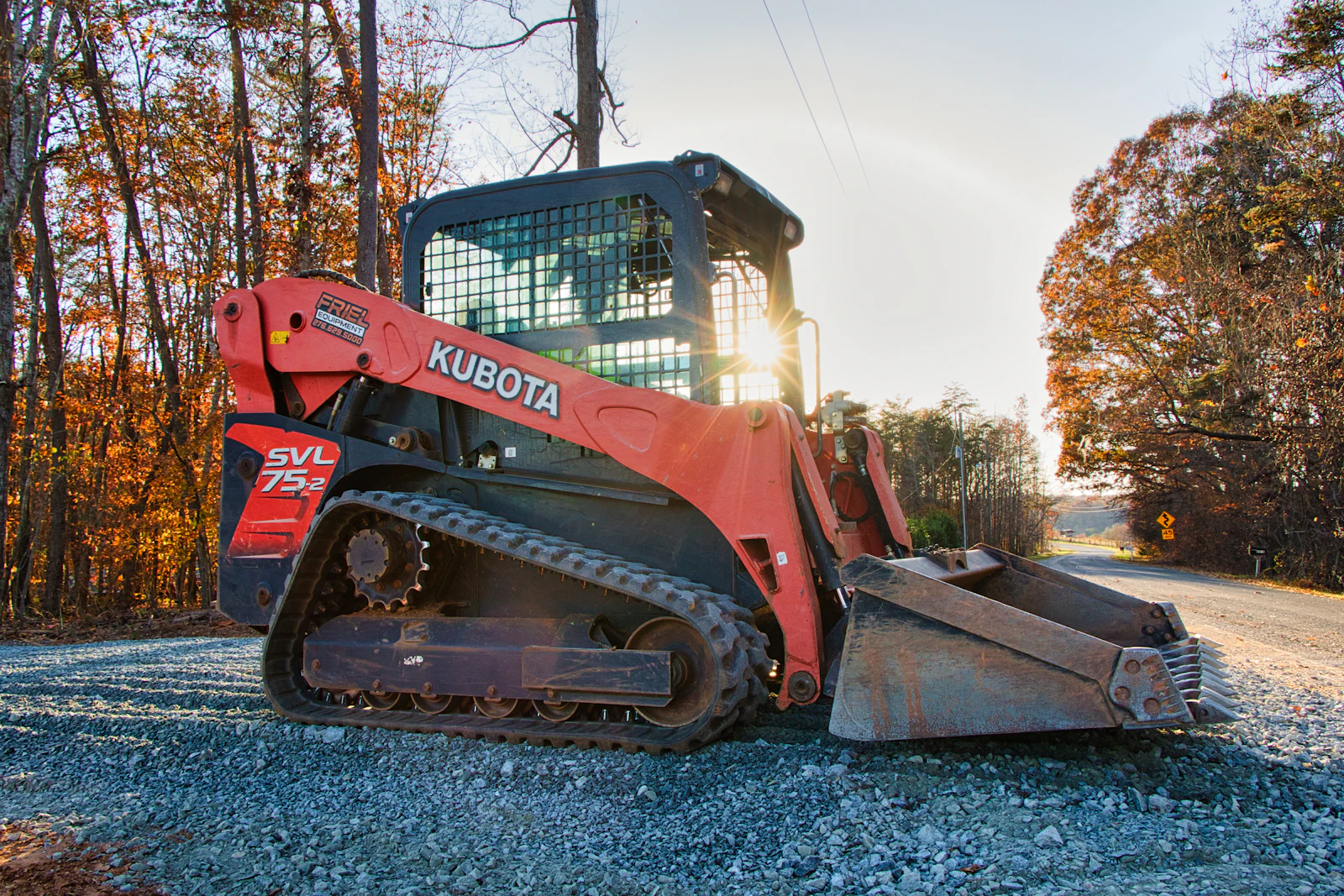
In San Jose infill work, the “right” undercarriage is often a cost control decision. Wheeled skid steers are typically less expensive to hire and easier to trailer, but they can struggle in saturated winter subgrades and can be rougher on finished paving. Compact track loaders cost more per day/week yet can reduce getting-stuck risk, reduce rework in soft soils, and improve traction on slopes around the Santa Cruz foothills. Budget-wise, published Bay Area rate cards show CTLs stepping up from the mid-$300s/day into the $400s/day range as you move into larger classes and cabbed units.
Also plan for surface protection and housekeeping. On tighter commercial sites (schools, hospitals, tech campuses), you may be required to use ground protection (mats/plywood) and implement dust-control that adds labor and sometimes additional rented accessories (sweepers, vacs). These requirements don’t always show on the initial quote but they absolutely impact total equipment hire cost.
San Jose logistics can materially change your skid steer loader equipment hire costs—especially when you add same-day requests or restricted delivery windows. Three local realities to plan for:
As a planning allowance (because transport varies by vendor routing), many Bay Area contractors carry $175–$325 each way for basic delivery/pickup of a skid steer within a typical local radius, plus potential mileage adders on longer hauls. If you’re renting through a national provider, read the surcharge language: some providers explicitly apply a transportation surcharge on top of stated delivery rates (one major provider publishes a fixed component of 9% with a $9 minimum, plus a variable diesel-driven component).
Attachment pricing can rival the base machine if you’re running specialty scopes. Bay Area published rate cards show practical adders such as:
Cost-control tip: if the scope needs a breaker or planer, confirm standard-flow vs. high-flow requirements early. High-flow machines are typically more expensive, and swapping machines mid-rental can trigger additional transport charges plus downtime.
For professional skid steer loader hire pricing in San Jose, the “hidden fees” are usually contract-defined fees that weren’t carried in the original estimate. Build them into your estimator notes:
Use this as a no-table, estimator-ready worksheet for skid steer loader equipment hire costs in San Jose. Adjust to your vendor’s quote and contract terms.
Scenario: You’re supporting a 2-week (14 consecutive days) San Jose utility trench backfill on a constrained site with a guarded gate, limited laydown, and a Saturday push. You choose a mid-size CTL comparable to a published Bobcat T590 class at $395/day or $1,580/week (rate-card example).
Operational constraint callout: If your security gate only allows deliveries 7:00–9:00 AM and 2:00–3:30 PM, document that on the PO and confirm the carrier’s arrival window. A missed appointment often costs more than the waiver—because it can trigger a second trip (and another day billed if you lose your return cutoff).
Use this checklist to reduce change orders and disputes on skid steer loader equipment hire in San Jose.
On San Jose projects, lowering the total skid steer hire cost is usually about eliminating non-productive rental time and preventing backcharges. The most effective levers are operational:
For professional equipment managers, the key is not whether to take a damage waiver—it’s understanding how it changes your risk and your invoice. Many rental firms charge a waiver/protection fee as a percentage of the rental total (a common published example is 10%). Some published dealer terms also specify a $50 minimum and a $2,500 deductible for loss damage protection; others treat the waiver as non-insurance and limit coverage for theft, negligence, or misuse.
San Jose-specific risk note: In dense infill and campus environments, theft/vandalism exposure and “unattended equipment” rules matter. If your contract requires secure storage, include costs for fencing/locks or overnight positioning as part of your equipment hire plan.
Fuel is an avoidable cost driver when it’s managed deliberately. Some national rental terms explicitly describe three common approaches: prepay fuel, pay on return, or return full (with refuel charges applied if you return below the issued level). Align your internal yard policy with the rental contract so the foreman doesn’t unknowingly choose the most expensive option at checkout.
For estimating, carry a refuel allowance tied to your operating hours. As a public reference point for California diesel assumptions in rate methodologies, one published benchmark lists $4.85/gal for an April 1, 2026 to March 31, 2027 effective period (tax handling may differ for off-highway). That’s not your invoice price—but it’s a useful anchor for 2026 planning discussions.
Cleaning backcharges are one of the most common post-return invoice issues for skid steers and CTLs—particularly after demo, flatwork prep, or slurry-adjacent work. Major rental terms explicitly state that cleaning charges apply when equipment is returned with excessive dirt, concrete, and/or paint. Treat this as a real cost exposure and set expectations with the field team.
Practical controls that lower total equipment hire cost:
San Jose pricing swings more by availability and class than by the city name on the PO. Marketplace data for San Jose-area compact track loader classes shows an average daily price around $555 and also references higher “average across companies” numbers (e.g., $612/day, $1,837/week, $4,453/month) depending on the class mix being sampled. Use that information as a reality-check when a quote feels out of band, especially for larger CTLs or high-flow configurations.
Two local considerations to keep in your cost notes:
These are practical, no-table allowances that estimators and rental coordinators commonly carry (confirm with your vendor’s terms and your job constraints):
If you want, provide the planned rental duration, machine class (ROC), and attachments, and I can convert the above into a San Jose-ready “all-in” equipment hire budget narrative (still no tables) using your preferred assumptions for transport, waiver, and utilization.
