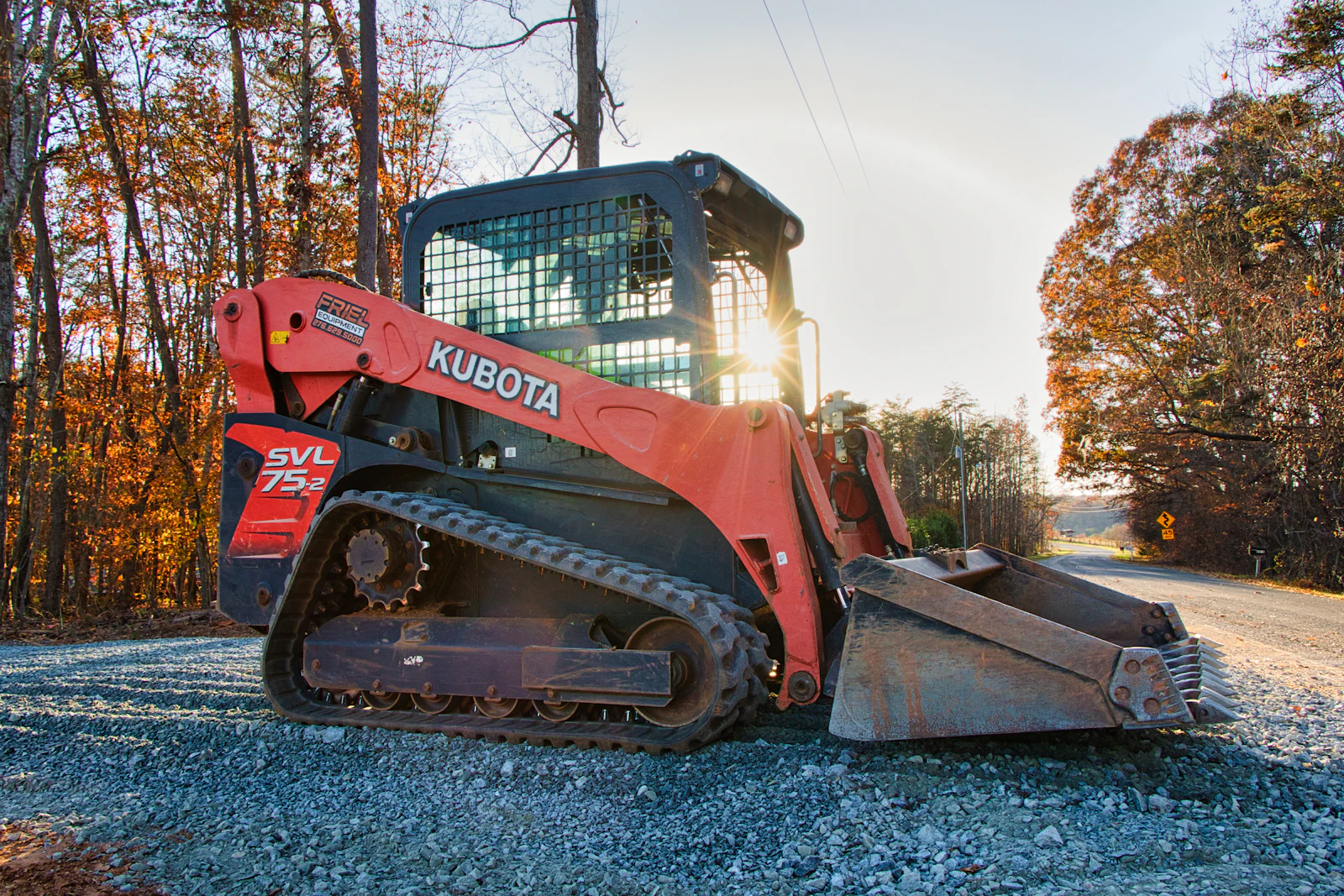
Skid Steer Loader Hire Costs Seattle 2026
For Seattle-area concrete driveway scopes (demo support, base import/export, grading, and cleanup), 2026 planning ranges for skid steer loader equipment hire typically land at $320–$475/day, $900–$1,250/week, and $2,150–$3,200 per 28-day for a mid-size wheeled skid steer (roughly 1,700–2,000 lb ROC). For a compact track loader (CTL)—often preferred in Seattle’s wet subgrades—budget $390–$575/day, $1,150–$1,650/week, and $2,700–$4,100 per 28-day depending on ROC, cab/heat, and hydraulics. These ranges assume “one-shift” utilization (8-hour meter day) and exclude delivery/pickup, fuel, damage waiver/insurance, cleaning, and attachment adders; they align with published Washington State contract rate benchmarks and Seattle market averages seen across large nationals (e.g., United Rentals, Sunbelt, Herc) and local yards that quote by class and availability.
| Vendor |
Daily Rate |
Weekly Rate |
Review Score |
Website |
| United Rentals |
$317 |
$895 |
9 |
Visit |
| Sunbelt Rentals |
$225 |
$660 |
9 |
Visit |
| Herc Rentals |
$264 |
$1 680 |
8 |
Visit |
| Star Rentals |
$290 |
$1 080 |
10 |
Visit |
Assumptions for 2026 budgeting in Seattle: (1) “Monthly” is treated as a 28-day / 4-week billing period unless your MSA states otherwise; (2) rates shown are for pickup unless noted; (3) utilization beyond 8 hours/day is billed as overtime or shift multipliers; (4) tracked machines reduce weather downtime but can increase cleaning/undercarriage time on return.
Rate Benchmarks You Can Use When Quoting Internally
If you need defensible “apples-to-apples” benchmarks for Seattle procurement or internal estimating, Washington State’s published contract pricing provides a useful floor/anchor for skid steer loader hire costs by ROC class (private-sector quotes can run higher based on demand and delivery constraints):
- Wheeled skid steer, ~1,700–1,899 lb ROC: published benchmark around $296/day, $856/week, $1,860/month.
- Wheeled skid steer, ~1,900–2,000 lb ROC: published benchmark around $317/day, $895/week, $2,173/month.
- Compact track loader, ~1,700–1,999 lb ROC: published benchmark around $381/day, $1,146/week, $2,711/month.
- Compact track loader, ~2,000–2,399 lb ROC: published benchmark around $393/day, $1,170/week, $2,856/month.
- Higher-capacity CTL, ~2,400–2,799 lb ROC: published benchmark around $463/day, $1,194/week, $3,045/month.
- High-capacity CTL, ~2,800–3,399 lb ROC: published benchmark around $528/day, $1,369/week, $3,202/month.
Seattle marketplace averages published by third-party aggregators often price a mid-size wheeled skid steer higher than public benchmarks (availability, delivery congestion, and seasonal demand). Use the public benchmark for “not-to-exceed” sanity checks, then apply your standard escalation and logistics adders for 2026.
What Drives Skid Steer Hire Pricing On Seattle Concrete Driveway Work?
Concrete driveway jobs tend to inflate the “real” hire cost versus soft-landscape scopes because you often need (a) a breaker or concrete-handling attachment, (b) tight residential access equipment (narrower machines or protective track options), and (c) extra cleanup standards to avoid chargebacks. In Seattle specifically, three recurring cost drivers show up in quotes:
- Weather and subgrade moisture: CTLs keep production up on wet, pumping base but usually cost more per day than wheels—and may come back with heavier undercarriage cleaning exposure.
- Access and slope: Queen Anne / Magnolia / West Seattle-type grades can push you toward a higher-capacity machine for stability, or toward rubber tracks/mats to protect finished surfaces—both adders.
- Logistics windows: dense neighborhoods and traffic routinely compress delivery/pickup windows; missed cutoff times can burn an extra billed day even if your crew is “off-rent ready.”
Attachments And Accessory Adders That Commonly Hit Driveway Budgets
Attachment pricing is where many skid steer loader equipment hire quotes move from “reasonable” to “surprising,” especially on demolition-adjacent driveway scopes.
Use these published adders as reference points when building a 2026 estimate (availability and class will vary):
- Hydraulic breaker (skid steer mounted): published benchmark around $674/day and $1,607/week. For 2026 planning in Seattle, carry $550–$850/day depending on breaker size and hydraulic flow.
- Auger power unit (if you’re setting new forms/posts/fence resets): published benchmark around $299/day and $851/week.
- Pickup broom / sweeper (for street/sidewalk cleanup and track-out control): published benchmark around $387/day and $1,004/week. 2026 planning range: $300–$475/day.
- Forks (standard): published benchmark around $154/day and $398/week. Heavy-duty forks published around $194/day and $488/week.
- Grapple bucket: published benchmark around $323/day and $845/week (useful if you’re handling demo debris before loading).
- Dozer blade (72 in.): published benchmark around $297/day and $715/week for fine grading of driveway base.
- Angle broom: published benchmark around $344/day and $943/week.
- Standard-tooth / smooth buckets (special sizes): published benchmark examples include $25/day (60 in. smooth), $33/day (36 in. smooth), and small “swap” bucket charges (single digits/day) depending on size. Treat these as small-but-real adders when your spec calls for a narrow bucket to fit gate access.
- Trailer rental (if self-hauling instead of delivery): local published examples show a small tilt-deck trailer around $375/day.
Estimator tip: for concrete driveway scopes, pre-select two machine options (wheels vs CTL) and two attachment packages (breaker package vs grading/cleanup package). Then compare which package minimizes billed days under Seattle’s weather and logistics realities.
Hidden-Fee Breakdown
Below are the line items that most often change your “rate sheet” into your “actual invoice” for delivered skid steer rental Seattle jobs. Use these as 2026 planning allowances unless your MSA fixes them.
- Delivery and pickup: carry $175–$325 each way within a typical metro radius; beyond the base radius, many yards shift to mileage (commonly $4.50 per road mile outside a stated radius in at least some published policies). If you need a specific delivery time window (e.g., before 7:00 AM) or a constrained alley drop, carry an additional $75–$150 for special handling.
- Minimum rental term: for some classes and some local policies, you may see a 2-day minimum (especially for delivered units or specialty attachments).
- Damage waiver / rental protection: plan 10%–15% of time-and-attachment rental as a common range if you don’t provide acceptable proof of insurance.
- Shift / overtime usage: many contracts define one shift as 8 hours/day, 40 hours/week, 160 hours/4 weeks; excess usage can be billed as overtime hours or shift multipliers (for example, 1.5× for double shift and 2× for triple shift in at least one published contract schedule). If your driveway job needs extended hours for concrete placement coordination, this matters.
- Weekend and holiday billing: some public benchmark terms explicitly state rental charges accrue on Saturdays, Sundays, and Holidays once on rent—so don’t assume you can “park it” over a weekend for free.
- Fuel (diesel): plan a refuel and service charge if returned short. For budgeting, carry $6–$9/gal all-in equivalent (fuel + handling) unless your contract specifies pump-rate billing.
- Cleaning / concrete contamination: for “excessively dirty” returns, published minimum cleaning fees can start around $50, but concrete/mud in buckets, caked undercarriages, or paint transfer typically lands higher. Carry $150–$350 for a rainy Seattle driveway demo week, and $250–$500 if you’re running a breaker and generating heavy fines.
Budget Worksheet (Seattle Concrete Driveway Skid Steer Hire)
Use this as a no-table worksheet for a rental coordinator or estimator. Adjust quantities to your planned duration and crew sequence.
- Skid steer / CTL base hire: 2–5 days at $320–$575/day (select wheels vs tracks by site moisture and access).
- Breaker attachment (if used): 1–3 days at $550–$850/day (confirm coupler type and hydraulic flow).
- Forks (optional): 2–5 days at $150–$225/day (forms, pallets of base, rebar/mesh bundles).
- Pickup broom (optional but common in Seattle neighborhoods): 1–2 days at $300–$475/day for track-out control and final cleanup.
- Delivery + pickup: allowance $350–$650 total (higher if narrow access, steep drive, or timed delivery requested).
- Damage waiver / rental protection: allowance 10%–15% of rental subtotal (machine + attachments).
- Fuel/DEF return condition: allowance $75–$225 depending on runtime and refuel plan.
- Cleaning / washdown contingency: allowance $150–$350 (rainy-week premium).
- Overtime / extended runtime: allowance $150–$450 if you expect >8-hour days or weekend holds.
- Surface protection (mats/plywood): allowance $120–$300 if you must cross finished walks, pavers, or a neighbor’s apron.
Example: Two-Day Demo Support And Base Prep For A 20 ft x 30 ft Driveway
Scenario: You’re replacing a 20 ft × 30 ft residential driveway in Seattle. The crew will break and remove the existing slab (demo saw handled separately), then import and grade base for the new pour. Access is a single-car width with tight turning; job is scheduled mid-week with rain in the forecast, so you select a CTL to avoid rutting and lost time.
Planned rental package and cost logic (2026 planning numbers):
- CTL (2,000–2,400 lb ROC class): 2 days × $450/day = $900 (planning rate within Seattle range; public benchmarks are lower but availability often drives up).
- Breaker attachment: 2 days × $700/day = $1,400 (published benchmarks show high breaker adders; plan accordingly).
- Delivery + pickup: $250 each way = $500 (tight access and timed window).
- Damage waiver: 12% × ($900 + $1,400) = $276.
- Fuel/return top-off: allowance $120 (roughly 15 gallons all-in at $8/gal equivalent).
- Cleaning contingency: allowance $250 (rain + concrete fines).
Planned invoice subtotal (before tax): $3,446.
Operational constraint that can swing cost: if you run 11 hours/day to stay ahead of weather and your contract bills excess hours at $75/hour, add 3 hours/day × 2 days × $75 = $450—your “2-day” plan becomes $3,896 before tax.
Rental Order Checklist
Use this to reduce chargebacks and keep your skid steer loader equipment hire cost Seattle aligned with your estimate.
- PO and account setup: confirm billing address, tax status, and whether a deposit/authorization is required (some policies require up to 2× the rental amount at booking for certain customers).
- Machine specification: ROC class, wheels vs tracks, cab/heat, auxiliary hydraulics (standard vs high-flow), quick-attach type, and bucket width (gate clearance).
- Attachment specification: breaker model class, couplers, hoses, and any required bits/points; forks, broom, or blade as needed.
- Delivery requirements: confirm site contact, delivery window, liftgate/tilt requirements, alley constraints, and whether the truck must avoid low branches or overhead lines.
- Off-rent rules: document the required off-rent notification cutoff time and whether weekends/holidays accrue once on rent.
- Return condition documentation: photos of machine on delivery and on pickup/return; note existing dents, track condition, bucket wear, and hour meter at both ends.
- Fuel and cleaning plan: designate who refuels; confirm whether you must pressure-wash before return to avoid cleaning charges (especially undercarriage on CTLs).
How To Control Total Hire Cost Without Under-Spec’ing The Machine
- Match machine to access first: a cheaper larger unit that can’t fit, can’t turn, or requires extra spotters will extend rental days and increase exposure to overtime and weekend accrual.
- Book attachments with the machine: breaker/broom shortages are a common cause of “extra idle day” charges while a yard sources the right coupler.
- Sequence the driveway scope: schedule demo debris hauling and base import so the skid steer is not sitting on rent while trucks are delayed by Seattle traffic.
- Plan the cleanup attachment deliberately: if you’ll be held to track-out control, the broom adder may be cheaper than paying labor to hand-broom and re-mobilize.
Operational Billing Rules That Change The Final Invoice
When you’re managing equipment hire across multiple driveway jobs, contract language matters as much as the day rate. Two rules that frequently affect skid steer invoices are:
- One-shift definition: published terms commonly define included utilization as 8 hours/day, 40 hours/week, 160 hours per four-week period. If your crew runs long days to hit a concrete pour window, you can trigger overtime charges or shift multipliers.
- Weekend/holiday accrual while on rent: at least one Washington contract benchmark explicitly states that rental charges accrue during Saturdays, Sundays, and Holidays. For Seattle driveway work, this means you should avoid taking delivery on Friday unless you are certain you’ll produce through the weekend or your supplier offers a written “weekend saver” policy.
Insurance, Damage Waiver, And Liability Planning
From a rental coordinator perspective, the cost decision is usually: provide your own inland marine / rented equipment coverage (meeting the lessor’s requirements) or buy the yard’s damage waiver / rental protection product. Industry commentary and some published guidance commonly place damage waiver pricing in the 10%–15% range of the rental time charges, but you should confirm whether it applies to attachments as well as the base machine.
Also watch the deductible/cap mechanics. For example, one large national’s published rental protection terms describe caps (in certain cases) tied to the lesser of a percentage of replacement value/repair cost or a stated dollar amount (example: $500 referenced in published language for certain losses), which can materially reduce your worst-case exposure—but does not eliminate responsibility for exclusions (abuse, misuse, improper transport, etc.).
Seattle-Specific Considerations That Can Add Days (And Dollars)
Even when the day rate is competitive, Seattle operations can push total hire costs up through non-obvious mechanisms:
- Rain-driven return condition risk: if you’re working in sustained rain, plan for higher undercarriage cleaning exposure on CTLs. A published minimum cleaning fee can start around $50, but that’s rarely sufficient for a muddy driveway demo; carry the higher contingency discussed in your worksheet.
- Right-of-way staging constraints: if you can’t stage on-site, the skid steer may be “on rent” while trucks and spotters rotate. This typically increases hours/day and triggers overtime mechanisms rather than extending calendar days—still a cost increase.
- Track-out control expectations: dense residential streets often require more frequent sweeping. A pickup broom attachment benchmark around $387/day (plus the machine day rate) can be cheaper than paying for a second mobilization if complaints or inspections shut you down.
When Self-Haul Beats Delivery (And When It Doesn’t)
Self-hauling can reduce delivery line items, but only if your internal truck/trailer availability is reliable and compliant. Local published examples show a small equipment tilt-deck trailer around $375/day, which can erase the perceived savings if you only need the skid steer for 1–2 days and still must rent a trailer.
In Seattle, delivery often “wins” for short-duration driveway scopes because (a) yard delivery is usually scheduled in the same dispatch system as pickups (less risk of late returns), and (b) you reduce exposure to transport-related damage disputes. That said, if you’re running back-to-back driveway packages within a tight radius, a week hire plus self-haul can be the lowest total cost—provided your contract doesn’t accrue weekend charges the way some published benchmarks do.
Ownership Vs. Equipment Hire: A Practical Threshold For Driveway Crews
For a contractor doing repeated driveway replacements, the question isn’t “is hire expensive?”—it’s “what utilization do we truly have?” As a rough planning check, if you’re consistently renting a mid-size skid steer/CTL 12–16 days per month (especially with frequent breaker/broom adders), ownership may pencil out even after insurance, maintenance, and hauling—because attachments and delivery adders repeat every job. If you’re at 3–6 days per month with variable timing, equipment hire tends to remain the better risk posture (no downtime, no capital tie-up, and easier machine class swaps as site access changes).
Keep the comparison disciplined: include (1) your internal hauling cost, (2) your effective damage exposure with owned iron, and (3) the fact that rental agreements typically price “one shift” and charge for extended use.
Estimator Notes For 2026 Seattle Skid Steer Hire
- Use wheels when access is clean, base is firm, and you can protect finished surfaces; use a CTL when moisture and schedule risk would otherwise add billed days.
- Carry delivery/pickup as a separate allowance, and confirm the supplier’s cutoff times to avoid an extra day.
- Assume 10%–15% for damage waiver if you’re not providing proof of coverage; confirm whether it applies to attachments.
- On driveway scopes, treat the breaker/broom as the primary cost swing: published benchmarks show breaker and broom adders that can rival the base machine day rate.