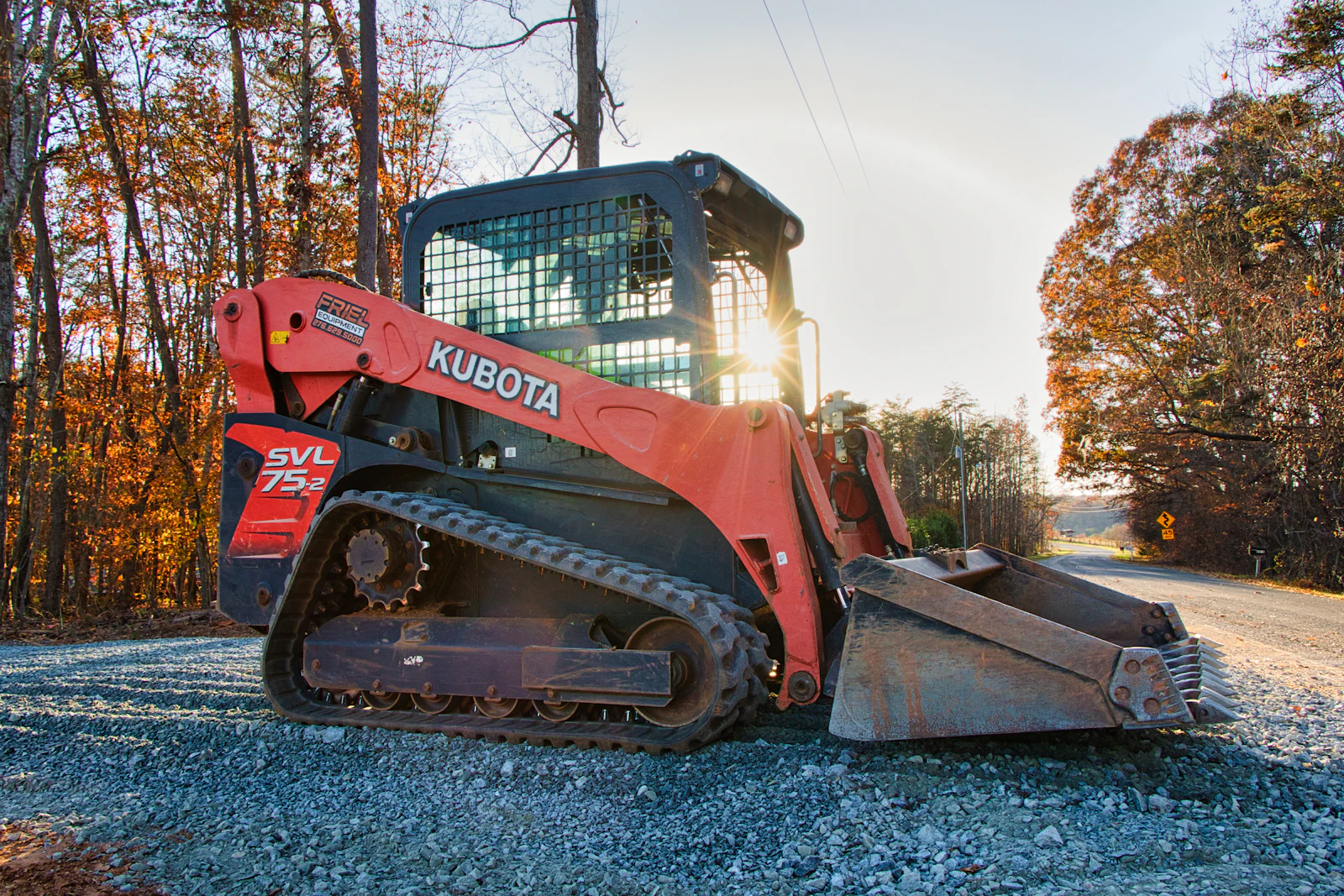
Skid Steer Loader Rental Rates Washington 2026
For Washington, D.C. concrete driveway scopes, a practical 2026 planning range to budget skid steer loader equipment hire is $260–$420/day, $825–$1,350/week, and $2,300–$3,900/4-week for a mid-size wheeled skid steer package (typically 1,500–2,700 lb ROC class). Heavier compact track loaders (often substituted when the base is soft or you need pushing/traction) tend to land higher, commonly $330–$525/day, $1,020–$1,650/week, and $3,120–$4,500/4-week. These ranges assume a one-shift rental (8 hours/day, 40 hours/week, 160 hours/4-weeks) with meter overages billed as overtime, and they exclude freight, attachments, damage waiver/LDW, and consumables. In the DC metro, national account programs (United Rentals, Sunbelt Rentals, Herc Rentals) and local yards in Prince George’s County / Southern Maryland both price competitively, but the actual “all-in” hire number for driveway work is typically driven by delivery windows, attachment mix (breaker vs. bucket-only), and cleaning/wear exposure from concrete dust and slurry.
| Vendor |
Daily Rate |
Weekly Rate |
Review Score |
Website |
| United Rentals |
$390 |
$1 450 |
9 |
Visit |
| Sunbelt Rentals |
$375 |
$1 400 |
9 |
Visit |
| Herc Rentals |
$365 |
$1 350 |
8 |
Visit |
| The Home Depot Tool Rental |
$330 |
$1 250 |
8 |
Visit |
| BigRentz |
$360 |
$1 325 |
8 |
Visit |
What Drives Skid Steer Loader Equipment Hire Cost for Concrete Driveway Work in Washington, D.C.?
Concrete driveway scopes in Washington, D.C. tend to amplify cost variability because the skid steer is rarely “just a loader.” Most coordinators are renting (1) the carrier, (2) at least one attachment beyond the standard bucket, and (3) logistics/controls that keep the job compliant in tight urban conditions. The most common cost drivers that change your equipment hire total are below.
- Machine class (tires vs. track): If you can stay on a stable stone base and you’re working curb-to-garage on a typical rowhouse drive, a wheeled skid steer usually pencils better. If you’re stripping topsoil, crossing lawn, or pushing/stockpiling in damp shoulder seasons, a compact track loader can reduce “stuck time,” but the hire rate and transport weight usually go up. (DC-area published rates show wheeled and tracked units frequently priced in different bands.)
- Rated operating capacity (ROC) and operating weight: ROC drives cycle time (loading spoils, placing base stone), while operating weight affects whether the supplier sends a pickup+trailer or a rollback/lowboy—directly impacting delivery and any street-occupancy planning.
- Cab configuration: Enclosed cab with heat/AC can cost more than open ROPS. For concrete driveway demo, enclosed cab also reduces operator fatigue during extended breaker time and can help keep dust exposure controlled (but does not remove the need for site dust suppression).
- Hydraulics (standard-flow vs. high-flow): Standard bucket/forks/leveling typically do not need high-flow. Breakers, cold planers, and some brooms may. High-flow packages usually carry higher daily/weekly rates and may tighten availability in peak months.
- Availability timing: In the DC metro, Monday delivery congestion and end-of-month construction cycles can push you into timed deliveries and/or substitute models. If you can accept “equivalent” substitutions, you often avoid premium upgrades.
Washington, D.C.-specific practical constraints that regularly show up on tickets: (a) curb space and alley access that forces a smaller trailer or narrower machine, (b) delivery windows that must be less than 3 hours to coordinate with concrete sawcut crews or dump swaps, and (c) security screening or controlled-access procedures when work is adjacent to federal facilities or protected campuses.
Attachment And Tooling Adders That Change Skid Steer Hire Pricing
For skid steer loader hire for concrete driveway removal, the attachment is often the difference between a “loader rental” and a productive demo package. Even when the base machine looks inexpensive on a daily rate, the attachment mix can double the hire line item on short-duration work.
- Hydraulic hammer/breaker: A published example rate for a skid steer hammer is $264/day and $660/week (often plus its own deposit/waiver). On driveway demo, the hammer is also the main trigger for overtime hours because the operator tends to run past the planned 8-hour shift.
- Grapple bucket / brush bucket: A published example for a grapple bucket is $96/day and $240/week. For concrete driveway scopes, a grapple can help handle demo debris, rebar clumps, and irregular waste—but it is not a substitute for a dedicated demolition attachment when slab is intact.
- Forks: Published examples range from $80/day and $250/week for heavy-duty forks, or lower rates (e.g., $36/day, $108/week) depending on yard and class. Forks matter on driveway scopes when you’re staging palletized pavers/edgers, bagged cement, or setting forms and barriers.
- 4-in-1 bucket: A published example for a 4-in-1 bucket is $145/day and $440/week. It can reduce labor on fine grading and grabbing, but it adds cleaning exposure with concrete slurry and base fines.
- Bucket broom / power broom: If the specification requires tight housekeeping before concrete placement, broom attachments can be significant adders (published example $150/day for a bucket broom; $120/day for a power broom in another rate sheet).
Estimator note: If your driveway scope includes sawcutting and breakout, compare two approaches: (1) skid steer + breaker, versus (2) mini excavator + hydraulic hammer. The “best” hire option is the one that reduces extra shift hours and re-handling, not necessarily the lowest day rate.
Delivery, Pick-Up, And Urban Access Charges In Washington, D.C.
In Washington, D.C., freight and access costs are not “miscellaneous”—they are often a primary driver of the equipment hire total. A local DC delivery schedule (not specific to heavy equipment, but representative of how metro DC logistics are frequently priced) shows the kinds of surcharges coordinators should plan for: $135 for standard delivery with pickup in the metro area (3-hour windows), $185 for timed delivery with pickup (window less than 3 hours), $250 for same-day emergency delivery, $100 for re-runs, $75 for security screening, and $225 after-hours surcharges for activity after 8:00pm / before 8:00am.
For skid steer loader equipment hire in Washington, D.C., you should also budget for practical jobsite conditions that can force re-runs or timed delivery even if you planned otherwise:
- Curb lane occupancy and staging: If the carrier arrives and cannot stage, re-runs can be charged as a separate line. (Treat $100 as a reasonable planning anchor for an avoidable re-run, even if your vendor’s policy differs.)
- Alley-only access: Many residential corridors require smaller trucks or a tighter delivery window. This can push you toward timed delivery rather than a broad “AM/PM” delivery.
- Federal/campus screening: If a project is near a controlled facility, screening or inspection time can become a billable surcharge. Use $75 as an explicit allowance unless you have written confirmation it’s waived.
If you are contracting delivery via mileage-based schedules (more common for construction yards), published examples include $200 + $3.00 per loaded mile for semi delivery, or $50 + $2.00 per loaded mile for pickup truck delivery. Those structures are useful for budgeting DC-to-MD/VA cross-border haul variations when the nearest branch is not in-district.
Meter Hours, Overtime, And Weekend Billing Rules That Change the Hire Total
Many DC-area yards run metered equipment rules that treat a “day” as a defined number of hours, and bill overages. One published local policy states metered rates are based on 4 hours (half day), 8 hours (day), 40 hours (week), and 168 hours (month).
National rental contract language often defines the same one-shift concept: the basic daily/weekly/4-week rates entitle you to 8 hours per day, 40 hours per week, and 160 hours per 4 weeks. Importantly, overages may be billed at 1/8 of the daily charge per extra hour (daily rentals), 1/40 of the weekly charge (weekly rentals), and 1/160 of the 4-week charge (4-week rentals).
Weekend and off-rent reality (driveway scopes): If you take delivery late Friday and do not off-rent until Monday, clarify whether your rental is billed as a true 3-day, a weekend package, or a full week. Some published rate sheets explicitly price “weekend” as its own column; others do not. Plan and document your off-rent call time, and confirm whether the “clock stops” when you request pickup or when it’s physically retrieved.
Hidden-Fee Breakdown
Below is a field-focused hidden-fee breakdown that typically impacts skid steer loader hire costs for concrete driveway work in Washington, D.C. Use these as 2026 estimating allowances unless you have your vendor’s written rate schedule for the project.
- Damage waiver / LDW: commonly budget 12%–18% of the time/attachment rental subtotal (varies by account structure and coverage scope). This can be material on short rentals with high attachment adders.
- Cleaning (concrete and slurry): cleaning is frequently chargeable when equipment is returned with excessive concrete, dirt, or paint. A published example shows an excessive cleaning fee of $75.00 per hour, and notes thresholds (e.g., daily rentals exceeding 2 hours of cleaning).
- Refuel / make-up fuel: many fleets deliver “full tank out” and charge make-up fuel on return. Budget a conservative allowance of $25–$50 as a service component plus fuel at local market pricing if you cannot return full.
- Tire/track wear and undercarriage: driveway demo can chew tires on exposed rebar and sharp slab edges. Treat tire damage as a potential backcharge and ensure pre- and post-condition photos are taken.
- Delivery changes: timed windows ($185), emergency same-day orders ($250), re-runs ($100), Sunday service ($175–$225), and after-hours surcharges ($225) can stack quickly if the jobsite is not ready.
- Security screening: add an explicit $75 allowance when access procedures are uncertain.
- Operator overages: if you exceed the one-shift meter, apply the overtime fractions (for example, 1/8 of the daily rate per hour) to your budget.
Concrete Driveway Scope Notes That Commonly Extend Rental Duration
Concrete driveway replacements frequently go long on the skid steer rental because field conditions force more handling cycles than planned. The cost impact is not only extra day(s); it is also overtime hours and delivery schedule disruption.
- Slab thickness and reinforcement: thicker slabs, wire mesh, and rebar push you toward a breaker attachment (and longer run time).
- Haul-off coordination: if your dump truck swap misses the window, you end up stockpiling, re-handling, and running the skid steer past the 8-hour day.
- Base prep and compaction: driveway base often requires additional compaction equipment. A published local example rate for a plate/pad tamper is $65 per 8-hour day (or similar small-compaction hire).
- Dust and slurry control: DC neighborhoods can be sensitive to concrete dust. If wet methods are required, assume additional cleanup time at return (cleaning exposure).
Example: 3-day concrete driveway demo and base prep in Northeast Washington, D.C.
Operational constraints: alley access requires timed delivery, debris staged curbside, and the pickup must occur before the Monday trash window; the crew runs 10 hours on Day 2 due to unexpected reinforcement.
Budgeted equipment hire (illustrative, using published adders where available):
- Skid steer loader hire: $325/day × 3 = $975 (planning mid-range for 2026)
- Hydraulic hammer add-on: $264/day × 3 = $792
- Timed delivery with pickup: $185
- Security screening allowance: $75
- Overtime: 2 extra hours on Day 2 at 1/8 of daily rate per hour → $81.25 (based on $325 daily)
- Damage waiver allowance: 14% × ($975 + $792) = $247 (planning allowance)
- Cleaning exposure allowance: 2 hours × $75/hour = $150 (if returned with concrete slurry)
- Refuel/service allowance: $195 (planning allowance; depends on return fuel level)
Illustrative “all-in” hire budget (above items only): ~$2,700 before tax and any street-occupancy/traffic control. The takeaway for DC driveway work: the base rental rate is often less than half the real equipment hire cost once attachments, delivery timing, and condition-related charges are included.
Budget Worksheet
Use this bullet worksheet to build a DC-ready skid steer loader equipment hire cost budget for a concrete driveway package (no tables; adjust quantities to your duration and production plan):
- Skid steer loader hire (tires, mid-size): $260–$420/day × ____ days
- Alternate (if traction/base is soft): compact track loader upgrade allowance: +$70–$150/day
- Hydraulic hammer/breaker attachment: $264/day (or vendor quote) × ____ days
- Grapple bucket / forks: $36–$96/day × ____ days
- 4-in-1 bucket (if specified): $145/day × ____ days
- Delivery/pickup (metro DC): $135 standard or $185 timed; add $100 re-run contingency
- After-hours contingency (if night pickup is possible): $225 per instance
- Security screening allowance (controlled access): $75
- Damage waiver allowance: 12%–18% of rent + attachments
- Fuel/make-up fuel allowance: $150–$350 (project dependent)
- Cleaning allowance (concrete/slurry): $75/hour × 2–4 hours worst case
- Deposit/authorization hold allowance (if required): $300–$500+ (varies by account and machine class; published examples show deposits around $303.50–$440 on some rate sheets)
Rental Order Checklist
Use this checklist to reduce avoidable DC metro charges and protect your equipment hire budget:
- PO issued with: job name, billing reference, and rental start date/time and off-rent procedure (who calls, when, and to what number).
- Confirm rate basis in writing: 8-hour day / 40-hour week meter rules and overtime fractions (1/8 daily, 1/40 weekly, 1/160 4-week).
- Delivery instructions: exact address, alley/curb access notes, truck size limits, and whether a timed window is required (budget $185 if so).
- Site readiness: confirm a staging area is available at arrival to avoid re-runs (budget $100 risk if uncertain).
- Attachments confirmed by serial/description: breaker, forks, bucket type; verify coupler compatibility and hydraulic flow requirements.
- Condition documentation: photos of tires/tracks, bucket cutting edge, quick-coupler, and hour meter at delivery and at return.
- Return condition plan: scrape concrete, rinse (where allowed), and keep slurry off the machine to reduce cleaning charges (published cleaning example $75/hour).
- Fuel policy confirmed: full-out/full-in expectation; assign responsibility to return full to minimize make-up fuel.
How To Forecast 2026 Skid Steer Equipment Hire Costs by Machine Class (Without a Table)
When you are forecasting skid steer loader equipment hire costs in Washington, D.C. for concrete driveway scopes, it helps to budget by class instead of by “one generic skid steer,” because delivery method, deposit exposure, and attachment suitability change materially.
- Light-duty / tight-access wheeled skid steer (often selected when alley width is the binding constraint): budget $260–$350/day plus delivery and at least one attachment adder.
- Mid-size wheeled skid steer (common driveway carrier): budget $300–$420/day. Published DC-area examples for skid loader day rates include $250 per 8-hour day on one local list (Kubota SSV65) and $275/day on another, which supports the band once you account for 2026 planning uplift and model/cab variance.
- Compact track loader substitution (when traction/floatation is the cost saver): published examples show tracked “skid loader” style units priced higher (e.g., $365/day, $1,275/week, $3,770/month for a track loader listing), and other rate sheets show weekly rates near $979/week for track loaders in similar classes. Budget $330–$525/day depending on size, cab, and availability.
Deposits and authorizations: Some published rate sheets show deposits in the $303.50–$440 range for skid steers and $442.50–$489.50 for compact track loaders in certain classes. Even if your account is set up for invoicing, confirm whether any attachment requires a separate authorization.
How To Reduce Skid Steer Loader Hire Costs on a Washington, D.C. Concrete Driveway
Cost control in DC driveway work is mostly operational discipline—preventing timed delivery from turning into emergency delivery, preventing overtime hours from turning into an extra day, and preventing concrete slurry from turning into cleaning backcharges.
- Schedule deliveries around DC congestion and permitting realities: If you require a tight delivery window, budget timed delivery explicitly (published example $185) instead of hoping standard windows ($135) will work. Same-day emergencies (published example $250) are the avoidable premium you want to prevent.
- Control meter hours: If your rental is one-shift based, set an internal rule that the skid steer shuts down at hour 7.5 unless the superintendent approves overtime, because overtime can be billed at 1/8 of the daily rate per hour.
- Bundle attachments only when they are truly productive: A hammer at $264/day is often justified for slab breakup; a specialty bucket at $96/day may not be if you only use it for 30 minutes.
- Prevent re-runs: A published example shows $100 re-run charges. Use a pre-delivery “site ready” call and ensure your curb space/alley gate is actually clear.
- Return clean and documented: Cleaning charges for concrete can be substantial (published example $75/hour), and cleaning is explicitly noted as the customer’s responsibility in standard rental terms when equipment comes back with concrete/paint/dirt. Assign end-of-shift wash/scrape responsibility and take photos.
Insurance, Damage Waiver, And DC-Area Documentation Requirements
For professional equipment hire, clarify whether you are providing your own coverage or purchasing damage waiver. Some DC-area yards explicitly require proof of insurance coverage sufficient to cover full repair/replacement cost and note that they do not provide on-road insurance. That affects whether you can self-haul versus requiring vendor delivery.
From a rental coordination standpoint, the key is to align your paperwork with jobsite risk:
- COI with correct additional insured/loss payee language (per vendor requirements).
- Jobsite access instructions (especially if security screening is likely; budget $75 if applicable).
- Operator qualification confirmation (many rate sheets note the lessee is responsible for a qualified operator).
Off-Rent Rules and Backhaul Timing: Avoiding “Extra Days” on Skid Steer Hire
On DC driveway scopes, “extra days” frequently happen when the site is complete but the machine sits waiting for pickup, or when the supplier cannot pick up inside your preferred window. To protect the equipment hire budget:
- Set the off-rent call time in the PO notes (for example, “off-rent by 2:00pm Friday”) and confirm whether billing stops on notification or on actual pickup.
- Request pickup windows that match your site constraints: If the only safe pickup is after hours, budget the after-hours surcharge (published example $225) rather than letting it surprise the closeout.
- Use metered-hour discipline: A published local policy defines month as 168 hours in some cases; national terms often use 160 hours per 4-week period. Your internal forecast should match the vendor’s definition for the contract you’re signing.
Commonly Missed Hire Items for Concrete Driveway Packages in Washington, D.C.
Below are adders that frequently get missed in a skid steer loader equipment hire cost takeoff for a driveway replacement and show up later as change orders or “misc” rental lines:
- Transport method changes: If the jobsite cannot accept a larger delivery truck, you may need a different transport class. Published mileage-based delivery examples include $50 + $2.00 per loaded mile (pickup delivery) or $200 + $3.00 per loaded mile (semi delivery). Use these as contingency anchors when the closest branch is in MD/VA rather than inside the District.
- Trailer needs for self-haul (if allowed): Some published rate sheets list trailer rental with machine at $62.40/day or $37.20/4-hour. Even if you do not plan to self-haul, these numbers help you sanity-check whether “free trailer” claims are real or embedded.
- Short minimums: Some yards publish a 4-hour minimum (example $250 for 4 hours), which matters if you are trying to “sneak in” a half-day rental between inspections.
- Compaction and finishing tools: Published local examples include a plate/pad tamper at $65 per 8-hour day. If you do not include compaction tools, the skid steer may sit idle while the crew waits—turning a 2-day plan into 3.
Bottom line for 2026 DC planning: When you build a skid steer loader hire budget for a concrete driveway, treat the rental as a package (carrier + attachment + delivery strategy + condition controls). That is how you avoid the most common DC metro overruns: overtime hours, timed delivery conversions, and cleaning/fuel backcharges at return.