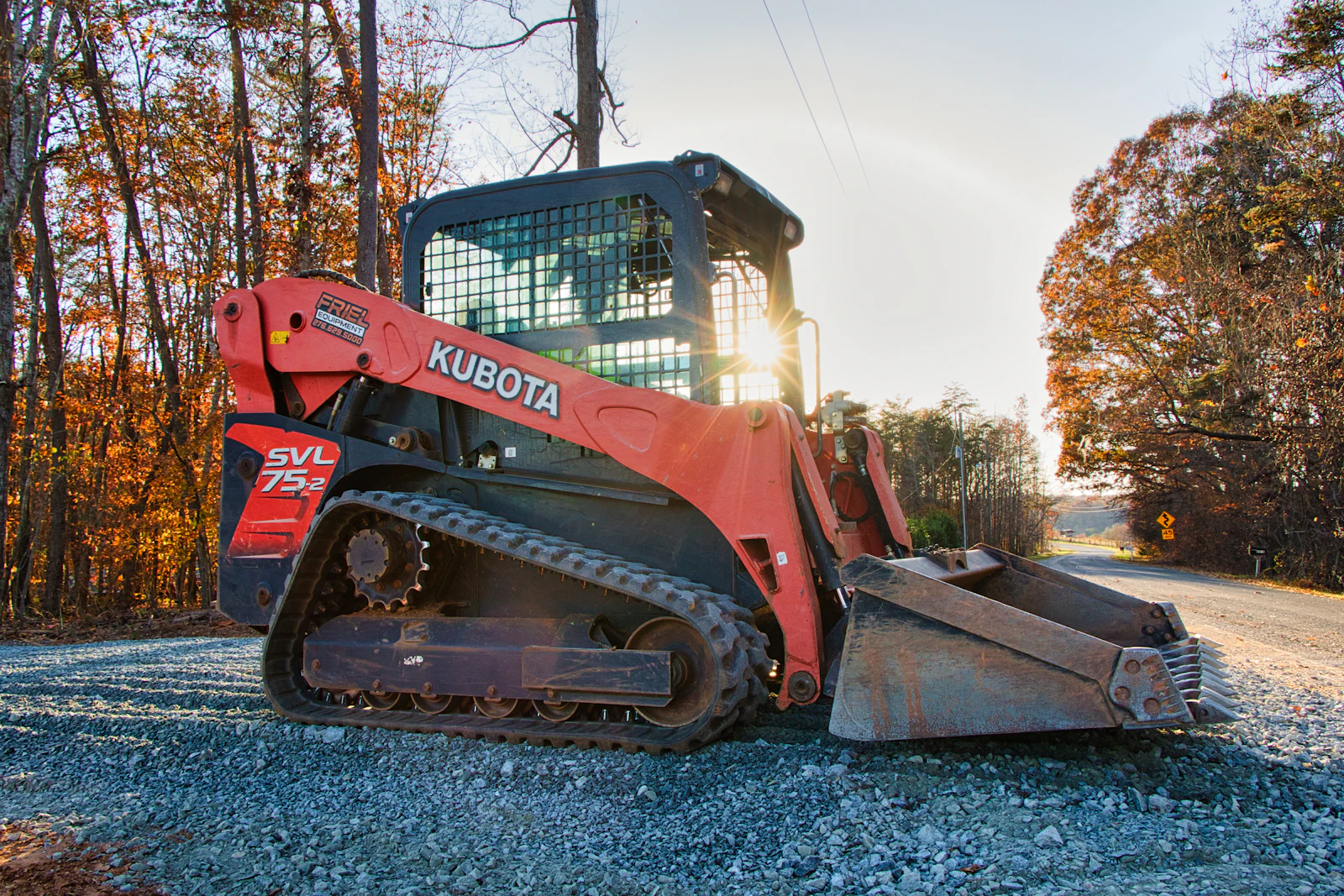
For skid steer loader equipment hire costs in Indianapolis planned for 2026 (concrete driveway demo, haul/stockpile, backfill, and final grade), most contractors should budget $275–$525/day, $1,050–$1,950/week, and $2,900–$4,900 per 28-day month for a wheeled skid steer in the 1,800–3,000 lb ROC class, assuming an 8-hour production shift and a standard bucket. Compact track loader (tracked skid steer) equivalents typically budget higher at $425–$650/day, $1,450–$2,250/week, and $3,200–$5,300 per 28-day month, driven by undercarriage wear and higher transport weights. In the Indianapolis market, national fleets (United Rentals, Sunbelt, Herc) and regional dealers (including Cat dealer rental operations and Bobcat-focused rental houses) all quote daily/weekly/28-day structures—your all-in cost will usually be dictated more by attachments, delivery, and waiver/insurance than by the base day rate alone.
| Vendor |
Daily Rate |
Weekly Rate |
Review Score |
Website |
| United Rentals |
$425 |
$1 275 |
9 |
Visit |
| Sunbelt Rentals |
$400 |
$1 200 |
9 |
Visit |
| MacAllister Rentals |
$385 |
$1 155 |
9 |
Visit |
Skid Steer Loader Rental Rates Indianapolis 2026
The ranges below are planning-level 2026 budget allowances for Indianapolis-area concrete driveway work (not guaranteed “street prices”). Assumptions: (1) 8-hour meter allowance per 24-hour rental day, (2) week billed as a 5-business-day week unless otherwise stated, (3) month billed as a 28-day rental period (common for national accounts), and (4) GP bucket included unless you specify otherwise.
Wheeled Skid Steer (Typical Driveway Support Class)
- Mid-size wheeled skid steer (approx. 1,800–2,700 lb ROC): $275–$450/day; $1,050–$1,650/week; $2,900–$4,200/28-days.
- Large/high-power wheeled skid steer (approx. 3,000 lb ROC and up, or high-flow requirement): $375–$525/day; $1,350–$1,950/week; $3,500–$4,900/28-days.
Published rate sheets in other Midwest markets show wheeled skid steers commonly advertised in the $185–$300/day range with $675–$1,100/week and $1,875–$3,100/month, which is useful as a baseline when you’re sanity-checking Indianapolis quotes (then add local transport, waiver/insurance, and attachment stack).
Compact Track Loader (Tracked Skid Steer) for Wet Subgrades
- Tracked loader (approx. 2,000 lb ROC class): $425–$650/day; $1,450–$2,250/week; $3,200–$5,300/28-days.
As a local Indianapolis data point, DOZR’s marketplace averages for compact track loaders show roughly $463/day, $1,444/week, and $3,136/month across participating rental companies (availability-dependent). Use this as a check against your preferred supplier’s quote when you’re building an equipment hire budget.
Mini/Walk-Behind Units (Access-Driven, Not Production-Driven)
If access is constrained (tight residential setbacks, fenced yards adjacent to the driveway, limited staging), a mini skid steer can be cost-effective even if production is lower. Indianapolis-area published mini rates include $275 first day then $175 each additional day and $950/week (40 hours) on a Ditch Witch-class unit, with a $50/day trailer option; other Indiana shops advertise a $294.25/day and $1,177/week mini track unit (location-dependent).
What Changes Skid Steer Equipment Hire Costs for a Concrete Driveway in Indianapolis?
For a concrete driveway scope, the base skid steer hire rate is rarely your cost driver. The invoice typically moves on (a) attachments needed to break/handle concrete, (b) delivery/pickup and transport surcharges, (c) damage waiver/insurance (especially if your COI can’t meet full replacement value), and (d) return condition (concrete dust, slurry, rebar wire, and mud in the undercarriage).
- Machine configuration: wheeled vs tracked; standard-flow vs high-flow; enclosed cab (winter) vs open cab.
- Concrete handling plan: are you breaking in place, lifting slabs, or loading out to trucks? Each choice changes attachment and cycle-time costs.
- Site logistics: Indianapolis infill neighborhoods can add time windows and staging constraints; suburban sites may add delivery miles but reduce idle time.
- Seasonality: freeze–thaw and rain events can shift you from wheeled to tracked to protect schedule (but at a higher daily hire cost).
Attachments and Add-Ons That Usually Determine the Total
Concrete driveway scopes often require at least one attachment beyond a GP bucket. When you request a quote, specify coupler type (standard vs Bob-Tach style), hydraulic flow requirement, and whether the vendor is providing hoses and flat-face couplers. As a published benchmark from a 2025 rental rate sheet (non-Indiana market), skid steer/CTL attachments commonly price in bands like:
- Hydraulic breaker / hammer (approx. 500 lb class): $205/day; $825/week; $2,375/month (benchmark).
- Auger powerhead: $175/day; $625/week; $1,825/month (benchmark).
- Auger bits: $50/day each; $225/week; $975/month (benchmark).
- Angle broom: $200/day; $850/week; $2,595/month (benchmark) (useful if you have stringent dust-control clean-down requirements).
Practical Indianapolis estimating note: for driveway removal, a breaker can be cheaper than overworking the loader trying to “pop” slabs—because you avoid excess tire wear, cutting-edge damage, and unplanned extra days. However, breaker rentals can carry additional expectations (proper greasing, correct operating angle, and return free of concrete slurry).
Hidden-Fee Breakdown
To control total skid steer equipment hire cost on a concrete driveway, carry explicit allowances for the items below and confirm each one on the quote or rental agreement.
- Delivery/pickup: common structures include flat fees, mileage, or a hybrid. One published example for skid steer delivery is $100 + $4 per mile (delivery and pickup included) from the store—useful as a budgeting reference when you’re outside a “free delivery” radius.
- Transport surcharge on top of transport rates: some national suppliers add a transportation services surcharge with a stated fixed component (example: 12% or minimum $12) plus a variable diesel-linked component; example calculations can push a transport surcharge into the 22% range depending on fuel index and state group.
- Damage waiver / loss damage waiver (LDW) / insurance alternative: if you cannot provide adequate insurance, Bobcat-focused rental agreements may offer a third-party policy at 18% of rental value.
- Fuel / return-full policy: many rental houses deliver full and expect return full; a fuel surcharge applies if returned short.
- Cleaning and decontamination: concrete dust, wet slurry, and rebar tie-wire can generate cleaning charges if the unit is not returned clean.
- Metered use overages: published Indianapolis-area listings commonly define 8 hours of use per day and 40 hours per week; carry an overtime allowance when you’re trying to “finish before the rain.”
Delivery, Access, And Off-Rent Rules That Change the Invoice
Indianapolis skid steer hire costs swing materially based on when the machine actually arrives, when your crew can start, and when the vendor considers the rental “off rent.” Before you release a PO, clarify:
- Delivery window and cutoffs: if your pour prep requires morning access, confirm AM delivery availability; after-hours or weekend drop-offs often add a $100–$250 premium (budget allowance).
- Downtown and tight-access sites: in the Indianapolis core, double-park restrictions and limited laydown may require smaller delivery trucks or lift-gate solutions—budget an extra $50–$175 for constrained delivery logistics (allowance).
- Weekend billing conventions: some suppliers offer “Friday PM to Monday AM” programs, while others bill each calendar day. If you plan a Saturday demo, assume a 1–2 day minimum unless confirmed otherwise.
- Off-rent notification: many contracts require calling in off-rent by a certain time (commonly early afternoon) to stop billing same-day; missing the cutoff can roll you into an additional day.
Budget Worksheet
- Base skid steer hire (wheeled, 2,000–3,000 lb ROC): $375/day x 2 days = $750 (allow $275–$525/day variance).
- Hydraulic breaker attachment: $225–$325/day x 2 days = $450–$650 (include hoses/bit and confirm flow requirement).
- Delivery/pickup: $200–$450 total (or $100 + $4/mile model; carry mileage beyond a 10–15 mile radius).
- Transport surcharge on delivery: 12%–25% of transport line item (carry $25–$110).
- Damage waiver / insurance: 10%–18% of rental value (carry $120–$260).
- Fuel: $45–$120 (job-dependent) plus “return full” risk allowance.
- Cleaning allowance (concrete dust/slurry): $75–$250; add $150–$400 if slurry contamination is likely (allowance).
- Meter overage allowance: $15–$35 per hour beyond 8 hours/day (carry 2–4 extra hours = $30–$140) (allowance).
- Consumables/wear: cutting edge wear or flat-tire risk allowance $50–$200 (scope-driven).
- Site protection: plywood/ground mats/steel plates allowance $75–$300 to avoid curb/sidewalk damage claims.
Example: Two-Day Concrete Driveway Demo And Regrade (Indianapolis)
Scenario: Remove and load out an ~800 sq ft driveway (tight residential street; limited staging), then regrade subbase for stone. Crew plans two 9-hour days to beat forecasted rain.
- Tracked loader hire (to reduce rutting on wet subgrade): $525/day x 2 = $1,050 (within a $425–$650/day planning band).
- Breaker attachment: $300/day x 2 = $600 (plus bit wear risk allowance $40).
- Delivery/pickup: assume $100 + $4/mile and 18 miles round-trip billable = $172 (reference structure).
- Transport surcharge: carry 22% of transport as a planning factor where applicable = $38.
- Damage waiver/insurance: carry 18% on rental value (machine + attachment) = $297.
- Meter overage: 2 extra hours/day beyond 8 = 4 hours at $25/hr = $100 (allowance).
- Cleaning: concrete dust and slurry cleanup allowance = $175.
Planning total (equipment hire + common fees only): approximately $2,432 before tax and any disposal/hauling equipment. The key operational constraint is the 8-hour meter allowance: if you actually run 10–11 hours/day, the overage plus an extra billed day can exceed the difference between “cheap” and “premium” base day rates.
How Rental Terms Translate Into Real Indianapolis Skid Steer Hire Cost
When you’re coordinating skid steer loader equipment hire for a concrete driveway, treat the quote as a rate structure rather than a single number. Two suppliers can both quote “$425/day” and still land hundreds apart on the invoice because one includes forks and a larger hour-meter allowance while the other charges separately for attachments, transport surcharge, and cleaning. National suppliers explicitly promote visibility into daily/weekly/28-day rates online once you enter jobsite ZIP code; build your estimate using the same cadence the supplier bills (day vs week vs 28-days) so you don’t accidentally budget a 30-day month against a 28-day contract.
Cost Drivers Specific To Concrete Driveway Work
- Breaking method: If you’re using a breaker, confirm whether the breaker is billed as a separate line with its own day/week/month cap; carry $225–$350/day for planning if you don’t have a firm quote.
- Material handling: “Includes bucket or forks” is not universal. One published Indianapolis-area listing includes bucket or forks with the skid steer day rate, which can avoid a $25–$60/day fork adder some houses apply.
- Hour-meter overages: Listings commonly reference 8 work hours per 24-hour period and a 40-hour weekly meter cap; if your schedule drives longer shifts, explicitly ask for the overtime rate or negotiate a higher meter cap.
- Undercarriage/tire exposure: concrete rubble and rebar can cut tires and damage tracks; carry a $150–$500 contingency for wear/damage exposure on aggressive demo days (especially if you’re not running solid tires or track guards).
- Dust-control expectations: some GCs require daily sweep-down; if you add an angle broom (benchmark $200/day), it can be cheaper than paying a labor crew to broom concrete dust and risk a cleaning charge on return.
Indianapolis Local Considerations That Commonly Affect Equipment Hire Costs
- Weather-driven equipment selection: Indianapolis rain and freeze–thaw cycles can soften subgrade. If you switch from wheels to tracks midstream to protect schedule, expect a step-up similar to market averages (e.g., tracked loader averages around $463/day in local marketplace data).
- Delivery miles and traffic timing: even short-radius deliveries can become “expensive miles” around peak-hour corridors (I-465/I-70/I-65). Ask whether the carrier bills by loaded mile, by zone, or by flat fee, and whether re-delivery is charged if the site isn’t ready.
- Urban access and surface protection: curb lines, sidewalks, and decorative concrete aprons increase your need for mats/plates—carry $75–$300 in site-protection cost to avoid back-charges that dwarf the day rate.
Rental Order Checklist
- PO and accounting: PO number, job name, cost code, agreed day/week/28-day cadence, and approved add-ons (delivery, waiver, attachments).
- Insurance/waiver decision: provide COI for full replacement value or approve waiver/third-party policy (example reference 18% of rental value where applicable).
- Machine spec confirmation: ROC class, operating weight (transport), width (gate clearance), tire type vs tracks, standard-flow vs high-flow, coupler type.
- Attachment list: bucket size, forks, breaker/hammer, auger, broom; confirm each attachment has the correct hydraulic couplers and hoses.
- Meter rules: confirm 8 hours/day and 40 hours/week (or negotiated caps), plus overtime billing method.
- Delivery requirements: delivery window, site contact, lift-gate/rollback needs, overhead clearance, and whether delivery pricing is flat or mileage-based (reference structure example $100 + $4/mile).
- Off-rent and return rules: cutoff time to stop billing, pickup scheduling lead time, and expectations for return condition (clean, fueled).
- Condition documentation: pre-rental walkaround photos/video (tires/tracks, cutting edge, aux hydraulics, cab glass), and return photos to prevent post-return damage disputes.
Negotiation Levers For 2026 Skid Steer Equipment Hire Budgets
- Convert day-rate exposure into a weekly cap: if you’re close to 4–5 days, lock a weekly rate up front so weather delays don’t create “accidental” daily overruns.
- Bundle attachments: ask for an attachment package price (skid steer + breaker + forks) rather than separate list rates; it simplifies job costing and reduces surprise adders.
- Clarify transport surcharge mechanics: if a transport surcharge applies, ask whether it is a percentage of the transport line item and whether it includes a fixed component (example fixed component 12% / minimum $12).
- Agree return condition expectations in writing: for concrete driveway work, pre-approve a realistic cleaning allowance rather than leaving it discretionary at closeout.
Closeout: Minimizing Back-End Charges
To keep Indianapolis skid steer loader hire costs predictable, close the loop on the three biggest back-end items: (1) fuel return-full (top off before pickup), (2) cleaning (blow out concrete dust; remove rebar wire; pressure wash if permitted), and (3) documented off-rent time (email/text confirmation). Even when the base hire is competitively priced, fuel and cleaning surcharges can be the difference between meeting budget and explaining a cost overrun at project close.