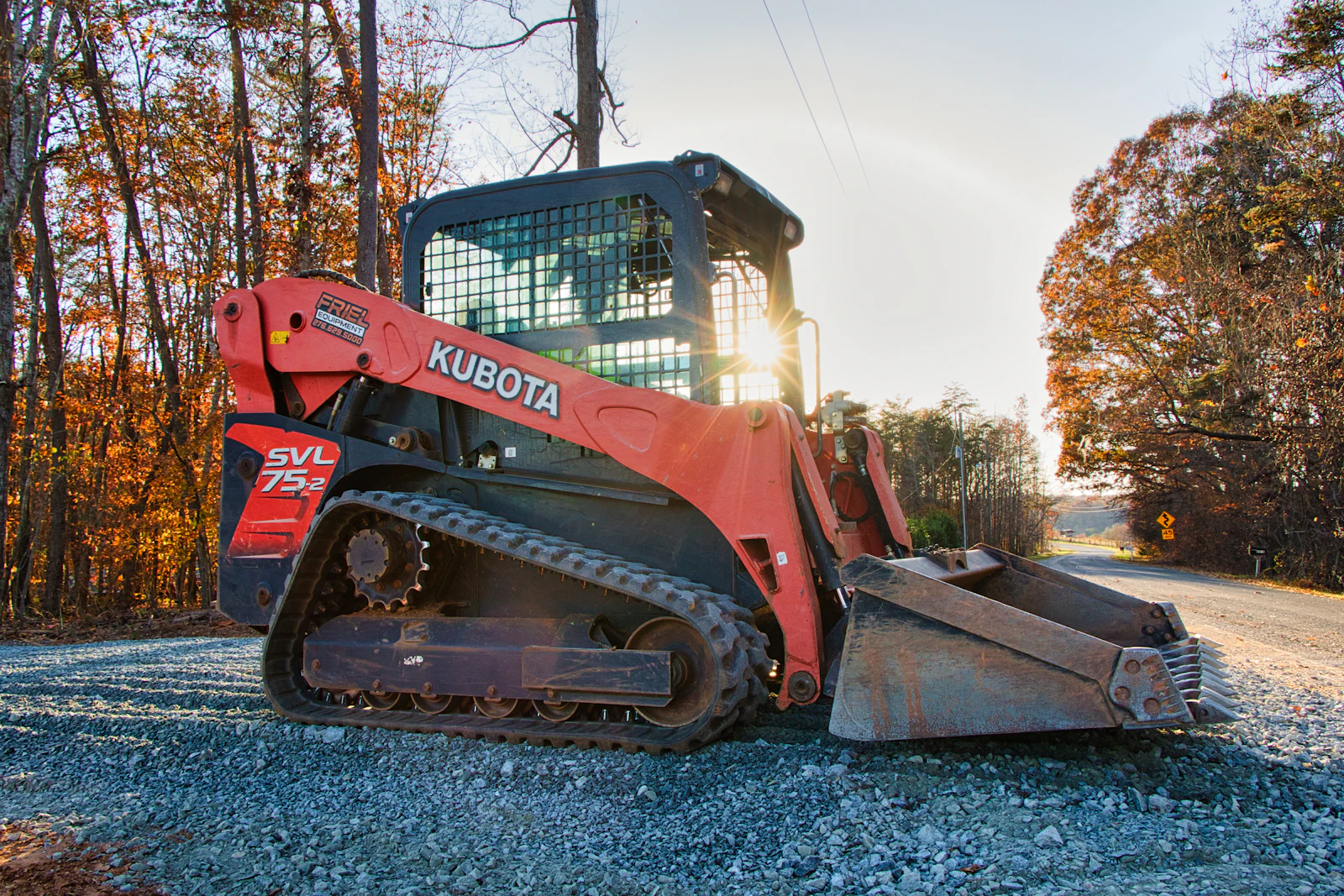
Skid Steer Loader Rental Rates Indianapolis 2026
For 2026 planning in Indianapolis, budget skid steer loader equipment hire in three bands: (1) small-frame wheeled units (roughly 1,300–2,100 lb ROC) at about $225–$325 per day, $700–$975 per week, and $1,900–$2,650 per 28-day month; (2) mid/large-frame wheeled units (roughly 2,400–3,350 lb ROC) at about $275–$450 per day, $825–$1,275 per week, and $2,350–$3,400 per 28-day month; and (3) compact track loaders (CTLs) at about $350–$600 per day, $1,100–$1,950 per week, and $3,000–$5,000 per 28-day month depending on size, cab, and hydraulics. These ranges assume a standard rental calendar where a day is 24 hours, a week is 7 days, and a month is typically billed on a 28-day cycle, which is how many national and local rental providers structure equipment hire. In Indy you can source units through national providers (for depth of fleet and transport coverage) and local dealers (for attachment availability and faster swaps); always validate quoted rates against delivery windows, off-rent rules, and whether the quoted machine includes a bucket and required jobsite accessories.
| Vendor |
Daily Rate |
Weekly Rate |
Review Score |
Website |
| United Rentals |
$395 |
$1 480 |
8 |
Visit |
| Sunbelt Rentals |
$375 |
$1 400 |
8 |
Visit |
| Herc Rentals |
$360 |
$1 350 |
7 |
Visit |
| The Cat Rental Store |
$385 |
$1 450 |
8 |
Visit |
| EquipmentShare Rentals |
$350 |
$1 300 |
8 |
Visit |
Assumptions used for 2026 budgeting: The local published rate sheet example cited below is from a central Indiana dealer and reflects a 28-day month and included bucket; the 2026 planning bands above are an estimating range that generally tracks typical escalation and demand (not a guaranteed quote). Confirm your actual hire costs with your account pricing, project duration, and the exact configuration (cab, tracks, high-flow, tires, and attachments).
Skid Steer Loader Rental
Skid steer loader hire costs move quickly when you shift from a wheeled machine to a CTL, add an enclosed cab, or require high-flow hydraulics for specialty attachments. In Indianapolis, the cost delta is often justified by production: CTLs typically carry higher weekly and 28-day rates but reduce rutting and rework during wet spring and fall conditions common around Marion County and the surrounding counties. From an equipment manager perspective, the most reliable way to control total cost is to spec the smallest frame that safely meets lift and breakout needs, lock down attachment scope early, and plan logistics around billing cutoffs (delivery, off-rent notice, and after-hours moves).
Rate Benchmarks By Loader Class And Configuration
The published local rate sheet below shows how rates step up with ROC and how CTLs price above wheeled skid steers. Use it as a sanity check when building an Indianapolis equipment hire estimate, then apply your contract discounts and 2026 escalation factor.
- Small-frame wheeled skid steer (example: ~1,370 lb ROC): $200/day, $615/week, $1,700 per 4 weeks on the referenced local sheet; a realistic 2026 planning allowance is commonly 10%–25% higher depending on fleet tightness and season.
- Mid-frame wheeled skid steer (example: ~2,900 lb ROC): $240/day, $720/week, $2,200 per 4 weeks on the referenced local sheet; 2026 planning commonly lands around the high-$200s to low-$400s per day when you add cab, higher spec tires, or tighter availability.
- Large-frame wheeled skid steer (example: ~3,350 lb ROC): $295/day, $950/week, $2,500 per 4 weeks on the referenced local sheet; for 2026, budget roughly $330–$450/day equivalent for comparable class with typical market movement.
- Compact track loader, small (example: ~1,490 lb ROC class): $275/day, $800/week, $2,400 per 4 weeks on the referenced local sheet; in 2026 this often estimates closer to $325–$450/day depending on tracks and undercarriage condition requirements.
- Compact track loader, mid/large (example: ~2,900–3,200 lb ROC class): $450/day, $1,700/week, $3,800 per 4 weeks on the referenced local sheet; in 2026, $450–$600/day is a common planning span for enclosed-cab, higher horsepower CTLs.
Note the billing language many contractors miss: on the cited Indianapolis-area rate sheet, a daily rental is based on 24 hours, a weekly rental is 7 days, and a monthly rental is based on 28 days. That matters for weekend strategy: if you take delivery Friday morning and don’t off-rent until Monday, you can burn through 3–4 billable days depending on the supplier’s cutoff and pickup availability.
Attachment Adders That Change The Hire Price Fast
Most skid steer loader rental quotes assume a general-purpose bucket only. The moment you add production attachments, your equipment hire costs can increase materially—and some attachments also drive insurance requirements, wear charges, and cleaning time. The following are representative attachment adders shown on the referenced local rate sheet (use these as line-item placeholders in your Indianapolis estimate):
- Pallet forks: $75/day, $225/week, $675 per 4 weeks.
- Auger with bit: $150/day, $450/week, $1,350 per 4 weeks (plus separate auger bit pricing in some cases).
- Hydraulic breaker (hammer): $200/day, $600/week, $1,800 per 4 weeks (breaker attachments can also trigger higher damage waiver or stricter return-condition checks).
- Brushcutter / forestry-style cutting head: $225/day, $675/week, $2,025 per 4 weeks (often requires high-flow and guarding).
- Grapple: $175/day, $525/week, $1,575 per 4 weeks.
- Landplane / eliminator grader: $175/day, $525/week, $1,175 per 4 weeks (note the 4-week price can vary by attachment category).
- Cold planer / miller: $325/day for a 24 in class head and $370/day for a 40 in class head (weekly and 4-week rates also published). Planer heads commonly bring extra wear exposure and stricter cleaning expectations.
- Soil conditioner: $175/day, $525/week, $1,575 per 4 weeks.
- Trencher: $175/day, $525/week, $1,575 per 4 weeks.
Practical estimating rule for Indy: if the crew requests “a skid steer with attachments,” don’t carry one blended rate. Carry the base machine plus each attachment as a discrete equipment hire line item, and add a logistics/cleaning allowance. This prevents the common cost overrun where a skid steer is competitively priced but the attachment package doubles the weekly spend.
Hidden-Fee Breakdown For Indianapolis Skid Steer Hire
Indianapolis equipment hire costs are usually won or lost in the “non-rate” details: delivery rules, damage waiver/insurance, fuel, and return condition. Below are the most common cost items to include as allowances (exact policies vary by supplier and account status):
- Delivery and pickup: minimum $65 each is explicitly stated on a local Indianapolis-area skid steer rental terms sheet. For many commercial jobs, actual transport often budgets higher (commonly $125–$250 each) when you require specific time windows, restricted access, or same-day moves.
- Delivery window constraints: plan around morning cutoffs (for example, many dispatch operations load trucks early; missed cutoffs can push delivery to the next business day). If your project needs a hard delivery at 7:00 a.m. or a haul-out after 3:00 p.m., carry an after-hours mobilization allowance (often $150–$300) even if your supplier waives it sometimes.
- Insurance / damage waiver: if you cannot provide required coverage, a third-party policy rate of 18% of rental value is stated on the referenced local terms sheet. Other suppliers may offer damage waiver options that are lower or tiered by risk.
- Fuel surcharge: the referenced local terms note the machine leaves full and a fuel surcharge is assessed if returned not full. In estimating, carry a refuel allowance based on your expected hours and local diesel pricing; many coordinators budget a refuel service charge equivalent to $6–$9 per gallon if the supplier refuels on return, plus a handling fee depending on contract terms.
- Cleaning charges: the referenced local terms explicitly note cleaning charges may be assessed if not returned clean. For Indy clay, wet topsoil, and concrete slurry, it is realistic to carry $95–$250 for end-of-rental cleaning if you cannot pressure wash before return (and more if the machine is returned with hardened material).
- Taxes and fees: the referenced local terms note quoted machine rates do not include taxes, insurance, delivery, and/or pickup. Make sure your internal estimate mirrors how AP will see the invoice: base rate + accessories + protection + transport + taxes.
Also remember that some national providers show daily, weekly, and 28-day (monthly) rates online once you set location, but the displayed number can change with availability and options. Use online rates as an index, not a guaranteed project budget.
Indianapolis-Specific Cost Drivers You Should Not Ignore
1) Wet-weather production and ground protection: Indianapolis spring rain and freeze-thaw cycles can turn lots and ROW shoulders into rut-prone subgrade. If you choose a wheeled skid steer to save $75–$150/day versus a CTL but then add stone, labor, and regrade time, your true equipment hire savings can evaporate. Consider budgeting for track mats or plywood (owner-furnished) when working on finished surfaces; if mats are rented, carry a separate line item and plan the added delivery weight.
2) Downtown access and traffic timing: Jobs near the central business district, hospitals, and campuses often have tight delivery windows and limited laydown. A “free” delivery can become a chargeable redelivery if the truck arrives and cannot offload due to blocked access or missing on-site receiver. Carry a standby/waiting-time allowance (often $75–$125 per hour) if your site logistics are uncertain, and confirm whether the supplier requires the renter to be present at delivery/pickup.
3) Indoor work and dust control: If you are using a skid steer in a warehouse or occupied facility for slab demo cleanup or material movement, you may need non-marking tires, additional floor protection, and strict cleaning documentation at off-rent (photos + condition report). Indoor dust-control can also drive attachment choices (for example, selecting a bucket and broom combination), which changes the accessory hire package and the cleaning exposure.
Example: 10-Day Site Utility Backfill And Final Grade (Indy Metro)
Scenario: You need a skid steer loader rental to backfill 300 linear feet of trench and fine grade a small commercial pad. The job is scheduled for two calendar weeks with weather risk, and the GC requires all equipment off the lot by 4:00 p.m. Friday of the second week.
- Equipment selection: mid-frame wheeled skid steer (around 2,900 lb ROC class) with standard bucket included, plus pallet forks for bundled pipe and a landplane for finish grade.
- Planned rental term: 10 working days. Depending on billing rules, this can invoice as (a) two weekly periods, or (b) a 28-day rate if you keep it longer due to rain. This is why off-rent timing matters more than day rate.
- Attachment hire allowance (based on published local adders): pallet forks at $75/day and landplane at $175/day (if carried for the full term, attachments alone can rival the machine cost; consider limiting attachments to the days they are truly needed).
- Logistics allowance: delivery and pickup at a minimum $65 each (carry higher if you need timed delivery).
- Protection allowance: if you cannot provide insurance, carry 18% of rental value for the protection policy noted in the referenced terms (budget this early so it is not a surprise on the first invoice).
- Closeout allowance: $150 for cleaning and $80 for refuel exposure if the crew returns the unit without washdown and full tank (adjust to your standards and contract expectations).
Operational constraint that changes cost: If rain pushes finish grade into the weekend and you miss the supplier’s Friday off-rent cutoff, you may pay Saturday/Sunday as billable days even if the unit sits. Mitigation: schedule pickup for early Friday, confirm the off-rent procedure (who calls it in, by what time), and take return-condition photos at load-out.
How Billing Rules And Off-Rent Procedures Change Skid Steer Hire Costs
Equipment hire cost control in Indianapolis is less about negotiating $10 off the day rate and more about preventing “extra days” from sneaking onto the ticket. Build these checks into your rental coordination:
- Confirm the billing clock: many suppliers define a day as 24 hours, a week as 7 days, and a month as a 28-day cycle. That means a Friday delivery with a Monday pickup can bill 3–4 days even if your crew only uses the unit for one shift.
- Off-rent notice: ask the branch what time off-rents must be called in to stop the clock that day. If your superintendent calls after cutoff, the unit can bill an additional day even if it is staged and ready.
- Weekend and holiday pickup limits: if the supplier does not pick up on weekends (or only by exception), your plan should assume weekend days are billable. If the project is sensitive to weekend billing, schedule pickup for Thursday/Friday morning and build float into the work plan.
- Partial-week economics: for a 4–5 day need, the weekly rate can sometimes be cheaper than stacking day rates. For a 9–12 day need, two weeklys can be cheaper than 10–12 daily charges. Always compare invoice outcomes, not only posted rates.
Damage Waiver, Insurance, Deposits, And Damage Exposure
Most commercial accounts carry their own insurance and skip supplier protection, but you still need an internal cost allowance for exposure. The referenced local terms require proof of insurance naming the supplier as certificate holder; if the customer cannot provide it, a third-party policy is available at 18% of rental value.
For 2026 estimating, many rental coordinators carry a damage waiver/protection allowance of 10%–18% of rental charges depending on the job risk (demolition, brush cutting, planer work, or confined indoor work). Also carry realistic “likely damage” allowances when appropriate: $350–$600 per tire for severe puncture/cut scenarios, and $1,500–$3,500 for track/undercarriage damage exposure on CTLs if the project involves broken concrete, rebar, or sharp rubble. Even if these costs don’t hit every job, they are the items that blow up the equipment hire budget when they do.
Delivery, Pickup, And Site Access Allowances For Indianapolis
To keep invoices predictable, set up logistics expectations in the PO and precon call:
- Base transport allowance: minimum $65 each for delivery and pickup is stated on the referenced local terms; many managed projects in the Indy metro should carry $125–$250 each way to cover restricted access, specific delivery windows, and dispatch variability.
- Mileage/radius concept: if your project is outside the supplier’s normal radius (common once you get beyond the I-465 loop), carry a mileage adder (often $4–$8 per loaded mile) or a higher flat mobilization.
- Redelivery risk: if the driver cannot unload due to blocked access, missing spotter, or inadequate ground bearing at the drop zone, budget a re-delivery or “dry run” charge (often $150–$300).
- Standby time: for downtown sites with tight docks, carry $75–$125 per hour for truck waiting if you cannot guarantee immediate offload and sign-off.
Fuel, Cleaning, And Return-Condition Requirements
These are the controllable closeout costs that frequently get missed in equipment hire estimates:
- Fuel: the referenced local terms state machines are filled at the start and a fuel surcharge applies if not returned full. Carry an internal allowance for refuel at $6–$9 per gallon if supplier refuels, plus your expected consumption.
- Cleaning: the referenced local terms allow cleaning charges if returned dirty. Carry $95–$250 for routine end-of-rental washdown and $300–$600 when the machine is exposed to concrete slurry, sticky clay, or landscaping mulch that packs into the chassis.
- Documentation: require before/after photos of bucket cutting edge, quick coupler, tires/tracks, cab glass, and hour meter at delivery and pickup. This single practice reduces “damage discovered later” disputes and helps close the ticket faster.
Budget Worksheet
Use the following bullet worksheet to build a project-ready Indianapolis skid steer loader equipment hire budget (adjust the quantities to your planned term and scope):
- Base skid steer loader rental: ____ days / ____ weeks / ____ x 28-day periods at $____
- Configuration adder (enclosed cab / heat / AC): allowance $25–$75 per day equivalent
- High-flow hydraulics adder (if required): allowance $40–$100 per day equivalent
- Attachment – pallet forks: $75/day (or $225/week) x ____ days/weeks
- Attachment – landplane/grade attachment: $175/day (or $525/week) x ____ days/weeks
- Attachment – auger with bit (if needed): $150/day x ____ days
- Attachment – breaker/hammer (if needed): $200/day x ____ days
- Delivery: $125–$250 each way x 2 (or use minimum $65 each where applicable)
- Timed delivery / after-hours mobilization: allowance $150–$300
- Standby/wait time for transport: allowance $75–$125 per hour x ____ hours
- Damage waiver / protection: 10%–18% of rental value (use 18% if you must buy the third-party policy per referenced terms)
- Fuel/def refuel exposure: allowance $80–$250 (scale to term and expected hours)
- Cleaning exposure: allowance $150–$600 based on soil/concrete conditions
- Contingency for weather extension (Indy spring/fall): add 2–3 billable days or 25% of one week
Rental Order Checklist
These are the PO and field controls that keep skid steer equipment hire costs aligned to the estimate:
- PO includes: rental term start date/time, anticipated off-rent date/time, and billing basis (day/week/28-day)
- Specify machine class: ROC range, wheeled vs CTL, cab requirement, and whether high-flow is required
- List included attachments (bucket type) and every paid attachment (forks, landplane, auger, breaker, broom)
- Provide jobsite address, on-site contact, gate codes, delivery constraints, and laydown/drop zone instructions
- Set delivery window and confirm dispatch cutoff times (especially for Monday starts)
- Insurance: provide COI naming supplier as certificate holder, or authorize protection option on PO (carry 10%–18% allowance; 18% is referenced as an available third-party policy on one local terms sheet)
- Damage/condition documentation: require delivery and pickup photos, hour meter readings, and signed condition reports
- Fuel/return: confirm full-tank return expectation and your internal refuel plan
- Cleaning: confirm return condition standard (tracks/tires, cab, radiator screen) and assign responsibility to crew
- Off-rent procedure: who calls it in, by what time, and whether pickup must be scheduled separately
- Return logistics: verify pickup access (no parked vehicles blocking) and whether a spotter is required
Ownership Vs Equipment Hire For Skid Steer Loaders (Cost Control View)
If you routinely have a skid steer on rent 20+ billable weeks per year across multiple projects, ownership can be competitive—but only if you also control maintenance downtime, transport, and attachment utilization. For most variable workloads, equipment hire remains the lower-risk option because it converts downtime and repair variability into a predictable weekly cost. A practical 2026 decision point used by many fleet managers is: if you cannot keep a specific skid steer class utilized above 60%–70% of the work year (billable), hire is usually the safer financial choice, particularly when CTL undercarriage wear and tire/track exposure is high.
Practical Negotiation Levers For 28-Day Skid Steer Hire In Indianapolis
To reduce total equipment hire cost without compromising production, focus on levers suppliers can actually approve at branch level:
- Bundle term: commit to a 28-day minimum to secure a lower effective daily rate (but only if you can truly keep it working; otherwise you pay for idle time).
- Limit attachments to needed days: carry forks for the first 2 days of unloading, then off-rent them while keeping the base unit; this can save $150–$350 per week in accessory hire on attachment-heavy scopes.
- Flexible delivery: accepting an “AM window” rather than a hard 7:00 a.m. can reduce transport premiums and redelivery risk.
- Swap language: pre-authorize a no-charge swap if the unit fails or arrives without required options (cab, high-flow, correct coupler). Faster swaps reduce idle crew time, which is often a bigger cost than the rental rate itself.
If you want, share your expected rental duration (days vs weeks vs multi-month), whether you need tracks, cab, and high-flow, plus the attachment list. I can convert the above into a tighter Indy-specific equipment hire cost budget with recommended allowances for delivery, protection, fuel, and cleaning.